
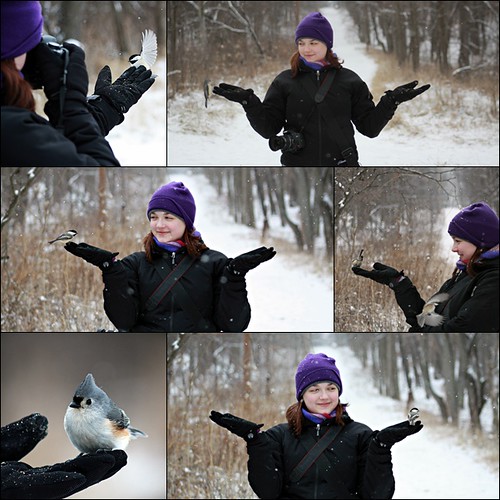
The Bird Girl Angie, photo by sharona 315 사론아.
Michigan in Pictures has a lot of Michigan birds but nothing quite like Angie!!
Check this out bigger in Sharon’s Winter slideshow.
The Bird Girl Angie, photo by sharona 315 사론아.
Michigan in Pictures has a lot of Michigan birds but nothing quite like Angie!!
Check this out bigger in Sharon’s Winter slideshow.

rough-legged hawk light morph, photo by Sherri & Dan.
Bird Web’s entry on Rough-legged Hawks (Buteo lagopus) says these birds:
…are variable in plumage, with light and dark color phases and variations in between. Dark phases account for only ten percent of western Rough-legged Hawks. Adults are generally mottled light-and-dark underneath, with dark patches at the wrists. Seen from below, the tails of both phases appear light with a dark terminal band. Seen from above, both phases appear mostly dark, but the light phase shows a light tail with a dark terminal band, and the tail of the dark phase appears dark all over. The adult male can have several dark bands at the tip of its tail as compared to the female, which only has one band. The light phase has a distinctive light-colored head, in contrast to its dark upperside. The Rough-legged Hawk’s bill and feet are relatively small.
Read more about these hawks at Rough-legged Hawk (Dark Morph) on Michigan in Pictures.
Check this out background big and in Sherri & Dan’s Animals slideshow.
Many more Michigan birds on Michigan in Pictures!

Ambience – Tannery Falls (Pictured Rocks National Lakeshore – Upper Michigan), photo by Aaron C. Jors
This was supposed to run on Saturday but I guess I didn’t hit the right buttons. One thing that I did so right was pick a time to visit the Pictured Rocks. Almost everywhere we went, we were the only people. Late November is definitely a time to visit if you want to experience the Lakeshore more or less by yourself!
Aaron has done an amazing job capturing the magic of the Pictured Rocks National Lakeshore.
See it bigger in his Michigan slideshow.

Crane Fest, photo by .jowo..
Joel says that last weekend the Michigan Audubon Society and Battle Creek Kiwanis hosted Crane Fest at Baker Sanctuary, near Bellevue. The event celebrates the annual fall migration of the Sandhill Crane. While we’ve missed that, he writes:
Thousands of Sandhill Cranes gather at Big Marsh Lake every evening in October. Well worth your evening.
What my camera cannot capture is the glorious racket these large birds make. Absolutely incredible.
Shot from the Kiwanis Youth Area, which will be open from 4 to 7 every Saturday and Sunday in October. If you can’t make the festival, you can still see the spectacle. Go. You’ll enjoy!
Check this out background boomtacular and in his Baker Sanctuary slideshow.

I’m a year older and a little wiser and pretty sure these are edible honey mushrooms, although I’m not sure about the darker brown bumps. Still a fantastically vital idea to know what you’re picking and eating!!
While morels draw the lion’s share of mushroom coverage, there are a ton of edible mushrooms out in the woods right now. The other day I had some fantastic Oyster mushrooms. Can you eat the mushrooms pictured here? Who knows? One thing is for certain, if you aren’t sure, don’t eat it!!
One way to learn what you can and can’t eat is to join a public mushroom hunt through the Michigan Mushroom Hunters Club. These hunts are held throughout the year and all around the state and offer a chance to tour the woods with a knowledgeable guide.
Check this photo out bigger in James’ Pictured Rocks slideshow!

Kingfisher… again, photo by palofmine2.
All about Birds says that the Belted Kingfisher is:
A common waterside resident throughout North America, the Belted Kingfisher is often seen hovering before it plunges headfirst into water to catch a fish. It frequently announces its presence by its loud rattling cry.
It breeds along streams, rivers, lakes, and estuaries with banks for nest holes. The breeding distribution of the Belted Kingfisher is limited in some areas by the availability of suitable nesting sites. Human activity, such as road building and digging gravel pits, has created banks where kingfishers can nest and allowed the expansion of the breeding range.
Check this out bigger in Renee’s Birds slideshow and also check out more of her Kingfisher photos.
More Michigan Birds from Michigan in Pictures.

Shell Cluster, photo by johndecember.
All week we’re going to be featuring invasive species – who they are, what they’re doing to our lakes & land and how folks are working to stop them. See the articles as we post them on Absolute MichiganMichigan in Pictures and !
I actually already blogged this photo to Pandora’s Locks: How Invasive Species got into the Great Lakes on Absolute Michigan. The book is a must-read for anyone who wants to learn how the way the shipping industry operates guarantees that invasive species will spread.
You will note that John has TWO invaders here, the zebra mussel and the Asian ladybird beetle. Check this out bigger in John’s slideshow!
This entry is now located at: https://michpics.wordpress.com/2015/04/16/birds-of-michigan-osprey/
Michigan in Pictures has lots more Michigan Bird photos!!

The University of Michigan Animal Diversity Web entry for Ondatra zibethicus, muskrat says:
Muskrats are found in wet environments, favoring locations with four to six feet of water. While muskrats are found in ponds, lakes, and swamps, their favorite locations are marshes, where the water level stays constant. Marshes provide the best vegetation for muskrats. They find shelter in bank burrows and their distinctive nests. Bank burrows are tunnels excavated in a bank. The nests of the muskrats are formed by piles of vegetation placed on top of a good base, for example a tree stump, generally in 15 to 40 inches of water.
…Muskrats have large, robust bodies, with a total body length of twelve and a half inches. The tail is flat and scaly and is nine and a half inches in length. Muskrats have dense fur that traps air underneath for insulation and buoyancy. Their heads are very large and their ears are almost invisible underneath the fur. The whiskers are mediun size. Muskrats have short legs and big feet; the back feet are slightly webbed for swimming. Adult muskrats have glossy upper parts that are dark brown, darker in winter and paler in the summer.
A Michigan muskrat recently made the news in these photos from the Kalamazoo River oil spill.
See this photo bigger in Eli’s Nature slideshow and check out more Michigan animals on Michigan in Pictures.
Thanks to the good folks at WordPress.com for featuring this post (and for hosting Michigan in Pictures)!

Vacant Factory, photo by Voxphoto.
I was driving the other day and noticing that the ivy seems especially profuse this summer. I was ready to chalk it up solely to the warm, wet summer of 2010 when my daughter Kenyon told me about this interview of Dr. Lewis Ziska, plant physiologist for the U.S. Department of Agriculture’s Agricultural Research Service by Michele Norris on NPR:
NORRIS: We’ve long known that poison ivy is nasty stuff. Even if you barely brush up against it, you can get an angry, weeping, contagious, red rash that takes weeks to heal. Well, it turns out that poison ivy, along with its voracious cousins poison oak and poison sumac, is even more of a nuisance this summer. The plants are spreading faster, growing larger, showing up in new places and becoming more toxic. It’s the kind of thing that’s so scary, it almost deserves its own soundtrack.
…NORRIS: Why is the plant spreading more and becoming more voracious? Why is it growing larger?
Dr. ZISKA: One of the things that we think is occurring is that as carbon dioxide is increasing in the atmosphere – carbon dioxide, as everyone knows, is a basic greenhouse gas, but it’s also plant food. And plants take that carbon, and they convert it into sugars and carbohydrates and so forth.
But not all plants respond the same way to that resource, and we think that vines, particularly vines like poison ivy or kudzu or other noxious weeds, seem to show a much stronger response to the change in CO2 than other plant species. So on average, the poison ivy plant of, say, 1901, can grow up to 50 to 60 percent larger as of 2010 just from the change in CO2 alone, all other things being equal.
And as a result of that change, we see not only more growth but also a more virulent form of the oil within poison ivy. The oil is called urushiol, and it’s that oil that causes that causes that rash to occur on your skin when you come into contact with it. Read on >
Check this out bigger and in in Ross’s A Few in Color slideshow and know your poison ivy!
 Michigan in Pictures