Winter Study: Observing Wolves & Moose on Isle Royale

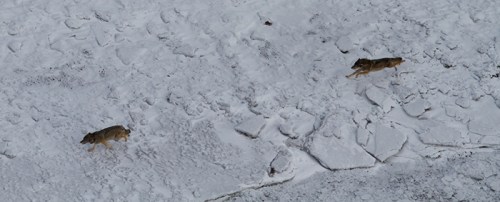
Isabelle being chased by her assailant

Isabelle being chased by her assailant, photo by isleroyalewolf.org

A couple of weeks ago a reader sent me a link isleroyalewolf.org. The website documents the interactions of the island’s wolf & moose population as their decades long dance unfolds on this remote, wilderness island. Their overview explains:

Isle Royale has offered many discoveries… how wolves affect populations of their prey, how population health is affected by inbreeding and genetics, what moose teeth can tell us about long-term trends in air pollution, how ravens give wolves a reason to live in packs, why wolves don’t always eat all the food that they kill, and more. The wolves and moose of Isle Royale also frequently reveal intimate details of their daily life experiences and they have inspired numerous artistic expressions. If we pay attention, they all tell us something important about our relationship with nature. These insights and discoveries are all presented here for you.

Building on the graph above and to develop a deeper understanding, here is more on the history of wolves and moose on Isle Royale. Moose first came to Isle Royale in the early 20th century, and for fifty years, their numbers fluctuated with weather conditions and food abundance. Wolves first arrived in the late 1940s by crossing an ice bridge from Canada. The lives of Isle Royale moose would never be the same.

Every winter since 1958, a team of researchers has spent numerous weeks at Isle Royale observing the lives of these wolves and moose and reporting back. Now they offer a website with photos and detailed reports, a fascinating tale that I encourage you to follow. Today’s photo is from the edition I began with – It’s Complicated. A snapshot:

Isabelle’s signal was surprisingly close. By the time we saw her, she was running for her life, north along the beach of Rainbow Cove. She was being chased by Pip’s two companions. Pip was nowhere in sight. While those two wolves have been eating regularly, Isabelle may not have had a decent meal in weeks, perhaps longer. Isabelle’s half-mile lead was reduced to nothing in just a few minutes.

Definitely read on for photos and a gripping account of these wolves battling and follow the whole 2013 Winter Study as it unfolds (sign up for their email).

More wolves on Michigan in Pictures.
A Michigan groundhog for Groundhog Day

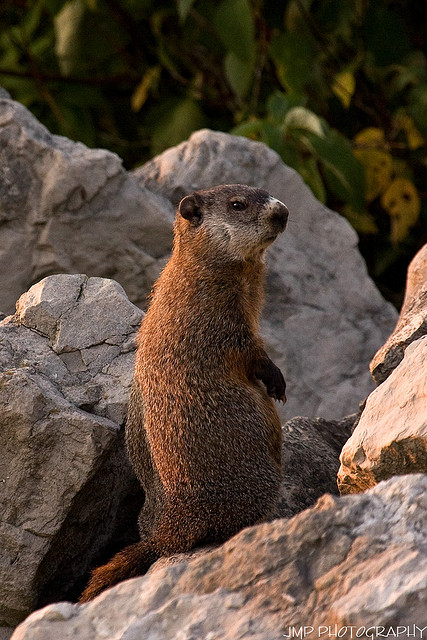
Standing Guard

Standing Guard, photo by James Marvin Phelps

Today (February 2nd) is Groundhog Day, the day halfway between the Winter Solstice and the Spring Equinox. The most famous groundhog in the world, Punxsutawney Phil, didn’t see his shadow this morning. Apparently, Michigan has its own official woodchuck weather forecaster, Woody. She lives at the Howell Nature Center and also didn’t  see her shadow. If you put your trust in celebrity rodents, that means we’re in for an early spring.

Michigan has native groundhogs, also known as woodchucks, whistle-pigs, or land-beavers. The University of Michigan Animal Diversity Web entry for Marmota monax (woodchuck) explains in part that:

Woodchucks are stocky in appearance and often stand up on their hind legs, making them look tall. Their pelage varies greatly in color but ranges from gray to cinnamon to dark brown. Their body is covered with white-tipped guard hairs giving them a grizzled appearance. Their paws vary in color from a typical black to dark brown in most subspecies. However, one subspecies has paws that appear pink. Their short bushy tail is often black to dark brown and is 20 to 25% their total body length. They weigh from 2 to 6 kg, range from 415 to 675 mm in total length, and have tails that range from 100 to 160 mm in length. Although males and females are the same color, males are larger than females. Woodchucks have white teeth, which is uncharacteristic of rodents, and a dental formula of 1/1, 0/0, 2/1, 3/3, for a total of 22 teeth. They have rounded ears that can cover the external auditory canal which prevents dirt from entering the ear canal while burrowing.

…Woodchucks are diurnal, solitary animals … Woodchucks are burrowing mammals and generally construct summer and winter dens. These dens generally have several entrances (including an escape hole) and many chambers and tunnels. Woodchucks usually feed twice daily during the summer, with each feeding session lasting no more than 2 hours. They are often found sunning themselves in the middle of the day during summer.

…Abandoned woodchuck dens are used by a number of different species, including rabbits, skunks, raccoons, opossums, foxes, weasels, ground squirrels, river otters, chipmunks, meadow voles, short-tailed shrews, house mice, pine voles, white-footed mice, lizards, snakes, and arthropods.

You can read more and see photos at ADW and also at Wikipedia.

James took this photo at the Lake Erie Metro Park in August of 2009. See it bigger and see more in his Michigan Groundhog slideshow.

More Michigan animals on Michigan in Pictures.

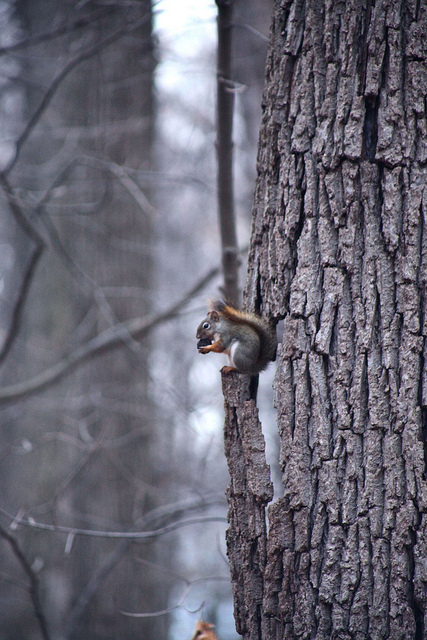
Tamiasciurus hudsonicus alias American red squirrel alias Pine Squirrel

pine squirrel in winter coat

pine squirrel in winter coat, photo by jb goodwater

The University of Michigan Museum of Zoology Animal Diversity Web is a massive online database of animal natural history, distribution, classification and conservation biology. Their entry for  Tamiasciurus hudsonicus red squirrel says (in part) that:

Red squirrels occupy northern boreal coniferous forests abundant with conifer seeds, fungi, and interlocking canopies … Populations of red squirrels occur in different habit conditions due to the vastness of their range. They occur in both temperate and polar environments and are considered to be primarily arboreal. They can be found in a mixed variety of forests including coniferous, deciduous, and mixed forests and they are also able to thrive in suburban and urban settings, as long as cool, coniferous forests with dense, interlocking canopies and abundant fungal resources are present.

Red squirrels differ from other tree squirrels by their deep reddish color, territorial behavior, and their smaller body size. They are less than 30% the size of grey squirrels (Sciurus carolinensis). While size and pelage color can vary geographically, they generally have a reddish back and white underside that is demarcated by dark lateral lines, which are especially visible in summer. A white eye ring is present year-round and tufted ears are during the winter.

Read on for a whole lot more including photos, lifespan (5 years average), how they communicate and mark their territory, and what they eat (and what eats them).

Check this photo out background bigtacular and see more in Joshua’s slideshow.

More squirrels on Michigan in Pictures.

The Other Witch of November: Witch Hazel

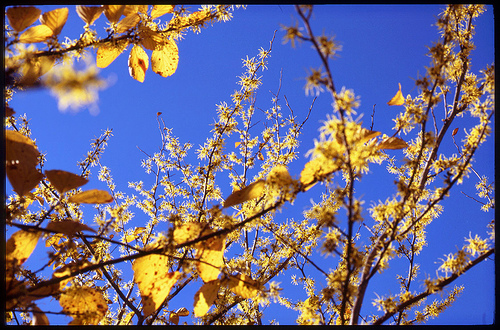
Witch Hazel

Witch Hazel, photo by Voxphoto

Naturalist Jonathan Schechter wrote an article last year entitled Witch of the Woods – and her name is Hazel about this small  tree that actually flowers in November:

Native Americans knew this tree before the invaders with guns and axes in tall sailing ships landed on the eastern shore and carved the land to suit their wants and needs. In colonial America even as the British exchanged shots with the rebellious colonists, the shrub’s flexible forked branches was being used as “witching stick” by the dousers: folks who held the forked branches in hand waiting for the tip to point to hidden waters. Bad news for Halloween fans: The word witch in witch hazel originates from the old English word for pliable branches “wych” and has nothing to do with a lady in black straddling an airborne broom.

Your grandmother and probably your mom (and maybe you) used this plant for a wide array of medical ailments. It is found in a liquid form in almost all drug stores today and sold as an astringent, and for treaments of irritations, pain and itching, skin conditions and another 20 or 30 uses!

More about Witch Hazel (Hamamelis) on Wikipedia.

Check this out background big, see  more in Ross’s garden slideshow and also see his past work on Michigan in Pictures.

Thursday Morning Face-off: Michigan Moose Edition

Foggy Morning Face-off

Foggy Morning Face-off, photo by yooper1949

In their History of Moose in Michigan, the DNR notes that moose are native to Michigan and were present throughout the state except for the southwestern Lower Peninsula prior to European settlement. Due to extensive logging of their habitat, hunting and likely a parasitic brainworm, they disappeared from the Lower Peninsula in the 1890s, with only a few hanging on in the UP. You can click the link above for the story of the recovery to the current level of around 500 and see Moose in Michigan for more.

Nature Works page on Moose – Alces alces tells us that:

The moose is the largest member of the deer family and the tallest mammal in North America. It stands six feet tall from shoulders to feet. Females weigh between 800 to 1,300 pounds and males weigh 1,200 to 1,600 pounds. The moose has long, thick, light brown to dark brown fur. Moose hair is hollow, which helps keep the moose warm. The moose has long legs. Its front legs are longer than its rear legs. This helps it jump over fallen trees and other forest debris…

The male or bull moose has huge broad and flat antlers that can stretch 4 to 5 feet across. Antlers start to grow in the early summer. When antlers first start to grow, they are covered with a soft fuzzy skin called velvet. The velvet has blood vessels in it that deliver nutrients that help the antlers grow. By late summer, when the antlers reach full size, the blood supply dries up and the velvet starts to drop off.

Moose mate in early fall. During mating season, females attract males with their deep calls and strong scent. Bull moose use their antlers in threat displays when they are fighting over females. Sometimes they will get into a pushing fight with their antlers. These fights rarely get too serious because the antlers could catch together and both moose could die.

The UM Animal Diversity Web entry for Alces alces Eurasian elk aka Moose has a lot of great information and photos as well and they add that:

The word “moose” comes from the Native American tribe, the Algonquins, which means “twig eater” in their language. It is an appropriate name because moose primarily browse upon the stems and twigs of woody plants in the winter and the leaves and shoots of deciduous plants in the summer.

If you happen to come across moose and want to help Michigan out with moose management, consider filing a moose observation report.

Carl says that the two young moose locked horns and pushed each other around for a while, but no real battle ensued. Check this out big as a moose, see a close-up of the confrontation and in his slideshow.

More Michigan animals on Michigan in Pictures.

Eastern Chipmunk (Tamias striatus)

Untitled

Untitled, photo by kdclarkfarm1

The newly redesigned University of Michigan Animal Diversity Web says that Tamias striatus (eastern chipmunk):

Eastern chipmunks live in shallow burrows in the ground. They are partial to areas near rocky crevices, decayed tree trunks, and fence corners. They do not like dense forests where no sunlight reaches the ground. Burrows are made by digging and carrying away the dirt in their pouched mouths. Unlike prairie dogs and other sciurids, eastern chipmunks do not leave the dirt in mounds near the entrances of their burrows. This makes it harder for predators to find chipmunks in their homes. These burrows can be up to 30 ft. in length with several different exits and tunnels. Eastern chipmunks conceal the exits with leaves and rocks. They may inhabit these burrows for several years.

Eastern chipmunks are larger than most chipmunks. They are reddish brown in color with 5 black stripes on their backs. These stripes are separated by brown, white, or grey fur stripes. They also have white and dark markings around their eyes. The stomach is usually a yellowish brown or white color. Their tails are reddish brown and furry, but not bushy like common squirrels. Like many rodents, Tamias striatus has 4 toes on the front feet and 5 toes on the rear feet.

…Eastern chipmunks have excellent vision, hearing, and sense of smell. They communicate with each other by making a variety of sounds, including the ‘chip’ for which they are named.

Tamias striatus eats a wide variety of foods including nuts, acorns, seeds, mushrooms, fruits, berries, and corn. They also eat insects, bird eggs, and sometimes small vertebrates such as young mice.

Read more and see a bunch more photos of chipmunks as well!

Check this out background big (which is decidedly bigger than a chipmunk) and see more in Diane’s slideshow.

More Michigan animals right here.

The Gray Treefrog doesn’t care if you’re confused

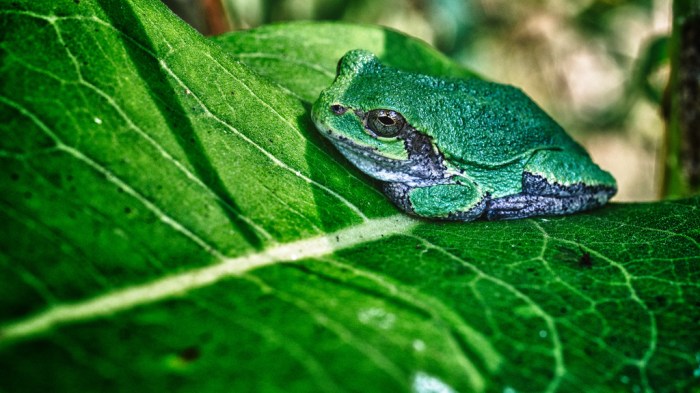
Gray Tree Frog

You Can’t See Me, photo by MacDonald_Photo (Formerly Sl33stak)

Michigan has two species of Gray Treefrog – the Eastern (Hyla versicolor) and Cope’s (H. chrysoscelis) that are hard to distinguish, sometimes even sharing the same ponds. Check out the Hyla versicolor page at the UM Animal Diversity Web for a bit about that. Their color spans a range of gray, green or brown according to environment or activity. See a collection of photos showing their wide range of color at the UM Animal Diversity Web.

They can be found in woods, swamps and your own backyard. Their ability to climb vertically & horizontally is due to their specially adapted toe pads, and you’ll sometimes find them on your screen windows at night. You’ll hear their short musical trill on warm spring & summer nights.

Jamie writes that he walked 20′ into the woods off a heavily used path and ran into this little guy – small as his thumb and sitting on a milkweed. Check this out background bigtacular and see more in his Fauna slideshow.

More Michigan frogs on Michigan in Pictures. Or, for something different, here’s what we have for green!

Have you gotten your dose of Vitamin N today?

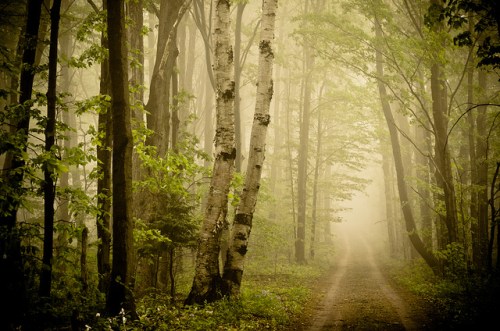
Green Point in Fog

Green Point in Fog, photo by *ojoyous1*

I was paging through a copy of the AARP Bulletin (not mine … yet) and came across an interesting little article about the benefits of spending time in nature by Richard Louv. Louv wrote the book Last Child in the Woods, which introduced the concept of “nature-deficit disorder”. He writes:

A growing body of research links more time in nature — or in home, work or hospital environments enhanced through nature-based design — with reduction of stress and depression, faster healing time and less need for pain medication.

Health care professionals are taking note. In 2010, a pilot program in Portland, Ore., began pairing physicians with park professionals, who helped children and families get their green exercise or, as I call it, their dose of “vitamin N.”

Other benefits of vitamin N include enhanced use of the senses and higher work productivity. In 2008, University of Michigan researchers demonstrated that, after just an hour interacting with nature, memory performance and attention spans improved by 20 percent. In April, researchers at the University of Kansas reported a 50 percent boost in creativity for people who were steeped in nature for a few days.

Michigan is blessed with an amazing amount of opportunities to slip into nature for ten minutes or ten days so what’s stopping you?? Check out books and more at Richard Louv’s website.

Joy took this photo at the Green Point Nature Reserve near Elberta. Check it out bigger and in her Up North slideshow.

More nature on Michigan in Pictures!

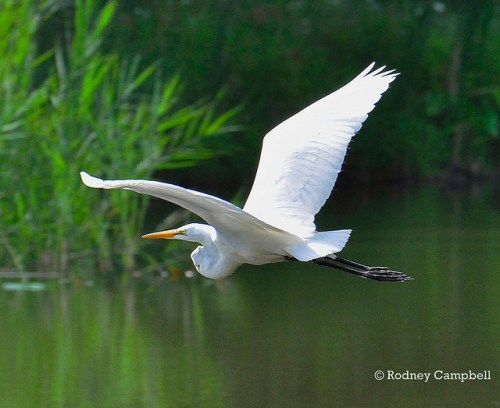
Great Egret (Ardea alba) in Flight

Great Egret (Ardea alba) in Flight

Great Egret (Ardea alba) in Flight, photo by AcrylicArtist

The Michigan Bird Atlas has a nice document on the Great Egret in Michigan that says (in part):

Today, the Great Egret is a powerful symbol of early conservation efforts mounted to safeguard it and other species from overhunting for their feathers in the 1800s. Protection in the early 1900s is credited with population recovery and establishment of the Great Egret as a breeding species in Michigan approximately 50 years ago.

…Great Egrets reach the northern edge of their U.S. distribution in Michigan. Historically, there is no evidence that this species nested in Michigan until the 1950s. For example, Barrows (1912) and Wood (1951) did not report Great Egrets as breeders in Michigan at the time of their studies, but Kelley et al. (1963) confirmed nesting in 1954 by nine pairs on Stoney Island (Detroit River) and seven on Dickinson Island (Lake St. Clair). These colonies appear to have persisted into the mid-1970s when W. Scharf et al. (1978) documented egrets at these sites in 1976. Although these colonies were no longer active at the time of the 1989-91 Great Lakes Colonial Waterbird Census, Sharf and Shugart (1998) reported new colonies in Saginaw Bay and at Pte. Mouillee State Game Area, Monroe Co.

The UM Animal Diversity Web has some information, calls and photos for Ardea alba, and also Great Egret (Ardea alba) on Michigan in Pictures.

Check this photo out background big and see more in Rodney’s Animals slideshow.

More Michigan birds on Michigan in Pictures.

Photographic Proof of the Michigan Cougar!

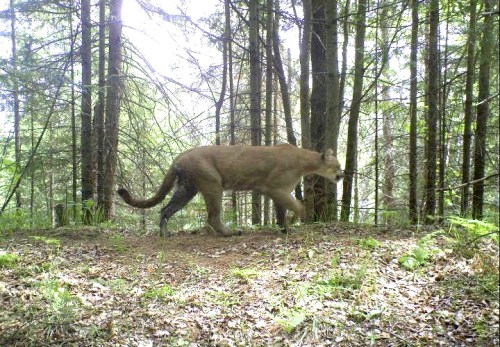
Marquette County Cougar, photo by Michigan Wildlife Conservancy

A trail cam in southern Marquette County operated by the Michigan Wildlife Conservancy (MWC) recently captured the above photo of a cougar. Dr. Patrick Rusz, Director of Wildlife Programs for the MWC and retired DNR forester Michael Zuidema verified the trail camera’s location on a well-worn wildlife trail atop a wooded ridge. The camera has also photographed wolves, coyotes, fishers and numerous other species at the same site over a four year period.

The MWC is publicizing this photograph because it may be the best, clearest photograph of a wild Michigan cougar ever taken. It is also unusually interesting because Mr. Zuidema has recorded over twenty credible cougar sightings in the same vicinity since the 1970s. These include several sightings within a few miles of the trail camera location.

Dr. Rusz stated that “the long history of sighting reports in the area indicates the cougar photographed on June 1 may be part of a resident population rather than a wandering cat from a western state.” Dr. Rusz has studied cougars for the Conservancy for 14 years and is co-author of a peer-reviewed study that confirmed cougars in both peninsulas of Michigan by analyses of DNA in droppings. He has also identified a long list of additional physical evidence dating back to 1966, and notes that Michigan State College zoologist Richard Manville documented several cougar sightings or incidents when he inventoried the fauna of Marquette County’s Huron Mountains from 1939 to 1942.

“The MDNR cougar team should now look at the very good evidence of a remnant cougar population collected before 2008,” said Bill Taylor, President of the Conservancy. “They could still easily verify cougar photos taken in the 1990’s in Alcona and Oscoda Counties in the Lower Peninsula and some others. The vegetation and other landmarks needed to confirm the photos are still there.”

You can compare the photograph above with photos of a wolf, coyote, raccoon, and porcupine taken by the same camera in the same location at the MWC website at www.miwildlife.org.

The Michigan Wildlife Conservancy is a non-profit citizens group established to restore Michigan’s wildlife legacy. They have restored more than 8,200 acres of wetlands, 2,500 acres of prairies and grasslands, and hundreds of miles of trout streams, and helped with several rare species recoveries and the creation of many backyard habitats.

More about cougars in Michigan on Michigan in Pictures and weigh in with your comments below or on the Absolute Michigan Facebook!