
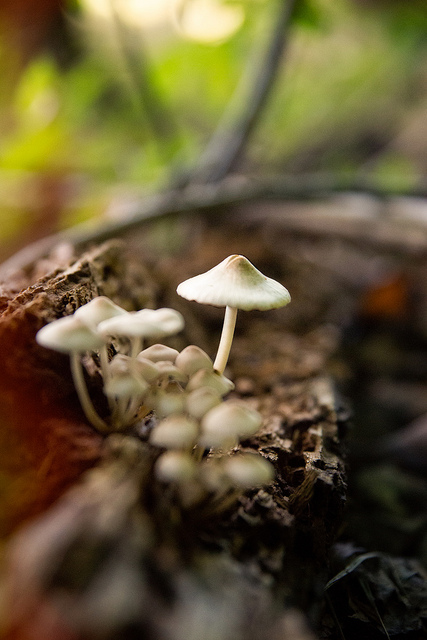
Explore colors of fall – wild mushroom, photo by bumkicho
Bumki Cho offers a visual reminder that the colors of fall are up, down and all around.
Check the photo out background big and see more in his slideshow.
More fall on Michigan in Pictures!
Explore colors of fall – wild mushroom, photo by bumkicho
Bumki Cho offers a visual reminder that the colors of fall are up, down and all around.
Check the photo out background big and see more in his slideshow.
More fall on Michigan in Pictures!
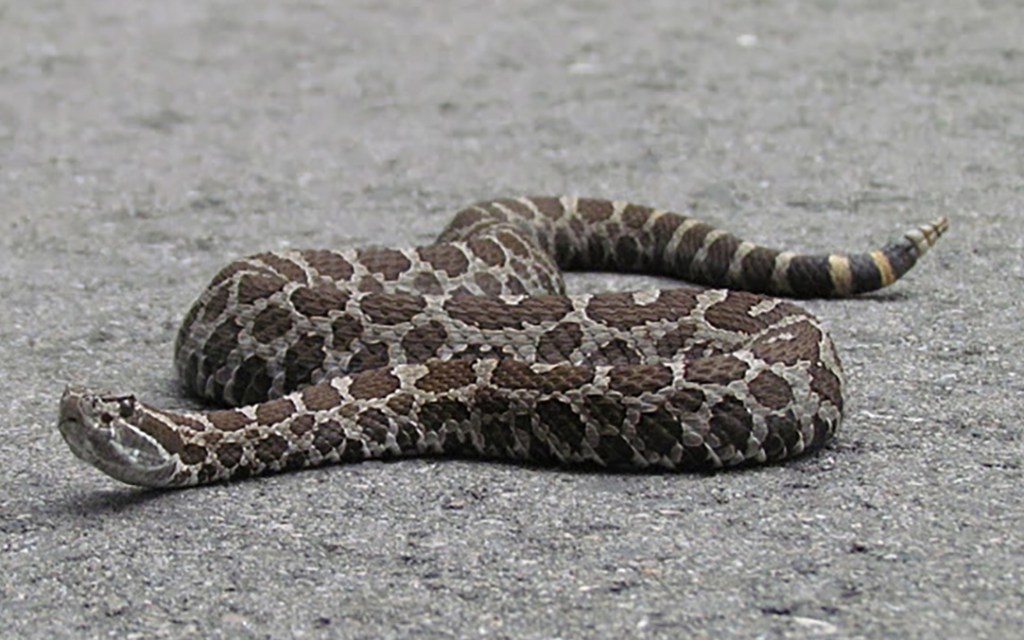
Eastern Massasauga Rattlesnake by Jonathan Schechter/Earth’s Almanac
In Season of the Massasauga Rattler!, Jonathan Schechter writes that the massasauga likes our sun-soaked trails in the waning days of summer and early autumn, so you may catch a glimpse of one if you’re out and about in Lower Michigan. The Michigan DNR page on the Eastern Massasauga Rattlesnake (Sistrurus catenatus catenatus) explains:
Michigan’s only venomous snake is a rare sight for most state residents. Historically, they could be found in a variety of wetlands and nearby upland woods throughout the lower peninsula. During the late spring, these snakes move from their winter hibernation sites, such as crayfish chimneys and other small mammal burrows in swamps and marshlands, to hunt on the drier upland sites – likely in search of mice and voles, their favorite food.
Females give birth to 8 to 20 young in late summer. The young snakes have a single “button” on their tails; a new rattle segment is added at each shedding of the skin, which occurs several times per year.
The massasauga can be characterized as a shy, sluggish snake. Its thick body is colored with a pattern of dark brown slightly rectangular patches set against a light gray-to-brown background. Occasionally, this coloration can be so dark as to appear almost black. The belly is mostly black. It is the only Michigan snake with segmented rattles on the end of its tail and elliptical, (“cat like”) vertical pupils in the eyes. The neck is narrow, contrasting with the wide head and body and the head appears triangular in shape. Adult length is 2 to 3 feet.
These rattlesnakes avoid confrontation with humans; they are not prone to strike – preferring to leave the area when they are threatened. Like any animal though, these snakes will protect themselves from anything they see as a potential predator. Their short fangs can easily puncture skin and they do possess a potent venom. It is best to treat them with respect and leave them alone. The few bites that occur to humans often result from attempts to handle or kill the snakes. Any bite from a massasauga should receive prompt professional medical attention. When compared to other rattlesnakes found in the United States, the massasauga is the smallest and has the least toxic venom.
Massasaugas are found throughout the Lower Peninsula, but not in the Upper Peninsula (thus there are no poisonous snakes on the Upper Peninsula mainland.)
They stress that Massasaugas are listed as a “species of special concern” and are protected by state law, so don’t kill or harm them. Read on for more including some lookalike snakes.
Jonathan adds that almost all rattler bites are on the dominant hand of the offending human! He took the photo above two years ago on a popular Oakland County hike-bike trail and notes that much of Oakland County is ratter habitat. Visit Earth’s Almanac to read more and be sure to subscribe to his blog when you’re there!
PS: Nick Scobel of the Herping Michigan blog has a great video of some Eastern Massasaugas that you should check out!
More Michigan snakes on Michigan in Pictures!
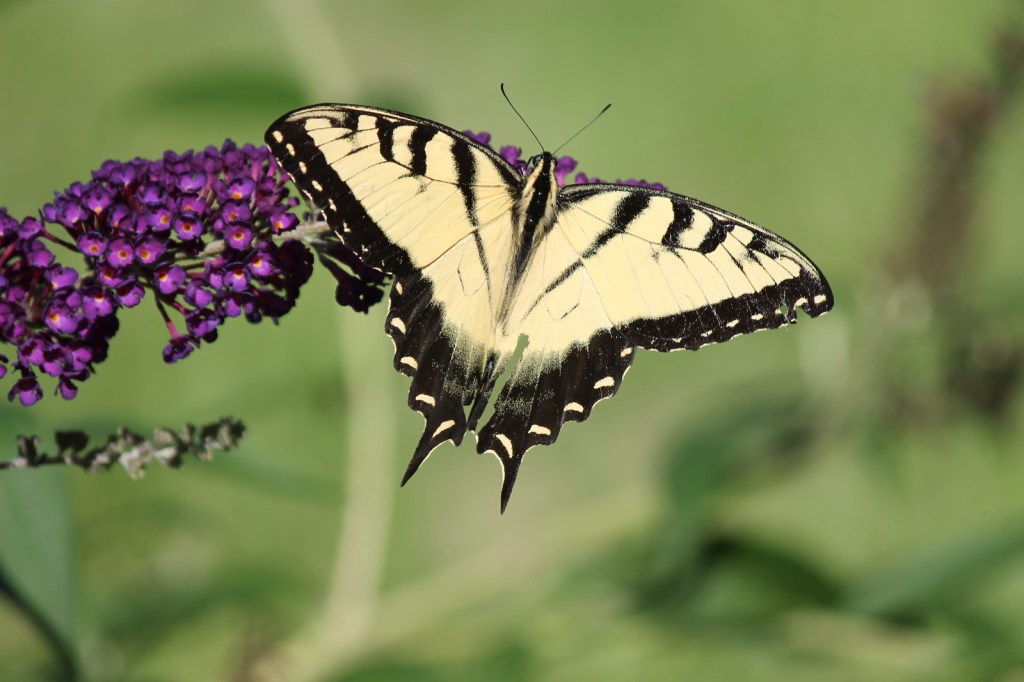
Eastern Tiger Swallowtail Butterfly (Saline, Michigan), photo by cseeman
The University of Michigan Animal Diversity Web entry for the eastern tiger swallowtail butterfly (Papilio glaucus) says in part:
The eastern tiger swallowtail ranges from Alaska and the Hudsonian zone of Canada to the southern United States, east of the Rocky Mountains.
This species occurs in nearly every area where deciduous woods are present, including towns and cities. It is most numerous along streams and river, and in wooded swamps.
As with most butterflies, Eastern tiger swallowtails tend to be solitary. Males “patrol” for a mate, flying from place to place actively searching for females. “Patrolling” male tiger swallowtails can recognize areas of high moisture absorbtion by the sodium ion concentration of the area. It is believed that the moisture found by these males helps cool them by initiating an active-transport pump. Both male and female tiger swallowtails are known to be high fliers. Groups of fifty butterflies have been spotted in Maryland flying 50 meters high, around the tops of tulip trees.
The tiger swallowtail is thought of as the American insect, in much the same way as the Bald Eagle is thought of as the American bird. It was the first American insect pictured in Europe; a drawing was sent to England from Sir Walter Raleighs’ third expedition to Virginia.
You can read on for more including photos. I also found a page with a listing of Michigan butterflies and apparently we have eight species of swallowtail butterfly. You can also see some great eastern swallowtail photos from Butterflies & Moths. Spoiler alert: the female can look a lot different.
Corey writes that he got this shot at the butterfly bush he planted this year. Check it out background big and see more great shots of this fellow in his butterfly slideshow.


Along the Trail, photo by nasunto
Michigan in Pictures regular Nina Asunto is posting trip reports about her trip at the end of June to the Pictured Rocks National Lakeshore. In Day One: Chapel / Mosquito Trailhead to Chapel Beach she writes about a common June annoyance in the Upper Peninsula that this year proved more that annoying:
We arrived at Chapel Beach campground just before noon and had to put our bug nets on as soon as we got there. The campground consists of six sites, which are in the woods at the top of a bluff above Lake Superior. One of them (#6) is at the edge of the woods, and it is close enough to the beach to benefit from the breeze coming from the lake. This site was already occupied, of course, so we chose site #3, which was further into the woods. Under normal circumstances, this would be a really good campsite, with Chapel Creek running alongside it creating a nice atmosphere. Unfortunately, the exceptionally wet spring had ensured that this typically buggy season far exceeded expectations. The word “brutal” doesn’t quite do it justice – it was a buzzing hell-scape. The only thing to do was to set up camp as quickly as possible and flee to the beach.
Curiously enough, I was also in the UP and stopped at Pictured Rocks that weekend. Without Deep Woods Off, I am pretty sure I would have ended up a bloodless corpse! Click to read more (including her analysis of permethrin vs mosquitos). Follow along as Nina posts the rest of the report on Black Coffee at Sunrise.
Check it out bigger and see more in Nina’s Pictured Rocks National Lakeshore | June 2013 slideshow.

Northern Water Snake, photo by Brian Laskowski
The Michigan Department of Natural Resources page on the Northern Water Snake says:
Description: A water snake with dark bands or blotches on a light brown or gray background color. Some old adults may appear solid black or brown. The belly is white with reddish half moon shaped markings; some specimens have an orange belly speckled with brown or black. (The endangered Copper Bellied Water Snake has an unmarked reddish or orange belly.) Adult length: 2 to 4 feet.
Habitat and Habits: These snakes inhabit the shorelines of lakes, ponds, or streams. They swim well, seeking food (frogs and fish) and safety in the water, and often bask on objects hanging over the water. Water snakes are not venomous, but will bite if cornered or handled. They are sometimes mistakenly called “water moccasins” (which are not native to Michigan).
Reproduction: Females give birth to their 7 to 9 inch young in late summer. There are 8 to 48 babies in a litter. The young are gray or brown with bold black bands.
Range and Status: Northern water snakes are found throughout the Lower Peninsula and the eastern Upper Peninsula. Needless persecution by humans has eliminated water snakes from many places where they were once common.
The DNR’s Michigan Snake Page adds that there are just 17 species of snake in Michigan, so do what you can to protect this snake and its kin.
Check it out bigger and see more in Brian’s Michiganscapes slideshow.
More Michigan snakes on Michigan in Pictures.

Sizzle, photo by corinne.schwarz
I think this squirrel accurately reflects the feelings of many of us following a week of sauna-like conditions. The squirrel is heat dumping, shedding maximum heat by flattening its body. You can see some more examples of this in the hilarious Squirrel Pancakes photo group.
Check this out background big and see more (including a couple more shots of this squirrel or a relative) in Corinne’s slideshow.

“Bridge to Nowhere” Foggy Mackinac Bridge – Mackinaw City , Michigan, photo by Michigan Nut
“Unless we move without delay to halt the deterioration of our land, our water and our air, our own children may see the last traces of earth’s beauty crushed beneath the weight of man’s waste and ruin.”
~Governor William Milliken to the Michigan legislature, January 1970
While “environmentalism” has become a polarizing term, it seems to me to be a concept that’s at the core of loving & caring for the Great Lakes State. One of my personal heros, Michigan Governor Bill Milliken, recognized this and he and his wife Helen fought strongly throughout their careers to enshrine protection of the natural bounty that they loved into the fabric of Michigan’s laws. It’s no surprise that every year the Michigan Environmental Council recognizes an individual for outstanding leadership, enduring commitment and extraordinary public service in protecting natural resources at the local, state and national levels with the Helen & William Milliken Distinguished Service Award.
The 2013 recipient has been announced, Dave Dempsey. Dempsey is the author of numerous books, a former member of the Great Lakes Fishery Commission, environmental policy adviser to former Michigan Gov. James Blanchard, and member of the state’s Natural Resources Trust Fund Board.
“Dave Dempsey is the rare leader who is able to move effortlessly from talking about the arcane technical details of some issue, to explaining in vivid and powerful terms why that issue is so critical to the quality of life for the generations that come after us,” Chris Kolb, MEC president, said in a press release Monday.
“Dave’s contributions to a better Michigan through his public policy advocacy alone deserve our recognition and gratitude. However, when you add in his authoritative chronicling of Michigan’s environmental history through his books, it’s clear he has made a special, positive, and lasting impact on our state.”
There’s no doubt that Dempsey has been a champion of the Great Lakes, and this Sunday (July 14) you have a chance to do some championing of your own as dedicated groups from all over the state host Oil & Water Don’t Mix: A Rally for the Great Lakes to raise awareness about climate change and the dangers posed by an oil pipeline that runs through the Mackinac Straits. Enbridge Energy – the company responsible for the devastating July 2010 Kalamazoo River oil spill and over 800 other spills since 1999 – has been pumping oil through the Straits for 60 years. They are seeking to pump even more oil through the aging Mackinac pipeline – possibly including tar sands, the most toxic and hard to clean up if spilled.
The rally this Sunday, July 14 at noon at Bridge View Park in St. Ignace (just across the bridge) and there are numerous busses heading there from Kalamazoo, Lansing, Traverse City and other locations. Click for details or view the event on Facebook!
Check John’s photo out bigger and see more in his Bridges / Covered Bridges slideshow.
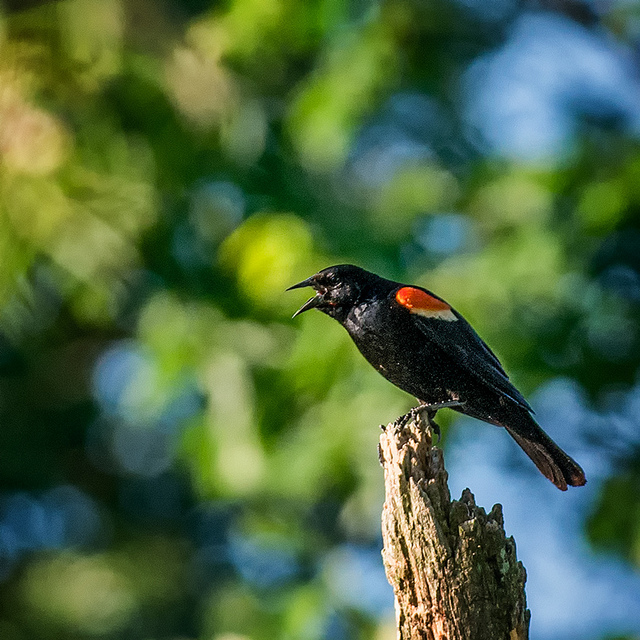
Pond Boss, photo by MichaelinA2
I grew up by a marsh that was filled with Red-winged Blackbirds, and their song has always felt like lazy summer days to me. All About Birds entry for Red-winged Blackbird Agelaius phoeniceus says:
One of the most abundant birds across North America, and one of the most boldly colored, the Red-winged Blackbird is a familiar sight atop cattails, along soggy roadsides, and on telephone wires. Glossy-black males have scarlet-and-yellow shoulder patches they can puff up or hide depending on how confident they feel. Females are a subdued, streaky brown, almost like a large, dark sparrow. In the North, their early arrival and tumbling song are happy indications of the return of spring.
Male Red-winged Blackbirds do everything they can to get noticed, sitting on high perches and belting out their conk-la-ree! song all day long. Females stay lower, skulking through vegetation for food and quietly weaving together their remarkable nests.
Read on for more including video and blackbird calls. The Red-winged blackbird entry on Wikipedia has more, including a photo of the aforementioned red wing blackbird nest which I have to admit looks very cool!
Check this out bigger and see more in Michael’s 2013 birds slideshow.
More birds on Michigan in Pictures!

Great Blue Herons adding sticks to their nest, photo by ellenm1
The Michigan Natural Features Inventory entry for Great Blue Heron Rookeries explains:
The great blue herons in Michigan are largely migratory, with almost all leaving the state during the winter months. Most leave by end of October and return in early to mid-March.
The great blue heron is mostly a colonial nester, occasionally they nest in single pairs. Colonies are typically found in lowland swamps, islands, upland hardwoods and forests adjacent to lakes, ponds and rivers. Nests are usually in trees and may be as high as 98 ft. (30 m) or more from the ground. The platform like nests are constructed out of medium-sized sticks and materials may be added throughout the nesting cycle. Nests are usually lined with finer twigs, leaves, grass, pine needles, moss, reeds, or dry gras. The same nests are refurbished and used year after year. Nest size varies; newer nests may be 1.5 ft. (0.5 m) in diameter with older nests reaching up to 4 ft (1.2 m) in diameter (Andrle 1988). Nests can also be used by Canada geese (Branta canadensis), house sparrows (Passer domesticus), and great-horned owls (Bubo virginianus)…
Most great blue herons return to southern Michigan heronries in mid-March although a few may remain through the winter if there are areas of open water. Courtship and nest building commences from early April in southern Michigan to early May in the extreme northern portions of the state. Both sexes are involved in the nest building process with males primarily gathering sticks from the ground, nearby trees, or ungarded nearby nests. Males pass sticks to females who then place them on the nests. Between 3 and 7 (usually 4) greenish blue eggs are laid in April and May in Michigan. Both sexes take a turn at incubation with females incubating mostly at night and males during the day. The incubation period lasts from 25-29 days. In Michigan hatching occurs in the first week of May in the south while parents are still incubating nests in the far northern part of the state. For the first 3-4 weeks post hatching, one parent remains on the nest with the young.
Check this photo out big as the sky and see more in Ellen’s Kensington Metropark slideshow.
More herons & birds on Michigan in Pictures, and also check out this photo of a Heronry on Absolute Michigan.

Great Horned Owlets, photo by Kevin Povenz
April is the season for owls to fledge, or learn to fly. The Raptor Education Group from over in Wisconsin has a page about owlets that includes what to do if you come across one of these cute balls of fluff on the ground:
Great-horned Owls do not build their own nest. Instead, they choose an old nest of a crow, hawk, or even a squirrel to call their own.
When the young owls are 6-8 weeks old, they begin to venture from their nest. This is before they can actually fly. Nature’s method provides owlets opportunities to develop their leg muscles that will very soon be catching their own prey. In a natural setting owlets that appear to have fallen from their nest actually have fledged. In a natural wooded area, bushes and smaller trees provide a ladder of sorts and allow the chicks to climb to a higher perch until they can fly. When owls nest in a city with concrete below them rather than a soft forest floor, problems arise. That is also the case with a well-manicured park or lawn setting that has nothing that can function as a ladder for the tykes.
…If you find a young owl, leave it where it is, unless it is in imminent danger. Give us a call and let us help you decide if the adults are in attendance and the chick is just fledging naturally or if there is something wrong with the little one. Remember, owls are nocturnal for the most part and are not easy to see during daylight hours. Mom and dad could be very close and yet be so well camouflaged they are hard to see.
Michigan in Pictures has a feature on Great Horned Owls with a lot more about these birds!
View this on black, check out more from Kevin on Michigan in Pictures and definitely have a look at his great Birds of Prey slideshow.
 Michigan in Pictures
