Chillin’ with the Wood Ducks

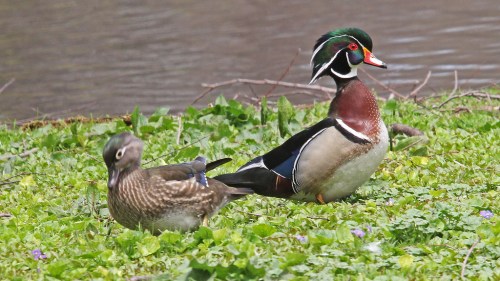
Wood Duck

Wood Duck, photo by Dan Lockard

The All About Birds listing for Aix sponsa (wood duck) says in part:

The Wood Duck is one of the most stunningly pretty of all waterfowl. Males are iridescent chestnut and green, with ornate patterns on nearly every feather; the elegant females have a distinctive profile and delicate white pattern around the eye. These birds live in wooded swamps, where they nest in holes in trees or in nest boxes put up around lake margins. They are one of the few duck species equipped with strong claws that can grip bark and perch on branches.

Wood Ducks thrive in bottomland forests, swamps, freshwater marshes, and beaver ponds. They are also common along streams of all sizes, from creeks to rivers, and the sheer extent of these make them an important habitat. Wood Ducks seem to fare best when open water alternates with 50–75% vegetative cover that the ducks can hide and forage in.

Some wood duck facts:

  • Natural cavities for nesting are scarce, and the Wood Duck readily uses nest boxes provided for it. If nest boxes are placed too close together, many females lay eggs in the nests of other females. (click for info about building a nest box)
  • The Wood Duck nests in trees near water, sometimes directly over water, but other times up to 2 km (1.2 mi) away. After hatching, the ducklings jump down from the nest tree and make their way to water. The mother calls them to her, but does not help them in any way. The ducklings may jump from heights of up to 89 m (290 ft) without injury.
  • Wood Ducks pair up in January, and most birds arriving at the breeding grounds in the spring are already paired. The Wood Duck is the only North American duck that regularly produces two broods in one year.

View Sherri & Dan’s photo background big and see more in their Animals slideshow.

Many (many) more Michigan birds on Michigan in Pictures.
Know Your Michigan Turtles: Blanding’s Turtle

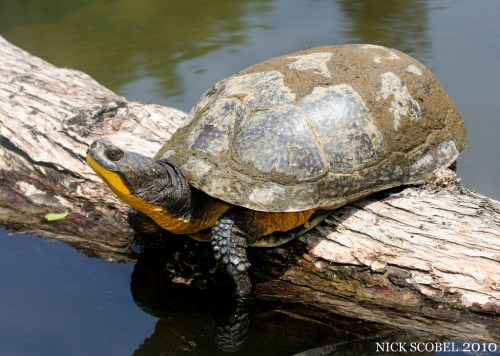
Blanding's Turtle

Blanding’s Turtle, photo by Nick Scobel

One of the most popular posts on Michigan in Pictures is Know Your Michigan Turtles where there’s now 6 of Michigan’s 10 turtle species profiled. For all those folks who come by to hang with our hard-shelled friends, here’s the latest installment in the series! 

The University of Michigan Animal Diversity Web entry for Emydoidea blandingii (Blanding’s Turtle) says that the Great Lakes region is currently a stronghold for this species:

Blanding’s turtles are found in and around shallow weedy ponds, marshes, swamps, and lake inlets and coves most of the year. They prefer slow-moving, shallow water and a muddy bottom with plenty of vegetation.

Blanding’s turtle are medium sized turtles with a carapace length ranging from 15.2 to 27.4 cm. These semi-aquatic turtles have moderately high, domed carapaces. They are elongate and smooth, lacking keels or sculpturing. The carapacial scutes display distinct growth annuli most prominently seen in juveniles. Coloration between individuals is highly variable. The carapace is black or gray with any variation of scattered light yellow or whitish flecks or dots. The light spots and flecks predominate in some individuals while others are almost solid black. The plastron is yellow in color with a dark blotch in the outer corner of each scute, and has a V-shaped notch near the tail.

Blanding’s turtles, like most other turtles, emerge to bask on sunny days. Basking sits include logs, grass clumps, sloping banks, or high perches near the water. Although these turtles are quite tolerant to cold, the summer heat may restrict their activities to early morning and evening or possibly a more nocturnal lifestyle. In the event of their habitat drying up some individuals will opt to migrate to new bodies of water while others simply burrow into the mud and aestivate until conditions improve. Blanding’s turtles generally hibernate from late October until early April, but quite often they can be seen moving slowly below the ice.

Blanding’s turtles are omnivores. Their favorite food items are crustaceans but they also feed on insects, leeches, snails, small fish, frogs, and occasionally some plants. Food is captured with a rapid thrust of this turtle’s long neck, similar to the feeding actions of the snapping turtle (Chelydra). Feeding mostly occurs underwater and food seized on land is generally carried to the water for swallowing. Prey is either swallowed whole or if it is too large it is held by the jaws and shredded into smaller pieces by the front claws.

The Michigan DNR notes that Blanding’s Turtle is protected as a species of special concern in Michigan and also has a map of occurences of Blanding’s Turtle.

View Nick’s photo bigger and see a lot more of his photos of Blanding’s turtles on Flickr including this shot of the turtle’s amazingly long neck. Nick also runs the Herping Michigan Blog, a great resource to see a lot of reptiles and amphibians in the wild!

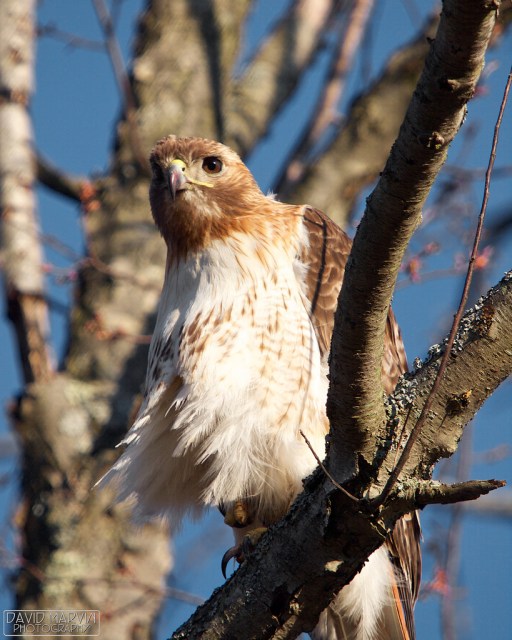
Red-Tailed Hawk (buteo jamaicensis)

Red Tailed Hawk

Red Tailed Hawk, photo by David Marvin

Sometimes the photos I link to go away, so here’s an old post with a new face!

All About Birds page on the Red-tailed Hawk (Buteo jamaicensis) says:

This is probably the most common hawk in North America. If you’ve got sharp eyes you’ll see several individuals on almost any long car ride, anywhere. Red-tailed Hawks soar above open fields, slowly turning circles on their broad, rounded wings. Other times you’ll see them atop telephone poles, eyes fixed on the ground to catch the movements of a vole or a rabbit, or simply waiting out cold weather before climbing a thermal updraft into the sky.

A couple fun facts:

The Red-tailed Hawk has a thrilling, raspy scream that sounds exactly like a raptor should sound. At least, that’s what Hollywood directors seem to think. Whenever a hawk or eagle appears onscreen, no matter what species, the shrill cry on the soundtrack is almost always a Red-tailed Hawk.

The Red-tailed Hawk is one of the largest birds you’ll see in North America, yet even the biggest females weigh in at only about 3 pounds. A similar-sized small dog might weigh 10 times that.

Courting Red-tailed Hawks put on a display in which they soar in wide circles at a great height. The male dives steeply, then shoots up again at an angle nearly as steep. After several of these swoops he approaches the female from above, extends his legs, and touches her briefly. Sometimes, the pair grab onto one other, clasp talons, and plummet in spirals toward the ground before pulling away.

Red-tailed Hawks have been seen hunting as a pair, guarding opposite sides of the same tree to catch tree squirrels.

The oldest known Red-tailed Hawk was 28 years 10 months old.

Click through for more info, photos and hawk sounds. Also see Buteo jamaicensis (red-tailed hawk) from the ADWRed-tailed Hawk on Wikipedia and Red-tailed hawk for Kids (also ADW).

View David’s photo background bigtacular and see more in his Birds slideshow.

More Michigan birds from Michigan in Pictures!

Fancy Feathers, Fashion and the Dawn of Bird Conservation

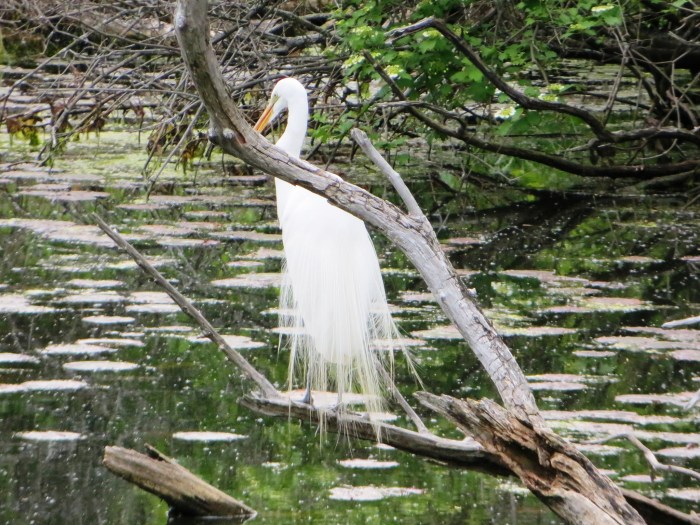
Spring Arrival Egret

Spring Arrival, photo by Cowboy*

How the Great White Egret Inspired Bird Conservation in the Smithsonian says:

One particular group of birds suffered near extermination at the hands of feather hunters, and their plight helped awaken a conservation ethic that still resonates in the modern environmental movement. With striking white plumes and crowded, conspicuous nesting colonies, Great Egrets and Snowy Egrets faced an unfortunate double jeopardy: their feathers fetched a high price, and their breeding habits made them an easy mark.

To make matters worse, both sexes bore the fancy plumage, so hunters didn’t just target the males; they decimated entire rookeries. At the peak of the trade, an ounce of egret plume fetched the modern equivalent of two thousand dollars, and successful hunters could net a cool hundred grand in a single season. But every ounce of breeding plumes represented six dead adults, and each slain pair left behind three to five starving nestlings. Millions of birds died, and by the turn of the century this once common species survived only in the deep Everglades and other remote wetlands.

This slaughter inspired Audubon members to campaign for environmental protections and bird preservation, at the state, national and international levels. The Lacey Act passed Congress in 1900, restricting interstate transport of wild fowl and game. In 1911 New York State outlawed the sale of all native birds and their feathers, and other states soon followed suit. Passage of the Weeks-McLean Act (1913) and the Migratory Bird Act (1918) took the protections nationwide and mirrored legislation in Canada, Britain, and Europe, effectively ending the fancy-feather era.

More about Great Egrets on the UM Animal Diversity Web.

You can view Cowboy’s photo from last May background big and see more in his Animals & Wildlife slideshow.

More birds and more Spring wallpaper on Michigan in Pictures!

Bad news for Michigan bats: White-nose syndrome found

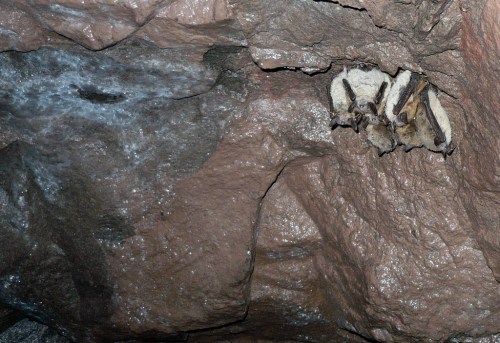
Bats of Copper Country

Bats of Copper Country, photo by GollyGforce – Living My Worst Nightmare

In “A sad day” for Michigan bats: White-nose syndrome found in 3 counties, Michigan Radio reports:

The Michigan Department of Natural Resources today confirmed the presence of white-nose syndrome in three counties: Alpena, Dickinson and Mackinac.

White-nose syndrome is blamed for the deaths of six million bats in 27 states and five Canadian provinces since 2006. In some places where the fungus outbreak has taken hold, 90% of the bats have died.

“We anticipated that this day would come. It’s not unexpected. But it’s still a sad day,” says Dan O’Brien, a state wildlife veterinarian. “Once this fungus gets into a bat hibernacula it’s going to be there, current evidence suggests, for a long time.”

The fungal disease could have a big impact on Michigan’s economy. Wildlife biologists estimate bats have a roughly $1 billion impact on the state’s agriculture industry by eating harmful insects.

The DNR adds:

“At this point, there is no effective treatment for WNS and no practical way to deliver the treatment to millions of affected bats even if treatment existed. Rehabilitation of bats is prohibited in Michigan because of the potential for the exposure of humans to rabies,” said O’Brien. “The best thing the public can do when they find a dying or dead bat is to leave it alone and keep children, livestock and pets away from it.”

Bat die-offs can be reported through an observation report on the DNR website at www.michigan.gov/wildlife or by calling the DNR at 517-336-3050.

View G’s photo big as a batcave and see more in her In the Wild slideshow.

More animals on Michigan in Pictures.

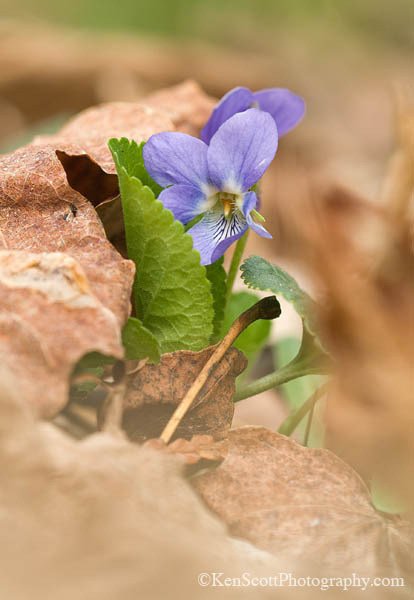
Common blue violet (Viola sororia)

Coincidentally enough, I just found out that Ken will be doing the next Glen Arbor Art Association Talk About Art this Thursday, April 10, 7:30 p.m. at the GAAA in Glen Arbor.

Spring Speak ... violet

Spring Speak … violet, photo by Ken Scott

Today’s post comes via eatdrinkTCMichigan is the second most agriculturally diverse state in the U.S. and that diversity doesn’t stop at the market! Our woods are alive with tasty and nutritious food if you know where to look. In our Wild Food Wednesdays we’ll tip you off to seasonal goodies and give you a recipe or two so you can enjoy the meal as much as the hike to find it!

In many years, we will have seen Viola sororia (Common blue violet) in the woods and often in our lawns by now. Violets can be found in a variety of soil conditions, from moist and even swampy deciduous forests to drier forests (though not usually near pines). The flowers and young leaves are delicious! The Culinary Violet page at the American Violet Society says (in part):

Both the flowers and leaves in fresh and dried forms have been standard fare in Europe and other areas in the world since before the 14th century. Fresh flowers are most often used for garnishing and crystallizing, The pungent perfume of some varieties of v.odorata adds inimitable sweetness to desserts, fruit salads and teas while the mild pea flavor of v.tricolor and most other viola combines equally well with sweet or savory foods, like grilled meats and steamed vegetables. The heart-shaped leaves of the v. odorata provide a free source of greens throughout a long growing season. They add texture to green salads when young and tender. Later in the season, slightly tougher, older leaves are cooked with other potted herbs and greens in soups, stews and stir-frys.

Violets aren’t just another pretty face. They are loaded with phytochemicals and medicinal constituents that have been used in the treatment of numerous health problems from the common cold to cancer. The late Euell Gibbons even referred to them as “nature’s vitamin pill (1).” A 1/2 cup serving of leaves can provide as much vitamin C as three oranges.

You can see some more photos and a county distribution at the Herbarium of the University of Michigan and get a lot more, including recipes, from eatdrinkTC!

Ken took this shot in March of 2012. See it on Flickr and see more in his Flowers slideshow!

More flowers and more food on Michigan in Pictures!

Let’s Do Lunch (Snowy Owl Style)

Snowy Owl 1

Snowy Owl 1, Sherri & Dan

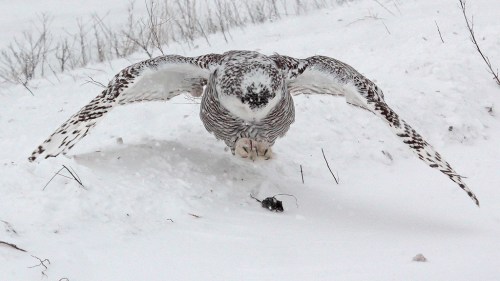
Dan Lockard captured a cool sequence last weekend of a snowy owl on the hunt. View his photo background big, watch the hunt (which doesn’t end well for Mr. Mouse) or check out his owls slideshow.

The Owl Pages entry for the Snowy Owl (Bubo scandiacus) says in part:

The Snowy Owl is a large diurnal white Owl with a rounded head, yellow eyes and black bill. The name “scandiacus” is a Latinised word referring to Scandinavia, as the Owl was first observed in the northern parts of Europe. Some other names for the Snowy Owl are Snow Owl, Arctic Owl, Great White Owl, Ghost Owl, Ermine Owl, Tundra Ghost, Ookpik, Scandinavian Nightbird, White Terror of the North, and Highland Tundra Owl.

…Most hunting is done in the “sit and wait” style. These Owls are highly diurnal, although they may hunt at night as well. Prey are captured on the ground, in the air, or snatched off the surface of water bodies. When taking snowshoe hares, a Snowy Owl will sink its talons into the back and backflap until the hare is exhausted. The Owl will then break its neck with its beak. Snowy Owls have been known to raid traplines for trapped animals and bait, and will learn to follow traplines regularly. They also snatch fish with their talons. Small prey up to small hares are swallowed whole, while larger prey are carried away and torn into large chunks. Small young are fed boneless and furless pieces. Large prey are carried of in the Owl’s talons, with prey like lemmings being carried in the beak.

…Snowy Owls produce large, rough-looking cylindrical pellets with numerous bones, feathers, and fur showing. They are usually expelled at traditional roosting sites and large numbers of pellets can be found in one spot. When large prey are eaten in small pieces with little roughage, pellets will not be produced.

Read on for much more about these winter visitors, who the DNR explain migrate to Michigan in wintertime and have been sighted as far south as Lansing. They add that because snowy owls see few if any humans in their Arctic home, they are not very timid and easier to observe than other owl species.

More Michigan owls on Michigan in Pictures!

American Kestrel, the Sparrow Hawk

American Kestrel with mouse

American Kestrel with mouse, photo by Kevin Povenz

The American Kestrel entry at Wikipedia says:

The American Kestrel (Falco sparverius), sometimes colloquially known as the Sparrow Hawk, is a small falcon, and the only kestrel found in the Americas. It is the most common falcon in North America, and is found in a wide variety of habitats. At 19–21 centimeters (7–8 in) long, it is also the smallest falcon in North America. It exhibits sexual dimorphism in size and plumage, although both genders have a rufous back with noticeable barring. Juveniles are similar in plumage to adults.

The American Kestrel hunts by hovering in the air with rapid wing beats or perching and scanning the ground for prey. Its diet typically consists of grasshoppers, lizards, mice, and other small birds. It nests in cavities in trees, cliffs, buildings, and other structures. The female lays three to seven eggs, which both sexes help to incubate. It is a common bird to be used in falconry, especially by beginners.

All About Birds adds that it’s perhaps the most colorful raptor in the world, Wing over to their American Kestrel (Falco sparverius) page for photos, kestrel calls & more info.

More birds on Michigan in Pictures.
Check it out on black and see more in Kevin’s amazing Birds of Prey slideshow.

Many more Michigan Birds on Michigan in Pictures!

A Fall Drink of Water

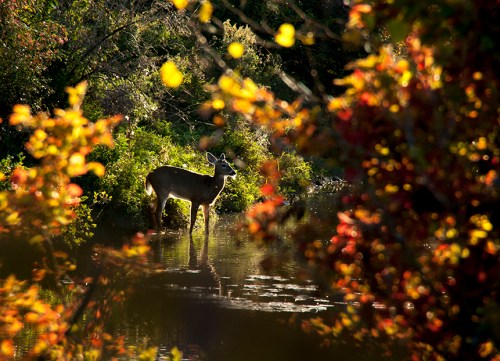
Doe

Doe, photo by sarah-nussbaumer

Here’s hoping your weekend holds a lot of autumn beauty … and a little bit of wonder.

Check it out bigger and see more in Sarah’s Autumn slideshow.

More fall photos on Michigan in Pictures.

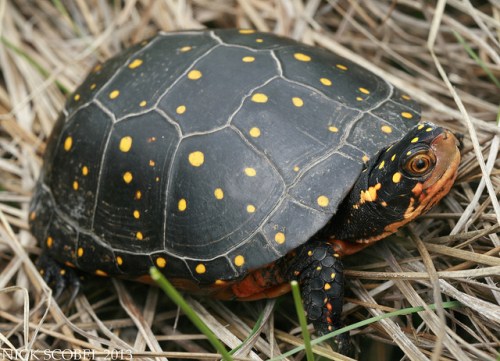
Know your Michigan Turtles: Spotted Turtle (Clemmys guttata)

Spotted Turtle

Spotted Turtle, photo by Nick Scobel

One of the most popular posts on Michigan in Pictures is Know Your Michigan Turtles, drawing around 100 people each day. Along with “Yay turtles!”, “Give the people what they want” has always been one of my philosophies so let’s get up close with one of our hard shelled neighbors. 

The UM Animal Diversity Web entry for Spotted Turtle (Clemmys guttata) says (in part):

Spotted Turtles prefer shallow waters with a soft bottom substrate and some submergent and emergent vegetation. These can include sedge meadows, boggy ponds, fens, tamarack swamps, sphagnum seepages, and slow, muddy streams. These turtles also frequently wander on land between wetlands, and may aestivate on land for weeks at a time.

Clemmys guttata is a very small species that rarely exceeds a straight-line carapace length of 11.4 cm (4.5 inches); the maximum recorded carapace length is 13.6 cm (5.4 inches). The adult carapace is smooth, without obvious growth ridges (annuli), and is black or brownish-black with a variable number of round yellow spots. These spots may fade in old adults, and occasional specimens lack carapace spots altogether.

…Spotted Turtles become active very early in the spring, and (as noted above) are often active at relatively cold water temperatures. Activity appears to peak during April and May in the northern part of the range. Spotted Turtles tend to become inactive in the warmest part of the summer (when water temperatures exceed 30°C) and they may aestivate aquatically or terrestrially for long periods of time. During summer dormancy, the turtles may burrow into leaf litter in woodlands or open fields or marsh edges; others remain in muskrat burrows or other aquatic refuge

…Spotted turtles are listed as vulnerable on the IUCN’s Red List, and they are considered threatened in the state of Michigan.

Read on for more and also see the Michigan DNR page on Spotted Turtles.

Check Nick’s photo out and see more in his Clemmys guttata slideshow which includes some pics of adult male spotted turtles. Nick runs the Herping Michigan Blog as well and has an interesting article about the recent division of the Clemmys genus into three genuses. The spotted turtles got to keep theirs with the other two being Wood Turtle (Glyptemys insculpta) & Bog Turtle (Glyptemys muhlenbergii).

More turtles on Michigan in Pictures!