Sizzle

Sizzle

Sizzle, photo by corinne.schwarz

I think this squirrel accurately reflects the feelings of many of us following a week of sauna-like conditions. The squirrel is heat dumping, shedding maximum heat by flattening its body. You can see some more examples of this in the hilarious Squirrel Pancakes photo group.

Check this out background big and see more (including a couple more shots of this squirrel or a relative) in Corinne’s slideshow.

Fighting for Michigan’s Environment

"Bridge to Nowhere" Foggy Mackinac Bridge - Mackinaw City , Michigan.

“Bridge to Nowhere” Foggy Mackinac Bridge – Mackinaw City , Michigan, photo by Michigan Nut

“Unless we move without delay to halt the deterioration of our land, our water and our air, our own children may see the last traces of earth’s beauty crushed beneath the weight of man’s waste and ruin.”
~Governor William Milliken to the Michigan legislature, January 1970

While “environmentalism” has become a polarizing term, it seems to me to be a concept that’s at the core of loving & caring for the Great Lakes State. One of my personal heros, Michigan Governor Bill Milliken, recognized this and he and his wife Helen fought strongly throughout their careers to enshrine protection of the natural bounty that they loved into the fabric of Michigan’s laws. It’s no surprise that every year the Michigan Environmental Council recognizes an individual for outstanding leadership, enduring commitment and extraordinary public service in protecting natural resources at the local, state and national levels with the Helen & William Milliken Distinguished Service Award.

The 2013 recipient has been announced, Dave Dempsey. Dempsey is the author of numerous books, a former member of the Great Lakes Fishery Commission, environmental policy adviser to former Michigan Gov. James Blanchard, and member of the state’s Natural Resources Trust Fund Board.

“Dave Dempsey is the rare leader who is able to move effortlessly from talking about the arcane technical details of some issue, to explaining in vivid and powerful terms why that issue is so critical to the quality of life for the generations that come after us,” Chris Kolb, MEC president, said in a press release Monday.

“Dave’s contributions to a better Michigan through his public policy advocacy alone deserve our recognition and gratitude. However, when you add in his authoritative chronicling of Michigan’s environmental history through his books, it’s clear he has made a special, positive, and lasting impact on our state.”

There’s no doubt that Dempsey has been a champion of the Great Lakes, and this Sunday (July 14) you have a chance to do some championing of your own as dedicated groups from all over the state host Oil & Water Don’t Mix: A Rally for the Great Lakes to raise awareness about climate change and the dangers posed by an oil pipeline that runs through the Mackinac Straits. Enbridge Energy – the company responsible for the devastating July 2010 Kalamazoo River oil spill and over 800 other spills since 1999 – has been pumping oil through the Straits for 60 years. They are seeking to pump even more oil through the aging Mackinac pipeline – possibly including tar sands, the most toxic and hard to clean up if spilled.

The rally this Sunday, July 14 at noon at Bridge View Park in St. Ignace (just across the bridge) and there are numerous busses heading there from Kalamazoo, Lansing, Traverse City and other locations. Click for details or view the event on Facebook!

Check John’s photo out bigger and see more in his Bridges / Covered Bridges slideshow.

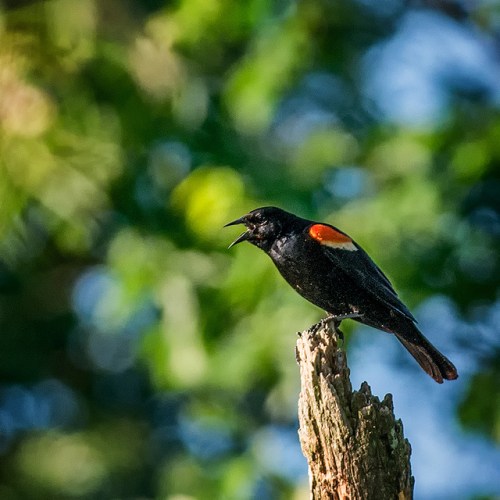
Pond Boss: The Red-winged Blackbird

Pond Boss

Pond Boss, photo by MichaelinA2

I grew up by a marsh that was filled with Red-winged Blackbirds, and their song has always felt like lazy summer days to me. All About Birds entry for Red-winged Blackbird Agelaius phoeniceus says:

One of the most abundant birds across North America, and one of the most boldly colored, the Red-winged Blackbird is a familiar sight atop cattails, along soggy roadsides, and on telephone wires. Glossy-black males have scarlet-and-yellow shoulder patches they can puff up or hide depending on how confident they feel. Females are a subdued, streaky brown, almost like a large, dark sparrow. In the North, their early arrival and tumbling song are happy indications of the return of spring.

Male Red-winged Blackbirds do everything they can to get noticed, sitting on high perches and belting out their conk-la-ree! song all day long. Females stay lower, skulking through vegetation for food and quietly weaving together their remarkable nests.

Read on for more including video and blackbird calls. The Red-winged blackbird entry on Wikipedia has more, including a photo of the aforementioned red wing blackbird nest which I have to admit looks very cool!

Check this out bigger and see more in Michael’s 2013 birds slideshow.

More birds on Michigan in Pictures!

Great Blue Heron Rookeries

Great Blue Heons adding sticks to their nest

Great Blue Herons adding sticks to their nest, photo by ellenm1

The Michigan Natural Features Inventory entry for Great Blue Heron Rookeries explains:

The great blue herons in Michigan are largely migratory, with almost all leaving the state during the winter months. Most leave by end of October and return in early to mid-March.

The great blue heron is mostly a colonial nester, occasionally they nest in single pairs. Colonies are typically found in lowland swamps, islands, upland hardwoods and forests adjacent to lakes, ponds and rivers. Nests are usually in trees and may be as high as 98 ft. (30 m) or more from the ground. The platform like nests are constructed out of medium-sized sticks and materials may be added throughout the nesting cycle. Nests are usually lined with finer twigs, leaves, grass, pine needles, moss, reeds, or dry gras. The same nests are refurbished and used year after year. Nest size varies; newer nests may be 1.5 ft. (0.5 m) in diameter with older nests reaching up to 4 ft (1.2 m) in diameter (Andrle 1988). Nests can also be used by Canada geese (Branta canadensis), house sparrows (Passer domesticus), and great-horned owls (Bubo virginianus)…

Most great blue herons return to southern Michigan heronries in mid-March although a few may remain through the winter if there are areas of open water. Courtship and nest building commences from early April in southern Michigan to early May in the extreme northern portions of the state. Both sexes are involved in the nest building process with males primarily gathering sticks from the ground, nearby trees, or ungarded nearby nests. Males pass sticks to females who then place them on the nests. Between 3 and 7 (usually 4) greenish blue eggs are laid in April and May in Michigan. Both sexes take a turn at incubation with females incubating mostly at night and males during the day. The incubation period lasts from 25-29 days. In Michigan hatching occurs in the first week of May in the south while parents are still incubating nests in the far northern part of the state. For the first 3-4 weeks post hatching, one parent remains on the nest with the young.

Check this photo out big as the sky and see more in Ellen’s Kensington Metropark slideshow.

More heronsbirds on Michigan in Pictures, and also check out this photo of a Heronry on Absolute Michigan.

Fledge Season & Great Horned Owlets

Great Horned Owlets

Great Horned Owlets, photo by Kevin Povenz

April is the season for owls to fledge, or learn to fly. The Raptor Education Group from over in Wisconsin has a page about owlets that includes what to do if you come across one of these cute balls of fluff on the ground:

Great-horned Owls do not build their own nest. Instead, they choose an old nest of a crow, hawk, or even a squirrel to call their own.

When the young owls are 6-8 weeks old, they begin to venture from their nest. This is before they can actually fly. Nature’s method provides owlets opportunities to develop their leg muscles that will very soon be catching their own prey. In a natural setting owlets that appear to have fallen from their nest actually have fledged. In a natural wooded area, bushes and smaller trees provide a ladder of sorts and allow the chicks to climb to a higher perch until they can fly. When owls nest in a city with concrete below them rather than a soft forest floor, problems arise. That is also the case with a well-manicured park or lawn setting that has nothing that can function as a ladder for the tykes.

…If you find a young owl, leave it where it is, unless it is in imminent danger. Give us a call and let us help you decide if the adults are in attendance and the chick is just fledging naturally or if there is something wrong with the little one. Remember, owls are nocturnal for the most part and are not easy to see during daylight hours. Mom and dad could be very close and yet be so well camouflaged they are hard to see.

Michigan in Pictures has a feature on Great Horned Owls with a lot more about these birds!

View this on black, check out more from Kevin on Michigan in Pictures and definitely have a look at his great Birds of Prey slideshow.

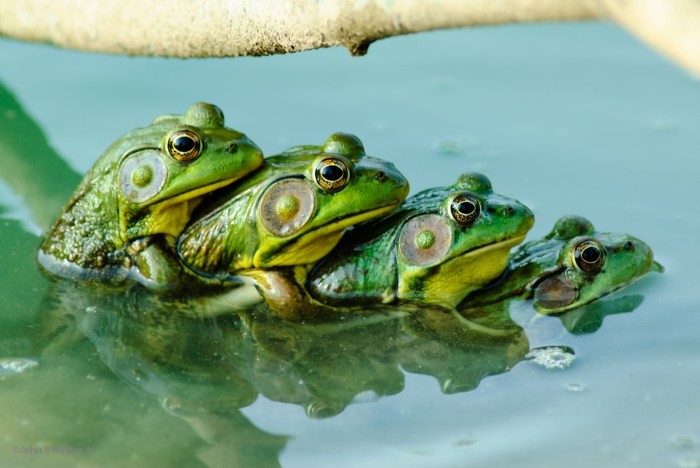
Frog Sex: It’s Complicated

Frog Sex Its Complicated

BACKYARD NATURE, photo by John E Heintz Jr

April is the time when we start to hear some of Michigan’s 13 species of frogs and toads making noise. While the green frogs pictured above were confusing their Frogbook friends in July, most of the distinctive spring frog calls are males advertising that they’re looking for love. The Michigan frog & toad page from the DNR explains:

As temperatures rise in early spring, frogs begin to move to their breeding sites. The actual timing depends on the warmth of the air and water, and the humidity, but there is noticeable order in which the various Michigan species become active and begin voicing their breeding calls. For example, in southern Michigan the raspy voice of the Western Chorus Frog is usually heard first, often in late March, followed quickly by the highpitched peeps of the Spring Peeper. In a few days the woodland swamps are filled with the quack like calls of the male Wood Frogs, while in another week in open marshes the low snores of the Leopard Frog are barely heard over the squeaky songs of newly arrived Red Winged Blackbirds.

The first warm rains of April bring American Toads out of the woods to the breeding ponds, where the air is soon filled with their melodious trills. Several of our frogs postpone their breeding activities until later in spring, when air and water temperatures are higher. Included in this late group are the Gray Tree Frog, Blanchard’s Cricket Frog, and Green and Bull Frogs.

Frogs are far more often heard than seen. Most frog sounds are the advertisement calls of the males, intended to attract the females for breeding. Frog voices may carry for long distances, especially the higher pitched calls of the smaller species. The males increase the loudness of their calls by ballooning out their throats or special sacs at the sides of their throats, creating a kind of resonating chamber. Only males produce advertisement calls, but both sexes may give shorter warning calls or screams when danger threatens. Males can also produce distinct calls that warn away rival males that approach their calling or breeding sites.

Female frogs and toads may lay hundreds or even thousands of eggs. These are usually attached to underwater vegetation or left floating in large masses at the surface. During egg laying, the male clings to the female’s back and fertilizes the eggs. The small, dark eggs are protected by layers of a jelly like substance. They may be in rounded masses (as in Wood and Leopard Frogs), loose clusters (Gray Tree Frogs), long necklace like strings (Toads), thin surface films (Bull and Green Frogs), or deposited singly or in small clusters (Spring Peeper). Many frog eggs are eaten by predators such as fish, turtles, and aquatic insects, or are lost to drying or destruction by micro organisms.

Read on for more and also read more about the frog life cycle from All About Frogs.

Check this out on black and see more in John’s BACKYARD NATURE slideshow.

More frogs & toads and more of our “Best Friends in Nature” series on Michigan in Pictures!

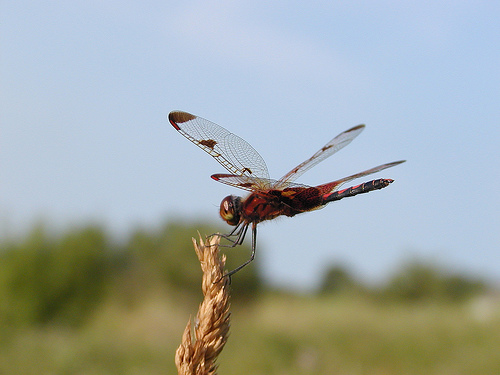
Don’t mess with a Dragonfly

DragOnFly

DragOnFly, photo by farlane

Yesterday Michigan in Pictures regular Mark O’Brien shared Nature’s Drone, Pretty and Deadly. The article says that although lions (25% hunting success rate) and great white sharks (50% success) look deadly, the dainty dragonfly may be the most effective hunter in the animal kingdom:

When setting off to feed on other flying insects, dragonflies manage to snatch their targets in midair more than 95 percent of the time, often wolfishly consuming the fresh meat on the spur without bothering to alight. “They’ll tear up the prey and mash it into a glob, munch, munch, munch,” said Michael L. May, an emeritus professor of entomology at Rutgers. “It almost looks like a wad of snuff in the mouth before they swallow it.”

Next step: grab more food. Dragonflies may be bantam, but their appetite is bottomless. Stacey Combes, who studies the biomechanics of dragonfly flight at Harvard, once watched a laboratory dragonfly eat 30 flies in a row. “It would have happily kept eating,” she said, “if there had been more food available.”

In a string of recent papers, scientists have pinpointed key features of the dragonfly’s brain, eyes and wings that allow it to hunt so unerringly. One research team has determined that the nervous system of a dragonfly displays an almost human capacity for selective attention, able to focus on a single prey as it flies amid a cloud of similarly fluttering insects, just as a guest at a party can attend to a friend’s words while ignoring the background chatter.

Read on for more including some very cool videos of dragonflies in action.

I don’t usually use my own photos on Michigan in Pictures, but I really like this one. Check it out background big and see more in my Leelanau slideshow.

More science on Michigan in Pictures!

Happy Easter(n) Cottontail!

ANIMALS

ANIMALS, photo by John E Heintz Jr.

Wishing everyone a Happy Easter or a happy weekend!

If you do see an Easter Bunny this weekend, he will probably be one of these guys. Sylvilagus floridanus (eastern cottontail) on the University of Michigan Animal Diversity Web explains (in part) that:

Eastern cottontails are solitary animals, and they tend to be intolerant of each other. Their home range is dependent on terrain and food supply. It is usually between 5 and 8 acres, increasing during the breeding season. Males generally have a larger home range than females. The eastern cottontail has keen senses of sight, smell and hearing. It is crepuscular (active at dawn & dusk) and nocturnal, and is active all winter. During daylight hours, the eastern cottontail remains crouched in a hollow under a log or in a thicket or brushpile. Here it naps and grooms itself. The cottontail sometimes checks the surroundings by standing on its hind legs with its forepaws tucked next to its chest.

Escape methods of the eastern cottontail include freezing and/or “flushing” (Chapman et al., 1980). Flushing consists of escaping to cover by a rapid and zig-zag series of bounds. The cottontail is a quick runner and can reach speeds up to 18 miles per hour. Vocalizations of the eastern cottontail include distress cries (to startle an enemy and warn others of danger), squeals (during copulation) and grunts (if predators approach a nesting doe and her litter). Eastern cottontails are short-lived; most do not survive beyond their third year. Enemies include hawks, owls, foxes, coyotes, weasels and man.

…The eastern cottontail is a vegetarian, with the majority of its diet made up of complex carbohydrates and cellulose. The digestion of these substances is made possible by caecal fermentation. The cottontail must reingest fecal pellets to reabsorb nutrients from its food after this process. Their diet varies between seasons due to availability. In the summer, green plants are favored. About 50% of the cottontail’s intake is grasses, including bluegrass and wild rye. Other summer favorites are wild strawberry, clover and garden vegetables. In the winter, the cottontail subsists on woody plant parts, including the twigs, bark and buds of oak, dogwood, sumac, maple and birch.

Click through to ADW for more (including pictures). Also see the Michigan DNR page on Eastern Cottontail and the BioKids cottontail page at UM, which appears to have exactly the same information as ADW, proving that I am not smarter than a 4th grader.

John started adding pics to the Absolute Michigan pool on Flickr about a month ago. He has some really great animal shots – so good in fact that I wonder if he has some Doolittle blood! See his photo on black and see more in his Animal Photography slideshow.

More Michigan animals on Michigan in Pictures.

Black Bear in Michigan

Bear

Bear, photo by Majestic View Photography

Here’s a few of the many Michigan Black Bear Facts available from the DNR:

What is the status of black bear in Michigan?

Approximately 15,000 – 19,000 black bears (including cubs) roam the hardwood and conifer forests of northern Michigan. About 90 percent of the bear live in the Upper Peninsula, while the remaining ten percent are mainly found in the northern Lower Peninsula. However, it is becoming increasingly common to see bear in the southern half of the Lower Peninsula. During the past twenty-five years, the status of the Michigan black bear has been elevated from pest to prized game species. Today, Michigan’s only bear species is protected by law and managed by the Department of Natural Resources (DNR).

What are the physical characteristics of the black bear?

Most black bear in Michigan have dark black fur. Brown color variations are more common in western states. The size of a bear depends on its age, sex, diet, and season of the year. Adult female bear are generally smaller than adult males. In Michigan, female bear range from 100-250 pounds, while adult males weigh between 150-400 pounds. Adult black bear measure about three feet high when on all four feet and about five feet when standing upright. A bear is considered an “adult” when it is capable of reproducing, which generally occurs at three to four years of age in Michigan. In the wild, bear can live 20 to 30 years.

What is the home range of a black bear?

A bear’s home range is the area that provides sufficient food and cover for the animal to survive. Black bear are solitary animals, but family groups such as a sow and her cubs may be observed. Male black bear live in an area about 100 square miles in size, while females live in smaller areas of 10-20 square miles. Home range size is affected by food availability, the number of other bear in an area, and human development. As more people move to northern Michigan, the amount of undeveloped bear habitat declines.

What is the diet of the black bear?

In one word – everything. Black bear are considered opportunistic feeders, taking advantage of many seasonally available foods. Bear eat succulent, new green vegetation in the spring after they leave their dens. Colonial insects, such as ants and bees, may make up over half of their diet in late spring and early summer. Black bear experience rapid weight gain in years when wild berries, which are high in sugars and other carbohydrates, are available beginning in mid summer. Nuts and acorns, because they are high in fats and protein, are the best fall foods for bear when preparing for their winter’s sleep. If given the chance, black bear will supplement their natural diet with human garbage, pet foods, birdseed, or any foods placed to feed or attract other wildlife.

Read on for more, see the State of Michigan’s Black Bear section and also check Ursus americanus American black bear from the UM Animal Diversity Web for comprehensive information & photos.

View Dan’s photo out on black  and see more in his Animals slideshow.

More animals on Michigan in Pictures.

White-Footed Mouse

ANIMALS

ANIMALS, photo by John E Heintz Jr

The University of Michigan Animal Diversity Web says (in part) that Peromyscus leucopus white-footed mouse:

White-footed mice are found throughout most of the eastern United States. The easternmost part of their range extends from Nova Scotia in the north to Virginia in the south. They occur as far west as Saskatchewan and throughout the plains states, extending through eastern Mexico to southern Mexico and the Yucatan peninsula.

White-footed mice live in a wide variety of habitats but are most abundant in warm, dry forests and brushlands at middle elevations. They are the most abundant small rodent in mixed forests in the eastern United States and in brushy areas bordering agricultural lands. In the southern and western portions of their range they are more restricted in distribution, occurring mainly in wooded areas and semi-desert scrub near waterways. In southern Mexico they occur mainly in agricultural areas. They build nests in places that are warm and dry, such as a hollow tree or vacated bird’s nest. Their home ranges vary from 1/2 to 1 1/2 acres with 4 to 12 mice per acre.

…Most white-footed mice live for one year in the wild. This means that there is an almost complete replacement of all mice in the population from one year to the next. Most mortality occurs in the spring and early summer.

White-footed mice are primarily nocturnal. They are mainly solitary and are territorial, though adjacent home ranges do overlap. White-footed mice climb and swim well. Peromyscus leucopus individuals have keen homing instincts. In experiments in which they were captured and let go 2 miles away, they found their way back to where they were captured. When the young are threatened, the mother carries them to safety one at a time by holding them by the neck with her teeth.

A distinctive behavior of P. leucopus is drumming on a hollow reed or a dry leaf with its fore paws. This produces a prolonged musical buzzing, the meaning of which is unclear.

Read on for more and for pictures. Also (if you’re not the sort who will be disturbed by seeing a video of an indoor mouse) see this video of a mouse drumming on a plastic hose.

Check this out on black and see a series of these little guys in John’s Animal Photography slideshow.

More animals on Michigan in Pictures.