Common blue violet (Viola sororia)

Coincidentally enough, I just found out that Ken will be doing the next Glen Arbor Art Association Talk About Art this Thursday, April 10, 7:30 p.m. at the GAAA in Glen Arbor.
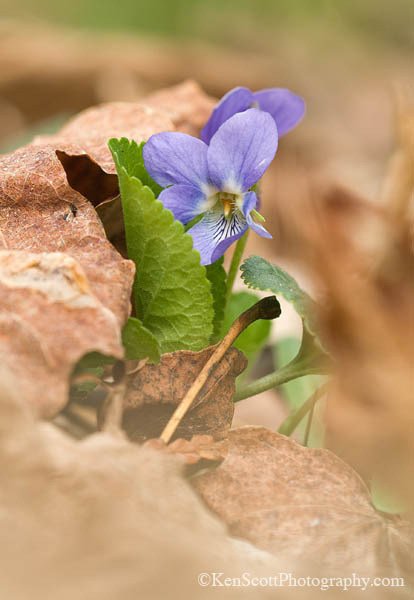
Spring Speak ... violet

Spring Speak … violet, photo by Ken Scott

Today’s post comes via eatdrinkTCMichigan is the second most agriculturally diverse state in the U.S. and that diversity doesn’t stop at the market! Our woods are alive with tasty and nutritious food if you know where to look. In our Wild Food Wednesdays we’ll tip you off to seasonal goodies and give you a recipe or two so you can enjoy the meal as much as the hike to find it!

In many years, we will have seen Viola sororia (Common blue violet) in the woods and often in our lawns by now. Violets can be found in a variety of soil conditions, from moist and even swampy deciduous forests to drier forests (though not usually near pines). The flowers and young leaves are delicious! The Culinary Violet page at the American Violet Society says (in part):

Both the flowers and leaves in fresh and dried forms have been standard fare in Europe and other areas in the world since before the 14th century. Fresh flowers are most often used for garnishing and crystallizing, The pungent perfume of some varieties of v.odorata adds inimitable sweetness to desserts, fruit salads and teas while the mild pea flavor of v.tricolor and most other viola combines equally well with sweet or savory foods, like grilled meats and steamed vegetables. The heart-shaped leaves of the v. odorata provide a free source of greens throughout a long growing season. They add texture to green salads when young and tender. Later in the season, slightly tougher, older leaves are cooked with other potted herbs and greens in soups, stews and stir-frys.

Violets aren’t just another pretty face. They are loaded with phytochemicals and medicinal constituents that have been used in the treatment of numerous health problems from the common cold to cancer. The late Euell Gibbons even referred to them as “nature’s vitamin pill (1).” A 1/2 cup serving of leaves can provide as much vitamin C as three oranges.

You can see some more photos and a county distribution at the Herbarium of the University of Michigan and get a lot more, including recipes, from eatdrinkTC!

Ken took this shot in March of 2012. See it on Flickr and see more in his Flowers slideshow!
More flowers and more food on Michigan in Pictures!

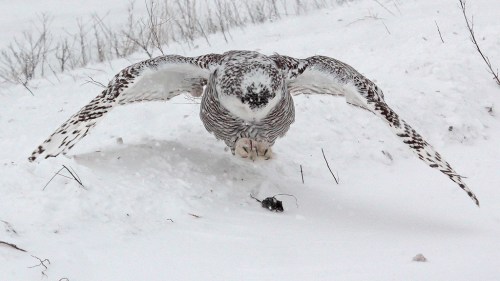
Let’s Do Lunch (Snowy Owl Style)

Snowy Owl 1

Snowy Owl 1, Sherri & Dan

Dan Lockard captured a cool sequence last weekend of a snowy owl on the hunt. View his photo background big, watch the hunt (which doesn’t end well for Mr. Mouse) or check out his owls slideshow.

The Owl Pages entry for the Snowy Owl (Bubo scandiacus) says in part:

The Snowy Owl is a large diurnal white Owl with a rounded head, yellow eyes and black bill. The name “scandiacus” is a Latinised word referring to Scandinavia, as the Owl was first observed in the northern parts of Europe. Some other names for the Snowy Owl are Snow Owl, Arctic Owl, Great White Owl, Ghost Owl, Ermine Owl, Tundra Ghost, Ookpik, Scandinavian Nightbird, White Terror of the North, and Highland Tundra Owl.

…Most hunting is done in the “sit and wait” style. These Owls are highly diurnal, although they may hunt at night as well. Prey are captured on the ground, in the air, or snatched off the surface of water bodies. When taking snowshoe hares, a Snowy Owl will sink its talons into the back and backflap until the hare is exhausted. The Owl will then break its neck with its beak. Snowy Owls have been known to raid traplines for trapped animals and bait, and will learn to follow traplines regularly. They also snatch fish with their talons. Small prey up to small hares are swallowed whole, while larger prey are carried away and torn into large chunks. Small young are fed boneless and furless pieces. Large prey are carried of in the Owl’s talons, with prey like lemmings being carried in the beak.

…Snowy Owls produce large, rough-looking cylindrical pellets with numerous bones, feathers, and fur showing. They are usually expelled at traditional roosting sites and large numbers of pellets can be found in one spot. When large prey are eaten in small pieces with little roughage, pellets will not be produced.

Read on for much more about these winter visitors, who the DNR explain migrate to Michigan in wintertime and have been sighted as far south as Lansing. They add that because snowy owls see few if any humans in their Arctic home, they are not very timid and easier to observe than other owl species.

More Michigan owls on Michigan in Pictures!

American Kestrel, the Sparrow Hawk

American Kestrel with mouse

American Kestrel with mouse, photo by Kevin Povenz

The American Kestrel entry at Wikipedia says:

The American Kestrel (Falco sparverius), sometimes colloquially known as the Sparrow Hawk, is a small falcon, and the only kestrel found in the Americas. It is the most common falcon in North America, and is found in a wide variety of habitats. At 19–21 centimeters (7–8 in) long, it is also the smallest falcon in North America. It exhibits sexual dimorphism in size and plumage, although both genders have a rufous back with noticeable barring. Juveniles are similar in plumage to adults.

The American Kestrel hunts by hovering in the air with rapid wing beats or perching and scanning the ground for prey. Its diet typically consists of grasshoppers, lizards, mice, and other small birds. It nests in cavities in trees, cliffs, buildings, and other structures. The female lays three to seven eggs, which both sexes help to incubate. It is a common bird to be used in falconry, especially by beginners.

All About Birds adds that it’s perhaps the most colorful raptor in the world, Wing over to their American Kestrel (Falco sparverius) page for photos, kestrel calls & more info.

More birds on Michigan in Pictures.

Check it out on black and see more in Kevin’s amazing Birds of Prey slideshow.

Many more Michigan Birds on Michigan in Pictures!

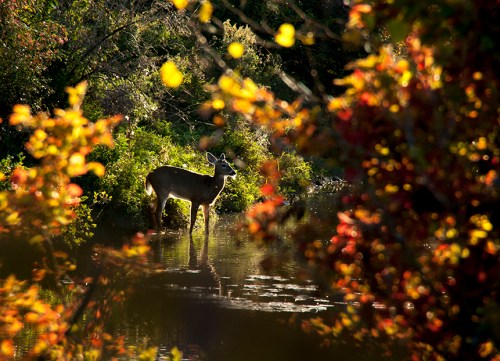
A Fall Drink of Water

Doe

Doe, photo by sarah-nussbaumer

Here’s hoping your weekend holds a lot of autumn beauty … and a little bit of wonder.

Check it out bigger and see more in Sarah’s Autumn slideshow.

More fall photos on Michigan in Pictures.

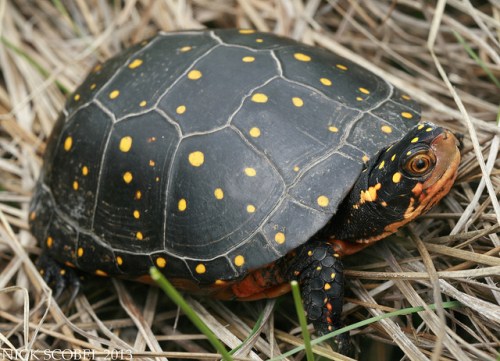
Know your Michigan Turtles: Spotted Turtle (Clemmys guttata)

Spotted Turtle

Spotted Turtle, photo by Nick Scobel

One of the most popular posts on Michigan in Pictures is Know Your Michigan Turtles, drawing around 100 people each day. Along with “Yay turtles!”, “Give the people what they want” has always been one of my philosophies so let’s get up close with one of our hard shelled neighbors. 

The UM Animal Diversity Web entry for Spotted Turtle (Clemmys guttata) says (in part):

Spotted Turtles prefer shallow waters with a soft bottom substrate and some submergent and emergent vegetation. These can include sedge meadows, boggy ponds, fens, tamarack swamps, sphagnum seepages, and slow, muddy streams. These turtles also frequently wander on land between wetlands, and may aestivate on land for weeks at a time.

Clemmys guttata is a very small species that rarely exceeds a straight-line carapace length of 11.4 cm (4.5 inches); the maximum recorded carapace length is 13.6 cm (5.4 inches). The adult carapace is smooth, without obvious growth ridges (annuli), and is black or brownish-black with a variable number of round yellow spots. These spots may fade in old adults, and occasional specimens lack carapace spots altogether.

…Spotted Turtles become active very early in the spring, and (as noted above) are often active at relatively cold water temperatures. Activity appears to peak during April and May in the northern part of the range. Spotted Turtles tend to become inactive in the warmest part of the summer (when water temperatures exceed 30°C) and they may aestivate aquatically or terrestrially for long periods of time. During summer dormancy, the turtles may burrow into leaf litter in woodlands or open fields or marsh edges; others remain in muskrat burrows or other aquatic refuge

…Spotted turtles are listed as vulnerable on the IUCN’s Red List, and they are considered threatened in the state of Michigan.

Read on for more and also see the Michigan DNR page on Spotted Turtles.

Check Nick’s photo out and see more in his Clemmys guttata slideshow which includes some pics of adult male spotted turtles. Nick runs the Herping Michigan Blog as well and has an interesting article about the recent division of the Clemmys genus into three genuses. The spotted turtles got to keep theirs with the other two being Wood Turtle (Glyptemys insculpta) & Bog Turtle (Glyptemys muhlenbergii).

More turtles on Michigan in Pictures!

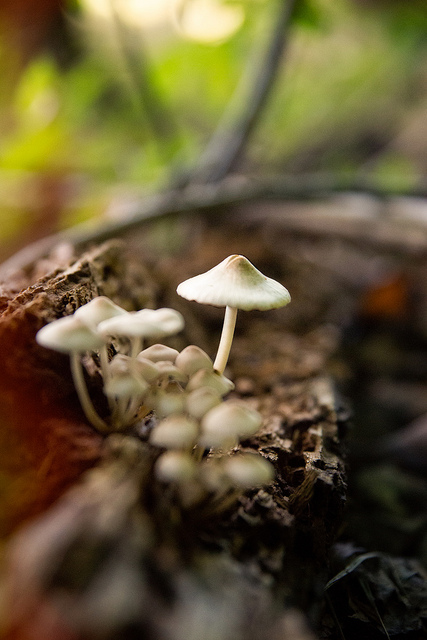
The colors of fall are all around

Explore colors of fall - wild mushroom

Explore colors of fall – wild mushroom, photo by bumkicho

Bumki Cho offers a visual reminder that the colors of fall are up, down and all around.

Check the photo out background big and see more in his slideshow.

More fall on Michigan in Pictures!

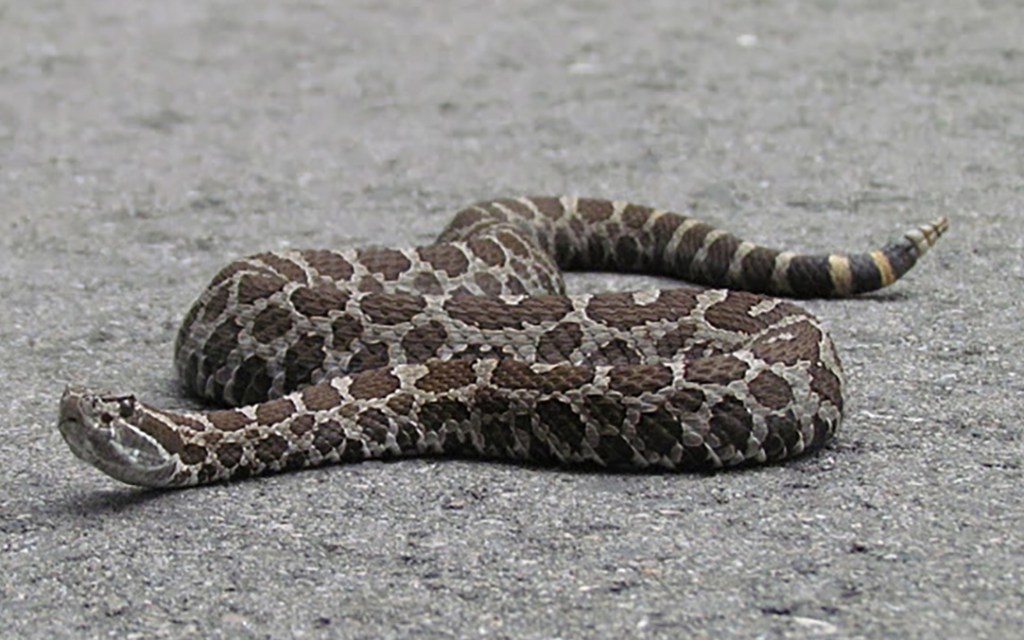
Eastern Massasauga Rattlesnake (Sistrurus catenatus catenatus)

Eastern Massasauga Rattlesnake by Jonathan Schechter/Earth’s Almanac

In Season of the Massasauga Rattler!, Jonathan Schechter writes that the massasauga  likes our sun-soaked trails in the waning days of summer and early autumn, so you may catch a glimpse of one if you’re out and about in Lower Michigan. The Michigan DNR page on the Eastern Massasauga Rattlesnake (Sistrurus catenatus catenatus) explains:

Michigan’s only venomous snake is a rare sight for most state residents. Historically, they could be found in a variety of wetlands and nearby upland woods throughout the lower peninsula. During the late spring, these snakes move from their winter hibernation sites, such as crayfish chimneys and other small mammal burrows in swamps and marshlands, to hunt on the drier upland sites – likely in search of mice and voles, their favorite food.

Females give birth to 8 to 20 young in late summer. The young snakes have a single “button” on their tails; a new rattle segment is added at each shedding of the skin, which occurs several times per year.

The massasauga can be characterized as a shy, sluggish snake. Its thick body is colored with a pattern of dark brown slightly rectangular patches set against a light gray-to-brown background. Occasionally, this coloration can be so dark as to appear almost black. The belly is mostly black. It is the only Michigan snake with segmented rattles on the end of its tail and elliptical, (“cat like”) vertical pupils in the eyes. The neck is narrow, contrasting with the wide head and body and the head appears triangular in shape. Adult length is 2 to 3 feet.

These rattlesnakes avoid confrontation with humans; they are not prone to strike – preferring to leave the area when they are threatened. Like any animal though, these snakes will protect themselves from anything they see as a potential predator. Their short fangs can easily puncture skin and they do possess a potent venom. It is best to treat them with respect and leave them alone. The few bites that occur to humans often result from attempts to handle or kill the snakes. Any bite from a massasauga should receive prompt professional medical attention. When compared to other rattlesnakes found in the United States, the massasauga is the smallest and has the least toxic venom.

Massasaugas are found throughout the Lower Peninsula, but not in the Upper Peninsula (thus there are no poisonous snakes on the Upper Peninsula mainland.)

They stress that Massasaugas are listed as a “species of special concern” and are protected by state law, so don’t kill or harm them. Read on for more including some lookalike snakes.

Jonathan adds that almost all rattler bites are on the dominant hand of the offending human! He took the photo above two years ago on a popular Oakland County hike-bike trail and notes that much of Oakland County is ratter habitat. Visit Earth’s Almanac to read more and be sure to subscribe to his blog when you’re there!

PS: Nick Scobel of the Herping Michigan blog has a great video of some Eastern Massasaugas that you should check out!

More Michigan snakes on Michigan in Pictures!

Eastern Tiger Swallowtail Butterfly

Eastern Tiger Swallowtail Butterfly (Saline, Michigan)

Eastern Tiger Swallowtail Butterfly (Saline, Michigan), photo by cseeman

The University of Michigan Animal Diversity Web entry for the eastern tiger swallowtail butterfly (Papilio glaucus) says in part:

The eastern tiger swallowtail ranges from Alaska and the Hudsonian zone of Canada to the southern United States, east of the Rocky Mountains.

This species occurs in nearly every area where deciduous woods are present, including towns and cities. It is most numerous along streams and river, and in wooded swamps.

As with most butterflies, Eastern tiger swallowtails tend to be solitary. Males “patrol” for a mate, flying from place to place actively searching for females. “Patrolling” male tiger swallowtails can recognize areas of high moisture absorbtion by the sodium ion concentration of the area. It is believed that the moisture found by these males helps cool them by initiating an active-transport pump. Both male and female tiger swallowtails are known to be high fliers. Groups of fifty butterflies have been spotted in Maryland flying 50 meters high, around the tops of tulip trees.

The tiger swallowtail is thought of as the American insect, in much the same way as the Bald Eagle is thought of as the American bird. It was the first American insect pictured in Europe; a drawing was sent to England from Sir Walter Raleighs’ third expedition to Virginia.

You can read on for more including photos. I also found a page with a listing of Michigan butterflies and apparently we have eight species of swallowtail butterfly. You can also see some great eastern swallowtail photos from Butterflies & Moths. Spoiler alert: the female can look a lot different.

Corey writes that he got this shot at the butterfly bush he planted this year. Check it out background big and see more great shots of this fellow in his butterfly slideshow.

Along the Trail at Pictured Rocks

Along The Trail

Along the Trail, photo by nasunto

Michigan in Pictures regular Nina Asunto is posting trip reports about her trip at the end of June to the Pictured Rocks National Lakeshore. In Day One: Chapel / Mosquito Trailhead to Chapel Beach she writes about a common June annoyance in the Upper Peninsula that this year proved more that annoying:

We arrived at Chapel Beach campground just before noon and had to put our bug nets on as soon as we got there. The campground consists of six sites, which are in the woods at the top of a bluff above Lake Superior. One of them (#6) is at the edge of the woods, and it is close enough to the beach to benefit from the breeze coming from the lake. This site was already occupied, of course, so we chose site #3, which was further into the woods. Under normal circumstances, this would be a really good campsite, with Chapel Creek running alongside it creating a nice atmosphere. Unfortunately, the exceptionally wet spring had ensured that this typically buggy season far exceeded expectations. The word “brutal” doesn’t quite do it justice – it was a buzzing hell-scape. The only thing to do was to set up camp as quickly as possible and flee to the beach.

Curiously enough, I was also in the UP and stopped at Pictured Rocks that weekend. Without Deep Woods Off, I am pretty sure I would have ended up a bloodless corpse! Click to read more (including her analysis of permethrin vs mosquitos). Follow along as Nina posts the rest of the report on Black Coffee at Sunrise.

Check it out bigger and see more in Nina’s Pictured Rocks National Lakeshore | June 2013 slideshow.

Northern Water Snake

Northern Water Snake

Northern Water Snake, photo by Brian Laskowski

The Michigan Department of Natural Resources page on the Northern Water Snake says:

Description: A water snake with dark bands or blotches on a light brown or gray background color. Some old adults may appear solid black or brown. The belly is white with reddish half moon shaped markings; some specimens have an orange belly speckled with brown or black. (The endangered Copper Bellied Water Snake has an unmarked reddish or orange belly.) Adult length: 2 to 4 feet.

Habitat and Habits: These snakes inhabit the shorelines of lakes, ponds, or streams. They swim well, seeking food (frogs and fish) and safety in the water, and often bask on objects hanging over the water. Water snakes are not venomous, but will bite if cornered or handled. They are sometimes mistakenly called “water moccasins” (which are not native to Michigan).

Reproduction: Females give birth to their 7 to 9 inch young in late summer. There are 8 to 48 babies in a litter. The young are gray or brown with bold black bands.

Range and Status: Northern water snakes are found throughout the Lower Peninsula and the eastern Upper Peninsula. Needless persecution by humans has eliminated water snakes from many places where they were once common.

The DNR’s Michigan Snake Page adds that there are just 17 species of snake in Michigan, so do what you can to protect this snake and its kin.

Check it out bigger and see more in Brian’s Michiganscapes slideshow.

More Michigan snakes on Michigan in Pictures.