Must be a Monday: Be Yourself Blue Heron Edition

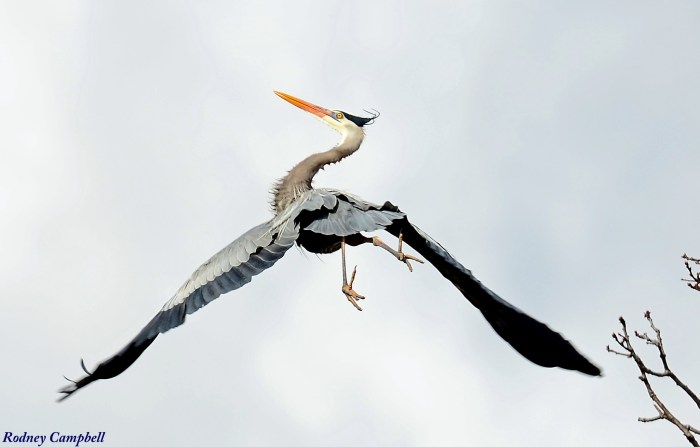
Great Blue Heron Leaving Roost

Great Blue Heron Leaving its Roost, photo by Rodney Campbell

Hope you have a wonderful week, even if you look a little goofy at times. ;)

The Michigan Natural Features Inventory entry for Great Blue Heron Rookeries explains:

The great blue herons in Michigan are largely migratory, with almost all leaving the state during the winter months. Most leave by end of October and return in early to mid-March.

The great blue heron is mostly a colonial nester, occasionally they nest in single pairs. Colonies are typically found in lowland swamps, islands, upland hardwoods and forests adjacent to lakes, ponds and rivers. Nests are usually in trees and may be as high as 98 ft. (30 m) or more from the ground. The platform like nests are constructed out of medium-sized sticks and materials may be added throughout the nesting cycle. Nests are usually lined with finer twigs, leaves, grass, pine needles, moss, reeds, or dry gras. The same nests are refurbished and used year after year.

Most great blue herons return to southern Michigan heronries in mid-March although a few may remain through the winter if there are areas of open water. Courtship and nest building commences from early April in southern Michigan to early May in the extreme northern portions of the state. Both sexes are involved in the nest building process with males primarily gathering sticks from the ground, nearby trees, or ungarded nearby nests.

More about Great Blue Herons on Michigan in Pictures.

View Rodney’s photo background bigtacular and see more in his Birds slideshow.
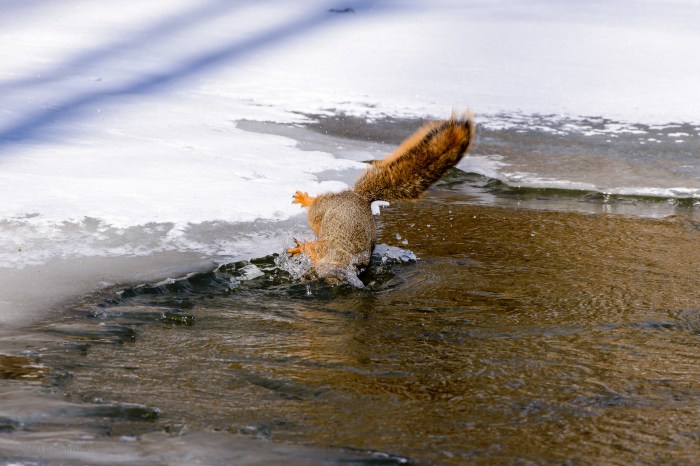
 

Must be a Monday

Fox Squirrel Falls in the River

FOX SQUIRREL, photo by John E Heintz Jr

“If one place is as good as any other, it’s high time we decided. Otherwise when we get there, we won’t know we’ve arrived.”
~Dr. Doolittle

I swear that John Heintz is a direct descendent of Dr. Doolittle – gets the best nature photos! View his photo bigger and definitely watch his slideshow for the whole story.

More from the animal kingdom and more funny photos on Michigan in Pictures.

Bonaparte’s Gull (Chroicocephalus philadelphia)

Bonapartes Gull

Bonaparte’s Gull, photo by James Salinas

All About Birds has this to say about Bonaparte’s Gull (Chroicocephalus philadelphia):

A small, graceful gull with bright white patches in its wings, the Bonaparte’s Gull winters near people, but breeds in the isolated taiga and boreal forest.

  • The Bonaparte’s Gull is the only gull that regularly nests in trees.
  • The English name of the Bonaparte’s Gull honors Charles Lucien Bonaparte, who made important contributions to American ornithology while an active member of the Academy of Natural Sciences of Philadelphia during the 1820s. The scientific name philadelphia was given in 1815 by the describer of the species, George Ord of Philadelphia, presumably because he collected his specimen there.
  • During the breeding season, the Bonaparte’s Gull feeds mainly on insects, often catching them on the wing.
  • Breeds around lakes and marshes in boreal forest. Winters along lakes, rivers, marshes, bays, and beaches along coasts.
  • Eats small fish and large invertebrates, including insects. Does not eat garbage or carrion.

Read on for more and some photos and the gull’s distinctive call.

James took this photo in Port Huron. View it bigger and see more in his slideshow.

Lots more Michigan birds on Michigan in Pictures!


Happy Thanksgiving to you!

Happy Thanksgiving

Happy Thanksgiving, photo by Rick Corriveau

I am grateful for what I am and have. My thanksgiving is perpetual.
~Henry David Thoreau

I hope you have much to be thankful for, today and every day, within and without. I am thankful for all of you who give me reason to keep doing something that I dearly love – sharing photos of this beautiful and diverse place. Happy Thanksgiving to you all!!

Also sorry folks – had this scheduled for first thing this morning I thought!!

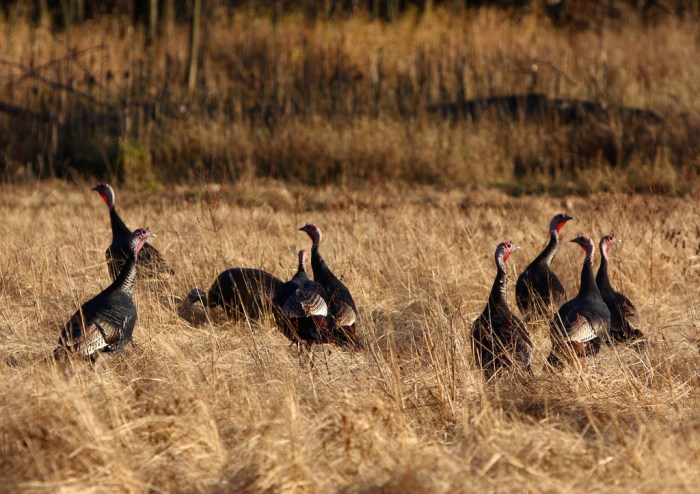
Rick says he’ll take one drumstick please! View his photo bigger and see more in his Birds slideshow.
Make Mine a Michigan Thanksgiving: High Bush Cranberry Edition

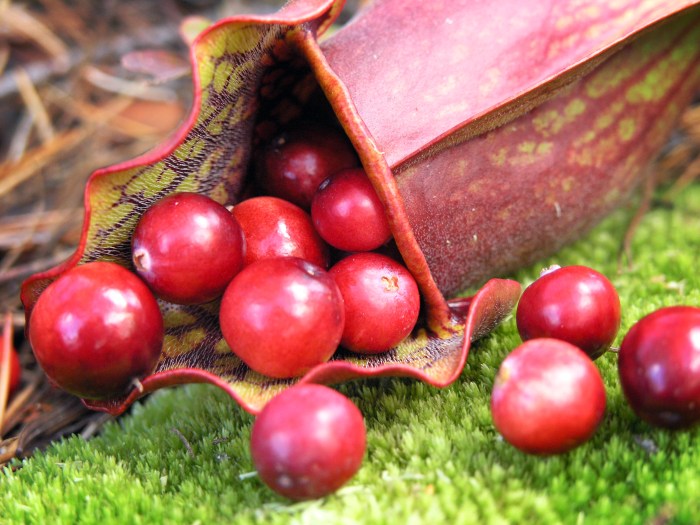
Highbush Cranberries by Blondieyooper

Cranberries, photo by Blondieyooper

One thing that I love is Thanksgiving dinner, and another is Michigan grown food. Dianna at Promote Michigan brings those together with 15 things that make Thanksgiving Pure Michigan. From starters like Koeze nuts, McClure’s Pickles, Koegel Meats, and Leelanau Cheese to sides like Michigan potatoes & squash to Michigan-raised turkeys and (of course) pumpkin & apple pie and ice cream!

One Thanksgiving staple that Michigan is producing more of are cranberries, and you can get all kinds of information from the US Cranberry Marketing Committee. While it’s too late to get them this year, we have another cranberry that grows in Michigan you might not be aware of. Green Deane’s Eat the Weeds is a great blog, and his page on the High Bush Cranberry says (in part):

The High Bush Cranberry is actually a Viburnum (Viburnum trilobum) and a cousin of the elderberry. Both are in the greater Honeysuckle Family and have a characteristic musky odor. That family by the way straddles the edibility line, with some members edible and others not, some tasty and some not. As one might suspect by the name, the High Bush Cranberry has tart fruit. Bradford Angier, a well-known Canada-based forager along side Euell Gibbons, wrote they require a “conditioned palate” to appreciate.

In North America the High Bush Cranberry is found in Canada and the northern half of the United States plus, oddly, New Mexico. It is not as that friendly to wildlife as one might suspect. The fruit persists into the winter because they are not on the top of birds’ preferred food. Birds like the berries after they soften and ferment. White-Tailed deer also browse on the twigs and leaves. For humans the berries are high in Vitamin C, about 30 milligrams per 100 grams.

Viburnum trilobum has several disputed botanical names and several mistaken common names including Pimbina, Mooseberry, Cranberry Tree, Cranberry Bush, American Cranberry, and Squashberry.

Read on for lots more including identification tips. There’s much more Michigan Thanksgiving to feast on at Michigan in Pictures too!

Blondieyooper says she picked over 8 pounds of these gorgeous highbush cranberries in the UP back in October of 2011. View her photo background bigilicious and see more in her Fall 2011 slideshow.

Beating the Winter Blahs at Elizabeth Park

Winter's Beauty

Untitled, photo by mballen89

Several of my friends shared this very appropriate article today about how Norwegians in the far north of the country deal with the dark and cold of winter:

First, Norwegians celebrate the things one can only do in winter. “People couldn’t wait for the ski season to start,” says Leibowitz. Getting outside is a known mood booster, and so Norwegians keep going outside, whatever is happening out there. Notes Leibowitz: “There’s a saying that there’s no such thing as bad weather, only bad clothing.”

Norwegians also have a word, koselig, that means a sense of coziness. It’s like the best parts of Christmas, without all the stress. People light candles, light fires, drink warm beverages, and sit under fuzzy blankets. There’s a community aspect to it too; it’s not just an excuse to sit on the couch watching Netflix. Leibowitz reports that Tromsø had plenty of festivals and community activities creating the sense that everyone was in it together.

And finally, people are enamored with the sheer beauty of the season. Leibowitz grew up near the Jersey shore, and “I just took it as a fact that everyone likes summer the best.” But deep in the winter in Norway, when the sun doesn’t rise above the horizon, multiple hours a day can still look like sunrise and sunset, and against the snow, “the colors are incredibly beautiful,” she says. “The light is very soft and indirect.”

Most likely you can’t cross-country ski straight out of your house, and while Norwegian sweaters may be catching on, restaurants and coffee shops in more temperate climates don’t all feature the fireplaces and candles common to the far north. Still, there are little things non-Norwegians can do. “One of the things we do a lot of in the States is we bond by complaining about the winter,” says Leibowitz. “It’s hard to have a positive wintertime mindset when we make small talk by being negative about the winter.”

Read on for more good advice on battling the winter blahs – I hope it’s helpful to you!

The photo was taken in Elizabeth Park in Trenton which I just learned is Michigan’s first county park!

This 162-acre family estate was bequeathed to the Wayne County Park Trustees in October of 1919 by the children of Elizabeth Slocum.

The acceptance of this special gift marks the beginning of the Wayne County Park System. Elizabeth Park sits like an emerald jewel along the banks of the Detroit River, and features over 1,300 feet of riverwalk for fishing and river watching. In addition Elizabeth Park also offers activities such as softball, cycling, in-line skating, hiking, cross-country skiing and ice skating.

View the photo background bigtacular and see more in mballen89’s slideshow.

More winter wallpaper and more straight-up winter on Michigan in Pictures!

Fiery Fall Foliage at Fenner

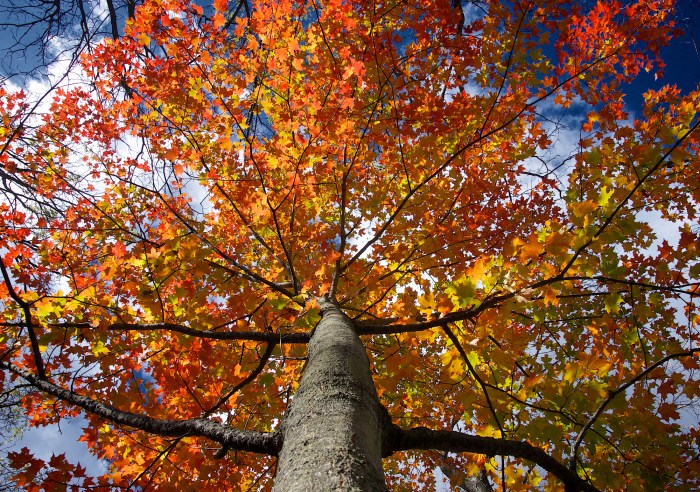
Fiery Fall Foliage

Fiery Fall Foliage, photo by David Marvin

Let’s head out of autumn with a with a bang and this firework of a maple! I hope you get a chance to get out and enjoy what remains of the 2015 fall color touring season in Michigan. mLive updated their color report with some pics from readers:

The colors are fading fast and the leaves are falling, but there are still some Michigan areas with peak color. The inland areas of the Upper Peninsula and the inland areas of northern Lower Michigan are past fall color peak now. The leaves are falling fast.

But the shoreline areas and the peninsulas are warmer. Some of those areas are still at peak, or even just peaking now.

It will still be well worth the trip to the Leelanau Peninsula and the Old Mission Peninsula this week and probably even this weekend.

We took the drive of M-22 along the shore of Leelanau County Sunday, October 18, 2015. Along the shore there was still some green and was a few days away from peak. Old Mission Peninsula was 50 percent green still on Sunday, Oct. 18, 2015. So if you are going north this weekend, take the routes near water and you’ll be pleased.

The southern half of Lower Michigan is peaking now through the next few days. This weekend will still be real nice to take that last fall color drive.

Also have at these aerial photos of fall color from a U.S. Coast Guard MH-65D Dolphin helicopter they shared a week ago.

Check this photo out big as a tree and head over to Dave’s blog for more photos & writing from Fenner Nature Center.

More fall wallpaper on Michigan in Pictures.

Golden Mushroom

Mushroom by Kevin Povenz

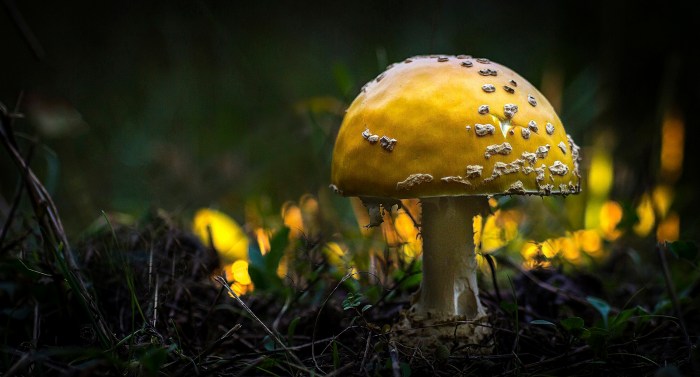
Mushroom, photo by Kevin Povenz

Kevin says that Google suggests this mushroom is amanita flavoconia, putting it squarely in the “look but probably better not eat” category.

View it bigger and see more in Kevin’s Flowers/Plants slideshow.

More mushrooms on Michigan in Pictures.

Best Friends in Nature: Crayfish & Green Frog Edition

Best Friends Crayfish & Green Frog

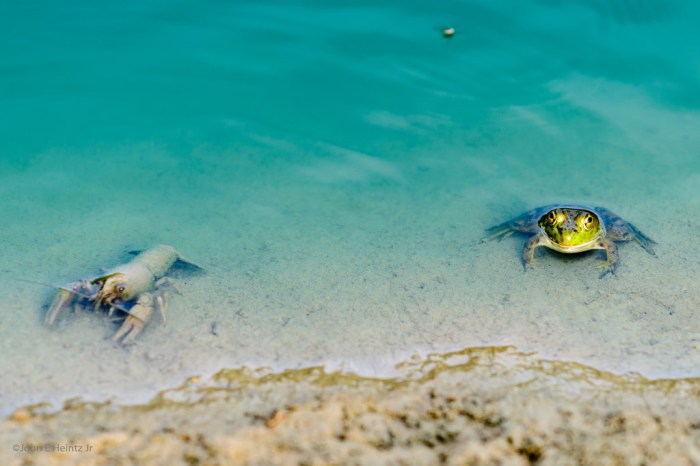
Crayfish & Green Frog, photo by John Heintz Jr.

The next installment of the critically acclaimed Michigan in Pictures exclusive “Best Friends in Nature” series. I believe what these two have in common is a long list of shared predators, so this could well be a pond-side support group meeting. ;)

View John’s photo bigger and see more of his cool wildlife photos. Seriously, I feel like he’s the long-lost nephew of Doctor Doolittle when I look at his photos!

More animals on Michigan in Pictures, and also more about the Northern Green Frog.

Waterfall Wednesday: Big Pup Falls

Big Pup Falls

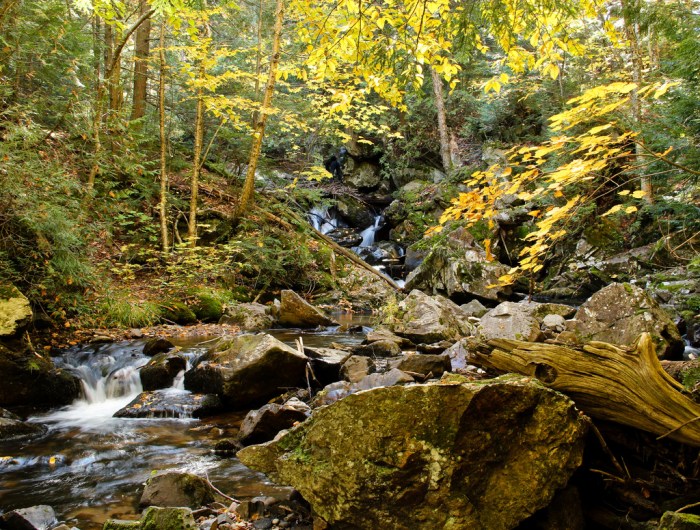
Big Pup, photo by Kim Nixon

Travel Marquette shares:

Big Pup Creek Falls (Lat. N46 Degrees 42′ 42″ Long W87 Degrees 42′ 14″) is located from Marquette – Travel County Road 550 north toward Big Bay approximately 23 miles to County Road 510. Travel about 7 miles (you will cross the steel bridge which spans the Yellow Dog River as directed for Yellow Dog (River) Falls). Drive approximately 2 miles farther on the winding road. Just before the bridge about 60 yard. Park safely off to the side of the road before the bridge. Walk down the hill off the road right of way to the falls.

View Kim’s photo bigger, see more in her September 2012 slideshow and follow her at Photography with Kim on Facebook.

FYI, there’s now 134 waterfall posts on Michigan in Pictures!