The Belle Isle Bridge | Detroit, MI

The Belle Isle Bridge | Detroit, MI

The Belle Isle Bridge | Detroit, MI, photo by .brianday..

Wikipedia notes that the official name of the bridge across the Detroit River to Belle Isle from Detroit is the MacArthur Bridge. The bridge uses nineteen arches to span the 2,193 feet to Belle Isle. Completed in 1923 for $2,635,000, it replaced a mostly wooden bridge that was destroyed by fire in 1915. See The day the bridge to Belle Isle burned down for more on that. While it was once known as the Belle Isle Bridge, was renamed in honor of General Douglas MacArthur in 1942.

Belle Isle Bridge “Douglas MacArthur Bridge” at HistoricBridges.org explains:

This is an extremely long multi-span concrete arch bridge that gives people access to Belle Isle, and the structure is the longest arch bridge in the state of Michigan.

This bridge is extremely significant not only because of its length, but because it is a very early example of a cantilevered concrete arch. A cantilevered concrete arch does not function like a traditional arch. Traditional arch bridges require the arch to be a complete and connected arch to function. This arch bridge does not function in that way. Each half of each arch spans is a cantilever arm that is structurally independent from the other half of the arch in that span. Standing under a span of this bridge, a clear gap at the center of the span is visible. Indeed, on the outermost part of the arch, a decorative “keystone” was placed for aesthetic reasons to cover up this gap.

Wayne County Road Commission was among Michigan’s counties, an innovative and creative road commission and they apparently made significant use of concrete cantilever arch structures. Other examples of concrete cantilever bridges in the county remain. These other examples are different from the Belle Isle Bridge, and feature a third central “suspended” span between the cantilever arms.

Check it out bigger and in Brian’s Long Exposure slideshow.

A Belated Happy Birthday to Michigan Governor William G. Milliken

Untitled, photo by BryantDIGITAL

Yesterday (March 26th), former Michigan Governor William G. Milliken turned 88. I bumped into him a few weeks ago and he seemed in great health, so hopefully he has many more coming.

Several years ago, in The Very Best People in the Northern Express, Robert Downes wrote:

Raised on Washington Street in Traverse City, Bill Milliken was the longest-serving governor in the state’s history, occupying the office from 1969 to 1983.

Gov. Milliken is an honest-to-gosh war hero: He flew 50 combat missions in WWII as a waist-gunner in a B-24. He survived two crash landings; received a flak stomach wound on one mission; and once had to bail out in Italy when his plane ran out of fuel 50 miles from its base. He received seven medals for his service, according to “The Milliken Years” by Joyce Braithwaite and George Weeks.

Still considered one of the leaders of the moderate wing of the Republican Party, Governor Milliken’s administration saw many advancements in civil rights and environmental protections. The governor signed Michigan’s landmark bottle deposit law into effect in 1976 and it was during his tenure that the Sleeping Bear National Lakeshore was created by an act of Congress in 1970. Although he hailed from Northern Michigan, Gov. Milliken recognized the importance of preserving the viability of the City of Detroit and refused to play into the “us vs. them” mentality of outstate politicians. As governor, he lobbied against members of his own party in the late ’70s for the Detroit People Mover, which was ultimately approved in a drastically limited form.

…Little known fact: The governor’s middle initial stands for Grawn, the family namesake of the crossroads between TC and Interlochen.

More in the William G. Milliken entry from Wikipedia.

Check this out bigger in Bryant’s slideshow.

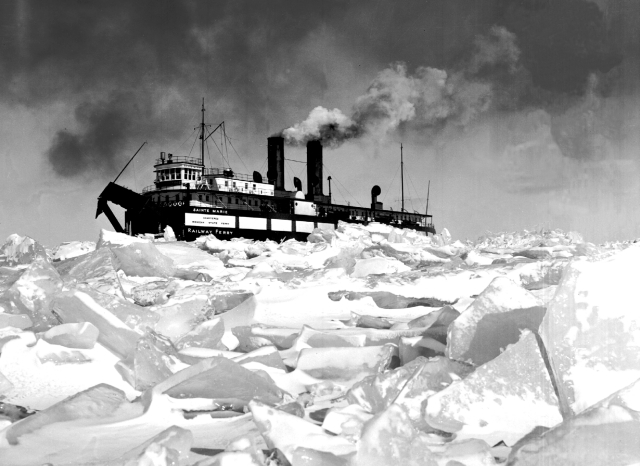
80 years of ice on the Straits of Mackinaw

Winter Service, photo courtesy Mackinac Bridge Authority

The Michigan State Ferry Album says:

Winter service began in 1931 when the Highway Department arranged with the Mackinaw Transportation Company to carry cars across the Straits on a railroad icebreaker during the cold months. This arrangement turned out to be poor business for the State, so in 1936 the Highway Department leased the railroad icebreaker “Sainte Marie” for winter operations on a regular schedule.Winter service began in 1931 when the Highway Department arranged with the Mackinaw Transportation Company to carry cars across the Straits on a railroad icebreaker during the cold months. This arrangement turned out to be poor business for the State, so in 1936 the Highway Department leased the railroad icebreaker “Sainte Marie” for winter operations on a regular schedule.

In case you’re wondering, the ice on the Straits of Mackinaw hasn’t changed a whole lot in 80 years, as this photo from February of 2008 titled Triangles by Dominique shows. See it bigger in her Snow/Ice slideshow or check out the whole set.

Triangles

Old Main and Wayne State University

Wayne State University

Wayne State University, photo by kmaz.

Wayne State University is Michigan’s only urban research university. The 203 acre campus is in Detroit’s University Cultural Center. The main campus and six extension centers are attended by 33,000 graduate and undergraduate students in 13 schools and colleges that offer more than 350 major subject areas.

Wikipedia’s Wayne State University entry says that the university was established in 1868 as the Detroit Medical College. Five more schools were added over the years and in the early 1930s the Detroit Board of Education organized them to form Wayne University. The building pictured is Old Main (c. 1904 photo of Old Main), about which Wikipedia says:

Old Main, originally called “Main Building”, was built December 13, 1894. It was the first major building of Wayne State University. Originally, every course offered was located in Old Main. It was built over a four year period out of limestone quarried from the land directly in front of it. The structure was designed by the architects Malcomson & Higginbotham and contained 103 classrooms, laboratories, offices, and residential space for 3000 students.

…Today, Old Main serves as the home of the College of Liberal Arts and Sciences of Wayne State University as well as accommodating many other classes of different subject matters.

See this bigger in Konrad’s Wayne State University slideshow.

Michigan Courthouses: Van Buren County Courthouse

Van Buren County Courthouse (Paw Paw, Michigan)

Van Buren County Courthouse (Paw Paw, Michigan), photo by courthouselover.

Jordan writes:

The Van Buren County Courthouse was erected in 1901 with the designs of Claire Allen of Jackson, Michigan. It is similar is appearance to the Classical Revival courthouse in Hillsdale, Michigan.

Wikipedia’s entry for Claire Allen says that he was was a prominent architect in southern Michigan in the early twentieth century. He was head of the firm of Claire Allen & Sons and his resume includes the Chelsea Clock Tower.

Be sure to check this out bigger and in his Michigan County Courthouses set (slideshow)

More Michigan courthouse shots on Michigan in Pictures.

TC 350 at the Sleeping Bear Dunes

KAScott_20090926_5415_cb

KAScott_20090926_5415_cb, photo by Ken Scott.

Head over to 350 is something you need to know, Michigan on Absolute Michigan to see the amazing time-lapse video Ken Scott created and to learn more about the 350 movement and TC 350.

This photo is part of Ken’s movie clips from stills set (slideshow) and you can see much more of his work at kenscottphotography.com!

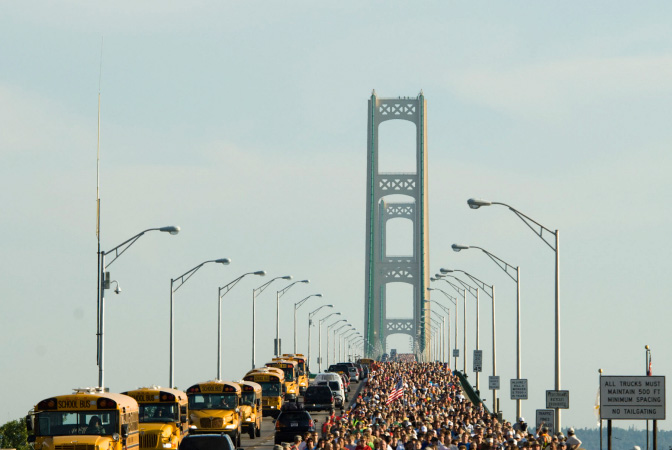
52nd Annual Mackinac Bridge Walk ~ September 7, 2009

2008 Mackinac Bridge Walk

2008 Mackinac Bridge Walk, photo courtesy Michigan Department of Transportation & Mackinac Bridge Authority

The annual Mackinac Bridge Walk is a Michigan tradition that has been held every year since the Bridge opened in 1957. This year is the 52nd annual and it takes place (as always) on Labor Day  (September 7) from 7-11 AM. The walk is free and you can get all the details from the official Mackinac Bridge web site.

There’s more info available on Wikipedia and you can learn all about the Mackinac Bridge over at Absolute Michigan.

The Mackinac Bridge

Rain is Good … unless you’re a weekend event

Rain is Good

Rain is Good, photo by photoshoparama.

This morning, for the first time in a long time, I had the chance to sit down for a few hours with coffee and my computer to wander around the Michigan photosphere and think about what to write on Michigan in Pictures today.

One of the first things I read was Sculpture city in ‘misunderestimated’ Michigan that looks at how Michigan is quietly growing as a destination for tourists of all kinds with landmarks like Frederik Meijer Gardens and Sculpture Park in Grand Rapids.

Bouncing around in my head was how rainy this summer has been, making things tough for outdoor events like this weekend’s*…

I’ll keep singing “rain, rain, go away” for all these folks and if it doesn’t I’ll try and take comfort in the fact that it’s boosting lake levels and hope that people will remember that rain is good, hunt down their rain gear and still show up to support folks who are working to build more fun stuff in Michigan!

Check out Dan’s photo bigger in his slideshow and splash around in the Frederik Meijer Gardens slideshow from the Absolute Michigan pool.

* Note: these events all came from the Absolute Michigan Event Calendar

Pellston, Icebox of the Nation

Brrr!
Brrr!, photo by loungelistener

The Icebox of the North page on the city of Pellston web site says that since Pellston recorded the State of Michigan’s record low temperature of -53° F. in 1933, it has been known as the Icebox (disclaimer: The Federal Trademark “Icebox of the Nation” is held by International Falls, MN).

With temperatures in Pellston well below zero for an average of around 40 days each winter, and beginning each November averaging the coldest temperatures in the state, it continues to be one of the coldest places in the nation. Many people nationwide hear the name of Pellston on their local weather each morning in the winter, along with towns like Big Piney, Wyoming, Fraser, Colorado and International Falls, Minnesota, it is continually called out as one of the coldest spots.

The record lows and the continuous cold streaks in Pellston are caused by a unique geography, as the village sits in a basin of sand between two vast semi-circular hill ranges. As the Maple River passes thru the basin, evaporation causes dense daytime cloud-cover, reflecting much of the suns heat away from the valley. As night falls and the air cools, those low-level clouds disperse allowing most of the remaining heat to radiate up and out of the basin.

If you grew up in Pellston, there’s a Facebook group for you.

Check this sign and many (many) more out bigger in Gary’s Michigan, My Michigan slideshow.

Grand Sable Dunes In Winter

Grand Sable Dunes In Winter

Grand Sable Dunes In Winter, photo by mandj98.

James says they rode his brother’s snowmobiles back along H58 to this overlook of Grand Sable Dunes in the Pictured Rocks National Lakeshore last weekend.

Grand Sable DunesHe has more photos from Pictured Rocks in winter & all seasons in his tremendous Pictured Rocks National Lakeshore set (slideshow) with tons of photos including the pic to the right of the same scene in August.

I was a little surprised to find that I hadn’t written anything about Grand Sable Dunes on Michigan in Pictures. In my opinion, it’s one of the most amazing vistas in Michigan, a broad sweeping dune that arcs along the shore of Lake Superior. It’s a great hike, either from the drive-up overlook (where you can view or visit the Au Sable Light Station) or by walking along the base on the Superior shore just a mile west from Grand Marais. Michigan Tech has a nice writeup on the history, geology and natural character of the Grand Sable Dunes. They’re a perched dune like the Sleeping Bear Dunes in lower Michigan that were formed when:

Glacial ice that melted within the Superior Basin produced many large rivers after the last major readvance, The Marquette readvance, in North America. These rivers deposited millions of tons of debris into many different configurations south of the Superior Basin. The Grand Sable Banks may have originated as a glaciofluvial kame terrace along one of these glacial rivers during deglaciation.

Pictured Rocks then became very dry about 9500 years before present due to the Lake Superior basin draining to the north. The outlets to the east were now the low spots. A north facing ice contact bluff and a platform to the south of it remained in place for 4500 years after deglaciation right around the area where Grand Marais is located today.

Isostatic rebound then occurred about 4000 to 6000 years before present. North Bay began to rise which caused water levels to rise rapidly. In fact, Lake Superior rose to about 40 feet higher than it is today! The rise in lake levels formed Lake Nipissing. Lake levels of Lake Nipissing also began to rise which caused the Grand Sable Banks to become unstable. From this point the formation of a perched dune can explain how the dunes formed from the Grand Sable Banks.

When Lake Nipissing water level rose it caused the Grand Sable Banks to become unstable. In turn, the high water eroded the bluffs which left them exposed to wind. A dominant northwesterly wind blew through the Grand Sable Banks which carried the wind from the bluff to the top of the flat upland. This sand was “perched” on top of the upland, hence the name, “perched dune system.”

You can check out Grand Sable Dunes on Absolute Michigan’s Map of Michigan and check out the Grand Sable Dunes slideshow on Flickr. I have written a fair amount on Pictured Rocks that you might enjoy.