#TBT: Atop Miners Castle

Atop Miners Castle

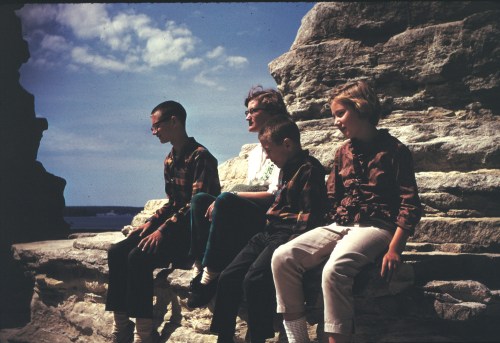
Atop Miners Castle, photo by Roger Dinda

On April 13, 2006 one of the most recognizable rock formations in the Pictured Rocks National Lakeshore, Miners Castle collapsed. The Lakeshore explains:

On Thursday morning, April 13, 2006, the northeast turret of Miners Castle collapsed. One turret remains on Miners Castle, the best-known feature of Pictured Rocks National Lakeshore. The collapse was reported via cell phone by fisherman in the area, according to chief ranger Larry Hach. Most of the rock fell north and into Lake Superior, and there were no injuries. The lower overlook platform near Miners Castle appears to be unaffected.

While the rockfall at Miners Castle on April 13 was startling, such events are not rare along the Pictured Rocks escarpment. At least five major falls have occurred over the past dozen years: 1) two different portions of Grand Portal Point, 2) the eastern side of Indian Head just east of Grand Portal Point, 3) Miners Falls just below the (now modified) viewing platform, and 4) beneath the lip of Munising Falls (along the former trail that went behind the cascade).

All the rockfalls involved the same rock unit, the Miners Castle Member of the Munising Formation. Rock units are named for places where they were first technically described. The Miners Castle Member consists of crumbly cross-bedded sandstone that is poorly cemented by secondary quartz, according to U.S. Geological Survey Research Ecologist Walter Loope.

Rockfalls along the cliffs typically occur in the spring and fall due to freezing and thawing action of Mother Nature.

Joel says that this photo was taken Roger Dinda in 1961 or ’62 “…before Pictured Rocks was a National Lakeshore, before Miners Castle lost its second turret, before they put up the boardwalks and railings. In this photo I’m just as tense as I look. I am deathly afraid of heights and this was (still is) about the scariest place I’ve ever been.”

View his photo background big more in his Lake Superior slideshow.

There’s more Throwback Thursdays, more Miners Castle & more from the Pictured Rocks National Lakeshore on Michigan in Pictures!
Michilimackinac and Pontiac’s Rebellion

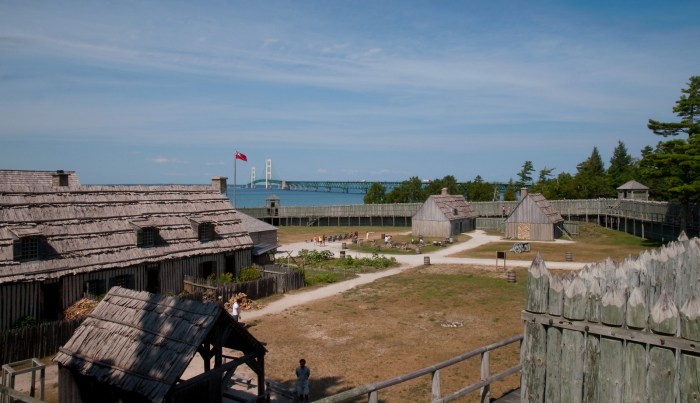
The Fort and the Bridge, photo by Joel Dinda

Mackinac State Historic Parks page on Colonial Michilimackinac says that:

French soldiers constructed the fortified community of Michilimackinac on the south side of the Straits of Mackinac in 1715. The community grew and prospered over the coming years as Michilimackinac became an important center of the Great Lakes fur trade. Every summer, thousands of Native Americans and French-Canadian voyageurs gathered at the post, which served as transfer station for furs trapped in the western Great Lakes and trade goods shipped in from eastern cities such as Montreal and Quebec. Michilimackinac came under British control in 1761, but the fur trade and community life remained relatively unchanged.

Fearful that the post was vulnerable to attack by American rebels, the British disassembled the fort and community and moved it to Mackinac Island in 1779-81.

One factor in the move may also have been an event that happened 252 years ago on June 2, 1763. The fort was captured by Ojibwa & Sauk warriors who gathered to play a huge game of baggatiway. Elizabeth Edwards of Traverse Magazine wrote a great article about the massacre that begins:

Under an unusually hot sun on a late spring day on the Straits of Mackinac, British Major George Etherington, commandant of Fort Michilimackinac, was suffering from an acute case of cultural blindness. And there was no excuse for it. Relaxed at the sidelines of a rousing game of baggatiway (similar to lacrosse) outside the fort, the major should have seen the danger signs in this Ojibwe versus Sauk contest of sweaty, half-naked bodies painted with white clay and charcoal.

The 30-year-old officer was born in the colonies, and most likely grew up on stories of Indian uprisings. He’d even served in the just-ending French and Indian War, in which the English had wrested control of North America from the French—a victory that had put this previously French fort in Etherington’s care. Though the major had been raised on American soil and had fought on it, he was still English. And in that country, a battle was a battle, and a sporting event was a sporting event.

Perhaps that explains why the major missed the clues…

Read on for much more at Traverse, and you can also watch a video on Pontiac’s Rebellion from the History Channel or jump right to the story.

Joel adds that almost every building at Colonial Michilimackinac is a reconstruction, with only two or three minor exceptions. View his photo background bigtacular and see more from the fort and surrounding area in his Straits of Mackinac slideshow.

Bridge to the North

Mackinac Bridge

Mackinac Bridge, photo by Dan Moran

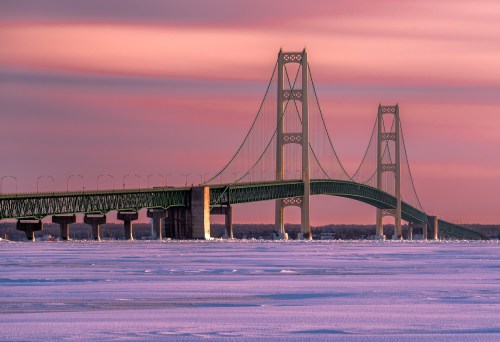
If you want to call this the world’s most beautiful bridge, you’ll get no argument from me.

View Dan’s photo background bigtacular and settle into his slideshow for a couple more amazing shots from Michigan. Then – because everyone needs a vacation every so often – keep watching for some jaw-dropping pics from Alaska. Seriously: wow, wow, WOW.

There’s lots more winter wallpaper and lots more of the Mackinac Bridge on Michigan in Pictures.

Above St. Joseph Pier

St Joseph Pier Light from Above

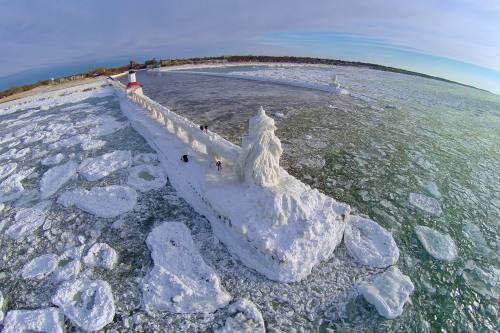
Above the ice encrusted St. Joseph pier, photo by Christopher Kierkus

As previously referenced, the fantastic ice on St. Joseph Pier has become a Michigan winter icon. Christopher took this shot with his drone SPIKE, a DJI Phantom 2 quadcopter and a GoPro Hero 3+ Black edition camera. I found it shared on Michpics regular Craig Sterken’s page – he’s the one bending down to get a lens out of the case.

Christopher shares that getting these photos can be more than a little harrowing:

We photogs are a little nuts … especially scary is walking the little “ice path” around the inner light to get to the outer part. One slip up there and you’re in the soup.

View the photo bigger on his Facebook and see more of his work including some more really cool aerials at PhotoDocGVSU on Flickr … or head straight for SPIKE’s pictures!

More aerials on Michigan in Pictures.

Cooler Tour … Fishtown

Cooler Tour ... fishtown, dam view

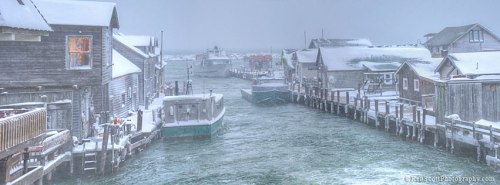
Cooler Tour … fishtown, dam view by Ken Scott Photography

Ah, November in Michigan. The Fishtown Preservation Society explains:

Fishtown is a unique historical attraction composed of weather-beaten fishing shanties and small shops lining the mouth of the Leland River. The site has endured and adapted over the last 150 years as an ever-evolving working waterfront that still operates as one of the only unmodernized commercial fishing villages in the state of Michigan.

One of the most important characteristics of Fishtown is its core of historic shanties. Though only a few are still used for commercial fishing operations, most of the structures in Fishtown had their origins as commercial fishing buildings. These buildings served many purposes, including net-mending sheds, ice houses, smoke houses, and storage. Though processes like ice-making are now mechanized in a commercial fishery, running a fishery still requires extensive space for equipment storage and net repairs.

Many buildings have come and gone from the Fishtown landscape with the changing fortunes of the industry, yet Fishtown survives as a rare working waterfront and an authentic and active commercial fishing village.

Head over to fishtownmi.org for more.

Click to see Ken’s photo bigger, check out his Cooler Tour photos and be sure to follow him at Ken Scott Photography on Facebook.

#TBT: The Bear of Sleeping Bear Dunes

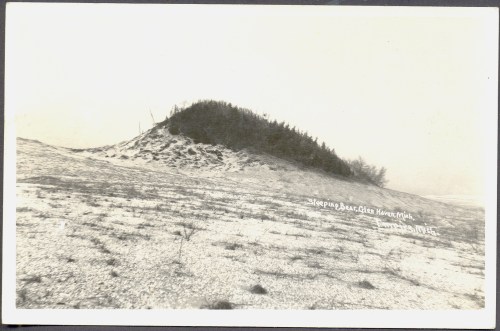
Glen Haven MI Sleeping Bear Dunes Empire and Glen Haven Marked RPPC Kodak Stampbox Unsent what looks like a hump of low scrub bushes is actually a forest hill buried in sand

Glen Haven MI Sleeping Bear Dunes, photo by Don…The UpNorth Memories Guy… Harrison

Tuesday was the 44th anniversary of the founding of the Sleeping Bear Dunes National Lakeshore. You may have heard the Chippewa tale that inspired the name of the park:

“Long ago, along the Wisconsin shoreline, a mother bear and her two cubs were driven into Lake Michigan by a raging forest fire. The bears swam for many hours, but eventually the cubs tried and lagged behind. Mother bear reached the shore and climbed to the top of a high bluff to watch and wait for her cubs. Too tired to continue, the cubs drowned within sight of the shore. The Great Spirit Manitou created two islands to mark the spot where the cubs disappeared and then created a solitary dune to represent the faithful mother bear”.

You might not be aware, however, that “the Bear” was also an actual formation atop a dune about a mile north of the Pierce Stocking Overlook. The Lakeshore says that the formation pictured above…

…hardly looks like a bear now, for it has been changing rapidly in recent years. At the turn of the century, it was a round knob completely covered with trees and shrubs. You can still see some of the thick vegetation that gave it a dark shaggy appearance.

…For a long time, the Sleeping Bear Dune stood at about 234 feet high with a dense plant cover. However, through most of the twentieth century, erosion has prevailed. By 1961, the dune was only 132 feet high, and by 1980, it was down to 103 feet. The process is a continuing one. The major cause of the dune’s erosion was wave action wearing away the base of the plateau on which the dune rests. As the west side of the dune loses its support, it cascades down the hill. The wind, too, is a major agent of erosion, removing sand and destroying the dune’s plant cover.

You can see what the area looks like now and read more right here.

View Don’s photo background bigtacular and get daily blasts from the past in his Northern Michigan Photo Postcards – Our History and Heritage group on Facebook!


The Sanilac Petroglyphs

Sanilac Petroglyphs

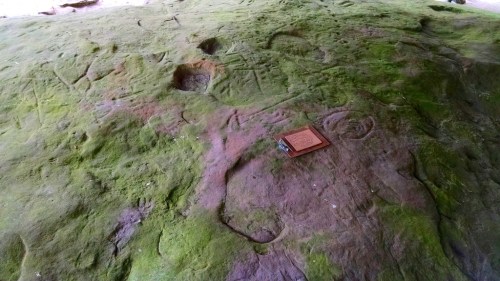
Sanilac Petroglyphs, photo by Leon Baker

M. Rebekah Otto of Atlas Obscura has an article about the Sanilac Petroglyphs:

The drawings were carved into the sandstone in Sanilac County but remained hidden by dense forests until the devastating fire exposed them.

The glyphs are carved into a large rock on the ground that is forty feet long and fifteen feet wide. Carved between 300 and 1,000 years ago, the drawings were likely made by the Hopewell or Chippewa Indians. They depict flying birds, other animals, and a man with a bow and arrow – lasting testaments to a former way of life.

Archaeologists have not determined the purpose or use of the drawings, though some have speculated that they were a destination for vision quests, as the rock is isolated near the fork in river. Shaman and holy men may have used the rock as a record of their visions, depicting animals that came to them in dreams.

Today the site is often closed to the public because the soft sandstone erodes easily and the figures are slowly fading away. Call the Sanilac Petroglyphs State Historic Park to get access before visiting.

Read on for more, visit the Sanilac Petroglyph State Historic Park website at the State of Michigan, and also check out this 2011 Detroit News article about the difficulty of preserving this unique bit of Michigan history.

Leon writes that the holes are from stolen petroglyphs. View his photo bigger and see more in his slideshow.

The Mackinac Bridge Walk: a Michigan Labor Day Tradition

Yikes! I accidentally re-blogged a photo by Dave so I switched it out for the one below…

OPEN ARMS

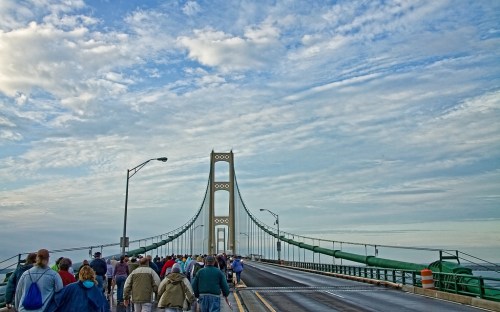
OPEN ARMS, photo Dave Trapp

The annual Mackinac Bridge Walk has been held every year on Labor Day since the Bridge opened in 1957, which means the Bridge Walk is celebrating its 57th anniversary. Just 68 people took that first 5 mile walk across the Mighty Mac, but since the Governor began leading the walk, it averages 40,000 to 65,000 attendees.

Follow along for photos and updates at the Mackinac Bridge Facebook page and also jump on the Mackinac Bridge Cam for a live view!

View Dave’s photo bigger and see more shots from his walk in 2010 in his slideshow.

Lots more about the Mackinac Bridge on Michigan in Pictures!

The Making of the Mackinac Bridge

Bridge_HDR2.jpg

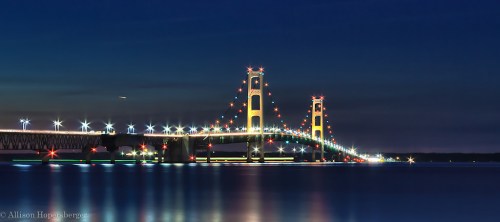
Bridge HDR 2, photo by Allison Hopersberger

A calm night on the Straits of Mackinac, and Michigan’s signature bridge was looking fine!

I’ve posted a ton about the Mighty Mackinac Bridge here on Michigan in Pictures, but had never seen this excellent summary of how it came to be courtesy the Michigan Dept. of Transportation’s page on I-75 and the Straits of Mackinac:

The five-mile stretch of water separating Michigan’s two peninsulas, the result of glacial action some twelve thousand years ago, has long served as a major barrier to the movement of people and goods. The three railroads that reached the Straits of Mackinac in the early 1880s, the Michigan Central and the Grand Rapids & Indiana Railway from the south, and the Detroit, Mackinac and Marquette from the north, jointly established the Mackinac Transportation Company in 1881 to operate a railroad car ferry service across the straits. The railroads and their shipping lines developed Mackinac Island into a major vacation destination in the 1880s.

Improved highways along the eastern shores of Michigan’s lower peninsula brought increased automobile traffic to the straits region starting in the 1910s. The state of Michigan initiated an automobile ferry service between St. Ignace and Mackinaw City in 1923 and eventually operated eight ferry boats. In peak travel periods, particularly during deer season, five mile backups and delays of four hours or longer became common at the state docks at Mackinaw City and St. Ignace.

With increased public pressure to break this bottleneck, the Michigan legislature established a Mackinac Straits Bridge Authority in 1934, with the power to issue bonds for bridge construction. The bridge authority supported a proposal first developed in 1921 by Charles Evan Fowler, the bridge engineer who had previously promoted a Detroit-Windsor bridge. Fowler’s plans called for an island-hopping route from the city of Cheboygan to Bois Blanc, Round, and Mackinac islands, thence to St. Ignace, along a twenty-four-mile route. The Public Works Administration flatly rejected a request for loans and grants to implement this project.

A plan was then drawn up for a direct crossing from Mackinaw City to St. Ignace, but they were again denied funds. In 1940, a plan was submitted for a suspension bridge with a main span of 4600 feet. This design was a larger version of the ill-fated Tacoma Narrows Bridge in Washington State, a structure destroyed by high winds on November 7, 1940. Although the disaster delayed any further action, the activities of 1938-1940 nevertheless produced some important results. The bridge authority conducted a series of soundings and borings across the straits and built a causeway extending out 4200 feet from the St. Ignace shore. The Second World War ended any additional work, and the Legislature abolished the bridge authority in 1947.

William Stewart Woodfill, president of the Grand Hotel on Mackinac Island, almost singlehandedly resuscitated the dream of a bridge across the Straits of Mackinac. Woodfill formed the statewide Mackinac Bridge Citizens Committee in 1949 to lobby for a new bridge authority, which the legislature created in 1950. A panel of three prominent engineers conducted a feasibility study and made recommendations to the bridge authority on the location, structure, and design of the bridge.

The State Highway Department, which had just placed a $4.5 million ferryboat, Vacationland, into service at the straits in January 1952, remained hostile to the bridge plan. In April 1952, the Michigan legislature authorized the bridge authority to issue bonds for the project, choose an engineer, and proceed with construction. The authority selected David B. Steinman as the chief engineer in January 1953 and tried unsuccessfully to sell the bridge bonds in April 1953, but by the end of the year, the authority had sold the $99.8 million in revenue bonds needed to begin construction.

View Allison’s photo bigger and see LOTS more in her Mackinac Island slideshow!

Birthday Butterfly for the Grand Hotel

Grand Hotel Birthday Butterfly

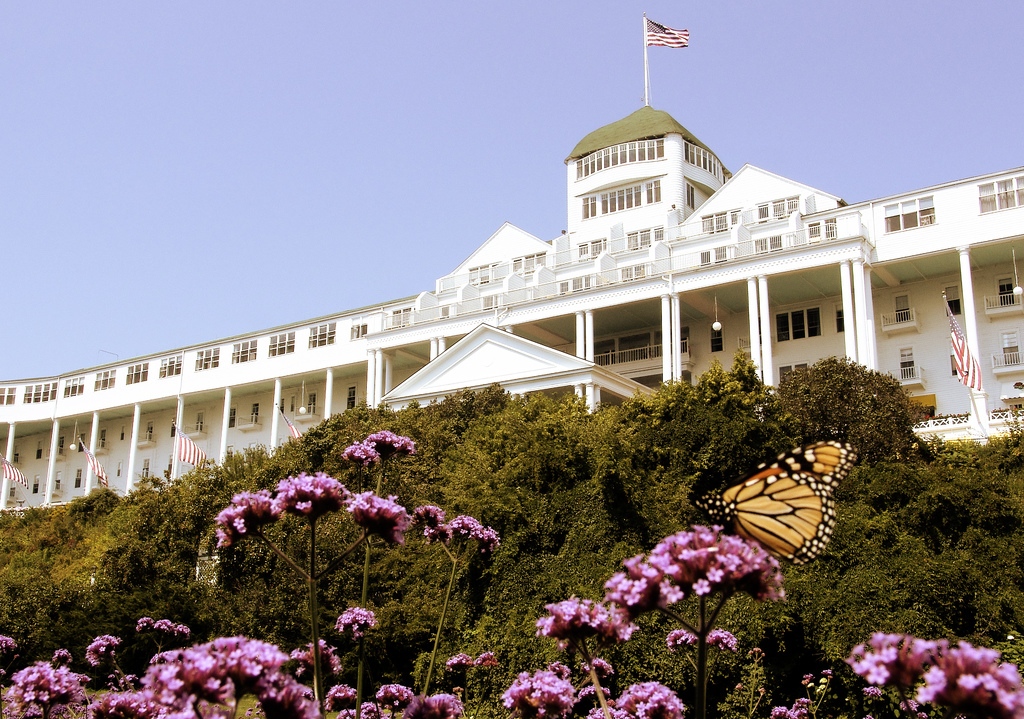
Grand Hotel Butterfly, photo by Alicia Bock

Today is the 127th birthday of the Grand Hotel on Mackinac Island. You can check out the Hotel’s historic photo gallery or if you want to roll with the times, the Grand Hotel Instagram.

View Alicia’s photo bigger, see more in her Mackinac slideshow and view and purchase more in the Mackinac Magic photo gallery on her photography website.

More about the Grand Hotel on Michigan in Pictures.