Tuesday Tweet: Great Lakes Ice at 85%

NOAA Ice Coverage

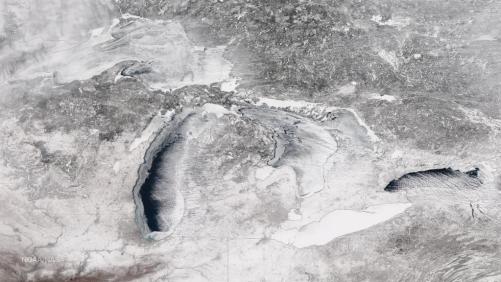
Great Lakes Ice Coverage on Feb 23, 2015, photo by NOAA Environmental Visualization Laboratory

In Great Lakes Total Ice Cover Nears 85% NOAA reports:

The NOAA Great Lakes Environmental Research Laboratory is showing total ice cover of 84.4% as of February 22, 2015, well above the long term average and closing in on last year’s mark of 92.5% coverage on March 6, 2014. In this image, Lake Erie is a vast white plain, joining Lake Huron and Lake Superior with coverages above 90% and only small areas of open water. This image was taken by the Suomi NPP satellite’s VIIRS instrument around 1803Z on February 23, 2015.

Click through to see it big as the Great Lakes and see more photos of the Great Lakes from high above if you click the “Great Lakes” keyword.

PS: Follow @NOAA@NOAA_GLERL & @NOAASatellites on Twitter for lots more great images!

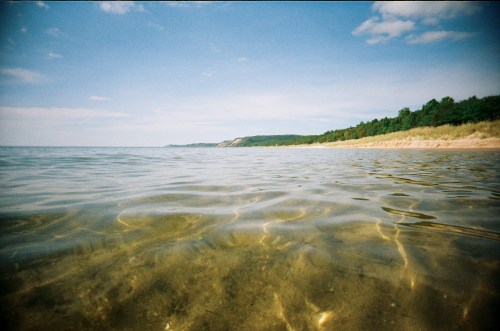
The Great Lakes, in Vivitar & summer

173316390006

173316390006, photo by Steve Swartz

Just love this shot. It’s always good to remember that we get to go back to this before too long…

View Steve’s photo background bigtacular and see more in his Vivitar slideshow.

More summer wallpaper and more camera fun on Michigan in Pictures.

Bad Ideas in Action

I need to provide a retraction of sorts for this post. While Enbridge Line 5 could carry the same corrosive tar sands of Keystone XL, it’s not a part of the XL network. It still most certainly could all the terrible impacts and remains a really bad idea.  More about Line 5 right here.

enbridge-pipeline-under-straits-of-mackinac

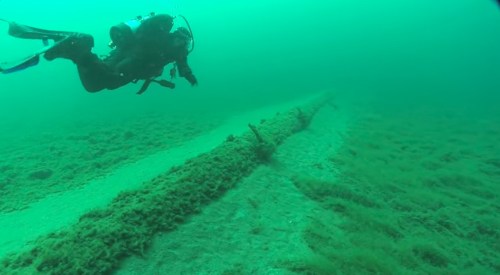
Broken Supports on the Straits Pipeline, photo courtesy National Wildlife Federation video

Here’s what we’re talking about when we talk about piping crude oil sludge under the Straits of Mackinac. It’s absolutely unfathomable to me how a politician could ever use “jobs” and “Keystone XL” in the same sentence except to say “Keystone XL could cost us tens or hundreds of thousands of jobs in the Great Lakes if anything goes wrong.”

Eco Watch writes (in part):

This past July, National Wildlife Federation (NWF) conducted a diving expedition to obtain footage of aging oil pipelines strung across one of the most sensitive locations in the Great Lakes, and possibly the world: the Straits of Mackinac. Footage of these pipelines has never been released to the public until now.

The Straits of Mackinac pipelines, owned by Enbridge Energy, are 60-years-old and considered one of the greatest threats to the Great Lakes because of their age, location and the hazardous products they transport—including tar sands derived oil.

Click above to read more and watch the video or click here to watch it on YouTube. The dive footage starts at about 3 minutes, and at about 4 minutes in you can see drop camera footage from 200′ deep that shows unsupported pipeline hanging over the lake bed.

I know that some folks get upset when I wander into “politics” but I don’t even think this falls under politics. This falls under “companies using lobbying money & influence to do things that are really dangerous without proper safety controls.” You can clearly see from the video that this pipeline is an outdated and unsafe piece of junk, and the Great Lakes don’t belong to any company. In my opinion (which may be different from yours) it is incumbent on our elected officials to safeguard the Great Lakes for the economic benefit and enjoyment of us ALL.

PS: If the name Enbridge Energy sounds familiar, they’re the company that brought Michigan the Kalamazoo River oil spill in 2010.

PPS: (edit) The Jobs, Economy and the Great Lakes report by Michigan Sea Grant found that in 2009, more than 1.5 million Great Lakes-related jobs generated $62 billion in wages for the Great Lakes region. (report is linked at the right)

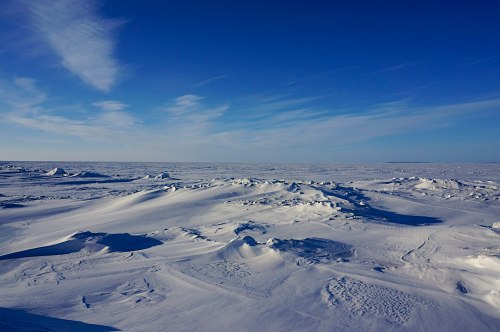
A Cold Calm

A Cold Calm

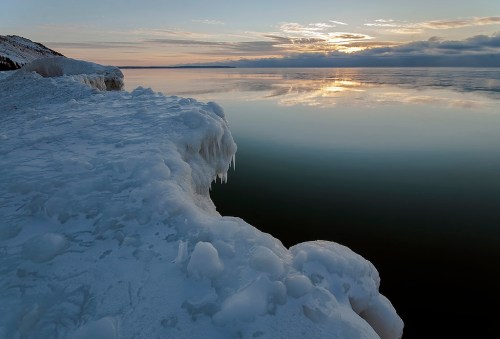
A Cold Calm, photo by Mark Miller

A scan of the Michigan mercury this morning shows a lot of record and near record low temps ranging from a balmy -10 in Grand Rapids to -24 in the Soo, -26 in Ann Arbor, -28 in Alpena, -29 in Port Huron and an eye-popping -34 in the “Icebox of the North” Pellston. I hope all of you find a way to stay warm this weekend!

View Mark’s photo from last Sunday in Empire bigger and see more in his slideshow.

PS: You can check out the view from Empire Bluff (upper left corner) right here on Michigan in Pictures.

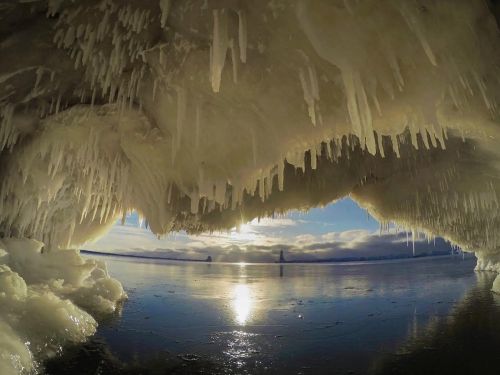
Frankfort Ice Cave

DCIM108GOPROG0639705.

Frankfort Ice Cave, photo by Sarah Hunt (oni_one_)

“Love lingers when the heart remembers to touch the light leaking from the soul.”
~R.M. Drake

Here’s a pretty incredible shot from Sunday in Frankfort Harbor.

Lots more great shots from outdoors in Michigan on Sarah’s Instagram. I’ll post this one and another shot bigger on the michpics Facebook.

In addition to being a pretty great photographer with a penchant for adventure, Sarah is an ambassador for Outdoor Bella, a community of strong women who are building strong relationships and lasting friendships and love to embrace the outdoors. She’s hosting a snowshoe hike meetup at 9:30am on Sunday, March 1st at the Sleeping Bear Point Trail in the Sleeping Bear Dunes National Lakeshore, followed by lunch at Art’s Tavern in Glen Arbor following the hike. Get all the details right here.

Welcome to Hoth: Record cold weekend for Michigan

Lake Michigan

Lake Michigan, photo by Frank Wulfers

What can you say about last weekend’s weather? The Elkhart Truth reports:

An Arctic cold front gripped Michigan on Sunday, sending temperatures plunging to minus 27 in the Upper Peninsula and minus 22 in the northern Lower Peninsula and shattering at least five record lows for the date.

The deep freeze came with an easing of the snow and windy conditions that forced a number of Upper Peninsula roads to close Saturday. At 6 a.m., state police announced the reopening of U.S. 2 between Manistique and Rapid River and Michigan 35 between Lathrop and Perkins.

“Both of the roadways closed yesterday and throughout the night due to inclement weather where snow and high winds were causing whiteout conditions,” the state police Negaunee post said in a statement.

…Overnight low temperatures Sunday fell to minus 27 at Newberry in central upper Michigan, the National Weather Service said. It said the low reached minus 22 at Pellston in the northern Lower Peninsula, while Detroit’s low fell to minus 7.

Authorities report record lows were set for the date in Ann Arbor, Flint, Grand Rapids and Monroe and at MBS International Airport in Saginaw County’s Tittabawassee Township.

View Frank’s photo from Cross Village background bigtacular and see more in his slideshow.

More winter wallpaper on Michigan in Pictures.

PS: Thanks to Moshe Kasher who appeared at the Winter Comedy Festival in Traverse City for the Hoth joke!

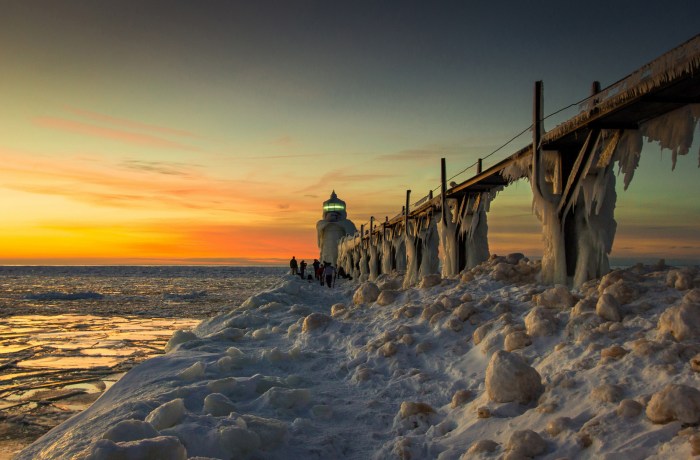
St Joseph Outer & Inner Pier Lighthouses

St Joseph Sunset

St Joseph Sunset, photo by PhotoJacko

We’ve all been seeing a bunch of photos from the frozen St. Joseph Pier, so I thought it would be good to give you a little primer about which is which. It took a little digging, but Dave Wobster at Boatnerd.com has the best info on St. Joseph North Pier Outer & Inner Lights:

The present range lights were built in 1907 when the north pier was extended 1000-feet necessitating two lights which serve as range lights. Previously, there had been lights erected as early as 1832 at this location. A round stone tower, built in 1859, was replaced by the present lights.

Outer – (Front Range) is a round, cast-iron plate 35-foot tall tower topped by a round watch room and 10-sided lantern room. The tower is painted white, and the lantern room is black. The fixed light is exhibited via a Fifth-Order Fresnel lens and two brass reflecting panels manufactured by Barbier & Benard of Paris. The light is visible for 180 degrees. (above)

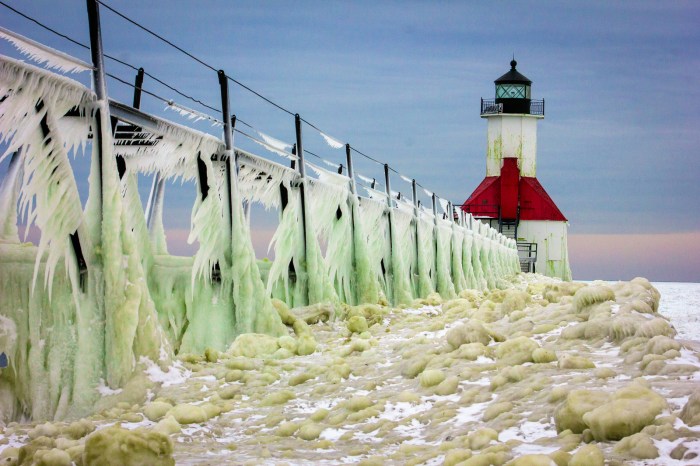
Inner – (Rear Range) was built in 1898 and rebuilt 1907. A 26-foot square steel-framed fog signal building encased in 3/8″ cast iron plates with an octagonal light tower on a hip roof. The helical bar lantern room contains a Fourth-Order fixed Fresnel lens with a brass reflector manufactured by Sautter & Company of Paris. The building is white with a red roof, and the lantern room is painted black. The light is visible over a range of 270 degrees. (below)

The lights are connected by an elevated catwalk that extends from the shore to the outer light. The walkway was constructed to permit the light keepers access to the light during rough weather.

Yesterday I featured a photo by Jackie as the cover of the Absolute Michigan Facebook page. Click the photos to view them bigger on Flickr, see more in her Winter slideshow and follow her  at Jackie Novak Photography on Facebook.

St Joseph Lighthouse

St Joseph Lighthouse, photo by PhotoJacko


Zenith

Zenith

Zenith, photo by Aaron Springer

Aaron writes:

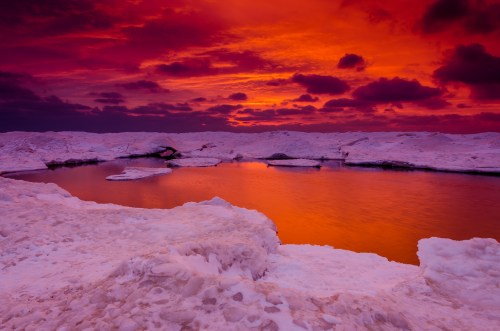
Crimson currents flow toward the deeper waters of Lake Michigan during an eruption of last light.

While at this location the night before I hastily packed up my things after sunset and left some gear behind by accident. I returned the next evening to see if I could find what had been forgotten. The light was glum and I began shooting long exposure panoramas with the intention of converting them to black and white. After a short time a very slight hue of pink began to show up in the exposures and within minutes the sky exploded with one of the most color intense sunsets that I have ever witnessed.

View his photo bigger on Flickr and check out more of his ice photos.

#TBT The Ice Caves of Leelanau from Ken Scott

Ken Scott Ice Cave

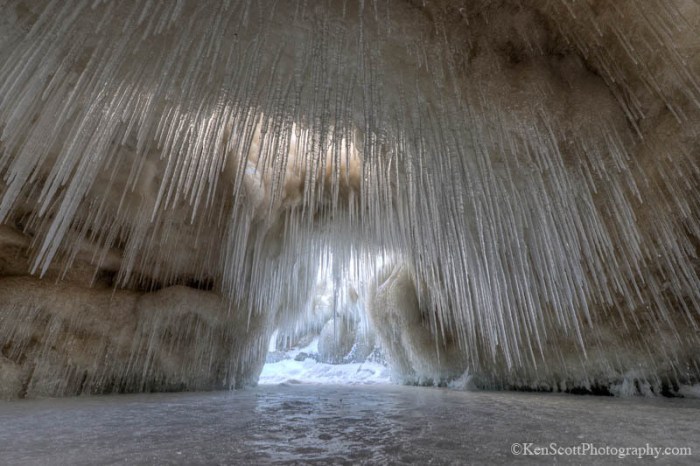
Lake Michigan … crystal cave II, photo by Ken Scott Photography

“My creative eye is always on. It doesn’t get bored. A lot of people get stuck on seeing things only one way, like the wide view or closeup view … but there’s everything in between. Boredom would come when you’re getting stuck in seeing things only one way. You just have to shift it a little bit and it can open up a whole other world.”
~Ken Scott

Kudos to Michigan in Pictures regular Ken Scott, whose photography of last winter’s ice caves on Lake Michigan is featured in the Huffington Post today. They write:

Scott’s documentation of the ice caves last year on Facebook drew likes, attention and, eventually, the book deal. In Ice Caves of Leelanau, he shows numerous views of the caves, blue ice, volcano ice, pancake ice, the large sheet of anchor ice along the shore, and the rounded and smoothed chunks of ice known as ice balls. Meteorologist Ernie Ostuno captioned Scott’s photographs for the book, and nature writer Jerry Dennis introduced them:

The caves were the surprising thing. Many of us had seen similar structures during other winters, but never many of them, and never this large. These were big enough to stand in — for a dozen people to stand in — and as elaborate as caves in limestone. They were domes and keyholes and grottos. Wave spray and intermittent thawing and freezing had embellished them with columns and pillars. Their surfaces were so smooth they gleamed in sunlight, and from their ceilings dripped hundreds of daggers of clear ice, like crystal stalactites.

George Leshkevich, a researcher with the North American Ocean Administration’s Great Lakes Environmental Research Laboratory, noted that last winter was particularly severe for the Great Lakes, resulting in unique conditions where ice reached peak thickness two separate times in the season.

Different kinds of ice formations occur because of a confluence of reasons, Leshkevich explained, including meteorological conditions, the physical location and wave action, so they’re hard to predict and will vary widely along the shore.

Click through for more great photos. You can check out a short video or a long one from this particular formation, and definitely get a copy of Ice Caves of Leelanau if you can!

PS: I hope all this ice caveyness isn’t bothering you – I’m so happy to see Michigan getting some wintertime love.

Like beauty, danger is all around you

Laura getting the shot

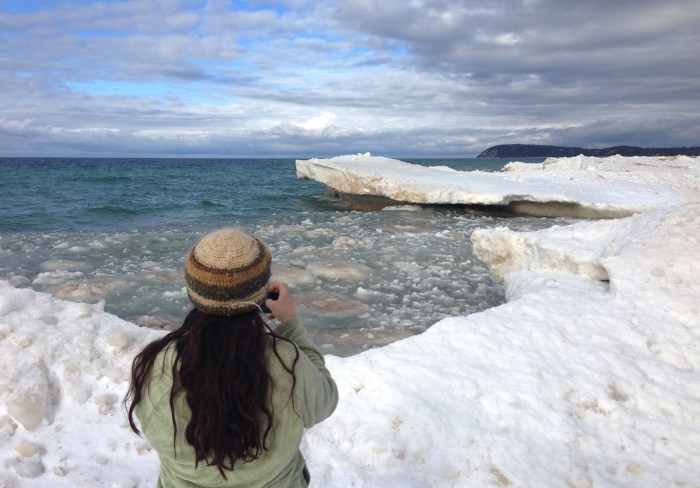
Laura getting the shot, photo by Andrew McFarlane

“A ship is safe in harbor, but that’s not what ships are for.”
~William G. T. Shedd

Every so often I have to write a post to clarify what Michigan in Pictures is or is not, and I guess that today is one of those days.

Sunday morning, I posted this photo (also at the bottom of this post) to the Michigan in Pictures Facebook page with the very accurate caption “We went out to Good Harbor Bay on Lake Michigan yesterday to play on the ice!” As you can see from the photo, Laura is positioned well back from the edge. While perhaps not perfectly safe, she is far safer than she was driving to the beach.

Several readers took issue with the idea that it’s appropriate to “play” in a potentially hazardous environment like shelf ice on Lake Michigan, suggesting that it’s irresponsible for me to share photos from risky environments, that I not do it, and that I focus on providing precautionary education encouraging people to make safe decisions. I replied (in part):

Shelf ice is indeed dangerous if you don’t know where you are and what you’re doing. The water where we were is 3′ deep in summer and the ice very solid, so in my opinion, play is exactly what it was.

Your concern for safety is good, but if you take proper precautions, you’re a heck of a lot safer here than driving on a winter road.

I post pictures all the time where the photographers have taken calculated risks to see, photograph and experience things that you cannot see and photograph without an element of risk. I allow my son to surf in conditions that can be very dangerous, let my daughter climb trees high enough to probably kill her if she fell, and hiked on trails where one slip meant death.

I suppose I should post disclaimers of “don’t be an idiot” with all photos of risky environments, but I think I will continue to assume that my readers will assess risks on their own, and I will continue to experience and share Michigan as I choose.

…Please understand that Michigan in Pictures is a place where I share amazing pictures that are shared with me. I’m not doing this as a public service to educate people on how to stay alive and safe. I do it for love of Michigan and to share the cool experiences it offers. I trust that my readers will exercise appropriate caution as they enjoy Michigan, and I’m 1000% sure that if folks get out and wisely play a little closer to the edge, they’ll have a happier and longer life.

Caveat emptor!

Caveat emptor will remain the policy of Michigan in Pictures, which I will again remind readers is my personal blog, not paid for by anyone and offered with the sole hope that you can find pictures and places that help you enjoy and appreciate Michigan more.

View my photo background big and see more on our mileelanau Instagram.

PS: Thanks to Kate Wittenberg for the perfect William G. T. Shedd quotation that she shared in the comments!

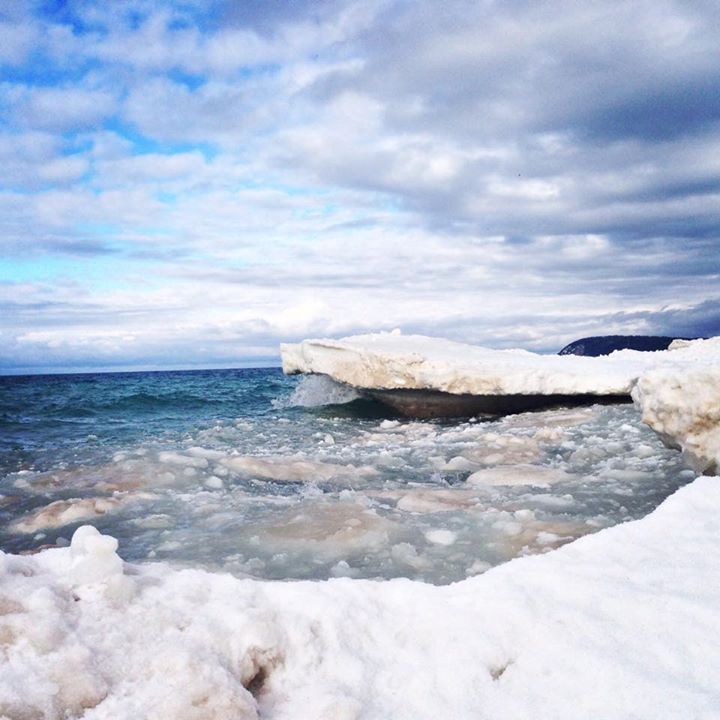
PPS: Here’s the photo Laura shot. Position, framing, tone.
Lauras Photo