Enter the Great Lakes Forever Photo Contest!

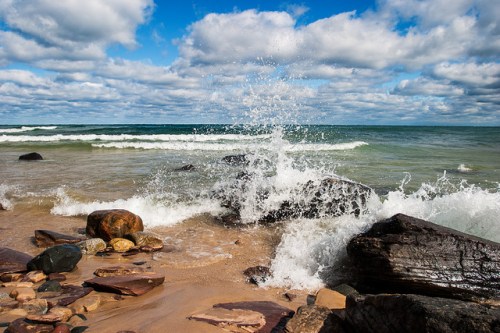
Crashing Wave

Crashing Wave, photo by James Marvin Phelps (mandj98).

When I was posting information about the Absolute Michigan Summer Photo Celebration to some Flickr photo groups, I came across another cool contest. Rebecca Dill from Great Lakes Forever writes:

With summer vacations to the Lakes just around the corner, the sixth annual Great Lakes Forever Photo Contest is accepting submissions from May 20 – July 18, 2010. Through the 2010 Great Lakes Forever Photo Contest, photographers can help defend the Great Lakes with their cameras – and get noticed throughout the Great Lakes region.

Biodiversity Project’s Great Lakes Forever program has again partnered with Budweiser to sponsor a photography contest that celebrates the beauty of the Great Lakes through the incredible talent of local photographers. Great Lakes Forever is a non-profit education and activism campaign designed to raise awareness about our vulnerable and valuable Lakes.

The grand prize winner in both the professional and amateur categories will be featured on the 2010 Great Lakes Forever/Budweiser beer coasters. These coasters will be distributed to bars and restaurants throughout the Great Lakes region…

Interested photographers can visit the Great Lakes Forever website for contest rules and submission details. The submission deadline is July 18, 2010.

The Grand Prize is a kayak and portable navigation system and you can get all the details on their 6th Annual Photo Contest page!

Check this out bigger and in James’ Pictured Rocks National Lakeshore set (slideshow). You can also purchase it if you like!

US Coast Guard Cutter Bramble: A Ramblin’ Gal

USCGC Bramble

USCGC Bramble, photo by k.l.macke.

Wikipedia says that the USCGC Bramble (WLB-392) is one of the 39 original 180-foot  seagoing buoy tenders built between 1942-1944 for the United States Coast Guard. Bramble is currently a museum ship, part of Port Huron Museum. The museum’s page on the USCG Cutter Bramble says:

The Coast Guard Cutter Bramble was commissioned in 1944 at a cost of just over $925,000. Following World War II, the Bramble participated in “Operation Crossroads,” the first test of an atomic bomb’s effect on surface ships, at Bikini Island. In 1957, along with the cutters Spar and Storis, it headed for the Northwest Passage, traveling through the Bering Straits and Arctic Ocean. Traveling for 64 days through 4,500 miles of partially uncharted waters, the vessels finally reached the Atlantic Ocean. These three surface vessels were the first to circumnavigate the North American Continent, an ambition mariners have had for more than 400 years.

In 1962, the Bramble transferred to Detroit to perform the missions of search and rescue, icebreaking, and law enforcement throughout the Great Lakes, in addition to aids to navigation. In 1975, the Bramble reported to Port Huron. The cutter’s areas of responsibility included eastern Lake Erie, southern Lake Huron and Saginaw Bay, and maintaining 187 buoys, one NOAA weather buoy, and three fog signals. During winter months, its capabilities as an icebreaker enabled it to escort ships through ice and assist ships in distress. The Bramble was decommissioned in 2003 to be used as a museum.

Check this out bigger and in Keith’s Ships, Boats & Water Toys set (slideshow).

Way Back When… (we had a chance to stop Asian Carp)

Way Back When...

Way Back When…, photo by oliviaburger08.

Grand Traverse Band of Ottawa and Chippewa Indians tribal chairman Derek Bailey had this Op-Ed in the Traverse City Record-Eagle this week. I know it’s kind of long but I wanted to share it with you

Forum: Work together against Asian carp
By Derek Bailey

Three decades ago many thought that the Great Lakes fisheries resources would be ruined by American Indian tribes exercising “treaty-fishing” rights. After the federal courts confirmed these treaty-reserved rights, the tribes demonstrated their primary concern is protection of the Great Lakes fisheries.

Ironically, these “treaty-fishing” rights now might prove crucial in protecting fisheries resources for all of Michigan’s citizens against the Asian carp invasion.

The United States Supreme Court has denied Michigan’s request for an injunction closing the shipping locks outside of Chicago to prevent any further migration of Asian carp into the Great Lakes. In the midst of the competing claims debating the economic losses of closing shipping to the Mississippi River system compared to potential harm to Great Lakes fisheries, all parties — Attorney General Cox, Gov. Granholm, the Army Corps of Engineers and other federal agencies — agree that the damage to the Great Lakes fisheries will be profound.

It has been almost six years since the U.S. Fish and Wildlife Service estimated that “Asian carp could have a devastating effect on the Great Lakes ecosystem and a significant impact on the $7 billion fishery.” During this time the Army Corps of Engineers failed to act promptly, in effect fiddling while Rome burned. To the extent the Army Corps is responsible for the impending disaster, the tribes may be better situated than the state to challenge the federal government.

In the scramble to stop Asian carp, the issue of American Indian “treaty-fishing” rights has not been considered at all. The 1836 Treaty tribes (the Bay Mills Indian Community, the Grand Traverse Band of Ottawa and Chippewa Indians, the Little River Band of Ottawa Indians, the Little Traverse Bay Bands of Odawa Indians and the Sault Ste Marie Tribe of Chippewa Indians) retain rights to fish for commercial and subsistence purposes in vast areas of lakes Michigan, Superior and Huron.

Historically, fishing played a central role in the spiritual and cultural framework of American Indian life. As the Supreme Court noted a century ago, access to fish and wildlife was “not much less necessary to the existence of the Indians than the atmosphere they breathed,” United States v. Winans, 198 U.S. 371, 381 (1905).

The precedent for American Indian tribes intervening to protect their property interests in disputes between states was clearly established in 1960’s California v. Arizona litigation involving allocation of Colorado River water rights, and confirmed in the Grand Traverse Band’s 1990s litigation assuring access to fishing grounds.

Given the Supreme Court’s refusal to act in the state’s litigation filed against Illinois, the tribes are considering an alternative litigation strategy to combat the latest and perhaps most serious threat to the Great Lakes from invasive species.

The issue isn’t just protecting tribal property rights. It’s past time for the state and tribes to put aside perceived differences, and to begin concentrating on how together we can cooperate to preserve the Great Lakes for all Michigan citizens.

I hope that we don’t look back on what we had for a fishery, recreational resource and amazing gift from whatever powers who bestow gifts on people bestowed upon us and say “Way Back When…”

Check this out on black and in Olivia’s Let’s Go Exploring set (slideshow).

Saginaw, Michigan … and Happy Birthday to Johnny Cash

Saginaw Bay-Michigan

Saginaw Bay-Michigan, photo by mark5032001.

The song Saginaw, Michigan was written by Bill Anderson and Don Wayne and famously covered by Johnny Cash, who was born on February 26, 1932.

I was born in Saginaw, Michigan.
I grew up in a house on Saginaw Bay.
My dad was a poor hard working Saginaw fisherman:
Too many times he came home with too little pay.

I loved a girl in Saginaw, Michigan.
The daughter of a wealthy, wealthy man.
But he called me: “That son of a Saginaw fisherman.”
And not good enough to claim his daughter’s hand.

Now I’m up here in Alaska looking around for gold.
Like a crazy fool I’m a digging in this frozen ground, so cold.
But with each new day I pray I’ll strike it rich and then,
I’ll go back home and claim my love in Saginaw, Michigan.

I wrote my love in Saginaw, Michigan.
I said: “Honey, I’m a coming home, please wait for me.
“And you can tell your dad, I’m coming back a richer man
“I’ve hit the biggest strike in Klondyke history.”

Her dad met me in Saginaw, Michigan.
He gave me a great big party with champagne.
Then he said: “Son, you’re wise, young ambitious man.
“Will you sell your father-in-law your Klondyke claim?”

Now he’s up there in Alaska digging in the cold, cold ground.
The greedy fool is a looking for the gold I never found.
It serves him right and no-one here is missing him.
Least of all the newly-weds of Saginaw, Michigan.

We’re the happiest man and wife in Saginaw, Michigan.
He’s ashamed to show his face in Saginaw, Michigan.

Much more in Wikipedia’s Johnny Cash entry and on the official Johnny Cash web site.

Unfortunately, I couldn’t find Johnny playing Saginaw, Michigan, but here’s Lefty Frizzell (who had the original hit) and one of my favorites, Leo Kottke singing the song.

Check this photo out bigger in Mark’s slideshow.

Forester Park on Lake Huron

HuronFeb1-3

HuronFeb1-3, photo by richwyllis.

Looks like a cool campground in warmer times.

Check it out bigger or in Rich’s slideshow.

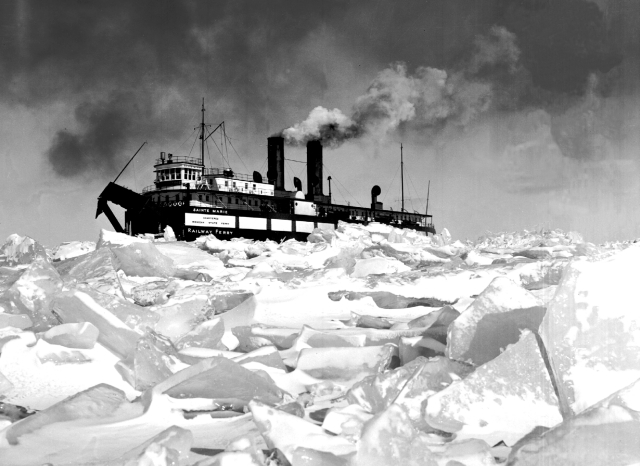
80 years of ice on the Straits of Mackinaw

Winter Service, photo courtesy Mackinac Bridge Authority

The Michigan State Ferry Album says:

Winter service began in 1931 when the Highway Department arranged with the Mackinaw Transportation Company to carry cars across the Straits on a railroad icebreaker during the cold months. This arrangement turned out to be poor business for the State, so in 1936 the Highway Department leased the railroad icebreaker “Sainte Marie” for winter operations on a regular schedule.Winter service began in 1931 when the Highway Department arranged with the Mackinaw Transportation Company to carry cars across the Straits on a railroad icebreaker during the cold months. This arrangement turned out to be poor business for the State, so in 1936 the Highway Department leased the railroad icebreaker “Sainte Marie” for winter operations on a regular schedule.

In case you’re wondering, the ice on the Straits of Mackinaw hasn’t changed a whole lot in 80 years, as this photo from February of 2008 titled Triangles by Dominique shows. See it bigger in her Snow/Ice slideshow or check out the whole set.

Triangles

Turnip Rock, Port Austin and The Thumb

Turnip Rock, Port Austin, Michigan

Turnip Rock, Port Austin, Michigan, photo by jensenl.

It’s been a while since Michigan in Pictures got out with the incomparable Lars Jensen, for my money one of Michigan’s best outdoor photographers.

His winter visit to The Thumb offers this photo and many more larger and he writes:

Turnip Rock and Kai standing on the “thumbnail” in Michigan’s thumb area. Unfortunately, this area is privately owned so Kai and I skied to it from the harbor at Port Austin (about 2.25 miles away) on Lake Huron. We then skied out to the Port Austin Lighthouse which sits out in the middle of the bay on a shallow shoal (about 2.5 miles from the shores of Port Austin). We saw all sorts of interesting ice formations along the way and had a great time on a cold and blustery day.

Click over to his site for the whole day of photos. Here’s more of Lars Jensen on Michigan in Pictures and I also recommend kicking back for his Michigan slideshow.

PS: Too cold for you? He has summertime photos in Kayaking the Thumb!

Before the Mackinac Bridge: City of Munising

Mackinac MI UP Great Lakes Passenger and Auto Ferry City of Munising connecting Mackinaw City and St Ignace before the Mackinaw Bridge was build

Mackinac MI UP Great Lakes Passenger and Auto Ferry City of Munising connecting Mackinaw City and St Ignace before the Mackinaw Bridge was built, photo by UpNorth Memories – Donald (Don) Harrison.

Before the Mackinac Bridge was built (check Absolute Michigan for lots more on that), going to or from the UP was by ferry. The City of Munising was the last of the breed:

Built by the American Ship Building Company of Cleveland in 1903 for the Pere Marquette Railway Company, the “Pere Marquette 20” became the “City of Munising” in 1937. The Michigan Department of Highways used the ship to ferry autos across the Straits of Mackinac until 1959. The ship was used for potato storage by a Washington Island, Wisconsin firm until 1973.

Michigan State Ferry Album has some photos of the City of Munising and other ships that plied the Straits.

Check this out bigger and see some shots of the old ferry docks in Don’s slideshow of old Mackinac photos

Freshwater Fury: The Great Lakes Storm of 1913

Charles S Price upside down, 1913

Charles S Price upside down, 1913,  Wikipedia

Dear wife and Children. We were left up here in Lake Michigan by McKinnon, captain James H. Martin tug, at anchor. He went away and never said goodbye or anything to us. Lost one man yesterday. We have been out in storm forty hours. Goodbye dear ones, I might see you in Heaven. Pray for me. / Chris K. / P.S. I felt so bad I had another man write for me. Goodbye forever.

~A message found in a bottle 11 days after Plymouth disappeared, dictated by Chris Keenan, federal marshal in charge of the barge

Wikipedia says that the Great Lakes Storm of 1913, also known as the “Freshwater Fury” or the “White Hurricane”, was a blizzard with hurricane-force winds that ravaged the Great Lakes November 7-10, 1913. With the sinking of 19 ships, the stranding of another 19 and a death toll of at least 250, it remains the deadliest and most destructive natural disaster in Great Lakes history.

detroit-news-great-lakes-stormMajor shipwrecks occurred on all but Lake Ontario, with most happening on southern and western Lake Huron. Lake masters recounted that waves reached at least 35 feet (11 m) in height. Being shorter in length than waves ordinarily formed by gales, they occurred in rapid succession, with three waves frequently striking in succession. Masters also stated that the wind often blew in directions opposite to the waves below. This was the result of the storm’s cyclonic motion, a phenomenon rarely seen on the Great Lakes.

In the late afternoon of November 10, an unknown vessel was spotted floating upside-down in about 60 feet (18 m) of water on the eastern coast of Michigan, within sight of Huronia Beach and the mouth of the St. Clair River. Determining the identity of this “mystery ship” became of regional interest, resulting in daily front-page newspaper articles. The ship eventually sank, and it was not until early Saturday morning, November 15, that it was finally identified as the Charles S. Price. The front page of that day’s Port Huron Times-Herald extra edition read, “BOAT IS PRICE — DIVER IS BAKER — SECRET KNOWN”. Milton Smith, the assistant engineer who decided at the last moment not to join his crew on premonition of disaster, aided in identifying any bodies that were found.

You can get a map to the wreck of the Charles S Price, and here’s a list of shipwrecks of the 1913 storm and an account of the weather. You can see more photos from Wikipedia and also in Lakeland Boating’s great slideshow of some of the on and offshore damage from the Freshwater Fury.

More at absolutemichigan.com/Shipwreck and even Michigan shipwrecks on Michigan in Pictures.

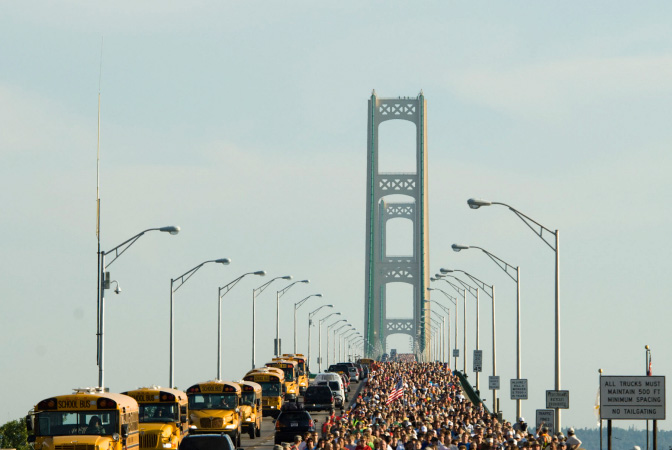
52nd Annual Mackinac Bridge Walk ~ September 7, 2009

2008 Mackinac Bridge Walk

2008 Mackinac Bridge Walk, photo courtesy Michigan Department of Transportation & Mackinac Bridge Authority

The annual Mackinac Bridge Walk is a Michigan tradition that has been held every year since the Bridge opened in 1957. This year is the 52nd annual and it takes place (as always) on Labor Day  (September 7) from 7-11 AM. The walk is free and you can get all the details from the official Mackinac Bridge web site.

There’s more info available on Wikipedia and you can learn all about the Mackinac Bridge over at Absolute Michigan.

The Mackinac Bridge