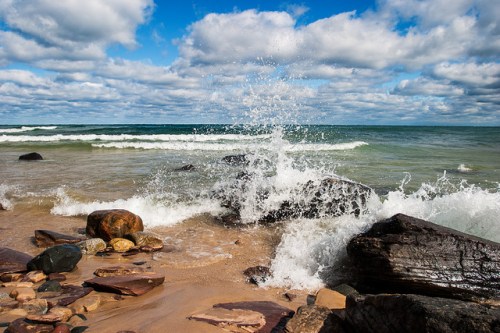
Yesterday: Sand. Today: Zebra Mussels & Quagga Mussels

Zebra Mussels

Zebra Mussels, photo by cedarkayak.

“In terms of the whole food web, I don’t think there’s any question that zebra and quagga mussels have had the largest impact on the biological communities of the Great Lakes”
~Tom Nalepa, Great Lakes Environmental Research Laboratory

Today’s villain in our Michigan Invasive Species series are Zebra Mussels & Quagga Mussels. That feature on Absolute Michigan goes in depth about who they are and what they do so I won’t go on and on here except to say that as someone who walks the beaches of Lake Michigan often, there’s few things that make me sadder or madder than these little bastards. They’ve trashed the food chain, spawned all manner of nasty plants & algae and they slice up your feet.

Todd writes:

This stretch of beach on South Manitou Island was once filled with sugary white sand. Today, the beach is covered in razor sharp zebra mussel shells. I knelt to take then photo, and when I stood, my knee was bleeding in 3 places.

Check this out background big and in his Lake Michigan slideshow.

End Of the Day … for fishing on the Great Lakes?

End Of the Day

End Of the Day, photo by Rob the Photog.

This week is Invasive Species Week on Absolute Michigan and Michigan in Pictures and today on Absolute Michigan we took a long look at the 800 pound gorilla of invasive species in Michigan, the Asian carp. These frightening fish have made their way up the Mississippi River and can weigh up to 100 pounds, grow to four feet in length, eat voraciously and make rabbits look like pikers when it comes to reproduction. Via TIME Magazine:

“They just eat so much,” says David Ullrich, executive director of the Great Lakes and St. Lawrence Cities Initiative. “They’re like the locusts of the river.”

That’s what makes them so dangerous to the lakes. Asian carp aren’t direct predators, but they eat plankton, which knocks out the bottom layers of the food chain. If they were to successfully establish themselves in the Great Lakes and start breeding, they could utterly disrupt the existing ecosystem, potentially starving out the trout and other native fish that make the Great Lakes a tourism hot spot.

Estimates put the Great Lakes sport and commercial fishery at $2.5 to $7 billion. While the loss of this would be a terrible shame, the thought that one day you wouldn’t see photos like this of a parent and child enjoying Michigan’s amazing fishery seems worse to me.

Rob feels this is one of the best photos he’s ever taken. Check it out bigger and in his slideshow.

And if you can, make sure you write your representatives to tell them how important it is to stop the Asian carp in Chicago!

Invasive Species in Michigan

Shell Cluster

Shell Cluster, photo by johndecember.

All week we’re going to be featuring invasive species – who they are, what they’re doing to our lakes & land and how folks are working to stop them. See the articles as we post them on Absolute MichiganMichigan in Pictures and !

I actually already blogged this photo to Pandora’s Locks: How Invasive Species got into the Great Lakes on Absolute Michigan. The book is a must-read for anyone who wants to learn how the way the shipping industry operates guarantees that invasive species will spread.

You will note that John has TWO invaders here, the zebra mussel and the Asian ladybird beetle. Check this out bigger in John’s slideshow!

Water is the Magic of Michigan

Viv goes surfing!

Viv goes surfing!, photo by kevindooley.

“If there is magic on this planet, it is contained in water.”
~Loren Eiseley

This week on Absolute Michigan we launched our Celebrating Michigan’s Water Photo Contest with a grand prize that includes a 2 nights at The Homestead Resort in Glen Arbor and a Crystal River eco-tour from The River.

To enter, all you need to do is add 1-3 photos of any Michigan lake, river, waterfall, pond or wetland to the Michigan Water Group on Flickr by July 23, 2010.

Here’s the Michigan Water slideshow – what an amazing gift we have been given in Michigan! Here’s hoping we can protect it.

Kevin says his Vivitar Ultra Wide & Slim went surfing! Check it out background boomtacular and in Kevin’s Water set (slideshow).

Enter the Great Lakes Forever Photo Contest!

Crashing Wave

Crashing Wave, photo by James Marvin Phelps (mandj98).

When I was posting information about the Absolute Michigan Summer Photo Celebration to some Flickr photo groups, I came across another cool contest. Rebecca Dill from Great Lakes Forever writes:

With summer vacations to the Lakes just around the corner, the sixth annual Great Lakes Forever Photo Contest is accepting submissions from May 20 – July 18, 2010. Through the 2010 Great Lakes Forever Photo Contest, photographers can help defend the Great Lakes with their cameras – and get noticed throughout the Great Lakes region.

Biodiversity Project’s Great Lakes Forever program has again partnered with Budweiser to sponsor a photography contest that celebrates the beauty of the Great Lakes through the incredible talent of local photographers. Great Lakes Forever is a non-profit education and activism campaign designed to raise awareness about our vulnerable and valuable Lakes.

The grand prize winner in both the professional and amateur categories will be featured on the 2010 Great Lakes Forever/Budweiser beer coasters. These coasters will be distributed to bars and restaurants throughout the Great Lakes region…

Interested photographers can visit the Great Lakes Forever website for contest rules and submission details. The submission deadline is July 18, 2010.

The Grand Prize is a kayak and portable navigation system and you can get all the details on their 6th Annual Photo Contest page!

Check this out bigger and in James’ Pictured Rocks National Lakeshore set (slideshow). You can also purchase it if you like!

Way Back When… (we had a chance to stop Asian Carp)

Way Back When...

Way Back When…, photo by oliviaburger08.

Grand Traverse Band of Ottawa and Chippewa Indians tribal chairman Derek Bailey had this Op-Ed in the Traverse City Record-Eagle this week. I know it’s kind of long but I wanted to share it with you

Forum: Work together against Asian carp
By Derek Bailey

Three decades ago many thought that the Great Lakes fisheries resources would be ruined by American Indian tribes exercising “treaty-fishing” rights. After the federal courts confirmed these treaty-reserved rights, the tribes demonstrated their primary concern is protection of the Great Lakes fisheries.

Ironically, these “treaty-fishing” rights now might prove crucial in protecting fisheries resources for all of Michigan’s citizens against the Asian carp invasion.

The United States Supreme Court has denied Michigan’s request for an injunction closing the shipping locks outside of Chicago to prevent any further migration of Asian carp into the Great Lakes. In the midst of the competing claims debating the economic losses of closing shipping to the Mississippi River system compared to potential harm to Great Lakes fisheries, all parties — Attorney General Cox, Gov. Granholm, the Army Corps of Engineers and other federal agencies — agree that the damage to the Great Lakes fisheries will be profound.

It has been almost six years since the U.S. Fish and Wildlife Service estimated that “Asian carp could have a devastating effect on the Great Lakes ecosystem and a significant impact on the $7 billion fishery.” During this time the Army Corps of Engineers failed to act promptly, in effect fiddling while Rome burned. To the extent the Army Corps is responsible for the impending disaster, the tribes may be better situated than the state to challenge the federal government.

In the scramble to stop Asian carp, the issue of American Indian “treaty-fishing” rights has not been considered at all. The 1836 Treaty tribes (the Bay Mills Indian Community, the Grand Traverse Band of Ottawa and Chippewa Indians, the Little River Band of Ottawa Indians, the Little Traverse Bay Bands of Odawa Indians and the Sault Ste Marie Tribe of Chippewa Indians) retain rights to fish for commercial and subsistence purposes in vast areas of lakes Michigan, Superior and Huron.

Historically, fishing played a central role in the spiritual and cultural framework of American Indian life. As the Supreme Court noted a century ago, access to fish and wildlife was “not much less necessary to the existence of the Indians than the atmosphere they breathed,” United States v. Winans, 198 U.S. 371, 381 (1905).

The precedent for American Indian tribes intervening to protect their property interests in disputes between states was clearly established in 1960’s California v. Arizona litigation involving allocation of Colorado River water rights, and confirmed in the Grand Traverse Band’s 1990s litigation assuring access to fishing grounds.

Given the Supreme Court’s refusal to act in the state’s litigation filed against Illinois, the tribes are considering an alternative litigation strategy to combat the latest and perhaps most serious threat to the Great Lakes from invasive species.

The issue isn’t just protecting tribal property rights. It’s past time for the state and tribes to put aside perceived differences, and to begin concentrating on how together we can cooperate to preserve the Great Lakes for all Michigan citizens.

I hope that we don’t look back on what we had for a fishery, recreational resource and amazing gift from whatever powers who bestow gifts on people bestowed upon us and say “Way Back When…”

Check this out on black and in Olivia’s Let’s Go Exploring set (slideshow).

Detroit River Lighthouse, Bar Shoal – Lake Erie

Detroit River Lighthouse

Detroit River Lighthouse, photo by James Marvin Phelps (mandj98).

The Detroit River Light, also known as Bar Point Shoal Light, was first established as a lightship in 1875. In his writeup of the Detroit River Light at boatnerd.com. Dave Wobster says:

Completed in 1885 by the U.S. Army Corps of Engineers at a cost of $78,000, the Detroit River Light replaced a Canadian lightship that had served since 1875. The light was first exhibited August 20, 1885. Located near the end Bar Shoal which projects from the Canadian shore, in Lake Erie just south of the entrance into the Detroit River. This is the point where up bound vessels make the turn into the Detroit River.

The 49-feet high cast iron plate tower is 22-feet in diameter at the base and 18-feet at the top. It was built on a pre-fabricated 45′ x 18′, crib that was transported to the site from Amherstburg, Ontario, sunk in 22-feet of water, filled with concrete and surrounded by a granite pier.

The light station pier has the appearance of a vessel, with the pointed end directed toward the mouth of the river to break ice flows coming down river.

Click through to read about how the light handled an impact from the 635′ freighter Buffalo and see an aerial shot that shows the unique shape at Wikipedia’s Detroit River Light entry.

Check it out bigger or in James’s Detroit River set (slideshow) where you can also see a side view of the lighthouse. This is also for sale as a print from James.

View many more Michigan lighthouses from Michigan in Pictures.

Freshwater Fury: The Great Lakes Storm of 1913

Charles S Price upside down, 1913

Charles S Price upside down, 1913,  Wikipedia

Dear wife and Children. We were left up here in Lake Michigan by McKinnon, captain James H. Martin tug, at anchor. He went away and never said goodbye or anything to us. Lost one man yesterday. We have been out in storm forty hours. Goodbye dear ones, I might see you in Heaven. Pray for me. / Chris K. / P.S. I felt so bad I had another man write for me. Goodbye forever.

~A message found in a bottle 11 days after Plymouth disappeared, dictated by Chris Keenan, federal marshal in charge of the barge

Wikipedia says that the Great Lakes Storm of 1913, also known as the “Freshwater Fury” or the “White Hurricane”, was a blizzard with hurricane-force winds that ravaged the Great Lakes November 7-10, 1913. With the sinking of 19 ships, the stranding of another 19 and a death toll of at least 250, it remains the deadliest and most destructive natural disaster in Great Lakes history.

detroit-news-great-lakes-stormMajor shipwrecks occurred on all but Lake Ontario, with most happening on southern and western Lake Huron. Lake masters recounted that waves reached at least 35 feet (11 m) in height. Being shorter in length than waves ordinarily formed by gales, they occurred in rapid succession, with three waves frequently striking in succession. Masters also stated that the wind often blew in directions opposite to the waves below. This was the result of the storm’s cyclonic motion, a phenomenon rarely seen on the Great Lakes.

In the late afternoon of November 10, an unknown vessel was spotted floating upside-down in about 60 feet (18 m) of water on the eastern coast of Michigan, within sight of Huronia Beach and the mouth of the St. Clair River. Determining the identity of this “mystery ship” became of regional interest, resulting in daily front-page newspaper articles. The ship eventually sank, and it was not until early Saturday morning, November 15, that it was finally identified as the Charles S. Price. The front page of that day’s Port Huron Times-Herald extra edition read, “BOAT IS PRICE — DIVER IS BAKER — SECRET KNOWN”. Milton Smith, the assistant engineer who decided at the last moment not to join his crew on premonition of disaster, aided in identifying any bodies that were found.

You can get a map to the wreck of the Charles S Price, and here’s a list of shipwrecks of the 1913 storm and an account of the weather. You can see more photos from Wikipedia and also in Lakeland Boating’s great slideshow of some of the on and offshore damage from the Freshwater Fury.

More at absolutemichigan.com/Shipwreck and even Michigan shipwrecks on Michigan in Pictures.

Grand Haven Coast Guard Festival and Coast Guard Cutters Mackinaw

Old USCG MackinawNew USCG Cutter Mackinaw
Old USCG Mackinaw and New USCG Cutter Mackinaw, photos by Bass Dude

On an average day, the Coast Guard will conduct 109 search & rescue operations, saving 10 lives and assisting 192 people in distress. The Grand Haven Coast Guard Festival is the nation’s largest festival that honors the men and women of the US Coast Guard. It takes place July 24 – August 2 in Grand Haven and features nightly entertainment at Waterfront Stadium, arts & crafts, downtown carnival, parades, ship tours and the world’s largest musical fountain with spectacular fireworks. This year is the 85th annual occurrence of the festival which unofficially began in 1924 as a Coast Guard personnel only picnic and has grown to attract over 350,000 people including the nation’s highest ranking Coast Guard dignitaries.

The Coast Guard Cutters Bristol Bay and Mackinaw will be in Grand Haven for the festival and offering tours. The 290 feet long old Mackinaw (WAGB 83) was built in Toledo, Ohio and commissioned in December 1944 and decommissioned June 10, 2006. It is now the Icebreaker Mackinaw Maritime Museum in Mackinaw City (here’s a tour of the Mackinaw).

The new US Coast Guard Cutter Mackinaw (WLBB 30) is the only heavy icebreaker assigned to the Great Lakes. It was commissioned June 10, 2006 and is powered by 3 Caterpillar 3612 Turbocharged V-12 engines – 3360 KW each. Prolusion comes from 2 ABB azimuthing electric propulsion drives where the propulsion motor is installed inside a submerged azimuthing (unlimited 360 degrees) pod and coupled directly to an extremely short propeller shaft. In addition to heavy icebreaking, the Mackinaw has state of the art systems and multi-mission capabilities that include servicing buoys, search & rescue, law enforcement and the ability to deploy an oil skimming system to respond to oil spill situations.

Check out this 360° tour of the Coast Guard Cutter Mackinaw and these photos from the Mackinaw’s launch via Boatnerd.

Be sure to check these photos out bigger (old and new) or in Skip’s Boats set (slideshow).

Invasive Menace of the Day: Round Goby

must be exterminated

must be exterminated, photo by Kasey Carroll.

Kasey writes:

About ten seconds after I caught this, my fiancee’s uncle beat it repeatedly against the side of the boat. He said that it was an “intruder from outer waters and it must be exterminated because it eats all the perch eggs in Lake Eerie.” I’m sorry Peta. I didn’t do it.

See this bigger in her Things slideshow. The USGS Invasive Species Center page on the round goby says:

The round goby, Neogobius melanstomus, is a small, bottom – dwelling fish that was first found in the Great Lakes region in 1990. Originally from the Black and Caspian Sea areas of Eastern Europe, it is believed that this exotic species arrived in the ballast water of vessels coming into the Great Lakes. Since the first sighting in the St. Clair River, round gobies have spread to all of the Great Lakes and are working their way inland through the rivers and canal systems.

…Round gobies are found in all of the Great Lakes with the greatest numbers in Lake Erie, Lake St. Claire and southern Lake Michigan. Many of the areas with round goby populations are best described as infested. Once round gobies arrive they can become the dominant fish species. Round gobies prefer rocky, shallow areas, but have flourished in a variety of habitat types. Regardless of the habitat, round gobies are very aggressive fish that compete with native fishes for food and space. Anglers who fish in areas with round gobies often find that the gobies steal their bait and appear to be the only type of fish in the area.

Round gobies can eat zebra mussels in addition to fish eggs, plankton, fish, and benthic invertebrates. Because zebra mussels are filter feeders that accumulate contaminants in their body tissues, round gobies that eat zebra mussels may be consuming a high level of contaminants. When a predatory fish such as a walleye eats a round go by that has fed primarily on zebra mussels, they may be getting a much larger load of contaminants than they would from eating other types of prey fish. This could put dangerous concentrations of contaminants into sport-fish at a much faster rate.

According to the MLive, there are now an estimated 10 million pounds of gobies in Lake Michigan alone! More information at round goby on Wikipedia and from the round goby page on Protect Your Waters. How do we stop their spread? Always follow the procedure to Stop Aquatic Hitchhikers!