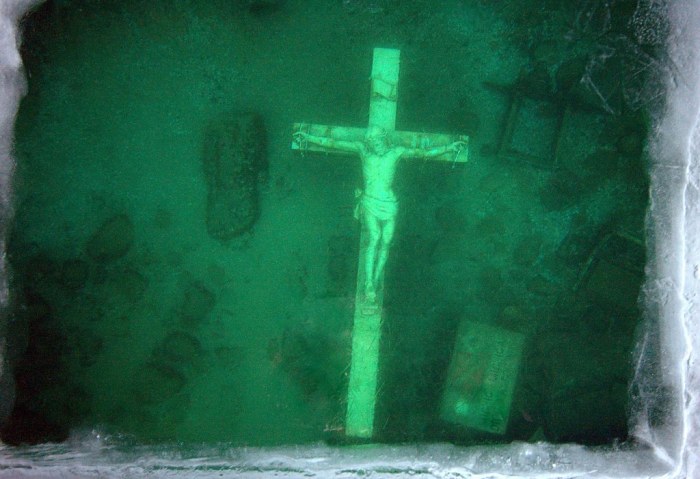
The Petoskey Underwater Crucifix

Petoskey Crucifix by Martin McReynolds

Petoskey Crucifix by Martin McReynolds

The Petoskey Visitors’ Bureau shares the story of the Petoskey Underwater Crucifix:

About 800 feet offshore and under 21 feet of water lies an Italian white marble crucifix, the only known freshwater-underwater crucifix. It came to Petoskey in 1962 in a round-about way, and has become a draw for divers and visitors alike ever since. You will not find a shrine like this anywhere else in the U.S.

The 11-foot tall crucifix, with a 5-foot 5-inch figure of Jesus Christ, was placed in the Bay, near the Petoskey breakwall at Bayfront Park, by the Wyandotte-based Superior Marine Divers Club in 1962. Its original intent was to honor Charles Raymond, a Southgate diver who drowned in Torch Lake. Later, the club expanded the focus of the monument to memorialize all those who have perished at sea.

Its origins date back to the late 1950s, when a grieving mother and father from Rapson in Michigan’s Thumb area had it crafted in memory of their son, Gerald Schipinski. Gerald was 15-years-old in 1956 when he was accidentally killed by a shotgun on the family farm.

After being crafted in Italy, the cross was broken during shipping to the Rapson Catholic church; the family rejected the damaged crucifix and it was sold in an insurance sale to the Wyandotte dive club. The crucifix made its way to Little Traverse Bay and was first placed by the U.S. Icebreaker Sundew 1,200 feet off the Petoskey breakwall on Aug. 12, 1962.

…in the early 1980s Dennis Jessick was president of the Little Traverse Bay Dive Club, and he proposed a winter viewing of the crucifix. The first was held in 1986, affording the community the chance to view the statue through a hole made in the ice. Lights are placed under water to help with viewing. The viewing of the crucifix,” as the locals call it, has continued.

The viewing of the Crucifix is always free and takes place if the ice is thick enough and other weather related conditions are right, usually in the end of February or early March. (NO VIEWING IN 2022) A tent is set up at the viewing area – which is a sure sign to the public that the viewing is taking place. It is also publicized in local media and on local Chamber of Commerce and Visitors’ Bureau web sites.

More at the Petoskey Visitors Bureau & for sure check out this article on the crucifix from Northern Michigan Mish-Mash for a ton more info & some photos. Not gonna lie – I was really hoping to see this in person this year, but unfortunately there won’t be a public viewing in 2022 as there usually is. 

Martin took this photo back in 2009. Head over to his Well Liked gallery on Flickr for lots more great shots from Petoskey & elsewhere.

Support Michigan in Pictures with Patreon

The Ontonagon Boulder

Ontonagon Copper Boulder at the Smithsonian

Ontonagon Copper Boulder at the Smithsonian by Ian Shackleford

Today’s post is what we call a foreshadowing in the photo blog game. It concerns the extremely messy saga of the Ontonagon Boulder which is now at the Smithsonian Museum of Natural History. You can (and should) read it all, but here’s some highlights:

In 1669 the French government sent Louis Joliet to search for copper deposits in the area. Joliet decided to discover the Mississippi River instead.

English adventurer and fur trader Alexander Henry trips up the Ontonagon River in 1765 and 1771. An underwhelmed (and astoundingly wrong) Henry was unimpressed writing, “The copper ores of Lake Superior can never be profitably sought for but for local consumption….” The 5 million plus tons of copper 5,400,000 disagree.

In 1819 Gen. Lewis Cass directed an expedition to the boulder & sought to move it by burning thirty cords of wood around the boulder & throwing water on the hot copper which didn’t succeed in fracturing the boulder.

In 1841, Detroit hardware merchant Julius Eldred and an interpreter set out to buy the boulder from the Chippewa on whose land it stood for $150. He failed that time & the next, but in 1843 with a portable railway & car managed to move it (after having to buy the rock AGAIN from some Wisconsin miners for $1,365).

From the U.S. National Museum report of 1895: For four miles and a half, over hills 600 feet high, through valleys and deep ravines; through thick forests where the path had to be cut; through tangled underbrush, the home of pestiferous mosquitoes, this railway was laid and the copper bowlder (sic) was transported; and when at last the rock was lowered to the main stream, nature smiled on the labors of the workmen by sending a freshet to carry their heavily laden boat over the lower rapids and down to the lake.

At this long-awaited, triumphant point, Eldred was confronted by an order from the Secretary of War to General Cunningham, directing that the copper boulder be seized for transportation to Washington.

“The persons [Eldred and his sons] claiming the rock have no right to it,” the Secretary decreed, “but justice and equity would require that they be amply compensated for the trouble and expense of its removal from its position on the Ontonagon to the lake; and for this purpose General C. will examine their accounts and allow them the costs, compensating them fully and fairly therefore, the sum, however, not to exceed $700….”

In the end & with the help of Congress, Eldred received $5,664.98 which is roughly $200,000 in today’s dollars.

Read lots more from the Smithsonian & also check out a more detailed look at the drama around Eldred from The Mining Journal.

The photo was taken by Ian Shackleford & appears in the Wikipedia entry for the Boulder

Support Michigan in Pictures with Patreon

Happy 185th Birthday, Michiganders!

Mighty Mac at 50 by Julie

Mighty Mac at 50 by Julie

On January 26, 1837 Michigan was admitted to the Union as the 26th state. The Freep has a feature with some fun facts about Michigan a few years ago. One that caught my eye was this one:

What’s a Michigander?

The term many of use and love today was coined by none other than Abraham Lincoln in 1848. Then an Illinois congressman, Lincoln referred to Michigan governor Lewis Cass, who was running for president as a Democrat, as a “Michigander”, meaning he was as silly as a goose. Lincoln was mad at the Democrats for making more than they should have of Cass’ military experience, and the term was meant as an insult. “There is one entire article of the sort I have not discussed yet;” Lincoln said, “I mean the military tale you Democrats are now engaged in dovetailing onto the great Michigander.”

They note that while neither is official, many prefer “Michiganian.” I have always been a fan of Michigander, but I confess this fact is making me reconsider!

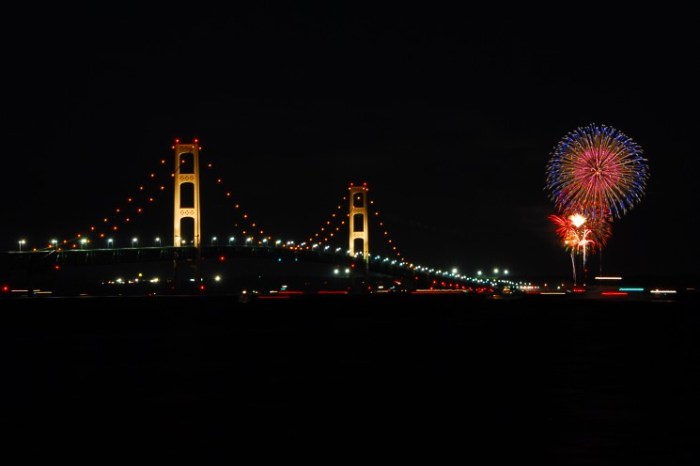
Julie took this photo at a big birthday for Michigan, the 50th anniversary of the opening of the Mackinac Bridge which (IMO) is what made Michigan, Michigan.  See MANY more photos in her Michigan album on Flickr & enjoy our collective birthday!

Support Michigan in Pictures with Patreon

MLK and the Garment of Destiny

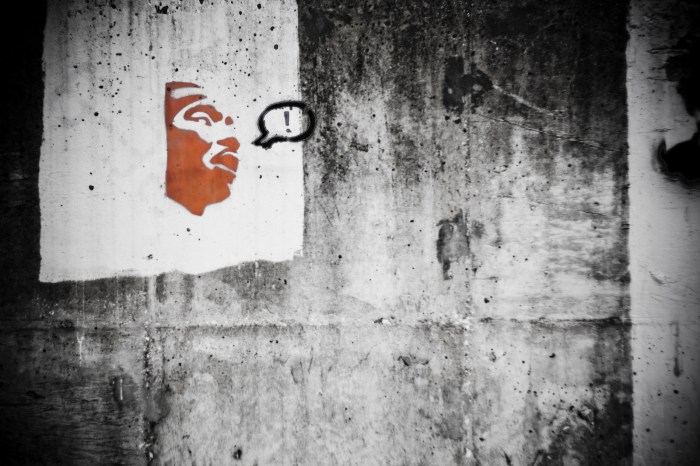
MLK Say ! by Rudy Malmquist

MLK Say ! by Rudy Malmquist

“Injustice anywhere is a threat to justice everywhere. We are caught in an inescapable network of mutuality, tied in a single garment of destiny. Whatever affects one directly, affects all indirectly.”
– Dr. Martin Luther King, Letter from Birmingham, Alabama jail, April 16, 1963

Today is the day America remembers civil rights giant Dr. Martin Luther King, and for me these words engraved on the north wall of the MLK Memorial in DC encapsulate both his work and the still incomplete journey to justice for every American, and for every person.

Are the conditions for justice for all better today than when Dr. King wrote those words? Unquestionably.

Are they as good as they can be? Of course not. As Flint, Benton Harbor, and other communities have shown, the drinkability of your water in Michigan depends in large part of the color of your skin. Three times as many Black Michiganders live in poverty and they face 7 years less lifespan on average, clearly demonstrating that a lot of the work that Dr. King championed still needs to be done.

For sure check out the Detroit March to Freedom of June 23, 1963 on Michigan in Pictures if you haven’t already. It was at the time the largest civil rights demonstration in U.S. history, with 125,000 marching down Woodward Avenue culminating in a speech by Dr. King at Cobo Hall that is recognized as his first delivery of the “I have a Dream” speech.

Rudy took this photo of graffiti in downtown Grand Rapids way back in 2009. See his latest on Flickr & Instagram.

Support Michigan in Pictures with Patreon

Leland Blue

via Leelanau.com

Leland Blue Stone by Cortney Brenner

Leland Blue Stone by Cortney Brenner

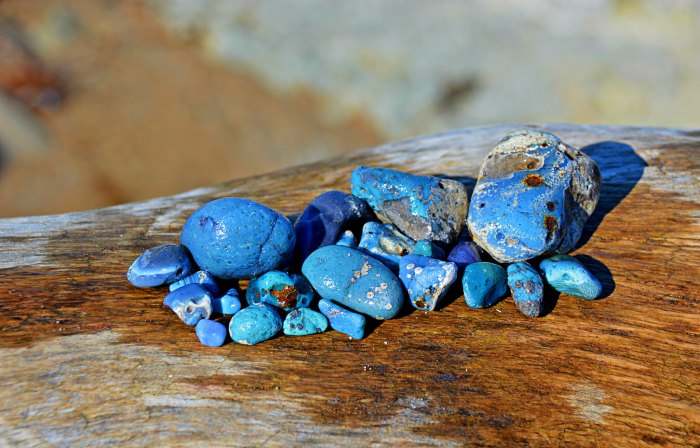
In last week’s post about an unidentified blue mineral discovered at the Adventure Mine on the Keweenaw Peninsula, I offered my personal theory that the color is due to the same reaction that created “Leland bluestones”. A couple people asked what the heck a Leland blue is, so here you go:

In the Glen Arbor Sun, Sandra Serra Bradshaw shares that Leland Bluestones were born over 100 years ago in the fires of the Leland Lake Superior Iron Company:

Between the years of 1870 to 1884, the Leland Lake Superior Iron Company operated an iron smelter north of the mouth of the river. They supplied the voracious furnace with ore from the Upper Peninsula. The charcoal they needed was made from local maple and beech timber that was produced in 14 beehive kilns that were kept near the smelting furnace. It produced up to an amazing 40 tons of iron per day. In 1884, the plant was sold to the Leland Lumber Co., which operated a sawmill on the site. Other sawmills and shingle mills operated in Leland during the years between 1885 through 1900.

Back then Leland was a smog-filled industrial town, the main industry of which was anchored by the iron company. The smelting industry failed because of large overhead costs and the lack of a good harbor in Leland. Interestingly, the remains of the industry, including heaps of slag, were dumped into the harbor and today, that has resulted in something as a precious collectible for many. As raw ore was heated, the desired iron ore was separated from various natural impurities. When those impurities cooled, it resulted in a stone-like slag. Hence the Leland Blue Stones were born!

The Leland Blue is a bit of a misleading title to this little man-made gem as it is the mix of blue glass with other chemicals — but this varying chemical medley can also cause the slag to appear in colors of purple, gray, or in shades of green. Today, people relish finding this slag material on the shores of Leland’s beaches. It is not only collectible as a stone, but also sought for as jewelry.

More in the Sun.

This sweet photo was taken by Cortney Brenner on the beach in Leland back in 2017. See more from Cortney on her Flickr!

PS: I promise no posts from Leelanau for at least the rest of the week!

Support Michigan in Pictures with Patreon

A New Blue at Adventure Mine

Blue Mineral at Adventure Mine

Blue Mineral at Adventure Mine

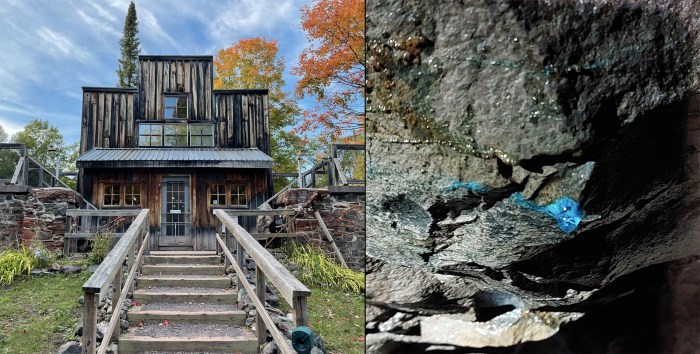
WWJ-Detroit shares that a bright blue mineral has been discovered at a mine on the Keweenaw Peninsula that so far has people perplexed:

The mysterious mineral was found on rock walls in the historic U.P. Adventure copper mine in Greenland Township, south of Lake Superior.

On Sunday, officials from the mine have posted pictures on Facebook of the mystery substance found on rock walls, but the bright blue material has not been positively identified.

Officials said they believe it to be a secondary mineral caused by a reaction with air and water. The mine operated from 1850 until 1920 and 11 million lbs. of native copper has been extracted.

Definitely visit the Adventure Mine website for information on their tours & the history of the mine.  In the Facebook post referenced, Adventure Mine said “This bright blue mineral has not been positively identified as of this post but it is a secondary mineral that is caused by a reaction with air and water. It was found on the 3rd level in a small stope.” A stope is an excavation in a mine working or quarry in the form of a step or notch & the comment thread has some very interesting ideas as to what the mineral could be.

My own personal pet theory based solely on how cool it would be is that this reaction is due to the same mineral that creates the unique iron ore slag known as Leland Blue

PS: After some discussion with Adventure Mine operators, I realize that I took my kids on a tour there 20 years ago. Super cool & a highlight of our visit to the awesome Keweenaw Peninsula – definitely put a trip to the copper-iest of Copper Country on your Michigan bucket list!

Support Michigan in Pictures with Patreon

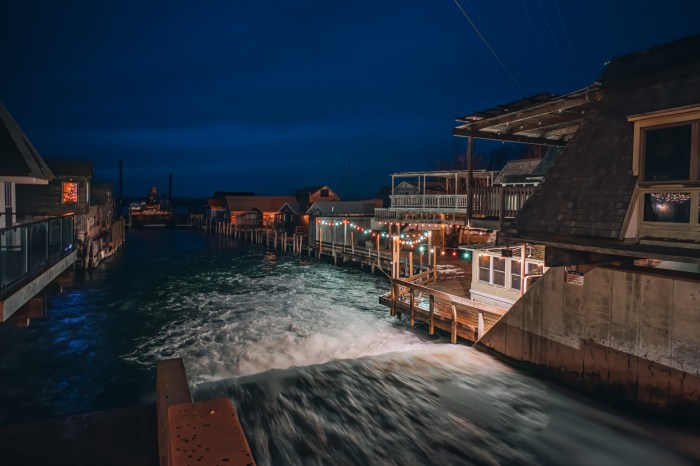
Waterfallish Wednesday: Seasons Greetings from Fishtown

via Leelanau.com…

Flowing All Night Long by Mark Smith

Flowing all night long by Mark Smith

While this dam isn’t an actual waterfall, I’m going to overlook it due to seasonal appropriateness. In their excellent overview of the history of Fishtown in Leland, the Glen Arbor Sun shares:

Fishtown is located where there once was a natural fish ladder on these traditional Native American fishing grounds. It is one of only few commercial fishing villages still operating today in Michigan. The Native Americans called this spot Mishi-me-go-bing, or alternatively Che-ma-go-bing or Chi-mak-a-ping, meaning “the place where canoes run up into the river to land, because they have no harbor.”

French Canadian millwright, Antoine Manseau, along with his family, are thought to be among some of the first whites to settle here. They came from North Manitou Island in 1853. The following year Manseau and his family, along with John Miller, built the dam at Fishtown. It raised the water level in the river and in Lake Leelanau by as much as an astonishing 12 feet. Since the dam prevented boat traffic from going back and forth in their daily business, launches were, and still are provided on both sides of the dam.

Lots more in the Sun. You can learn more about the history of the dam from Fishtown Preservation.

Mark took this photo a week ago. See more in his Leland gallery & view and purchase his work at Leelanau Landscapes.

Support Michigan in Pictures with Patreon

Wandering the sands of time

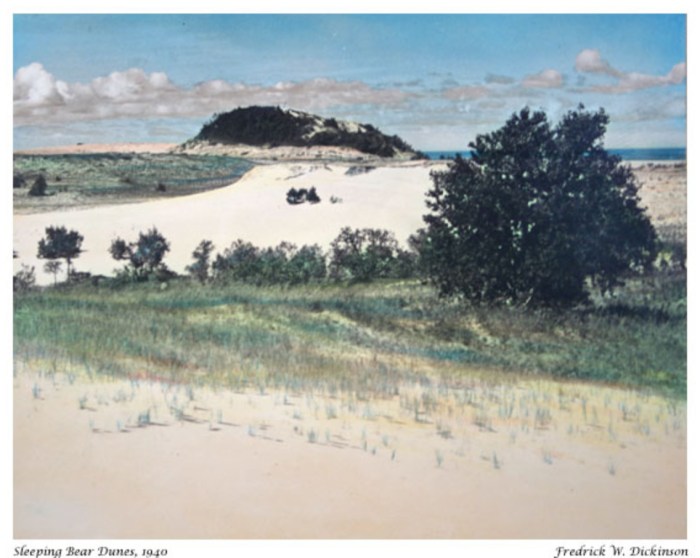
Sleeping Bear Dunes 1940 by Fredrick W Dickinson

Sleeping Bear Dunes 1940 by Fredrick W Dickinson

“What has been lost may yet live in memories.”
-Christopher Paolini

This morning a reader commented on John McCormick’s photo of the Au Sable Point Lighthouse that I shared last week, saying “This was an incredible shot, and I think of it whenever I go out to the lighthouse. I doubt that shot can be duplicated now; there are lights all along the foundation of the building, and the beacon is no longer operating.” That got me remembering other Michigan scenes that are lost to us except in photographs & one that was right in my backyard!

While the  that “the Bear” was also an actual formation atop a dune about a mile north of the Pierce Stocking Overlook. The Sleeping Bear Dunes National Lakeshore says that the formation pictured above known as “the Bear”…

…hardly looks like a bear now, for it has been changing rapidly in recent years. At the turn of the century, it was a round knob completely covered with trees and shrubs. You can still see some of the thick vegetation that gave it a dark shaggy appearance.

…For a long time, the sleeping Bear Dune stood at about 234 feet high with a dense plant cover. However, trough most of the twentieth century, erosion has prevailed. By 1961, the dune was only 132 feet high, and by 1980, it was down to 103 feet. The process is a continuing one. The major cause of the dune’s erosion was wave action wearing away the base of the plateau on which the dune rests. As the west side of the dune loses its support, it cascades down the hill. The wind, too, is a major agent of erosion, removing sand and destroying the dune’s plant cover.

The photo above was taken by Leelanau photographer Fred Dickinson. On Michigan in Pictures there’s a photo of Fishtown in 1940 that explains Dickinson’s hand coloration technique and another shot by Fred of some folks taking a break from a Sleeping Bear Dune ride.

Definitely check out the Dickinson Photo Gallery to view & purchase great photography of the dunes & other Leelanau locations. The gallery is still run by his daughter Grace who also colorizes photos. 

You can see a couple more photos of the Bear from MSU & click over to Leelanau.com for the Legend of the Sleeping Bear

Support Michigan in Pictures with Patreon

Remembering Michigan’s Christmas Tree Ships

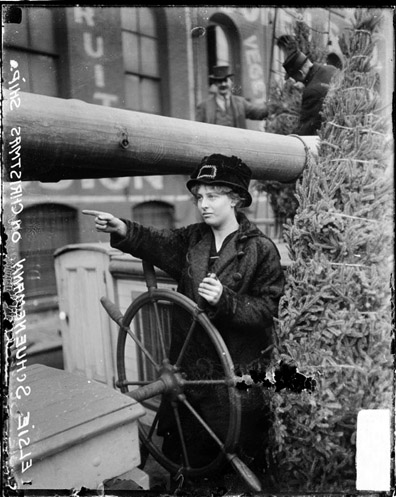
Elsie Schuenemann at the helm of the  Christmas Tree Ship

Above is a portrait of Elsie Schuenemann at the wheel of the Christmas Ship, near the Clark Street Bridge on the Chicago River in the Loop community area of Chicago, Illinois. The boat carried Christmas trees to Chicago from Michigan. Her father, Captain H. Schuenemann, died when the Rouse Simmons, a ship carrying Christmas trees, sank in 1912.

The trees behind her likely came from the woods of Escanaba. Though the story of Barbara Schuenemann and her three daughters carrying on the tradition of the Christmas Tree Ships has perhaps been a little over-romanticized, there can be little doubt that the Schuenemann family and the many others who participated in the difficult trade of hauling Christmas trees south as the storms of winter closed in were heroes cut from a cloth that isn’t found too often today.

If you’d like to read more about all the Christmas tree ships (there were many more than just the famous Rouse Simmons) I recommend Christmas Tree Ships from Fred Neuschel. He has also written a book called Lives and Legends of the Christmas Tree Ships (available from UM Press). The National Archive also has The Christmas Tree Ship: Captain Herman E. Schuenemann and the Schooner Rouse Simmons that details the Schuenemann’s story.

You can also see Rich Evenhouse’s cool video of diving the Rouse Simmons.

Support Michigan in Pictures with Patreon

The Legend lives on…

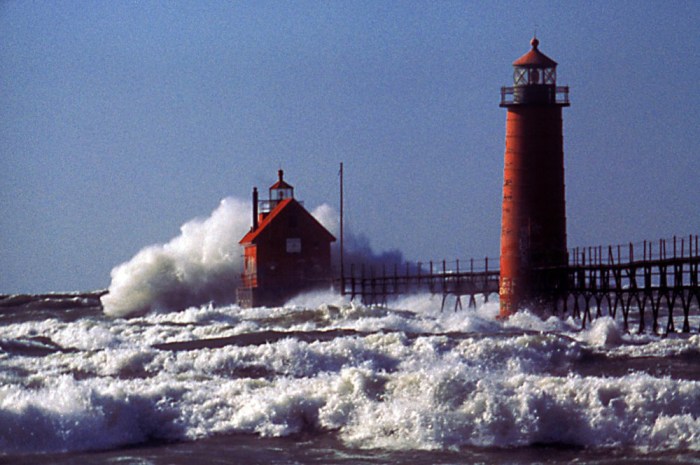
Grand Haven Fitz Storm by Carl TerHaar

Grand Haven Fitz Storm by Carl TerHaar

Most Michiganders of a certain age remember the furious storm of November 10, 1975, and 10-year-old me was no exception. I was enjoying re-creating the scene in the Wizard of Oz where the Tin Woodman leans at impossible angles by holding out my coat & leaning into the wind when the wind started ripping 4 x 8 sheets of metal roofing of our barn & driving them into the ground, ending that experiment in a hurry. 

The memory of the fury of that storm & the shock people around me has stuck with me all my life. I feel like the one video I watch every year by Joseph Fulton perfectly captures the impact, so please enjoy.

Carl took this shot way back on November 10, 1975 in Grand Haven where the storm also washed several people off the pier, killing 2. See more in his Lighthouses gallery & stay off piers in storms people!

Lots more about the Edmund Fitzgerald including these photos of the launch of the Fitz on Michigan in Pictures.

Support Michigan in Pictures with Patreon