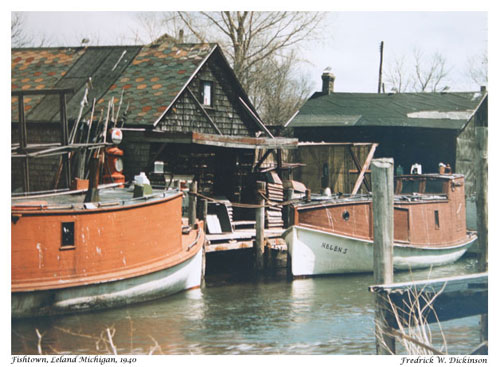
Fishtown 1940, Fred Dickinson

Fishtown, Leland Michigan 1940, photo by Fred Dickinson

I got a call yesterday from Grace Dickinson. In the course of talking with her, I found that she had a web site where her photography and the photography of her father, Frederick W. Dickinson, is on display. Fred is one of my all time favorite photographers and I had the chance to sit down with him years ago and talk about his life and work. It appears in Reflection: The Lens of Memory and you might enjoy it.

The above photo of Leland’s Fishtown is hand-colored and, according to the Dickinson Gallery in the Sleeping Bear Dunes:

This technique of hand coloring was widely used in previous years. The same process was also used in tinting/hand coloring high school senior pictures. The paint is transparent and oil based. The colors are applied to the black and white photograph with cotton and blended over the image without obscuring the image. The detail work in small area is done photo colored pencils. Hand colored landscape photos have a pleasing effect with its muted shades of color.

You can see more work and purchase photos from the Dickinson Gallery web site.

The Novi Special Water Tower

2006.06.11 - Water Tower - Novi - 004

2006.06.11 – Water Tower – Novi – 004, photo by ercy.

This is just one of the photos in the Michigan Water Towers group on Flickr. It might seem a little silly to have a collection of water towers, but (in Ercy’s apt phrasing) water towers are reminders of paths we’ve taken.

Since Wikipedia pretty much has the theory and history of water towers covered, here’s a bit on the Novi Special. Novi is a suburb located to the northwest of Detroit and according to the Motorsports Hall of Fame of America of Novi, it’s also the place where:

Ed & Bud Winfield designed and built a 181 cubic inch supercharged V-8 engine in 1938. It was arguably the most advanced piston engine in the world. It was this engine that became the famous Novi V-8 and powered a series of Novi Specials at Indianapolis from the 1940’s through the 1960’s. Even after the last Novi Special raced in 1965, the name has been associated with speed and power.

Click the Novi Special below for more details from the Motorsports Hall of Fame. If you click the car when you get there, you can see a nice photo of the last Novi Special ever made. (if you visit the Hall, you can see the actual car!)

Three Faces of the Barton Dam

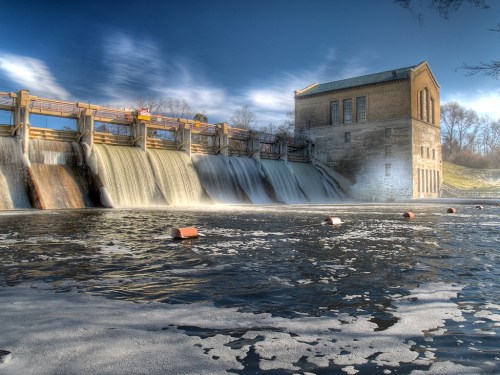
Barton Dam (Photomatix HDR)

Barton Dam (Photomatix HDR), photo by jhoweaa.

The photographer has posted three versions of this photo of the Barton Dam in Ann Arbor and is interested in hearing which of the three folks prefer. They also write “I really like this dam. It was designed by University of Michigan Dean of Architecture Emil Lorch and built in 1912” and provide a link to this great historical photo of the Barton Dam being built.

Here are the other two images (original and normal HDR):

A visit to Cranbrook House and Gardens

Untitled, photo by Rhonda_Marie.

Last weekend, the Exposure.Detroit group on Flickr held a photography meetup at Cranbrook. Here is a link to many more great photos taken at Cranbrook.

Cranbrook House and Gardens in Bloomfield Hills is the heart of the over 300-acre National Historic Landmark Cranbrook campus. The English Arts and Crafts-style Cranbrook House was designed by Detroit architect Albert Kahn in 1908 for Detroit News publisher George Gough Booth and Ellen Scripps Booth. The home is the oldest surviving manor in the metro Detroit area. According to the Cranbrook House and Gardens site:

The Booths commissioned the finest artisans, craftsmen and studios of the period to furnish the house with handcrafted furniture, tapestries, tiles, stained and leaded glass, and other works of fine and decorative art.

The 40 acres of gardens that surround Cranbrook House were originally designed by George Booth to entice visitors to savor the serenity of the spring and summer months. From the symmetry of the Sunken Garden to the scent of the herbaceous garden to the casual beauty of the bog garden, there is something to capture everyone’s interest. Sculpture, fountains and architectural fragments enhance the setting with spacious lawns, specimen trees, and a lake stretching out beyond the fieldstone walls.

Also see Cranbrook’s History in the Cranbrook Archives and How one man’s bad luck paved way for creation of Cranbrook from the Detroit News Rearview Mirror. Also see this map of the Cranbrook area with geotagged photos.

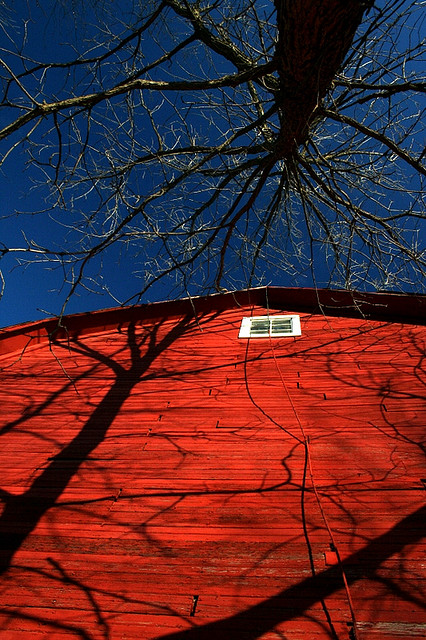
longtime friends, like barns and red

Like Barns & Red

longtime friends by markmarko

Charles Leik, editor of The Barn Journal says that the question of “Why are barns red?” is their all-time most popular FAQ:

Ferric oxide (rust), a primary component of red paint, is inexpensive and this appealed to the thrifty farmers of New England and New York State. Red is the predominant barn color in that region. Natives of these areas were the early settlers of the Great Lakes states migrating there via the Erie Canal and the Lakes. I grew up in central Michigan and there were only a few non-red barns in our area. Two nearby farmers had gray buildings and soon one of them opted for white, which was also a rare color. I conclude that the early settlers brought their red barn tradition (and thriftiness) with them, and this was followed by the later immigrants (Germans in our area) who came directly from Europe.

How Stuff Works adds that “Rust was plentiful on farms and is a poison to many fungi, including mold and moss, which were known to grown on barns.”

Old Crystal Lake Trout Ice Angler

Old Crystal Lake Trout Ice Angler

Old Crystal Lake Trout Ice Angler, photo by UpNorth Memories.

This photo is part of a neat set of photos titled Older Benzie County Fishing Memories. If old photos are something you enjoy, check out Don’s astonishing collection of old northern Michigan postcards.

For a while, it looked like most lakes in Michigan would need to dig into the archives to get ice this winter. However, as Eric Sharp writes, the Iceman has (finally) cometh.

Ford Airstream

Ford Airstream

Ford Airstream, photo by Spencer Olinek.

Spencer calls this a wonderfully crazy concept from Ford and Airstream. As a former Airstream owner, I have to agree!

You can get many more photos of the Ford Airstream Concept on Flick and also in this Ford Airstream photo gallery at Airstream.com. If this wacky ride isn’t your style, you’ll probably find something to your liking in the 2007 North American International Auto Show pool.

Also, as a part of our auto show coverage, we have posted our latest Michigan Automotive History feature on the Ford Motor Company.

Detroit Public Library Mural

Detroit Public Library

Detroit Public Library, photo by DSPII.

Mac also has a photo of the exterior of the main branch of the DPL.

I searched and searched for information about this mural and found nothing, even at the Detroit Public Library web site. I did find several more pics from the library at DetroitFunk. Still, if anyone knows the tale of this mural, I would love to hear it!

orange star car from the 2006 Detroit Auto Show

orange star car

orange star car, photo by Boston Fan in Michigan.

This Dodge Challenger concept car was the star of the 2006 Detroit Auto Show. It’s also part of a fantastic set of 2006 Detroit Auto Show photos. In addition to her camera, Sam brought her friend Dave (a “car fiend”) along and he offers commentary on the pictured cars. For this one, Dave says:

This car is an interesting design exercise. Unlike the new Mustang or Chevrolet’s Camaro concept, this design really does nothing to evolve the 1970s original. If Dodge produces this car, the response will be quite telling about the progression (or regression) of automotive design.

Dodge Challenger buffs might enjoy the Dodge Challenger home page, complete with history, photos and TV and magazine ads.

More coverage of the 2007 North American International Auto Show at Absolute Michigan.

PS: We’ll be posting an article on Absolute Michigan a little later this morning tomorrow with multimedia featuring this car and some other views from last year’s auto show that you have to see!!

Here’s the link to Detroit Auto Show Multimedia on Absolute Michigan! (be sure to check out those panorama tours at the full screen size – they are amazingly cool!!)

Up close with the Tawas Point Lighthouse

Tawas Point Lighthouse by midmichphotos

Tawas Point Lighthouse by midmichphotos

This photo is one of a set of lighthouse photos. According to Terry Pepper’s Seeing the Light (which also has a stunning photo of the Tawas light in the 1800s) nothing came easy for those who sought to establish an aid to navigation of Ottawa Point at one end of Tawas Bay on Lake Huron. By the 1870s, scant years after construction of the first light on the point:

By virtue of the prevailing Northeast wind, Ottawa Point had forever been in a state of evolution. Driven by wave and wind, sand from the lake-bed and the shoreline was continually deposited onto the end of the Point, changing its configuration. Over the years since the construction of the Light, this natural reshaping had continued unabated, lengthening the Point by almost a mile, and leaving the old lighthouse “high and dry,” three quarters of a mile from the end of the point it was designed to mark. Additionally, the light had a reputation among mariners as being extremely dim and difficult to see from out in the Lake. The combination of the dimness of the light and its distance from the Point represented a disaster waiting to happen.

Read on for the rest of the story. You can get directions to the light and information about nearby attractions from Michigan.gov and information about Tawas State Park from the DNR. You might also want to check this map of the location of the Tawas Point Lighthouse (and see some other pics taken there).