Memorial for the 1971 Port Huron Water Tunnel Explosion

"TUNNEL DISASTER"

“TUNNEL DISASTER”, photo by uthomie7264.

I got all excited that the 60,000th photo had been added to the Absolute Michigan pool on Flickr, but when I researched it, I found that there’s a terrible tragedy associated with it. The Detroit News relates that the events of December 11th, 1971 that resulted in the deaths of 22 workers.

Construction of the tunnel had begun in the spring of 1968 and was plagued by controversy, mishaps and plan changes from the start. The tunnel was to go five miles under the lake off Port Huron through bedrock to access fresh water for metropolitan Detroit. It was to be capable from the beginning of pumping 400 million gallons of pure drinking water per day to a thirsty Detroit, later expanding to 1.2 billion gallons to meet the demands of a rapidly growing area. The $120-million project was only three weeks from completion at the time of the blast.

“I don’t remember much about the explosion,” said one of the survivors, Richard Green, then 27. “I thought an air line broke, but it pushed the hell out of me. It seemed like a bomb. I was on top of the form (for concrete pouring) and the next thing I knew I was flying through the air.”

You can read more about the Memorial for the 1971 Water Tunnel Explosion from the Detroit Water and Sewerage Department and more about the sculpture from sculptor Paula Slater’s web site.

Be sure to check this photo out bigger too!

Set Sail on the SS Keewatin in Saugatuck / Douglas

Set Sail

Set Sail, photo by chicagokristi.

The Keewatin Maritime Museum is located in Saugatuck / Douglas and offers folks a chance to tour this 350′, wooden frame steamship:

The Keewatin was built for the Canadian Pacific Railway, in Scotland. Delivered to the Great Lakes in 1907, this lovely steamer was destined to make history. For over 50 years she served as a railway link, connecting the Georgian Bay and upper Lake Superior railheads. She is the last of the Classic Great Lakes Passenger Steamships still afloat.

Take a quick tour right here.There’s some cool views of this steamship in the Keewatin slideshow including a postcard of the Keewatin steaming along.

Be sure to view this photo larger

Remembering Detroit Pistons owner Bill Davidson

The Real Fab Five

The Real Fab Five, photo by Dave Hogg.

For any successful organization or business, you have to have integrity, and you have to make everything as straightforward as you can make it.
~Detroit Pistons owner William Davidson

Sometimes when I don’t know what I’m going to post on Michigan in Pictures, it’s a happy thing. Other days, like today, it’s not.

Last night we lost a man who has done as much as anyone to bring athletic excellence to the Palace and the state of Michigan. On his photo from December of 2005, Dave wrote “These five guys have brought a lot of joy to the Motor City in the last 18 months.” I think that Detroit Pistons owner William “Bill” Davidson certainly merits consideration as a sixth man.

bill-davidson-detroit-pistons1William Morse Davidson was born on December 5, 1922 in Detroit. He played football in the Navy during World War II and was a member of the track-and-field team at the University of Michigan, where he majored in business, following it up with a law degree from Wayne State in 1949. He eventually transformed the family business, the Guardian Glass Co., into Guardian Industries, one of the world’s largest manufacturers of architectural and automotive glass.

From William Davidson’s Wikipedia entry, I learned that Davidson was only the second owner the Pistons have ever had and that his name is on the Palace floor along with Piston legends who all played during his tenure: Dave Bing, Bob Lanier, Bill Laimbeer, Vinnie Johnson, Chuck Daly, Joe Dumars and Isiah Thomas. The Detroit Pistons web site tells the story of his involvement with the Pistons and the WNBA’s Detroit Shock:

Mr. Davidson owned the Pistons since 1974 and won three NBA Championships (1989, 1990, 2004), three WNBA Championships (2004, 2006, 2008) and one NHL Championship (2004). He became the first owner in sports history to win championships in three different professional sports leagues during the 2003-04 calendar year (NBA – Detroit Pistons, NHL – Tampa Bay Lightning and WNBA – Detroit Shock). In September 2008, Davidson’s contributions to the game of basketball were honored when he was officially enshrined into the Naismith Memorial Basketball Hall of Fame.

In 1988-89, the Pistons began play in The Palace of Auburn Hills, a state-of-the-art arena built with Davidson’s financial support: a privately-financed facility, which when combined with the Pistons, formed the foundation of his entertainment business.

…The Pistons have played in the postseason in 19 of the past 25 years, including 11 of the past 13 seasons. Davidson acquired the Detroit Pistons in 1974 from the late Fred Zollner, the man who founded the team in Fort Wayne, Indiana in the 1940s. With a franchise-record seven straight seasons of recording 50 or more wins, the Pistons have won 384 regular season games (.669 wining percentage) since 2001, including a franchise-record 63 wins in 2005-06. The club has compiled 73 playoff wins in that same span and made six consecutive trips to the Eastern Conference Finals for the first time in franchise history. Detroit has won six Central Division titles in the last seven seasons and nine overall since 1987-88. Only the San Antonio Spurs have won more division titles in the same 20-year span.

The Detroit Shock joined the Washington Mystics as the first two expansion teams in the WNBA in 1998 and the team was an immediate success in the upstart league. The Shock have won three championships since their inception (2004, 2006, 2008) and set a WNBA attendance record (22,076) in Game 3 of the 2004 WNBA Finals while also becoming the first team since 1890 to go from the worst team in a professional sports league to the best team.

The Detroit Free Press has a nice article on Bill Davidson that tells more of how Davidson presided over the transformation of a team that was “basically a laughingstock” into one that has won 3 championships and appeared in the post-season far more often than not. You probably will be happiest, however, with Mitch Albom’s September 2008 interview with Bill Davidson. They also have a nice photo gallery as does the Detroit News (the second photo in the gallery is great!)

Be sure to check the above photo out bigger and see more great work from Dave in his Your Favorites slideshow.

More Detroit Pistons from Michigan in Pictures.

Royal Oak, Michigan

Royal Oak, Michigan

Royal Oak, Michigan, photo by paulhitz.

Be sure to check Paul’s photo out bigger and see more of Royal Oak photos in his slideshow. You can also check out about 400 more Royal Oak photos from the Absolute Michigan pool.

On their History page, the City of Royal Oak explains that:

In 1819, Michigan Gov. Lewis Cass and several companions set out on an exploration of Michigan territory to disprove land surveyors’ claims that the territory was swampy and uninhabitable. The beginning of their journey seemed to support those claims until they reached a desirable area of higher ground near the intersections of Main, Rochester and Crooks Roads. Here they encountered a stately oak tree with a trunk considerably wider than most other oaks. Its large branches reminded Cass of the legend of the royal oak tree, under which King Charles II of England took sanctuary from enemy forces in 1660. Cass and his companions christened the tree, the “Royal Oak.” And so Royal Oak received its name.

As early as 1891, when Royal Oak was a small village, there were only a few hundred residents. In the 10-year span from 1900 to 1910 the population grew to over 1,000. By the time Royal Oak was incorporated as a city in 1921, the population had exploded to over 6,000. This was due in large part to new jobs created by the booming auto industry. The development of the super highway, Woodward Avenue, led to greater population expansion. Woodward Avenue replaced the old Indian road, Saginaw Trail, as the connection between Detroit, Pontiac, Flint and Saginaw, making Royal Oak more accessible. Today, the 28-mile Woodward Avenue (M-1), bridging 10 communities from the Detroit River north to downtown Pontiac, holds the honorary designation of Michigan Heritage Route. The designation was awarded because of the historical and cultural significance of some 350 sites along Woodward Avenue, including 42 historic churches.

You can get tons more great Royal Oak history & historic photos from Historic Royal Oak by Dr. David G. Penney.

Wikipedia’s Royal Oak entry says that as of 2000, the city had a total population of 60,062, making it Michigan’s 18th largest city. Michigan in Pictures has a lot of photos that involve Royal Oak (apparently there’s some sort of Photographic Guild that exhibits there).

Check out Royal Oak on Absolute Michigan’s Michigan Map.

Women’s Suffrage in Michigan

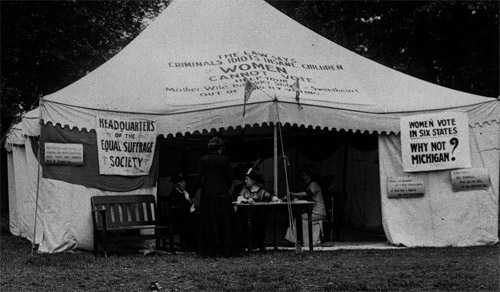
michigan-womens-suffrage-tent

Woman Suffrage Tent, 1912 Michigan State Fair, courtesy the Archives of Michigan

March is Women’s History Month in Michigan and this month’s Image of the Month from the Archives of Michigan tells of the arduous but eventually successful process that eventually secured the right to vote for women in Michigan with the ratification of the nineteenth amendment in 1919 (Michigan was one of the first 3 states to ratify).

In Michigan, that struggle spanned at least seven decades. In 1846, a woman named Ernestine Rose spoke to the Michigan legislature about the need for woman suffrage. This was two years before the first women’s rights convention in Seneca Falls, New York. In 1849, a Michigan state Senate committee proposed a “universal suffrage” amendment to the Michigan constitution. This would have granted voting rights to both women and African Americans, but no action was taken on the proposal. A woman suffrage bill did not come before the state legislature again until 1866. It was defeated by only one vote.

Click through to read the rest of a struggle that spanned lifetimes.

I love Michigan in Pictures

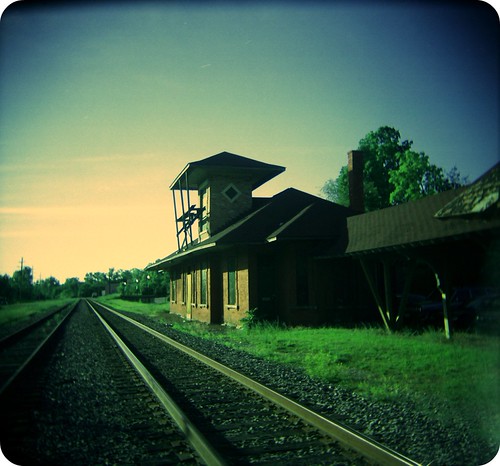
Holga_04_15.jpg, photo by Andy Tanguay

I think that Michigan in Pictures is the best web site that I have ever been involved with. Then again, my response to “You’ve won a trip to Milan!” would probably be “Milan, Michigan?”

One of the happiest parts of my life is that I get to spend some time every day looking at photos about Michigan from some amazing photographers and then learning about the subjects of the photographs and often times the people behind the lens. I’m very grateful for all that the photographers and readers contribute to make Michigan in Pictures what it is. Thanks!

The random background of the day on my computer is this photo from Andy’s Hardcore 313 set. This picture is of an abandoned train station station in Ypsilanti. It might be the same Ypsilanti train station where Presidents Ulysses S. Grant & Martin Van Buren delivered speeches and where Charles J. Guiteau, the assassin of President Garfield, was thrown off the train when the conductor found out he didn’t have a ticket.

Then again, it might be just an abandoned train station. You can view it bigger on white, or in Andy’s photostream.

Edit: Almost forgot! I did this post about Michigan in Pictures so I could link to it from the new Absolute Michigan group on Facebook.

Grand Sable Dunes In Winter

Grand Sable Dunes In Winter

Grand Sable Dunes In Winter, photo by mandj98.

James says they rode his brother’s snowmobiles back along H58 to this overlook of Grand Sable Dunes in the Pictured Rocks National Lakeshore last weekend.

Grand Sable DunesHe has more photos from Pictured Rocks in winter & all seasons in his tremendous Pictured Rocks National Lakeshore set (slideshow) with tons of photos including the pic to the right of the same scene in August.

I was a little surprised to find that I hadn’t written anything about Grand Sable Dunes on Michigan in Pictures. In my opinion, it’s one of the most amazing vistas in Michigan, a broad sweeping dune that arcs along the shore of Lake Superior. It’s a great hike, either from the drive-up overlook (where you can view or visit the Au Sable Light Station) or by walking along the base on the Superior shore just a mile west from Grand Marais. Michigan Tech has a nice writeup on the history, geology and natural character of the Grand Sable Dunes. They’re a perched dune like the Sleeping Bear Dunes in lower Michigan that were formed when:

Glacial ice that melted within the Superior Basin produced many large rivers after the last major readvance, The Marquette readvance, in North America. These rivers deposited millions of tons of debris into many different configurations south of the Superior Basin. The Grand Sable Banks may have originated as a glaciofluvial kame terrace along one of these glacial rivers during deglaciation.

Pictured Rocks then became very dry about 9500 years before present due to the Lake Superior basin draining to the north. The outlets to the east were now the low spots. A north facing ice contact bluff and a platform to the south of it remained in place for 4500 years after deglaciation right around the area where Grand Marais is located today.

Isostatic rebound then occurred about 4000 to 6000 years before present. North Bay began to rise which caused water levels to rise rapidly. In fact, Lake Superior rose to about 40 feet higher than it is today! The rise in lake levels formed Lake Nipissing. Lake levels of Lake Nipissing also began to rise which caused the Grand Sable Banks to become unstable. From this point the formation of a perched dune can explain how the dunes formed from the Grand Sable Banks.

When Lake Nipissing water level rose it caused the Grand Sable Banks to become unstable. In turn, the high water eroded the bluffs which left them exposed to wind. A dominant northwesterly wind blew through the Grand Sable Banks which carried the wind from the bluff to the top of the flat upland. This sand was “perched” on top of the upland, hence the name, “perched dune system.”

You can check out Grand Sable Dunes on Absolute Michigan’s Map of Michigan and check out the Grand Sable Dunes slideshow on Flickr. I have written a fair amount on Pictured Rocks that you might enjoy.

St. Johns, Michigan Bicycle Band

St. Johns, Michigan Bicycle Band

St. Johns, Michigan Bicycle Band, photo by Seeking Michigan.

I thought I’d follow up yesterday’s rant with something from the Archives of Michigan. A number of people have assured me that the Archives and Michigan’s broader arts & cultural support will remain following whatever reorganization happens. I hope so.

This photo made me think about how much more attention early photographers had to pay to lighting and composition. I can’t imagine getting this shot with the cameras they had in 1890. It was the December 2005 Image of the Month and you can read a lot more (and see another picture) there:

According to the Clinton County Republican-News Centennial Issue (published in 1956), the St. Johns Bicycle Band existed from 1886 to 1891 and usually consisted of about twenty pieces. The Republican-News Centennial Issue includes this photo of band members (pg. 6) and identified the drum player above as George Woodruff.

More at seekingmichigan.org and in the Seeking Michigan Fickriver.

What was … and what might have been

Polaris Ring by David Barr

Michigan Library II: Polaris Ring by David Barr, photo by farlane.

Since I’m writing a rant today, I figured I’d use my own photo.

The Freep reports (also Detroit News) that Michigan Governor Jennifer Granholm is expected to announce the disbanding of the Michigan Department of History, Arts & Libraries (HAL) in her State of the State Address tonight at 7 PM.

There’s no word as to how that would impact the libraries, arts organizations and museums that HAL works with, but one can only imagine that it won’t be good. With universities and schools, the State Fair and other state programs facing deep cuts, you can bet that there will be a lot of hand wringing by the Governor and legislators on both sides of the aisle in the days and months to come.

I just want to say that this crisis has been looming for years and as a person with the job of watching Michigan, I’ve watched our elected officials on all sides worry about their political capital, re-election, counting coup on each other and pretty much doing everything but making the hard choices they needed to make. Now, they will face a mountain of unhappy choices and wonder theatrically what they could have done.

My answer? The jobs we elected them to do…

Michigan public television stations will broadcast the address and the Freep will be streaming the State of the State online and I’ll be somehow or other live blogging it at Absolute Michigan.

The sculpture in front of the Library of Michigan is called Polaris Ring by David Barr. Here is the info about it from their “Visions of Michigan” page.

From Easter Island to Africa, from Greenland to New Guinea — David Barr’s work is displayed worldwide. Specializing in project that employ geographic, geometric and geological elements, his Polaris Ring outside the Center’s main entrance often reminds visitors of a modern-day Stonehenge.

Fifty steel columns encircle a five ton kona dolomite boulder. Smaller stones spinout in a spiral pattern on either side.

”The combination of stone and steel represents the interface of prehistoric imagery with man’s technological imagery and strengths,“ Barr notes. The result is a mystical progression of space and volume that draws people toward the facility.

Based on a universal symbol — Polaris, the North Star — viewers are able to stand behind the sculpture’s center stone and look between the two tallest columns to see the star.

”Instead of having to look at the overall sculpture from the outside, I want people to be able to experience if from inside as well,“ he says.

I hope you get a chance to experience this sculpture and this very cool museum.

Happy Birthday, Michigan!

The Capitol of Michigan

The Capitol of Michigan, photo by Ravi Vora.

Today (January 26, 2009) is Michigan’s 172nd birthday. I have to say she doesn’t look a day over 150 – must be all that fresh water!

The Michigan Historical Museum explains the somewhat lengthy process that Michigan took to becoming the 26th State of the Union:

Following the Compromise of 1820 it was the practice to admit a free state and a slave state at the same time. However, when both Arkansas and Michigan were ready for statehood, Michigan was involved in a dispute with Ohio over the Toledo Strip. President Jackson signed a bill on June 15, 1836, that admitted Arkansas but required the people of Michigan to settle the dispute before Michigan would be granted statehood. Michigan would need to consent to a compromise measure drawn up by Congress. The compromise gave the Toledo Strip to Ohio and the western two-third (2/3) of the present Upper Peninsula to Michigan.

A convention to consider the compromise took place in Ann Arbor on September 26, 1836, after delegates were elected. They deliberated for four days; then they rejected the compromise. On December 14 a second “Convention of Assent” was assembled, which—two days later—passed a resolution that accepted the compromise. After this news reached Washington, a bill was introduced to admit Michigan to the Union. Congress passed the bill, and President Jackson signed it on January 26, 1837.

Toledo for the Western U.P.? No offense to Toledo, but I think we made out all right in that one. More about Michigan’s path to statehood from Wikipedia.

Ravi says to check this out larger and cooler.