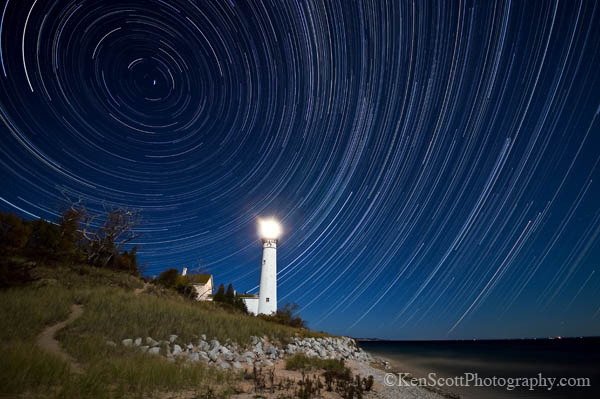
South Manitou Lighthouse Relighting Ceremony

KAScott_20081011_8056_trailsb

KAScott_20081011_8056_trailsb, photo by Ken Scott, Photography.

via Leelanau.com

This Saturday (May 30) the National Park Service invites you to officially celebrate the relighting of the South Manitou Island Lighthouse. Sleeping Bear Dunes National Lakeshore installed a replica third-order Fresnel lens in the completely refurbished lantern room of the lighthouse last fall, a historic event was made possible by a partnership between the park service, Manitou Islands Memorial Society, Manitou Island Transit, and Electro-Optics Technology, Inc. The light was tested then, but it was too late in the season for the a formal ceremony.

Starting at 9:00 PM at the Maritime Museum in Glen Haven, a National Park Service ranger will present a half-hour interpretive program about the history of the Manitou Passage and the shipwrecks that made it necessary to install a lighthouse to guide mariners through its hazardous waters. Following the program, Superintendent Dusty Shultz and representatives from the partner groups will provide brief remarks and recognize the numerous donors who made this project a reality. Light refreshments will be served and when it’s dark enough, the light will be illuminated.

Ken’s photo of the South Manitou Island Light features a collection of 350, 30 second still images stacked to create startrails. Check it out bigger in Ken’s sky stuff slideshow.

This image is available for purchase as a fundraiser to help pay off the relighting renovation bills. Contact Ken at Ken Scott Photography for more information.

More about the relighting of the South Manitou Light…

In Memorium

In Memorium

In Memorium, photo by powerbooktrance.

I hope you all have a chance to remember today.Here’s some more Michigan Memorial Day posts from Michigan in Pictures.

Founder’s Day Sunrise, Marquette Michigan

foundersboatsrise_autolv

foundersboatsrise_autolv, photo by TheDailies.

Kim has a great set of photos from Founder’s Day (slideshow).

On her blog, she relates the story of the Marquette’s first Founder’s Day (May 18, 2009):

While researching Marquette history, particularly the lower harbor and Founders Landing, Joe Constance, a partner with the Landing Development Group, ran across an address Peter White gave to Marquette’s YMCA in 1889. “On May 18, 1849, Peter White and Robert Graveraet first arrived in what would become Marquette,” says Constance. “Reading about their arrival at sunrise and meeting with Chief Kawbawgam, I started thinking about what that friendship meant for our community,” adds Constance. “The 160th anniversary of that date and event in our city’s history needs to be recognized.”

…According to White’s story, the party expected the trip to take three hours, but, “the seven oarsmen were pulling with a will-long strong, deep, regular strokes, that, made the boat show what the sailors call a bore in her teeth for these boys had been told that morning when breaking camp at 4 o’clock at Shot Point, that their destination was in sigh, and if they did as well as they sometimes did that a landing would be made inside of two hours, that the long trip–nine days of coasting would be ended, and the new Eldorado would be reached–and it was accomplished.”

Be sure to check this out bigger too!

In Flight: Bald Eagle De-listed in Michigan

In Flight

In Flight, photo by Mi Bob.

As yesterday’s Traverse City Record-Eagle reported:

The bald eagle is now off both state and federal endangered species lists for Michigan. But the federal Bald Eagle Protection Act of 1940 makes it a crime to hunt, kill or otherwise harm them.

Fewer than 100 nests existed in the state in 1969, DNR officials said. In 2006, there were nearly 500 occupied nests, and the number is growing.

The Michigan DNR page on the Bald Eagle in Michigan has lots of information about their seasonal behavior (they are beginning to hatch their eggs right now) and documents the history of the bald eagle in Michigan:

Before European settlement, bald eagles probably nested in all regions of Michigan where food was available. In the early 1900s they were described as being “generally distributed,” but “nowhere abundant.” A decline through the early and mid-1900s was probably related to slow but consistent loss of suitable habitat and available food, and predator control by humans. These eagles are so disturbed by the presence of humans near their nest that they may be induced to abandon the nest, or even chicks that have already hatched. By 1959, the species was considered, “largely restricted to the northern half of the state.”

Through the 1950s, the slow decline accelerated dramatically, until suddenly, bald eagles were on the brink of extinction in the lower 48 states. The population crash was due to several factors that had reduced reproductive success of nesting pairs, but was mostly the result of increased use of pesticides with chemicals such as PCB and DDT. These chemicals affected the eagles in many ways, including causing them to delay their breeding until it was too late in the season, or even to not breed at all. Eggs that were laid often had thin shells, causing them to break in the nest. At its worst in 1967, only 38 percent of the Michigan population of bald eagles were able to raise at least a single chick. Productivity must be at least 70 percent for a bald eagle population to remain stable.

Recognition of the plight of bald eagles in the US and its cause finally occurred in the 1960s. By the 1970s DDT had been banned in the US. Intensive monitoring of eagles in Michigan began in 1961. Although bald eagles had been protected at federal and state levels since 1940 and 1954, respectively, they received much greater protection after the ratification of the Endangered Species Act in 1973, and the Michigan endangered species act in 1974.

Reproductive success began to improve and in 1975, the 70 percent productivity mark was reached, although it dropped off again soon after. The population remained at around 86 nesting pairs through the 1970s. In 1981, the population at last began to increase. The 1999 survey found 343 nests that produced 321 young. The productivity was calculated as 96% (young per nests with known outcomes). But some problems still exist. Eagles nesting along the Great Lakes coasts have higher contaminant levels in their blood than inland nesting pairs.

The American Bald Eagle information site has all kinds of sighting information from Michigan and will help you find places to see bald eagles.

If you’d like to check them out from your computer, you can see the above photo background big or in Bob’s Eagles set (slideshow, check out the Bald Eagle slideshow in the Absolute Michigan pool and/or Michigan Bald Eagles on Flickr.

Happy Birthday to you, Traverse Colantha Walker

The 2010 Traverse Colantha Walker Festival happens on Sunday, June 13, 2010.

State Hospital Memorial Marker For Traverse Colantha Walker (Traverse City, MI)

State Hospital Memorial Marker For Traverse Colantha Walker (Traverse City, MI), photo by takomabibelot.

From World Champion Cow of the Insane at Roadside America:

Northern Michigan Asylum opened in 1885 and gradually became a sprawling complex on the western outskirts of Traverse City. It was so vast that it had orchards of cherries, peaches and apples, vineyards and vegetable gardens, field crops, and livestock from beef to chickens, horses to pigs. And it had its own herd of cows.

The most famous of these — the most famous inhabitant, period, of the entire Asylum — was Traverse Colantha Walker. She was a grand champion milk cow, producing 200,114 pounds of milk and 7,525 pounds of butterfat in her long life. When she died in 1932 the hospital staff and patients held a banquet in her honor. They buried her in a small, grassy knoll, under a marble tombstone, outside of the stately brick dairy barn that had been her home.

The inaugural Traverse Colantha Walker Dairy Festival will take place on Saturday, September 12, 2009 at the Grand Traverse Commons.

See this bigger right here and also check out takomabibelot’s slideshow. The marker reads:

Traverse Colantha Walker
361604
Born 4-29-1916
Died 1-8-1932
World’s Champion Cow
Milk 200,114.9 lbs.
Fat 7,525.8 lbs.
Nine Lactations
Bred, Owned, Developed
By Traverse City Hospital

The story of the Irish Hills Towers

Irish Hills Towers

Irish Hills Towers, photo by dt10111.

The Wikipedia entry for the Irish Hills Towers says that these wooden observation towers were constructed along US-12 in the Irish Hills region in northern Lenawee County as the result of a curious competition along the lines of the skyscraper frenzy in New York:

In the early 1920s, the Michigan Observation Company sought places of high elevation to erect fifty foot high enclosed platforms to boost tourism. In southern Michigan, a tower was placed atop Bundy Hill in Hillsdale County, Michigan and officials sought a knoll in the heart of the Irish Hills in Lenawee County. A farmer who owned half of the knoll, Edward Kelly, turned down the company’s offer to purchase his portion of the land. The adjoining land owner, Thomas Brighton, consented the sale of his plat, and construction of the Irish Hills Observatory commenced.

The opening of the Irish Hills Observatory was announced by The Brooklyn Exponent in September 1924. In a gala celebration on October 4 and October 5, hundreds of people ascended the hill and tower to gaze upon the rolling landscape and crystal blue lakes in all directions. Kelly seemed spited by the exploitation of the MOCs venture, and protested by erecting his own tower. By the end of November, 1924, his own observation platform was in place, just feet away from the MOCs structure, and several feet higher.

The Michigan Observation Company responded by adding a second observation enclosure to the top of its own facilities, now designated as the “Original Irish Hills Tower”. Kelly proceeded to add a raised platform to his “Gray” tower (named as such because of its gray-painted exterior), an act which brought the two edifices to an even height. The MOC informed Kelly that if he attempted to compete with more height given to his tower, they would tear down their own and construct a metal observatory so large that Kelly’s efforts would be nullified. He conceded, and turned his efforts instead to drawing more revenue to his creation.

In the 1950s Frank Lamping purchased both and added a gift shop. The towers closed in 2000.

Here’s a cool postcard from the 1930s of the view from Irish Hills Towers, a sweet photo from Matt Callow and a few photos showing different views of the towers. You can see the location on Waymarks.

See this bigger right here and in Daniel’s Buildings set (slideshow).

More Michigan roadside attractions from Michigan in Pictures!

Everybody’s heard about the Bird

1954-2009

1954-2009, photo by Boston Wolverine.

Detroit Tiger rookie phenom Mark “The Bird” Fidrych died yesterday in an accident. There’s lots more (including a great interview) at Remembering Mark “The Bird” Fidrych on Absolute Michigan.

Samara took this photo at a Red Sox/Tigers game in Boston. It’s part of her baseball miscellany set (slideshow). She also wrote RIP, Mark ‘the Bird’ Fidrych which you should read if at all possible.

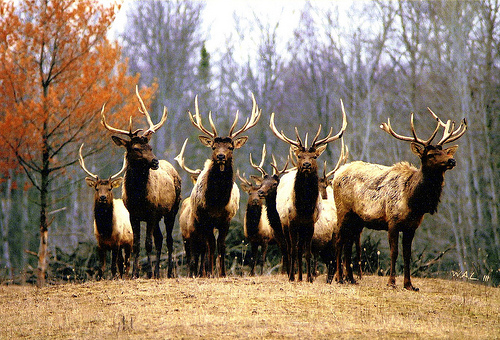
Got Rut? Chillin’ with Michigan’s Elk Herd

Got Rut?

Got Rut?, photo by lonewolv / William A. LaCrosse III.

When I saw this picture (shot in Hillman, MI in 2004) I figured “elk farm.” However, as I looked into the subject I discovered that Michigan has a significant wild elk population. Michigan Elk: Past and Present from the Michigan DNR says:

Michigan’s native elk disappeared around 1875. Today’s elk herd dates back to 1918, when seven western animals were released near Wolverine. From that reintroduction, the number of animals grew steadily to about 1,500 elk in the early 1960s. They reached the point where limited hunting was possible in 1964 and 1965.

… Reduced poaching losses, habitat improvement and successful management of hydrocarbon development resulted in an increase in elk numbers to 850 by 1984.

As the herd grew, problems also increased with forest and agricultural damage. To bring the herd in better balance with its natural food supplies and with the needs of landowners, elk hunting resumed in 1984. Biologists estimated the January 2006 population to be between 800-900 animals. This goal is a winter herd of 800 to 900 elk.

The village of Atlanta claims the title of Elk Capital of Michigan and holds an Elk Festival every September (September 25-27, 2009). You can read more about the second largest species of deer (following only the moose) in Wikipedia’s Elk entry which has this to say about rut:

Adult elk usually stay in single-sex groups for most of the year. During the mating period known as the rut, mature bulls compete for the attentions of the cows and will try to defend females in their harem. Rival bulls challenge opponents by bellowing and by paralleling each other, walking back and forth. This allows potential combatants to assess the others antlers, body size and fighting prowess. If neither bull backs down, they engage in antler wrestling, and bulls sometimes sustain serious injuries.

Find even more elk info and photos under Cervus elaphus, elk (also: red deer; wapiti) from the University of Michigan Museum of Zoology’s Animal Diversity Web.

See this larger in William’s slideshow.

Photos of Michigan Central Station

Michigan Central Station

Michigan Central Station, photo by Grant Zoschnick Photography.

On Tuesday the Detroit City Council passed a resolution for expedited demolition of Michigan Central Station alias Michigan Central Depot alias MCS alias Detroit’s largest ruin.

David Kohrman’s Forgotten Detroit has tons of historical photos and a detailed history of Michigan Central Depot that begins:

When the old Michigan Central Depot burned on December 26, 1913 the still unfinished structure off of Michigan Ave. was called into service. Designed by noted hotel architects Warren & Wetmore and engineers Reed and Stem, the MCS was an exceptionally beautiful building. The style of choice was beaux-arts neoclassical. Flanking massive arched windows were pairs of Corinthian columns, a hallmark of the style. Inside the rooms were modeled after an ancient Roman bathhouse, particularly the massive main waiting room. With an impressive vaulted ceiling this room was the most imposing in the building.

All Aboard: A Retrospective of the M.C.S. is a fantastic look at Michigan Central Station as it was in 1973 and as it is now. Be sure to check this one out.

Michigan Central Station on Wikipedia notes that the building was designed by the Warren & Wetmore and Reed and Stem firms who also designed New York City’s Grand Central Terminal.

Here’s the Michigan Central Station slideshow on Flickr. In Exposure Detroit, many of the photographers whose work is featured in that slideshow are discussing the city council’s vote and how to save MCS and the Save Michigan Central Station Group.

You might also like Detroit’s Michigan Central Station from Michigan in Pictures and watch this great old video on YouTube.

Be sure to check Grant’s photo out bigger and see more of his shots from Michigan Central Station (slideshow).

UPDATE (April 14): Heather Pennington has cool post titled Save Michigan Central Station in which she has some photos and eloquently wonders:

There is much debate on what should be done with this amazing structure. What cannot be debated is the fact that there are countless other structures that are “dangerous, open to the elements, and open to trespassers”. There are so many houses, and former businesses that are abandoned and burned that should be torn down for the safey of the city. The Detroit Fire Department lost one of its own last year when Walter Harris died after the roof of a charred vacant house collapsed on him (read article from Fire Rescue 1 here). Why???

Wouldn’t it cost less than $3.6M (that the city does not have) to demolish vacant and burned homes?

Let’s take some time to clean up the rest of the city; make it safe for all that live, work, and play here. And in the meantime, let’s try to find a reasonable fate for Michigan Central Station.

The Timber Wolf (canis lupus) in Michigan

2007 0300 Wolf on LakeMIUS2

2007 0300 Wolf on LakeMIUS2, photo by Dennis Raney.

Alexis writes Paw took this one of a wolf on Lake Michigan off US2 on the way back downstate. There was another wolf on the ice, but it didn’t make it into this frame It’s part of her very cool Michimania set (slideshow).

Wikpedia says the timber wolf, gray wolf or simply wolf is the largest member of the Canidae family. From the Michigan DNR page on the Gray Wolf (canis lupus) and a recent DNR release regarding the delisting of the gray wolf, we get a picture of the state of wolves in Michigan:

It is believed that wolves were once present in all 83 counties in the state of Michigan. A combination of European werewolf mythology, fairy tales, views that wolves were incompatible with civilization, and active predator control programs throughout the 20th century virtually eliminated the gray wolf from Michigan: by 1840, they could no longer be found in the southern portion of the Lower Peninsula; by around 1910 they had completely disappeared from the Lower Peninsula; and by 1960, when the state-paid bounty on wolves was repealed, they had nearly vanished from the Upper Peninsula.

In 2008, a minimum of 520 gray wolves lived in Michigan’s Upper Peninsula, part of an estimated population of 4,000 gray wolves living in Michigan, Minnesota and Wisconsin.

(DNR Director Rebecca Humphries) emphasized that while the gray wolf has been removed from the federal endangered species list, it remains on the state’s protection as a species. There currently is no hunting or trapping of gray wolves allowed in Michigan, and starting on April 22, the gray wolf will be listed as a nongame species in Michigan. In order for hunting to occur, the Michigan Legislature would need to pass a law to add the gray wolf to the list of game species in the state, she said.

You can get more about Canis lupus (gray wolf) from the University of Michigan Museum of Zoology’s Animal Diversity Web and check out pictures & sounds of the gray wolf from Wikimedia including this pic of a wolf print and these sounds from a wolf pack.

You might also want to check out this Absolute Michigan “Weird Wednesday” on the Giant Wolf of Flint by the author of Weird Michigan, Linda Godfrey.