Lake Michigan was first

Lake Michigan

Lake Michigan, photo by GLASman1.

This coming Thursday (January 26) is Michigan’s 175th Birthday (#mich175 on twitter). We’re making a big fuss of it with a 175th Birthday Bash on Absolute Michigan, and this morning I inadvertently stumbled on a piece of Michigan’s heritage that I guess I never really thought about.

Wikipedia’s Lake Michigan entry begins:

Lake Michigan is one of the five Great Lakes of North America and the only one located entirely within the United States. The other four Great Lakes are shared by the US and Canada. It is the second largest of the Great Lakes by volume and the third largest by surface area, after Lake Superior and Lake Huron (and is slightly smaller than the U.S. state of West Virginia).

Hydrologically, the lake is a large bay of Lake Michigan-Huron, having the same surface elevation as Lake Huron (among other shared properties). It is bounded, from west to east, by the U.S. states of Wisconsin, Illinois, Indiana, and Michigan. The word “Michigan” originally referred to the lake itself, and is believed to come from the Ojibwa word mishigami meaning “great water”.

It makes complete sense to me that the Lake was first. However, since I’m pretty much never able to leave ambiguities un-investigated, I dug up a discussion thread about the origin of “Michigan” from the Ojibwe Language Society Miinawaa. One member listed a few variants:

mishigami = large lake
mishigamaa = large lake
mishi’igan = large lake
mishigaam = large shoreline

and then another member wrote

my understanding of the word ‘Michigan’–which may be different from others’–is that it comes from ‘michi-zaaga’igan’, which means ‘only/just/nothing else but a lake’ [michi ‘only, just, that’s all there is’ + zaaga’igan ‘lake’].

If you think about Lake Michigan and Lake Huron and how you might perceive them before aerial capability or maps, wouldn’t they seem like one big lake to someone questing to walk or paddle the shoreline of Michigan’s Lower Peninsula? The “only lake”? Love to hear your thoughts in the comments.

Check this out bigger and in Mark’s Point Betsie Lighthouse slideshow.

More Lake Michigan on Michigan in Pictures.

Happy Martin Luther King Day

JELLY BEAN HOUSE-MLK

JELLY BEAN HOUSE-MLK, photo by marsha*morningstar.

I have a dream this afternoon that my four little children, that my four little children will not come up in the same young days that I came up within, but they will be judged on the basis of the content of their character, not the color of their skin.

I have a dream this afternoon that one day right here in Detroit, Negroes will be able to buy a house or rent a house anywhere that their money will carry them and they will be able to get a job.

~Martin Luther King, June 23, 1963 Detroit, Michigan

Martin Luther King delivered the above lines first in the massive Great March on Detroit in 1963 – click that link for the full speech and more on MLK.

See this photo bigger and see more in Marsha’s Heidelberg Project Detroit 2009 slideshow.

Ishpeming’s Suicide Hill

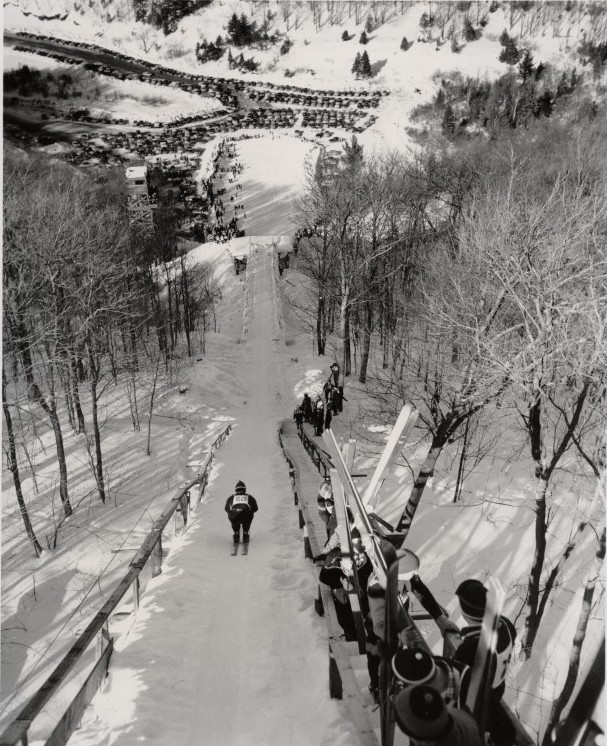
A skier glides down Suicide Hill, circa 1959, photo by Michigan Tourist Council

On Absolute Michigan we regularly feature articles & photos from the Archives of Michigan and their great web site Seeking Michigan. When Bob Garrett posted this feature, however, I knew that I couldn’t let Absolute Michigan have all the fun! 

Suicide Hill by Bob Garrett

Suicide Hill’s very name intimidates skiers. The Ishpeming Ski Club, however, describes it as “fine, competitive and safe” (See the Ishpeming Ski Club Web Site). Ski jump enthusiasts hold the hill – and its rich history – in high esteem.

In the Beginning

The Norden Ski Club – renamed the Ishpeming Ski Club in 1901 – held its first formal ski jump competition in 1888. The competition site was south of Lake Angeline, near Ishpeming, Michigan. An annual tradition did not immediately follow. The Club did, however, host competitions in some subsequent years. Various hills in the Ishpeming region served as competition sites.

In 1925, the Ishpeming Ski Club launched a search for a new hill. Peter Handberg and Leonard Flaa, then officers of the Club, found what would be called Suicide Hill. The Hill is located off what is now M-28, between Ishpeming and Negaunee. The Cleveland Cliffs mining company owned the land, and a lease was quickly negotiated.

In the autumn of 1925, development work began on the hill. It proved a community effort. Local citizens donated materials and volunteered their labor. The hill was cleared, graded and shaped. Finally, the Ishpeming Ski Club announced the first competition on the hill. This occurred on February 26, 1926.

“A Little Color”

Ted Butler, a local newspaper reporter, apparently gave the hill its nickname. An Ishpeming skier named Walter “Huns” Anderson was injured a few days before the 1926 meet. Butler wrote about this, using the phrase “Suicide Hill” in his story. “Sure, it’s a good hill, but why not add a little color to it?,” he reportedly said. James Flaa of the Ishpeming Ski Club protested the name, claiming that it created a bad impression and kept skiers away.

Today, eighty-six years later, skiers are still coming to Suicide Hill. They come from many countries and gather for the annual competitions, traditionally held in February.

The annual Suicide Hill Ski Tournament will be held next on February 8, 2012. Suicide Hill waits quietly for the day, ready to challenge a new wave of daring skiers.

Editor’s note: we found a great video of a jump at Suicide Hill and another from the point of view of the jumper

Sources

“Flying into the Future” by Jane Nordberg. Michigan History Magazine, March/April 2002, pp. 6-11.

Ishpeming Ski Club Web Site

For a related article, click Ishpeming winter events

Frankfort North Breakwater Light

Frankfort Lights by Jason Lome

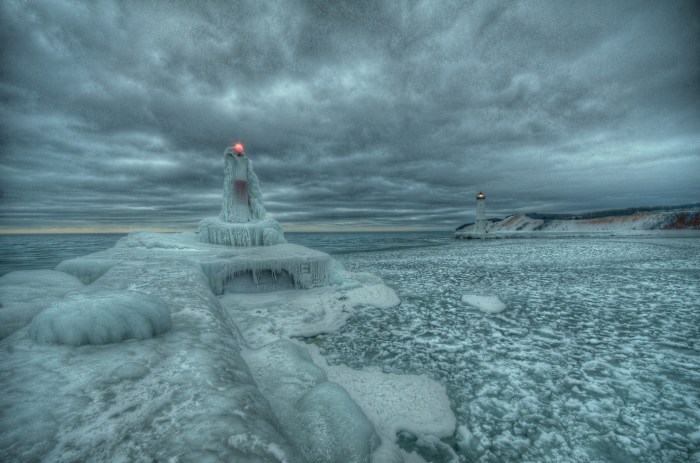
Frankfort Lights, photo by lomeranger.

The Detroit Free Press reports that Coast Guard has given the Frankfort Lighthouse to the City of Frankfort under the National Historic Lighthouse Preservation Act. It’s one of 15 historic light stations in Michigan that have been transferred at no cost to nonprofits and government agencies.

The Frankfort North Breakwater Light entry at Terry Pepper’s Seeing the Light details the long history of the lights at Frankfort Harbor and says that:

By 1924, the total car ferry tonnage through Frankfort Harbor was twenty five times greater than that prior to the establishment of the ferries. To better serve this vital commerce, the Army Corps of Engineers began construction of a pair of reinforced concrete arrowhead-type breakwaters at the harbor entrance in order to create a large stilling basin to protect the opening into the harbor. With the completion of these breakwaters in the early 1930’s, the twin piers at the entry into Lake Betsie no longer served any purpose. With plans in place to shorten them into short stub piers, the North Pierhead Light was lifted from the pier onto the deck of a barge and carried out to the end of the North Breakwater. A square steel base 25 feet in height had been erected on the end of the breakwater to receive it, and the tower was lifted onto the new base. After being bolted into position, the new tower stood 67 feet in height from the upper level of the pier to the top of the lantern ventilator ball. By virtue of its location on the concrete pier, the light stood at a focal plane of 72 feet, and the 17,000 candlepower incandescent electric light within the Fourth Order Fresnel was visible for a distance of 16 miles in clear weather.

Be sure to click for much more including some very cool old photo of the South Pier fog bells and the story of captain George Tifft, who more or less founded Frankfort when his schooner was driven into Lake Betsie.

See this photo bigger, in Jason’s fantastic ice slideshow, and purchase prints on his photography website.

Michigan in Pictures has a great vintage postcard of the Frankfort Light in winter and you can see the tower in this shot by jimflix from the Absolute Michigan pool.

The Perfect Christmas Tree (some assembly required)

Roll 1 FILM Snowy Pine SOOC

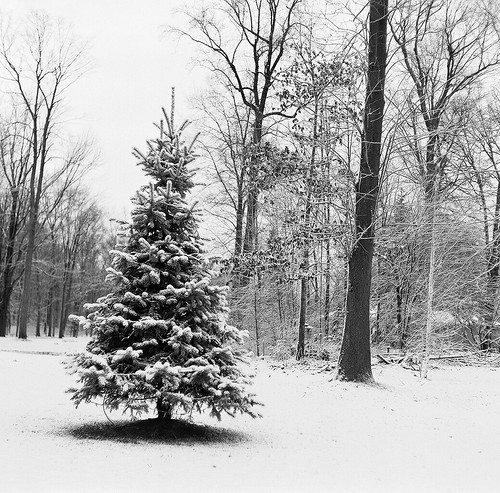
Roll 1 FILM Snowy Pine SOOC, photo by Carolyn Gallo

The History of Christmas Trees from the History Channel notes that ancient peoples hung evergreen boughs over their doors and windows, many in the belief that evergreens would keep away witches, ghosts, evil spirits, and illness. A popular belief is that Martin Luther was walking one winter evening, and was overcome by the brilliance of stars twinkling amidst evergreens. To recapture the scene for his family, he erected a tree in the main room and wired its branches with lighted candles.

They note that as as late as the 1840s Christmas trees were seen as pagan symbols and not accepted by most Americans:

It is not surprising that, like many other festive Christmas customs, the tree was adopted so late in America. To the New England Puritans, Christmas was sacred. The pilgrims’s second governor, William Bradford, wrote that he tried hard to stamp out “pagan mockery” of the observance, penalizing any frivolity. The influential Oliver Cromwell preached against “the heathen traditions” of Christmas carols, decorated trees, and any joyful expression that desecrated “that sacred event.” In 1659, the General Court of Massachusetts enacted a law making any observance of December 25 (other than a church service) a penal offense; people were fined for hanging decorations. That stern solemnity continued until the 19th century, when the influx of German and Irish immigrants undermined the Puritan legacy.

…By the 1890s Christmas ornaments were arriving from Germany and Christmas tree popularity was on the rise around the U.S. It was noted that Europeans used small trees about four feet in height, while Americans liked their Christmas trees to reach from floor to ceiling.

The early 20th century saw Americans decorating their trees mainly with homemade ornaments, while the German-American sect continued to use apples, nuts, and marzipan cookies. Popcorn joined in after being dyed bright colors and interlaced with berries and nuts. Electricity brought about Christmas lights, making it possible for Christmas trees to glow for days on end. With this, Christmas trees began to appear in town squares across the country and having a Christmas tree in the home became an American tradition.

See this gorgeous tree on black and in Carolyn’s snow slideshow.

Christmas in Old Detroit

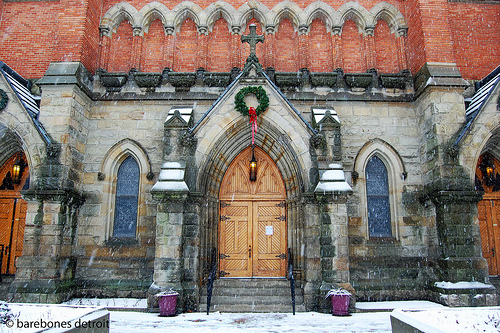
Untitled, photo by BareBonesDetroit

The Detroit News has a fantastic feature titled Christmas traditions in Old Detroit: Pigeon pie, horse racing, tapers on trees that is a wonderful look at the history of the Christmas holiday in Detroit. They begin:

Although Protestant churches in Detroit did not embrace the Christmas holiday until the 1840s, it was long celebrated in the French Catholic Churches such as Detroit’s oldest parish, St. Anne’s. (pictured above)

Before Christmas trees became the rage, the French holiday tradition in Detroit was represented by yule logs, reveillon feasting, and horse races. Yule logs were enormous logs or sometimes entire tree stumps that filled the hearth along with a half cord of wood to get it started. Holiday feasting began on Christmas Eve in a tradition called reveillon (pronounced Ray-veh-yon), which is still celebrated in Quebec and New Orleans (at least for the tourists).

In Detroit, families would carry a lantern to midnight mass and leave it with a beggar at the church door. When the Christmas mass was over, they would pick up their lantern and give a Christmas tip to the beggar. They then would go home for the feast that would last until 8 a.m.

The reveillon supper was a sumptuous menu that included la tourtiere — a meat pie made with pigeons in the 19th century and later with pork, veal or other game. Other dishes might include a stew of meat balls and pork, minced pork pie, turkey, pumpkin pie, mince pie and new cider.

There’s a whole lot more including holiday menus, toys, the hazards of decoration and even holiday horse racing through the streets of the city by the French and Ulysses S. Grant! Definitely read the rest and check out the photo gallery which includes some great old photos! About this photo from December 2010, BareBonesDetroit wrote:

Day Six: During the holidays, many of us end up donning our Sunday best and heading over to our local place of worship. Lucky for us here in Metro Detroit, the city overflows with churches, and even has a synagogue. Ste. Anne’s is the oldest church in Detroit. It’s massive structure is a beacon from both sides of the International border we share with Canada. For the season, it’s facade becomes even merrier. If you’ve never visited, for the history lesson and stained glass alone, it’s worth a visit.

View this photo bigger and see more in his Twelve Days of Christmas slideshow. Also be sure to check out barebonesdetroit.com for a cool photographic tour of the D!

More Christmas traditions on Michigan in Pictures…


The Light at Point Aux Bec Scies

 Pt. Betsie Lighthouse

Pt. Betsie Lighthouse , photo by GLASman1.

Point Betsie Light is one of the most photographed lighthouses in the world. The Friends of Point Betsie website notes that the point was originally known by the French as “Point Aux Bec Scies,” meaning “sawed beak point” and that it was was built in 1858 at a cost of $5000. If you want to get a taste of life at a lighthouse, you can rent the Assistant Keeper’s apartment in the summertime.

Check it out bigger and in Mark’s slideshow.

Much more about Point Betsie Lighthouse on Michigan in Pictures!

Petit Portal and the geology of Pictured Rocks

DSC00824_tonemapped

DSC00824_tonemapped, photo by ansonredford.

While Petit Portal – also called Petit Arch and Arch Rock by some – is often confused with the partially caved in Grand Portal, it’s a smaller and as yet intact formation. You can read about some of these from the Pictured Rocks National Lakeshore website. The two arches (and many cave structures) are formed by the powerful action of Lake Superior waves on the soft sandstone that underlies the harder layers above.

You can read more about the geology of Pictured Rocks from Oh Ranger! (a cool site I just found today) and also this PDF on geology from the Lakeshore. If you want to see them up close, the boat tours from Munising are worth every penny.

Donald took this 5 years ago. Check it out background bigtacular and in his stunning Pictured Rocks Nat’l Lakeshore slideshow which includes some jaw-dropping shots of Chapel Rock and even a look from inside Petit Portal.

Much more on the Pictured Rocks on Michigan in Pictures.

Coming Home

Iraqi child won't let go of Mich. Guardsman

Iraqi child won’t let go of Mich. Guardsman, photo by The National Guard.

The Iraq War began on March 20, 2003 and was formally ended yesterday, December 15, 2011. At 8 years, 9 months it was longer than Vietnam, longer than World War II. This Detroit Free Press article on the costs of the war in Iraq says they include 4,487 dead and 32,226 wounded Americans and over 100,000 Iraqi dead. Michigan’s contribution was at least 159 dead and 1,000 wounded, according to Pentagon records. Military Times has the number at 216, and you can see the list of Michiganders who gave their lives in the Iraq War.

Retired Marine and Iraq vet Steve Maddox says that veteran’s challenges are just beginning and cannot be answered by yellow ribbons or catchy sloganeering. In addition to combat injuries and frightening suicide rates he writes:

I see post-Iraq War challenges that are as big, if not bigger than those we faced as a nation for the past eight years. Iraq and Afghanistan veterans face higher unemployment rates than their contemporaries. In Michigan, with an overall unemployment rate hovering around 10%, Iraq and Afghanistan veterans’ unemployment rate is over 29%, by far the highest in the country.

One of the articles I read noted that we’re not leaving Iraq in very good shape. The Iraqi Hope Foundation was founded by Michigan Tech alum and Iraq veteran Major Don Makay. The foundation seeks to honor the sacrifices of veterans by building stability and prosperity of Iraq through investment in small and mid-level businesses. Read more about it right here.

About this photo, the National Guard says:

U.S. Army Sgt. Thomas Loyd, assigned to Foxtrot Company, 425th Infantry (Long Range Surveillance), Michigan National Guard, based in Selfridge, Mich., holds hands with an Iraqi child in Sununi, Iraq, Oct. 29, 2009. Loyd was standing outside the mayor’s office while a meeting was taking place when the child attached himself to Loyd and would not let go. (U.S. Navy photo by Mass Communication Specialist Carmichael Yepez/Released)

See it background big and see a few more in their Michigan slideshow.

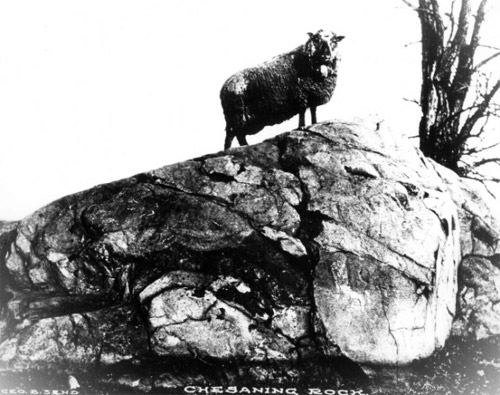
Chesaning and the Chesaning Rock

Chesaning Rock, photo by George B. Send (Courtesy Seeking Michigan)

The Wikipedia page for Chesaning, Michigan says that:

The first mention of Chesaning in the written pages of history is the Saginaw Treaty, signed in 1819. This treaty was between members of the Saginaw Tribe, Chippewa Indians and the government of the United States. They established a number of reservations, including 10,000 acres (40 km2) along the banks of the Shiawassee River known as “Big Rock Reserve.” Chesaning is a Chippewa word meaning “big rock place”. The treaty continued in effect until 1837 when a second treaty led to the reserve being surveyed and offered for sale in 1841. The first land was sold at $5 per acre to brothers Wellington and George W. Chapman, and Rufus Mason. After making their land purchase, they traveled back to Massachusetts and moved their families to their new wilderness home by late summer of 1842.

During the months they had been away from their land, several settlers had moved into the area, building a dam and a sawmill. A few years later, a grinding mill was added. The new settlers named their community “Northampton” in honor of the home they had left in Massachusetts. In 1853, the legislature changed the name to Chesaning, the traditional name for the village and township. The first township elections, held in 1847, are considered to be the official birthday of the community.

The Chesaning Historical Society has some more old photos of Chesaning, and Michigan GenWeb has a lot more Chesaning history.

I found this photo from the early 1900s at Seeking Michigan when I was looking for a photo for a feature on Saginaw’s coal mines. I think you’re agree it was simply too awesome not to share. ;)

They explain that The rock was one of the features of the area since Chesaning was settled. Located in woods to the east of Chesaning, the large rock inspired the name of the area. See it bigger at Seeking Michigan and check out more funny photos on Michigan in Pictures.