Sault Ste. Marie International Railroad Bridge

international railroad bridge, sault ste. marie, ontario / michigan

international railroad bridge, sault ste. marie, ontario / michigan, photo by twurdemann

The Library of Congress page on the Sault Ste. Marie International Railroad Bridge that spans the Soo Locks from Michigan to Canada at St. Marys Falls explains that:

The Sault Ste. Marie International Railroad Bridge has nine camelback truss spans crossing the St. Marys River with bascule and vertical lift bridge components crossing the American Locks at the St. Marys Falls Canal. It is the only bridge in the United States known to include these three types of spans in a single structure to use an interlocking mechanism to connect the leaves of the double-leaf bascule span.

It is Michigan’s most significant railroad bridge from an engineering history standpoint and is eligible for listing in the National Register of Historic Places.

Click through for some great old photos of the bridge and explore the various sections through Historic Bridges.

Check this photo out on black and see more great shots in twurdemann’s Sault Ste. Marie 2012-2013 slideshow.

More Michigan bridges on Michigan in Pictures.

Over the Moon with a Sandhill Crane

Over the moon

Over the moon, photo by TBPICKS

The 1896 book Myths and Legends of our Own Land by Charles M. Skinner relates a rather gruesome version of the tale of the origin of Whitefish, which this photo reminded me of.

An Indian who lived far in the north was so devoted to the chase that he was never at home for the whole of a day, to the sorrow of his two boys, who liked nothing so much as to sport with him and to be allowed to practise with his weapons. Their mother told them that on no account were they to speak to him of the young man who visited the lodge while their father was away, and it was not until they were well grown and knew what the duty of wives should be that they resolved to disobey her. The hunter struck the woman dead when he learned of her perfidy. So greatly did her spirit trouble them, however, that they could no longer abide in their old home in peace and comfort, and they left the country and journeyed southward until they came to the Sault Sainte Marie.

As they stood beside the falls a head came rolling toward them on the earth—the head of the dead woman. At that moment, too, a crane was seen riding on the surface of the water, whirling about in its strongest eddies, and when one of the boys called to it, “O Grandfather, we are persecuted by a spirit; take us across the falls,” the crane flew to them. “Cling to my back and do not touch my head,” it said to them, and landed them safely on the farther shore.

But now the head screamed, “Come, grandfather, and carry me over, for I have lost my children and am sorely distressed,” and the bird flew to her likewise. “Be careful not to touch my head,” it said. The head promised obedience, but succumbed to curiosity when half-way over and touched the bird’s head to see what was the matter with him. With a lurch the crane flung off his burden and it fell into the rapids. As it swept down, bumping against the rocks, the brains were pounded out and strewn over the water. “You were useless in life,” cried the crane. “You shall not be so in death. Become fish!” And the bits of brain changed to roe that presently hatched to a delicate white fish, the flesh whereof is esteemed by Indians of the lakes, and white men, likewise. The family pitched a lodge near the spot and took the crane as their totem or name-mark. Many of their descendants bear it to this day.

The version I read in one of my all-time favorite books, Lore of the Great Turtle : Indian Legends of Mackinac Retold by Dirk Gringhuis is pretty dark as well. Michigan in Pictures has a post with all the information about Sandhill Cranes in Michigan, and you can also check out Sandhill Crane (Grus canadensis) from the Michigan DNR.

View this out on black and see more in Todd’s slideshow.

More birds on Michigan in Pictures.

Good Harbor and Good Harbor Bay

Spring on Good Harbor Bay

Spring on Good Harbor Bay, photo by Eric Raymond

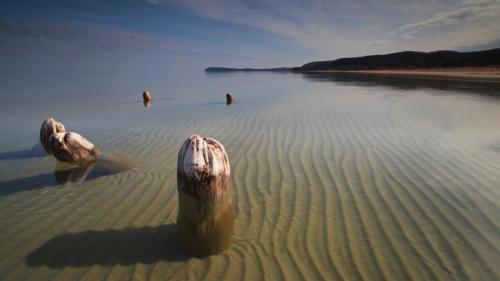
Good Harbor is located on the northern edge of Sleeping Bear Dunes National Lakeshore at the Lake Michigan end of County Road 651. Today only evidence of the vanished village are the pilings of what was once a 500′ dock that could load 4 schooners at a time. The Good Harbor page from the Lakeshore explains that logging in the area began in 1863 to supply cordwood fuel for  steamers, leading to the founding of a village in the 1870s.

Shortly after 1880 (Henry) Schomberg bought out Schwartz’s interest and built a big sawmill which had a capacity of 30,000 feet in a 10-hour day.

…The Schomberg Lumber Company ran a hotel, two stores which became a shopping center for the local farmers, and a saloon. The township line between Centerville and Cleveland townships ran down the middle of Main Street in Good Harbor. Centerville did not allow saloons, so Good Harbor’s saloon was built on the Cleveland township side of the street … At the height of the lumber business, the mill worked day and night during the winter and during the day in the summer. As many as 75 teams of horses were used hauling logs to the mill, lumber to the dock, and supplies to the camps. The lumber company owned some of the teams and the rest were owned by local farmers and rented to the lumber company. At its peak, the mill cut 8,000,000 board feet of lumber per year.

The schooners were loaded by farmers who were called to work at the dock when the ships arrived. Good Harbor had no protection from storms with a northwest wind, so ships had to leave the dock and sail to the Manitou Islands for protection when a storm would come up. Sometimes storms would come up too fast and the ships were driven aground.

You can read on for more and also see some of the wrecks in the area in the Manitou Passage Underwater Preserve.

Check this out bigger and see more great photos from the Sleeping Bear and Leelanau Peninsula (including another shot of the pilings by Terry Clark) on Eric’s Leelanau County Facebook page.

Detroit Water Board Building

Water Board Building Upper Floors--Detroit MI

Water Board Building Upper Floors–Detroit MI, photo by pinehurst19475

historicdetroit.org’s page on the Water Board Building explains:

The Art Moderne-styled Water Board Building has been a familiar part of Detroit’s skyline since October 1928. The Common council provided $1 million in the 1927-28 city budget for a triangular-shaped building on a site bounded by Randolph, Farmer, and Bates Streets. Louis Kamper – a Detroit-based architect known for his work on the houses of prominent Detroiters, as well as Detroit landmarks like the Book Building (1917), the Washington Boulevard Building (1923), and the Book-Cadillac Hotel (1924) – originally planned for a 14-story building. But, “because of the high value of the site, the Board decided that … it would build a twenty story building.”

The completed building reflects the trend toward simplification of forms typical of the Jazz Age. Standing 23 stories, it is comprised of a five-story base, a 15-story shaft, and a three-story penthouse. The total cost – including the $250,000 paid for the site, and the architect’s five-percent commission – was $1,768,760.20. It was one of the last buildings designed by Kamper, who was in his late sixties during its design and construction.

…The BOWC’s new building was constructed in a record-breaking seven months. It was considered state-of-the-art and fireproof by 1928 standards.

Click over to Historic Detroit to read a whole lot more and see a couple of old photos. Also check out the Water Board Building at Detroit 1701 where I found a link to this 300 year history of the Detroit Water Board.

View the photo big as the building and see more in pinehurst19475’s water board building slideshow.

More architecture on Michigan in Pictures.

Poe Reef Lighthouse

Poe Reef Light

Poe Reef Light, photo by joeldinda

Terry Pepper has (as usual) a very detailed entry for Poe Reef Lighthouse on his Seeing the Light website. This crib style lighthouse is located off Bois Blanc Island in Lake Huron. The reef is very close to the surface and posed a significant threat to navigation until the decision was made in the 1890s to anchor a lightship there. This served until Lighthouse Service decided to build a permanent station on Poe Reef in 1927:

The station building at Poe Reef was to be an exact duplicate of that which the crew had previously completed at Martins Reef. The main twenty-five foot square structure consisted of a steel skeletal framework to which an exterior sheathing of riveted steel plates was applied. Thirty-eight feet tall, it contained three levels, or “decks”, as the crews assigned to the station knew them. The two upper decks were set up as living quarters, while the main lower deck served as housing for the machinery required for powering the lights, heating system and foghorn.

Centered atop the main structure stood sixteen-foot square, ten-foot high watch room of similar construction, with a single observation window on each side. Finally, a decagonal cast iron lantern room was installed on the roof of the watch room, and outfitted with a Third Order Fresnel lens. The combination of pier and tower provided the Fresnel with a seventy-one foot focal plane, and a visibility range of almost twenty nautical miles in clear conditions. Work was completed at the station and the light exhibited for the first time on the evening of August 15, 1929.

At some point in time, in order to eliminate the possibility of the Poe Reef Light being mistaken for the identical all white structure at Martin Reef, the main deck and watch room of the Poe structure were given a contrasting coat of black paint.

Terry has some cool shots of this light as well including this wide shot with cormorants.

Check Joel’s photo out background bigtacular and see more shots from Poe Reef and elsewhere in his Lighthouses slideshow.

More Michigan lighthouses on Michigan in Pictures.

The Monarch and Hartwick Pines

Logging Era Grayling MI Monster Hartwick Michigan White Pine called the Monarch RPPC 1942 at the Memorial Park prior to Hartwick becoming a State Park

Logging Era Grayling MI Monster Hartwick Michigan White Pine, photo by UpNorth Memories – Donald (Don) Harrison

This Friday, April 26th is Arbor Day, and I thought it would be nice to take a look what is probably the most famous trees in Michigan’s history and the place where it once grew, Hartwick Pines State Park. In 1927, Karen Michelson Hartwick purchased over 8,000 acres of land that included 85 acres of old growth white pine from the Salling-Hanson Company of Grayling. Mrs. Hartwick was a daughter of  a founding partner of the logging company and shortly after the purchase, she donated the land to the State of Michigan as a memorial park named for her husband, the late Major Edward E. Hartwick of Grayling. A nice article from the Toledo Blade about Hartwick Pines explains:

This is Hartwick Pines, the largest stand of “old growth” forest in Michigan’s Lower Peninsula. Here, white pines, red pines and hemlocks ladder their way 160 feet to the sky.

…There are approximately 24,000 trees in the Hartwick Pines old growth grove today, but not all are “old growth” trees. Lightning and wind claim a few of the old trees each year, and they are replaced with a mixture of hardwoods and pines.

A large hemlock near the parking lot was recently damaged by a storm and had to be removed. Its stump showed 365 annual rings. The most famous tree at Hartwick Pines — The Monarch — lost its crown in a 1992 storm and then died four years later. It was 155 feet tall when healthy, with a circumference of 12 feet and an estimated age of 325 years.

Read on and learn more about Hartwick Pines from the State of Michigan.

See this big as the Monarch and jump in to Don’s slideshow of postcards for more vintage scenes from Hartwick Pines!

PS: The Monarch was a white pine, Michigan’s State Tree.

New owner for Irish Hills Towers

Irish Hills Towers from Route 12 (View 1)

Irish Hills Towers from Route 12 (View 1), photo by DarrylW4

The Adrian Daily Telegram reports that ownership of the Irish Hills Towers has formally been transfered to the Irish Hills Historical Society, a 501(c)(3) nonprofit. The towers have been stabilized and are being evaluated, and it appears that the IHHS would need about $300,000 to restore this attraction. Keep up with their progress at the Irish Hills Historical Society Facebook.

This page on the Irish Hills Towers notes that the top of the towers is 1400 feet above sea level, which makes them the highest point in southeastern Michigan. On a clear day (if they were open) you could see for seven miles with a ten lakes visible.  Michigan in Pictures has more shots of these iconic landmarks including the history of the towers and a crazy cool photo by Matt Callow.

Darren took the photo and suggests that he’d like to see the towers restored and converted to a museum for Michigan’s Roadside Attractions. Check it out on black and see more in his Irish Hills Towers slideshow.

Happy 101st Birthday, Tiger Stadium

Tigers at night

Tigers at night, photo by baklein62

101 years ago today on April 20, 1912, Tiger Stadium opened at the corner of Michigan & Trumbull in Detroit’s Corktown Neighborhood. Last year Eric Adelson of Yahoo Sports observed that this milestone passed largely unmarked:

It was 100 years ago this weekend. Ty Cobb scored the first run by stealing home. From that day until 1999, this very spot rumbled with din and greatness. Pretty much every legend that played in Fenway in the 20th century also played here. Lou Gehrig sat himself down for the first time in 2,130 games here, ending his incredible ironman streak. Babe Ruth hit his 700th home run here. Reggie Jackson hit one into the right field light tower here during the ’71 All-Star game. The Tigers won World Series titles here in 1968 and again in 1984, with Kirk Gibson launching a late-inning home run off Goose Gossage that no Tigers fan alive to see it will ever forget. Fair to say this was the most exciting place in the history of Michigan.

And now there’s hardly a trace. Fans committed to honoring the old stadium in some form maintain a home plate, a pitcher’s mound, two chalk lines for base paths and two benches where the dugouts used to be. The 125-foot flagpole from the old center field is still standing.

While the old ballpark’s birthday is definitely passing unmarked again this year, mLive hadan article about the uncertain future of the site a couple of weeks ago. If you’d like to do a little remembering, head over to 100 years at Tiger Stadium on Absolute Michigan for a whole lot more about this beloved ballpark and links to videos including the intro to the DVD Michigan & Trumbull featuring Ernie Harwell. (a 2 1/2 minute stroll through Tiger Stadium)

Check Barney’s photo out on black and see a whole lot more in his great Baseball as Art slideshow.

Lots more Detroit Tigers pictures on Michigan in Pictures!

Old Fire

old fire

old fire, photo by Marty Hogan

Marty took this shot near Houle & Wilson in Menominee County in the UP. One of the commenters on his photo who grew up about 3/4 of a mile from there explained that the kilns were used by a sawmill for drying lumber.

Check this out on black, see the whole group of them right here and see several more views of this ruin in his August 2012 slideshow!

More from Marty on Michigan in Pictures!

Before the fall at Miner’s Castle

Miners Castle

Miners Castle, photo by James Marvin Phelps

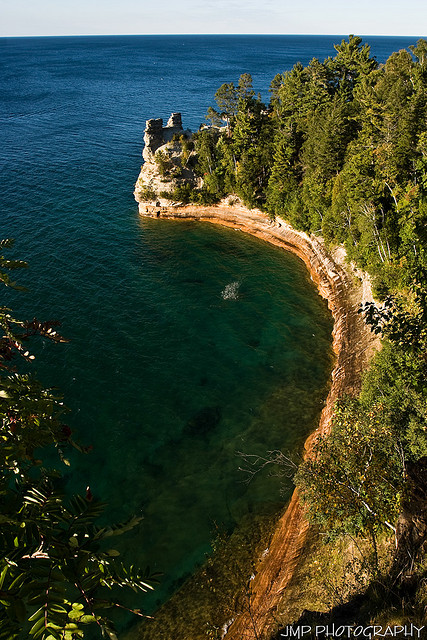
The Pictured Rocks National Lakeshore feature on the collapse of one of the two turrets at Miner’s Castle explains that 7 years ago today:

On Thursday morning, April 13, 2006, the northeast turret of Miners Castle collapsed. One turret remains on Miners Castle, the best-known feature of Pictured Rocks National Lakeshore. The collapse was reported via cell phone by fisherman in the area, according to chief ranger Larry Hach.

Most of the rock fell north and into Lake Superior, and there were no injuries. The lower overlook platform near Miners Castle appears to be unaffected.

While the rockfall at Miners Castle on April 13 was startling, such events are not rare along the Pictured Rocks escarpment. At least five major falls have occurred over the past dozen years: 1) two different portions of Grand Portal Point, 2) the eastern side of Indian Head just east of Grand Portal Point, 3) Miners Falls just below the (now modified) viewing platform, and 4) beneath the lip of Munising Falls (along the former trail that went behind the cascade).

All the rockfalls involved the same rock unit, the Miners Castle Member of the Munising Formation. Rock units are named for places where they were first technically described. The Miners Castle Member consists of crumbly cross-bedded sandstone that is poorly cemented by secondary quartz, according to U.S. Geological Survey Research Ecologist Walter Loope.

Rockfalls along the cliffs typically occur in the spring and fall due to freezing and thawing action of Mother Nature.

Check this photo out bigger, see Jim’s “after” photo and get a lot more great photos in his Pictured Rocks National Lakeshore slideshow.

There’s more from Jim and more from Pictured Rocks on Michigan in Pictures!