Know your Michigan Counties: Kalkaska County

The Mountains of Kalkaska

The Mountains of Kalkaska, photo by Dale DeVries

The State of Michigan has 83 counties, and since I got a number of comments asking for more about our communities, I’ll try and profile them all … sooner or later. Here’s some information via Wikipedia about Kalkaska County, Michigan:

The first settler in Kalkaska County was an Englishman named William Copeland, who purchased land in the northwest corner of the county in 1855. The county was set off in 1840 and called Wabasee until 1843. The name Kalkaska is thought to be a Chippewa word meaning flat or burned-over country. An alternative theory is that this is a neologism or neonym created by Henry Schoolcraft, originally spelled Calcasca. Some theorists suggest this is word play. Schoolcraft’s family name had been Calcraft, and the Ks may have been added to make the name appear more like a Native American word.

Logging was the first important industry. The discovery of substantial deposits of oil and natural gas resulted in the construction of a processing plant by Shell Oil Company in 1973 and a major economic boom in the community.

Kalkaska Sand, the state soil of Michigan, was named after the county because of the large amounts deposited in the area from the glaciers in the Ice Age. Kalkaska County has over 80 lakes and 275 miles of streams and rivers. Much of the county is marshland. County elevation ranges from 595 feet (181 m) to about 1,246 feet. This makes it one of the more uneven counties in the Lower Peninsula.

The Pere Marquette State Forest covers much of the county. Glaciers shaped the area, creating a unique regional ecosystem. A large portion of the area is the so-called Grayling outwash plain, which consists of broad outwash plain including sandy ice-disintegration ridges; jack pine barrens, some white pine-red pine forest, and northern hardwood forest. Large lakes were created by glacial action.

The population was population 17,153 in the 2010 census and you can click to Wikipedia for more, visit the official Kalkaska County website, read about their big, annual event, the National Trout Festival (April) on Michigan in Pictures, and click to see Kalkaska County on a map!

Dale writes:

“With abundant snow cover yet and temperatures around 65 F, fog forms in almost white out conditions near large snow fields! This can lead to near zero visibility in a matter of seconds and makes for some amazing photographs!”

View his March 9th photo background bigilicious and see more in his massive Fern Ridge Pictures slideshow.

More spring wallpaper on Michigan in Pictures.
Charles Stewart Mott and the Mott Foundation Building

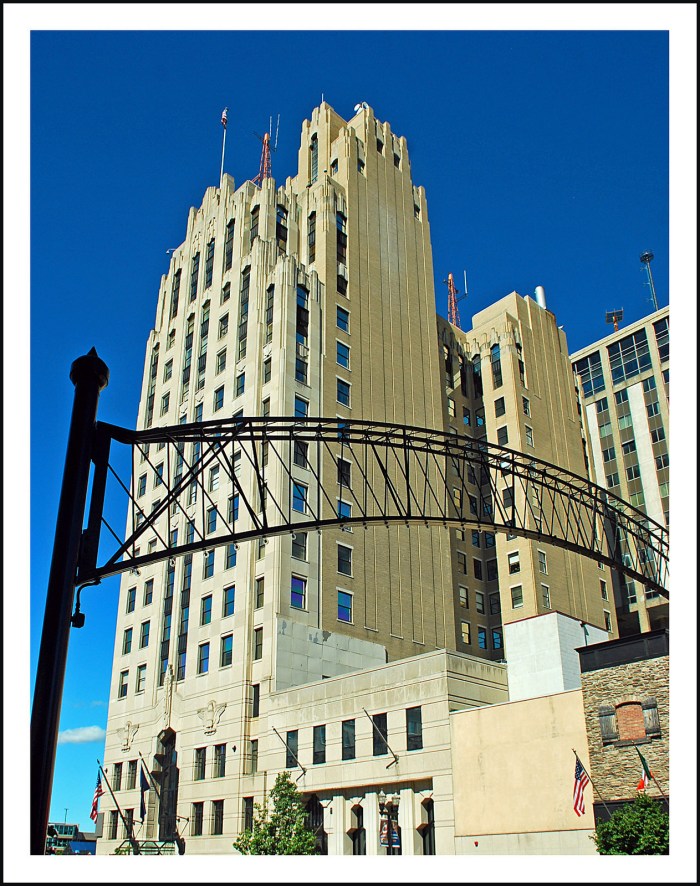
Mott Foundation Building in Flint

The Mott Foundation Building in Flint, photo by Steve Brown

My post on Tuesday generated a little controversy because I stated who I was supporting in Michigan’s primary and also that I’d continue to share my personal opinions here on Michigan in Pictures. Most readers who commented agreed, including Jim Schaefer who shared the most powerful comment I’ve ever read on my work:

Dear Farlane…I’m so glad you posted item #4 today along with the great photo. I had to move to Sheboygan, WI in 2014 for health reasons, leaving behind 45-yrs of life in Flint, MI. I’ve been saving your photos and their accompanying stories on a daily basis for several years now in their own special folder on my laptop. They are my daily reminder about all of the good things about Michigan that some Michigan residents seem to take for granted.

Unfortunately, some of these same people have conveniently forgotten about your 1st Amendment rights to editorialize on your own website. Shame on them! I am also a 72-yr old Army veteran who served a 13-month tour in a combat zone in Korea in 1966. That’s why I’m so glad that you reminded people to vote today. I was drafted against my will back in 1966 but I served my country and did my job over there and I’ll be damned if I’m going to let anyone take away my right to vote. So you keep right on posting all of those great photos along with the Michigan history behind them.

May God bless you always…Jim Schaefer

God bless you too Jim, and here’s something for your desktop folder from Flint! The Charles Stewart Mott Foundation shares this about their founder:

Charles Stewart Mott

Charles Stewart Mott established the C.S. Mott Foundation in 1926, in response to his deep concern about the welfare of Flint, Mich., as well as his abiding affection for his adopted community.

An automotive pioneer, Mr. Mott was an original partner in the creation of the General Motors Corporation, founded in Flint in 1908. As one of the city’s leading industrialists, Mr. Mott was elected mayor, serving three terms (1912–13, 1918) during periods of overwhelming and turbulent growth in the city. As mayor he was responsible for instituting fair property assessments, orderly accounting audits, health and safety ordinances, building codes and a house numbering system.

Read more about Mott in Autos not Apples. Here’s a few facts about the 16-story Art Deco building that bears his name and houses the Mott Foundation:

  • Flint’s first skyscraper with a total height of 226 feet to the top of the passenger elevator penthouse.
  • Designed by Smith, Hunchman & Grylls (SmithGroup) the oldest practicing architectural firm in the US.
  • Construction took one year to complete at a cost of approximately $2,000,000.
  • Original design included seven retail stores on the first floor. There were also originally men’s rooms on every floor, but women’s restrooms only on every other floor.
  • The Freight elevator is still operated with the vintage 1930 controls.
  • Building name was changed to the Mott Foundation Building on January 1, 1945.

View Steve’s photo big as a building and see more in his Flint, Michigan slideshow.

More Flint and more architecture on Michigan in Pictures. Also check out this guide to the architecture of Flint for more of the city’s architectural heritage.

#TBT: Marquette’s Chief Kawbawgam

Chief Kawbawgam

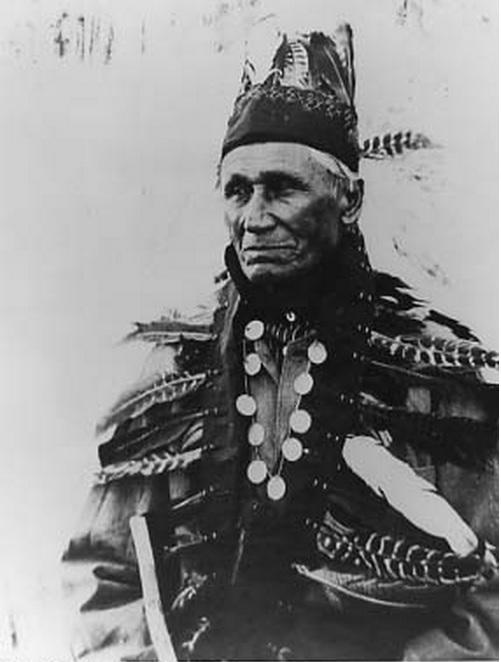
Chief Kawbawgam, photo via Michigan’s Past & Superior View Gallery

Michigan’s Past shares all kinds of great old photos on Twitter. This one shows Chief Kawbawgam, a Chippewa who was reportedly over 100 years old when he died in Marquette in 1903.  According to the January 1903 edition of the The Lake Superior Journal:

Charley Kaw-baw-gam’s long life was brought to a close about 2 o’clock Sunday afternoon, when the old chief passed peacefully away at St. Mary’s hospital at Marquette, where he had been lying ill for the past couple of months.

Charley was one of the best known figures in Marquette, and he enjoyed this distinction from the first day when white men began to frequent the spot where the city was to grow. Charley’s reputation was not local alone. He was known throughout the upper peninsula and even below the straits his name and fame were familiar to many people.

He was an excellent type of the original owners of the soil, and an unusually creditable specimen. He was a full blooded Chippewa and a chief by blood. What is more he was a good Indian, and he lived a good life, according to his lights.

Kaw-baw-gam was also remarked upon time and again for his great age. It is believed that he was over 100 years old at the time of his death.

In 1849 when Peter White first landed on the shores of Iron bay it is well known that the first Indian to greet him and the party of which he was a member was the same chieftain. In the same year 1849, Mr. White, in carrying on a conversation in Chippewa with Charley asked him, for the sake of having something to say, “How old are you, Bawgam?” Charley replying said: “I am fifty. I spent twenty at the Soo; twenty years on the Tonquomenon bay and ten years on the Canadian side.” If Charley spoke the truth on that occasion he was about 103 years of age when he died, and there was no reason to doubt that this was the case. The Indians of his day were a notoriously long lived race and Charley was a find Indian physically, strong, tireless and healthy. Furthermore his countenance was that of a patriarch.

You can see Chief Kawbawgam’s grave in Marquette’s Presque Isle Park.

View the photo bigger and definitely follow @MichiganHist on Twitter for lots more great photos.

More Throwback Thursdays and more portraits on Michigan in Pictures.

#TBT: Icebound Car Ferries in Ludington

Carferries Icebound in Ludington 1913

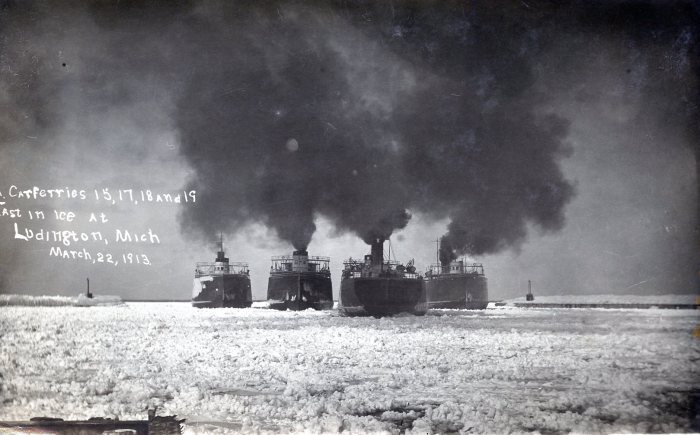
Icebound Carferries at Ludington, photo courtesy Karl Bahle

The caption reads “Carferries 15, 17, 18 and 19 – Fast in ice at Ludington, Mich March 22, 1913” and from that, I was able to dig up some tasty history! Carferries.com has great information on the Pere Marquette fleet of ferries that was based in Ludington. They say (in part):

At various times between 1897 and 1947, the Pere Marquette operated a total of 13 ferries on Lake Michigan, running between Ludington, Mich. and Milwaukee, Manitowoc and Kewaunee, Wis. These ships were then an efficient means of bypassing the congested rail yards in Chicago. They plied routes varying between 60 and 97 miles in length, and were often plagued by violent storms and heavy ice. Given the fact that most of the cross-lake runs were made at speeds of 12 to 14 miles per hour, a remarkable volume of freight was carried.

In those fifty years the Pere Marquette car ferries made well over 160,000 lake crossings and transported roughly 4.5 million railroad cars loaded with over 75 million tons of freight. Even these numbers are somewhat conservative, as early records no longer exist. They also carried approximately 1.6 million passengers and after the mid-1920’s, about 380,000 automobiles. Additionally, over the course of its history, the railroad operated a total of 4 river car ferries. These ran between Port Huron, Mich. and Sarnia, Ont., and between Detroit, Mich. and Windsor, Ont., connecting the PM’s Michigan and Canadian lines.

  • Pere Marquette 15 – launched in December of 1896 as the original Pere Marquette. She reportedly burned 30 tons of coal on an 1897 round trip from Ludington to Milwaukee. In 1924, the vessel was renamed Pere Marquette 15, and scrapped in Manitowoc in 1935.
  • Pere Marquette 17 – launched in 1901, hauled 2 “Jack Johnson” battleship guns in 1915, sold to the State of Michigan to be the car ferry “City of Petoskey” <-great info and photos there!
  • Pere Marquette 18 – here’s where the history gets a little murky, as the ship that was launched in 1902 sank in 1910 off Sheboygan, Wisconsin, so either the date is wrong on the photo above or that’s another ship! UPDATE: Karl informed me that the original 18 did sink in 1910, a new one was put into service in 1911 and sailed until 1954!
  • Pere Marquette 19 launched in 1903, ran aground numerous times before being sold for scrap in 1940. She was reduced to a barge profile and renamed the Hilda.

If you’re wondering “What happened to Pere Marquette 16?” that link has great info on the 16, only wooden car ferry in their fleet!

View Karl’s photo bigger and check out his Lake Boats album for many more photos!

Morning Light at the Manistee Pierhead Light

Manistee Lighthouse

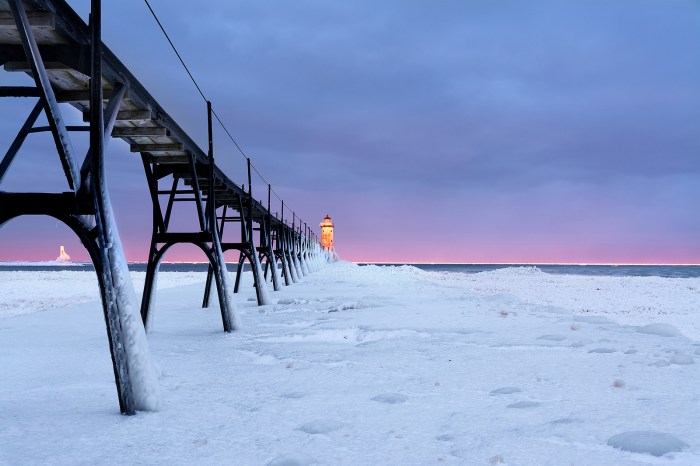
Manistee Morning Light, photo by Heather Higham

Terry Pepper’s Seeing the Light has an extensive entry on the history of the Manistee Pierhead Light with copious information and historical photos. Terry goes deep on Manistee’s history as a lumber port:

Although the first sawmill had been established on the banks of the Manistee in 1841, settlement in the area was not widespread until the Chippewa relinquished their reservation by treaty in 1849, and the federal government offered lands along the Manistee for public sale. It did not take lumber interests long to realize the incredible potential of the Manistee which snaked a hundred miles into the forests, and lumbermen soon began lobbying for federal funding to improve the harbor and to erect a lighthouse at the river mouth. With no appropriation forthcoming, the businessmen of Manistee took the matter into their own hands, erecting a pair of short stub piers at the river mouth in an attempt to stem the deposition of sand and silt.

In 1861, Congress instructed the Army Corps of Engineers to dispatch an Engineer Officer to Manistee to conduct a survey of the river entrance. Water depth in the opening between the piers was found to be from seven to eight feet, and a 250-foot long sand bar with a water depth of less than five feet above it was identified 600 feet off the end of the piers.

…To serve this burgeoning maritime commerce, the piers were extended an additional 150 feet in 1875, and the channel between them dredged to a minimum depth of ten feet. With the main light now standing a considerable distance to the rear of the pierheads, the decision was made to replace the shore light on the north bank with a pierhead beacon on the outer end of the longer south pier. Click to view enlarged image The new south pierhead light consisted of a timber-framed pyramidal beacon typical of the type being erected on pierheads throughout the Great Lakes. With its lower half open, the upper half immediately below the gallery was enclosed to provide a small service room for lamp maintenance. Equipped with windows, the service room also served as a sheltered area in which the keeper could stand watch during inclement weather. Standing 27 feet in height, the beacon was capped with a square gallery with iron handrails and an octagonal cast iron lantern installed at its center.

Read on for a whole lot more.

About the photo, Heather writes:

I still can’t believe I managed to drag myself out of bed this morning. There were 8 minutes of pink light – and a stunning sunrise to the east that I completely ignored – followed by about 90 minutes of interesting (if not sunrise) light.

View it bigger, see more in her Lighthouses slideshow and definitely add Snap Happy Gal Photography to your Facebook follows!

More Michigan Lighthouses and more sweet sunrises on Michigan in Pictures.

Happy Birthday Holland: Looking back on the Holland Channel

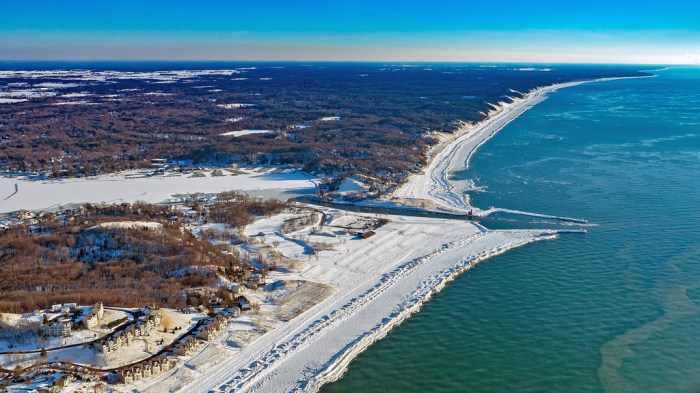
Looking Back on the Holland Channel

Looking Back at the Holland Channel, photo by Sandy Hansen Photography

February 9th is the 169th anniversary of the founding of Holland, Michigan. The History of Holland has some background about one of the prime factors for the city’s success, the Holland Channel:

From its very beginnings, Holland provided a refuge for those seeking freedom of expression and a more vibrant economy. Persuaded by religious oppression and economic depression, a group of 60 men, women, and children, led by Albertus C. VanRaalte, prepared for their 47-day trip from Rotterdam to New York. VanRaalte intended to purchase land in Wisconsin, but travel delays and an early winter caused the group to layover in Detroit. After hearing about available lands in west Michigan, VanRaalte decided to scout the territory. They reached their destination on February 9, 1847 on the banks of Black Lake—today’s Lake Macatawa.

The hundreds of Dutch immigrants that followed expected to find their promised land, but instead found a swamp and insect-infested forest. Although food was scarce, and the log sheds they built were unable to hold everyone, the settlers persevered. VanRaalte realized the practical and economic potential of the dense forest: trees could be felled to build homes and businesses, while the excess lumber could be sold to purchase farming supplies.

In the early years of Holland history, the settlers set out to conquer several projects. They knew that if Lake Michigan was to provide growth and development, it had to be made accessible by an adequate channel. After trying in vain to receive government aid, the determined Hollanders took up picks and shovels and went about digging the channel themselves. The immigrants also cleared a one-block square of land in the center of the colony—today’s Centennial Park—to serve as a market square.

Read on for more and click for a live webcam of the Holland Channel.

View Sandy’s photo bigger, see more in her Aerial slideshow, and follow her on Facebook too!

More aerial photos and more from Holland on Michigan in Pictures.

A Tale of Two Bridges: History of Port Huron’s Blue Water Bridge

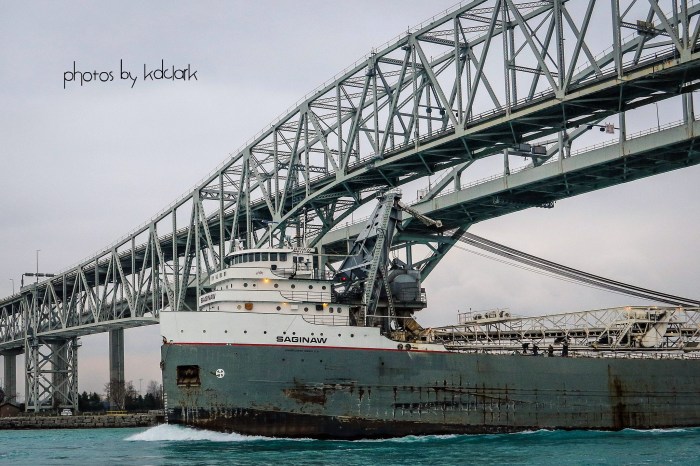
Freighter Saginaw Under the Blue Water Bridge

Untitled, photo by Diane

The website Michigan History was produced by someone at MSU. While I have no idea who or why they gave up on what was shaping up to be a cool website, the history checks out. The page on Port Huron’s Blue Water Bridge says:

Perhaps Port Huron’s greatest claim to fame is the Blue Water Bridge, a historic arcing bridge that serves as a means of transportation between Canada and the United States. The bridge is located over the St. Clair River, and connects Port Huron, Michigan, to Sarnia, Ontario. In 2013 the Blue Water Bridge celebrated its 75th anniversary, and a closer look at its history show why Port Huron residents take pride in the structure.

The original Blue Water Bridge was constructed in 1938, and was built by the American Bridge Company of New York, and the Hamilton Bridge Company of Ontario. The original bridge is an arch cantilever bridge, which was designed to not only support large amounts of traffic, but also to have an aesthetic arching look. In the late 1980s the border crossing became so popular that plans for a new bridge were brought up. However, instead of demolishing the old bridge, a new one was built in 1997 beside the old bridge, to support eastbound traffic.

The Michigan cost for building the new bridge, and renovating the old one was $62.6 million dollars. (Michigan Department of Transportation) The project was considered an enormous success and won awards from the American Society of Civil Engineers, the Ontario Institution of Steel Construction, and the Federal Highway Administration. For Port Huron residents the bridge signifies the close connection with Canada, and the willingness of the two sides to work closely together.

Click for more about the history of Port Huron. If you want to get really in depth, The Construction History of the Blue Water Bridge (pdf) is an excellent account that details the political maneuverings and construction challenges of both bridges.

View Diane’s photo of the freighter Saginaw passing under the Blue Water Bridge background bigtacular and see more in her Freighters and the St. Clair River slideshow.

There’s more Michigan bridges on Michigan in Pictures, and since you’ve read this far, Boatnerd’s page on the Saginaw has everything you’ll want to know about the self-unloading bulk carrier that was launched May 9th, 1953 as the John J. Boland. It’s one of three near sister vessels built by this shipyard: The John G. Munson which is still plying the lakes and the Detroit Edison that suffered a career-ending grounding in Lake Michigan in December of 1980.

#TBT: Winter Comes to Michigan

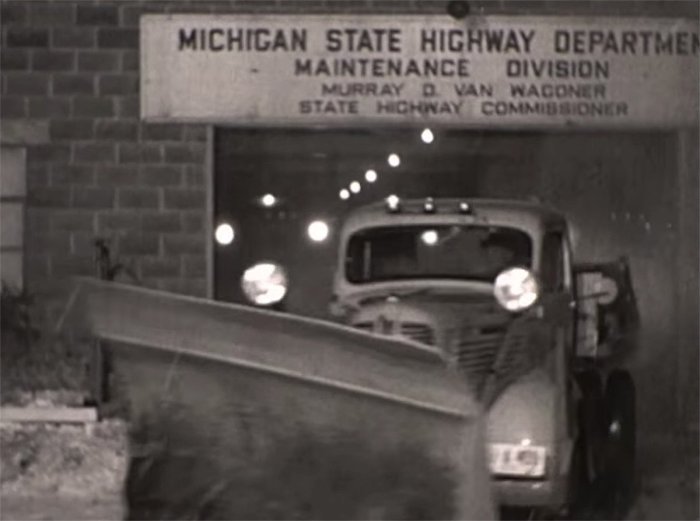
1930s Michigan Snowplow

1930s Snowplow, via Michigan Highway Department (now MDOT)

The Michigan Department of Transportation shared this awesome newsreel from the 1930s featuring all kinds of winter fun including ski jumping. Their predecessor, the Michigan Highway Department also used the video to talk up Michigan’s road system and winter road maintenance.

It was discovered by Nancy and Barbara Sleeper of Newberry, daughters of former Luce County Road Commission superintendent Sanborn Sleeper, and it’s super awesome!

#TBT: Remembering the Crew of Apollo 1

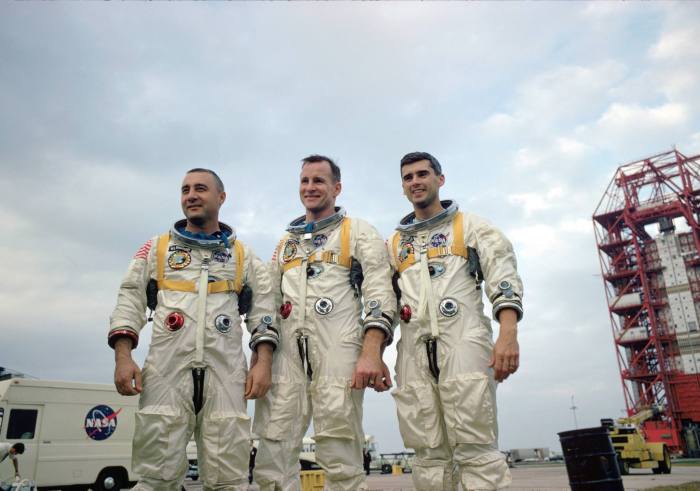
Remembering the Crew of Apollo 1

Remembering the Crew of Apollo 1, photo by NASA

“You’ll be flying along some nights with a full moon. You’re up at 45,000 feet. Up there you can see it like you can’t see it down here. It’s just the big, bright, clear moon. You look up there and just say to yourself: I’ve got to get up there. I’ve just got to get one of those flights.”
-Roger Chaffee (The New York Times, January 29, 1967, p. 48.)

Thanks to longtime Michigan in Pictures contributor Rudy Malmquist for the find on this. By total coincidence, Rudy will be back tomorrow with a photo!!

The National Air & Space Museum at the Smithsonian shared this photo yesterday, saying:

Remembering the crew of Apollo 1. On January 27, 1967, astronauts Virgil I. “Gus” Grissom, Edward H. White II, and Roger B. Chaffee perished in a fire during a pre-launch test for what was to be the first crewed Apollo mission.

Rudy pointed out that Chaffee was from Grand Rapids, and you can read a very detailed biography on Roger B. Chaffee from NASA’s History Office.  Here’s a few choice bits about his early life … and here’s hoping that Michigan in Pictures readers can do their best to instill a love of service, science and following ones dreams in the young folk in their lives:

“On my honor, I will do my best…” are the first eight words of the Scout Oath for the Boy Scouts of America. Individually, the words are short and simple. Collectively, however, they speak volumes and serve to inspire millions of boys to strive for excellence. Lieutenant Commander Roger Bruce Chaffee was a Scout for whom the Oath was more than just mere words. He took the pledge to heart and accepted the challenge to fully live the words of the Oath. Whether he was meticulously hand crafting items from wood or training to be the youngest man ever to fly in space, Chaffee always did his best by putting one hundred percent of himself into the effort.

…Earlier in his career, Don Chaffee had been a barnstorming pilot who flew a Waco 10 biplane. He was a regular sight at fairgrounds and made a bit of extra money on the side by transporting passengers. He also piloted planes for parachute jumpers. Later, Don worked for Army Ordnance in Greenville and in 1942, he was transferred to the Doehler-Jarvis plant in Grand Rapids, Michigan where he served as Chief Inspector of Army Ordnance.

Don shared his love of flying with his son and at the age of seven, Roger enjoyed his first ride in an airplane when the family went on a short excursion over Lake Michigan. Although it was a relatively brief flight, Roger was absolutely thrilled. To satisfy his continued interested in planes, Don set up a card table in the living room where he and Roger would create model airplanes piece by piece. By the time he was nine, Roger would point to a plane flying overhead and predict, “I’ll be up there flying in one of those someday”.

…By the time Roger was fourteen, he had developed an interest in electronics engineering and tinkered with various radio projects in his spare time. In high school, he received excellent grades and maintained a 92 average. Vocational tests showed that Roger’s strongest abilities were in the area of science. He also scored high mechanically and artistically. Mathematics and science were his favorite subjects, with chemistry being particularly appealing. Once the family switched to a gas heating system, Roger transformed the outdated coal bin area into his own private workshop where he spent countless hours experimenting with his chemistry set. By the time he was a junior in high school, he was leaning toward a career as a nuclear physicist. As a senior, he established a lofty goal for himself: he wanted to someday have his name written in history books. Before the world’s super powers took their first halting steps into space, Roger Chaffee had shared his dream of being the first man on the moon with his closest friends.

Here’s an article about the fire, and if you’re in Grand Rapids, check out the Roger B Chaffee Planetarium at the Grand Rapids Museum.

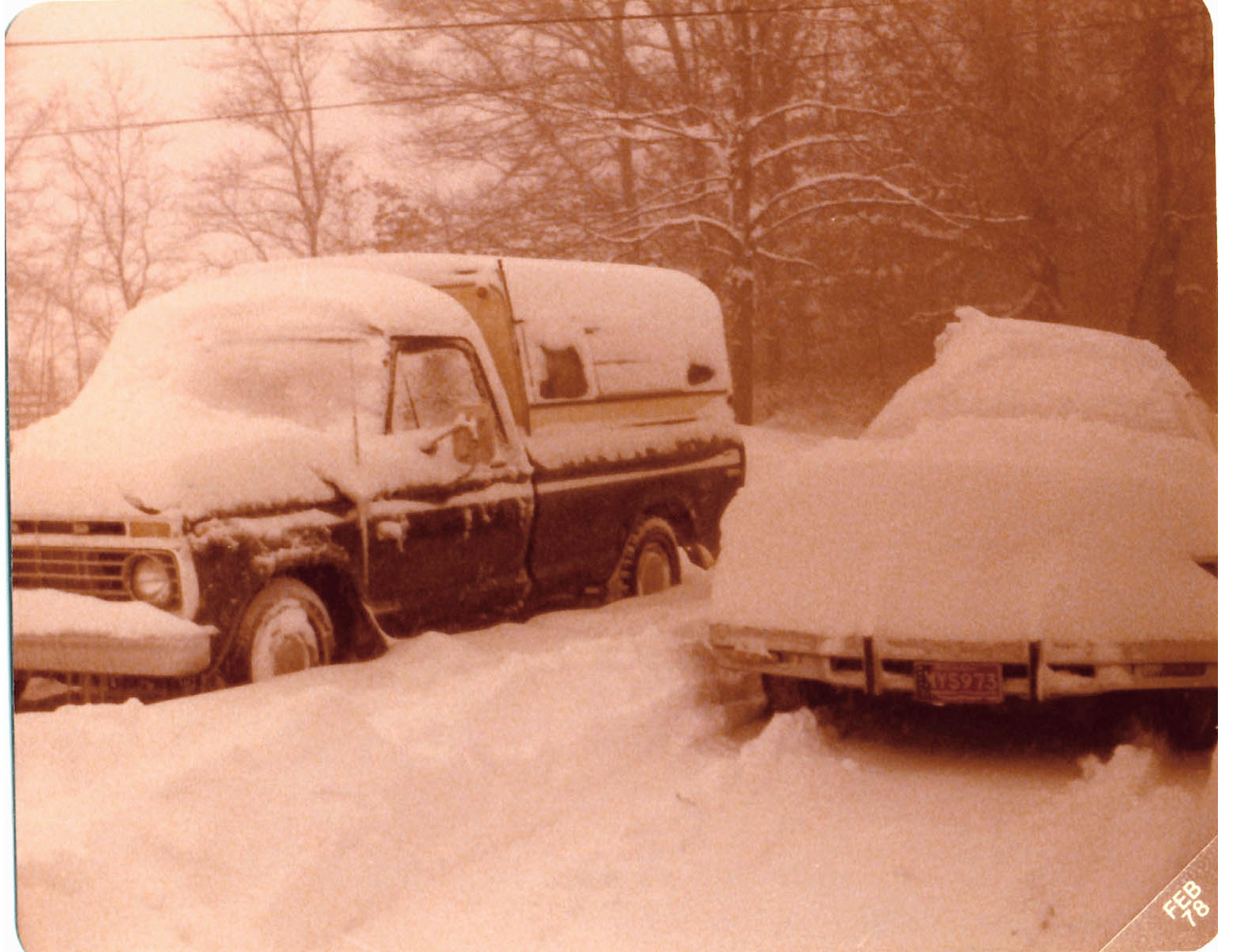
Remembering the Michigan Blizzard of 1978

Michigan Blizzard 1978

Blizzard of ’78 – Somerset, MI, photo by Bill

The most extensive and very nearly the most severe blizzard in Michigan history raged January 26, 1978 and into part of Friday January 27. About 20 people died as a direct or indirect result of the storm, most due to heart attacks or traffic accidents. At least one person died of exposure in a stranded automobile. Many were hospitalized for exposure, mostly from homes that lost power and heat. About 100,000 cars were abandoned on Michigan highways, most of them in the southeast part of the state.
~C. R. Snider, National Weather Service Meteorologist in Ann Arbor, Michigan

Today is Michigan’s 179th birthday, but it’s also the anniversary of one of the most significant storms to ever hit the state, the Great Blizzard of 1978. William Deedler’s article A Great Storm is Upon Michigan says in part:

While there are several contenders for the worst blizzard ever to hit the Great Lakes in relatively modern times (since 1870 when records began in Detroit), the immense and intense Blizzard of January 26-27th 1978 must rank at or near the top along with the Great White Hurricane of 1913 (my link) with its similar track and powerfulness.

…As the Arctic air circulated throughout the storm while it made its way over Lake Huron, the lowest pressure was reached around 950 millibars or a hurricane-like 28.05 inches! “A Great Storm is Upon Michigan” read the headline of the 800 AM EST Special Weather Statement issued by the National Weather Service Forecast Office in Ann Arbor that Thursday /26th/ morning. Heavy snow and blizzard conditions were extensive as wind gusts in excess of 35 mph whipped the snow into huge drifts across much of Southeast Lower Michigan. Other areas of Eastern Michigan, Indiana and Ohio reported near hurricane-force winds, heavy snow and temperatures hovering between zero and 10 above, resulting in extreme blizzard conditions. These conditions later expanded further east into Pennsylvania and West Virginia and prevailed into the night (26-27th) across much of the Eastern Great Lakes, Southern Ontario and the Upper Ohio Valley. With the storm generating copious amounts of snow and very strong winds, whiteout conditions were widespread. All land and air traffic came to a stand still in the affected regions. Several major roads were closed for at least two to three days, if not longer, while clean up got underway. Numerous NWS employees were stranded at work, home, or on the road somewhere between the two. Several employees worked double shifts into at least Friday (some longer) because of the impassable roads with others simply unable to get to work.

The Blizzard Warnings were allowed to die across Michigan during the forenoon hours of Friday, the 27th. Record 24 hour snowfall totals from the storm included, 16.1 inches at Grand Rapids, 15.4 inches at Houghton Lake and 12.2 at Dayton, OH. Snowfalls for the entire storm (25-27th) included a whopping 30.0 inches at Muskegon (some of which was Lake Michigan enhanced), 19.3 inches at Lansing and 19.2 at Grand Rapids. Snowfalls were less over Southeast Lower Michigan (mainly because of the rain that fell for a period) and included 9.9 inches at Flint and 8.2 inches at Detroit.

Read on for more about the storm.

View Bill’s photo background big and see more in his Kelso: The Wonder Years slideshow.

Support Michigan in Pictures with Patreon