
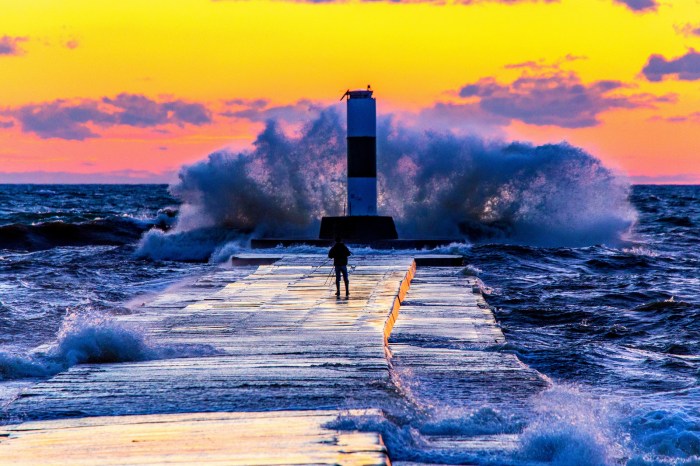
Spectacular Display, photo by Bob Gudas
Bob took this shot of a photographer on Grand Haven’s North Pier with more guts or maybe less sense than most. I bet his photo was pretty sweet though!
View it bigger and see more in his slideshow.
Spectacular Display, photo by Bob Gudas
Bob took this shot of a photographer on Grand Haven’s North Pier with more guts or maybe less sense than most. I bet his photo was pretty sweet though!
View it bigger and see more in his slideshow.

Untitled, photo by Todd Richter
Happy Leap Day everyone and here’s hoping that this quadrennial occurrence adds a little fun to your life! Borgna Brunner lays down Leap Year 101:
Leap years are added to the calendar to keep it working properly. The 365 days of the annual calendar are meant to match up with the solar year. A solar year is the time it takes the Earth to complete its orbit around the Sun — about one year. But the actual time it takes for the Earth to travel around the Sun is in fact a little longer than that—about 365 ¼ days (365 days, 5 hours, 48 minutes, and 46 seconds, to be precise). So the calendar and the solar year don’t completely match—the calendar year is a touch shorter than the solar year.
It may not seem like much of a difference, but after a few years those extra quarter days in the solar year begin to add up. After four years, for example, the four extra quarter days would make the calendar fall behind the solar year by about a day. Over the course of a century, the difference between the solar year and the calendar year would become 25 days! Instead of summer beginning in June, for example, it wouldn’t start until nearly a month later, in July. As every kid looking forward to summer vacation knows—calendar or no calendar—that’s way too late! So every four years a leap day is added to the calendar to allow it to catch up to the solar year.
Read on for more and enjoy your day.
Todd took this shot back in August of 2009 at one of my favorite spots for hiking (and jumping) – the Pyramid Point overlook in the Sleeping Bear Dunes National Lakeshore. Lake Michigan is hundreds of feet down a steep bluff from the point where she’s jumping, and many is the person who wished they didn’t run down that bluff after toiling up it!
View Todd’s photo background bigtacular and see more in his digital slideshow.
More dunes on Michigan in Pictures!
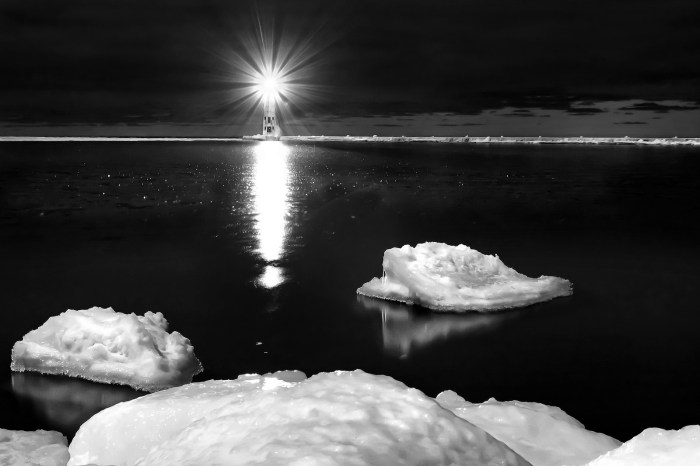
Quiet Night at Frankfort Lighthouse, photo by Snap Happy Gal Photography
I was going to talk this morning about how I will continue to talk about what I want to talk about on Michigan in Pictures, but then I saw this awesome photo by Heather. I’m sure you get the idea.
On her Snap Happy Gal blog where you can view & purchase some great lighthouse photos, Heather writes:
I think of myself as a serendipitous shooter: I go out to scenes in all kinds of light – the good, the bad, even the ugly – and I take photos. Sometimes I walk away with artwork worth sharing, and sometimes I just walk away with happy memories. I don’t often stalk a scene for the best light, I don’t think of myself as having a favorite thing to photograph, and I don’t find that I’m predictable (even I don’t know when or where I’ll be heading out to shoot until I get the itch). But, lately, if you wanted to catch me out and about, you’d look at northern Michigan’s west coast lighthouses.
I’ve visited every one of them from Manistee up to Northport (though I didn’t take the camera out), and I’ve been there from sunrise to sunset, and well into the night.
Last Wednesday, I checked the weather and saw something I hadn’t seen in what felt like eons: the possibility for clear night skies. I packed my gear, my cold weather clothes, and food and water, and headed for the coast. I missed the best light in an incredible sunset, but caught the afterglow and the first light of the moon on the lakeshore just south of Empire. While the skies were still cloudy, I headed south into Frankfort to see how the ice was shaping up along the beach. By this time, the winds had died down almost entirely. The water inside the breakwall was very still, the forming ice chattered, and tiny waves sloshed against the icebergs beached on the sand.
Read on for the rest, view & comment on her picture on Facebook, and definitely follow Snap Happy Gal for great pics of lighthouses and much more.
More about the Frankfort North Breakwater Light on Michigan in Pictures.
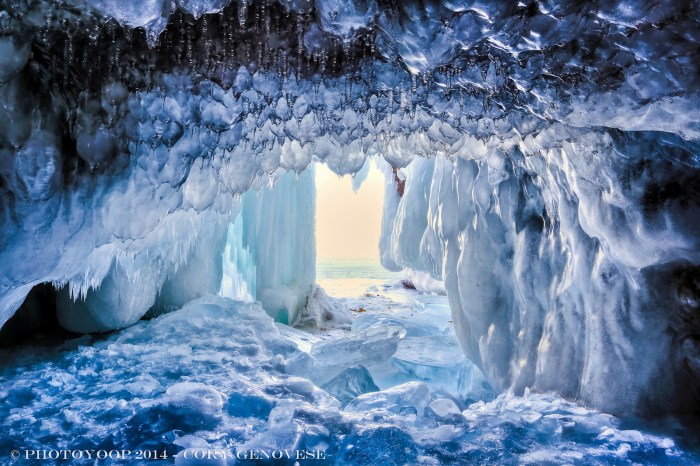
Soul of the Yoop, photo by Cory Genovese
While our Great Lakes shoreline still holds some cool formations this winter, unlike the last two years this winter hasn’t had the very cold days coupled with high winds that combine to form truly spectacular ice caves. Thankfully, we can look back … and hope for a wintry turn in the weather!
Cory took this photo of one of his favorite little Lake Superior ice caves in a spring thaw in April of 2014. View the photo bigger, see more in his Yoop Life slideshow, and definitely follow him on Facebook at PhotoYoop for more great shots of life on the edge in Michigan’s Upper Peninsula!
More ice caves on Michigan in Pictures, and please consider becoming a patron of Michigan in Pictures.
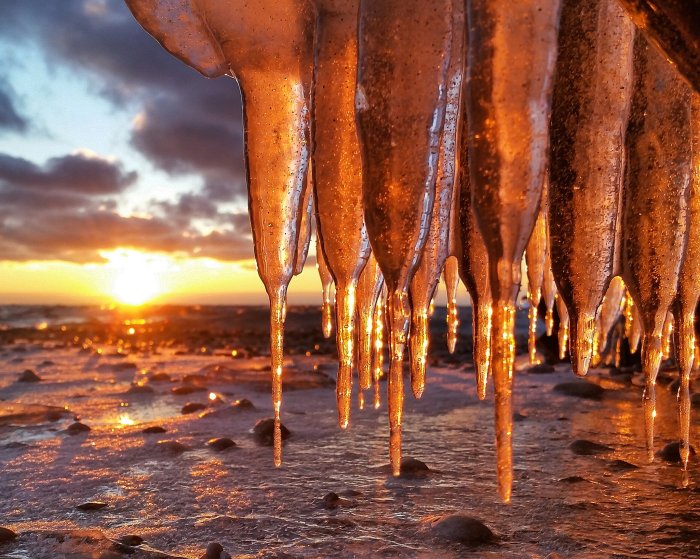
Niciclez, photo by Noah Soreson
Beautiful scene on the Lake Michigan shore. Here’s hoping you have a chance to get out there and have some fun this weekend!
View Noah’s photo background bigilicious, see more in his slideshow. and be sure to follow him on Instagram.
More winter wallpaper on Michigan in Pictures.
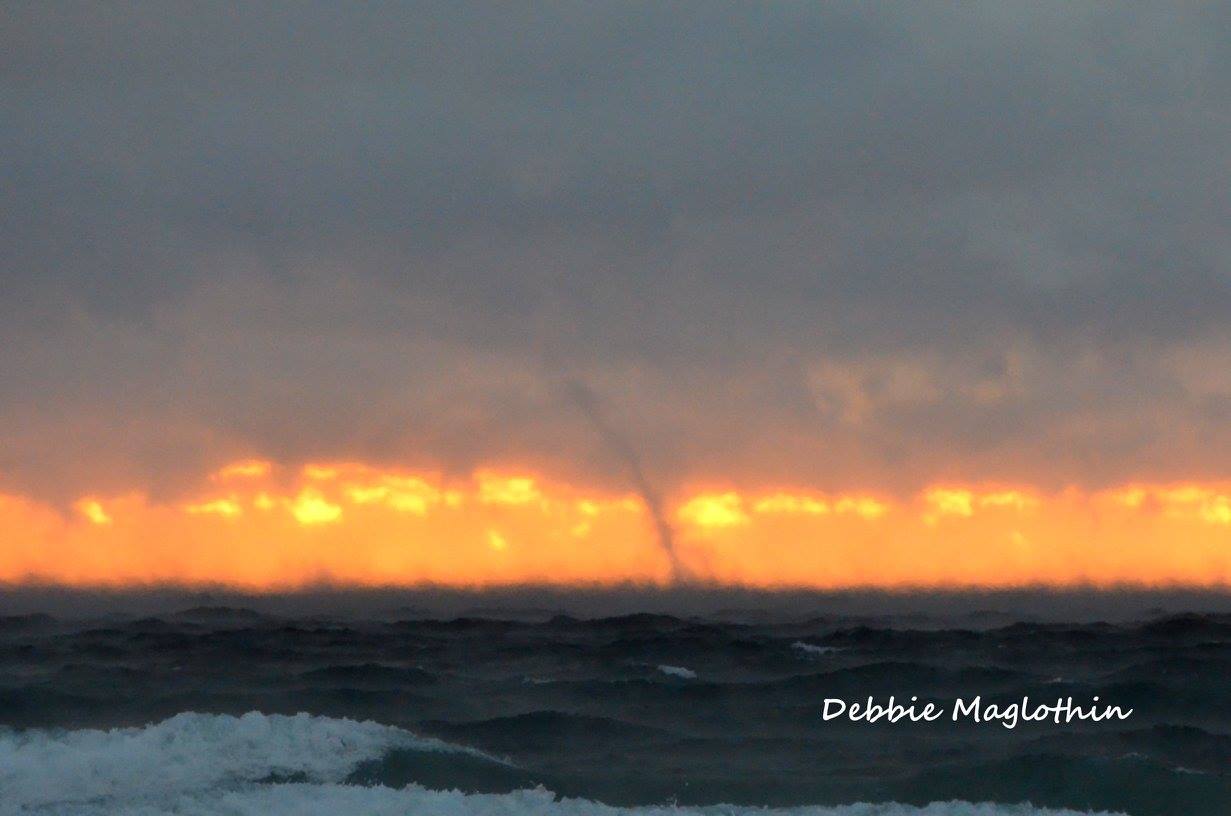
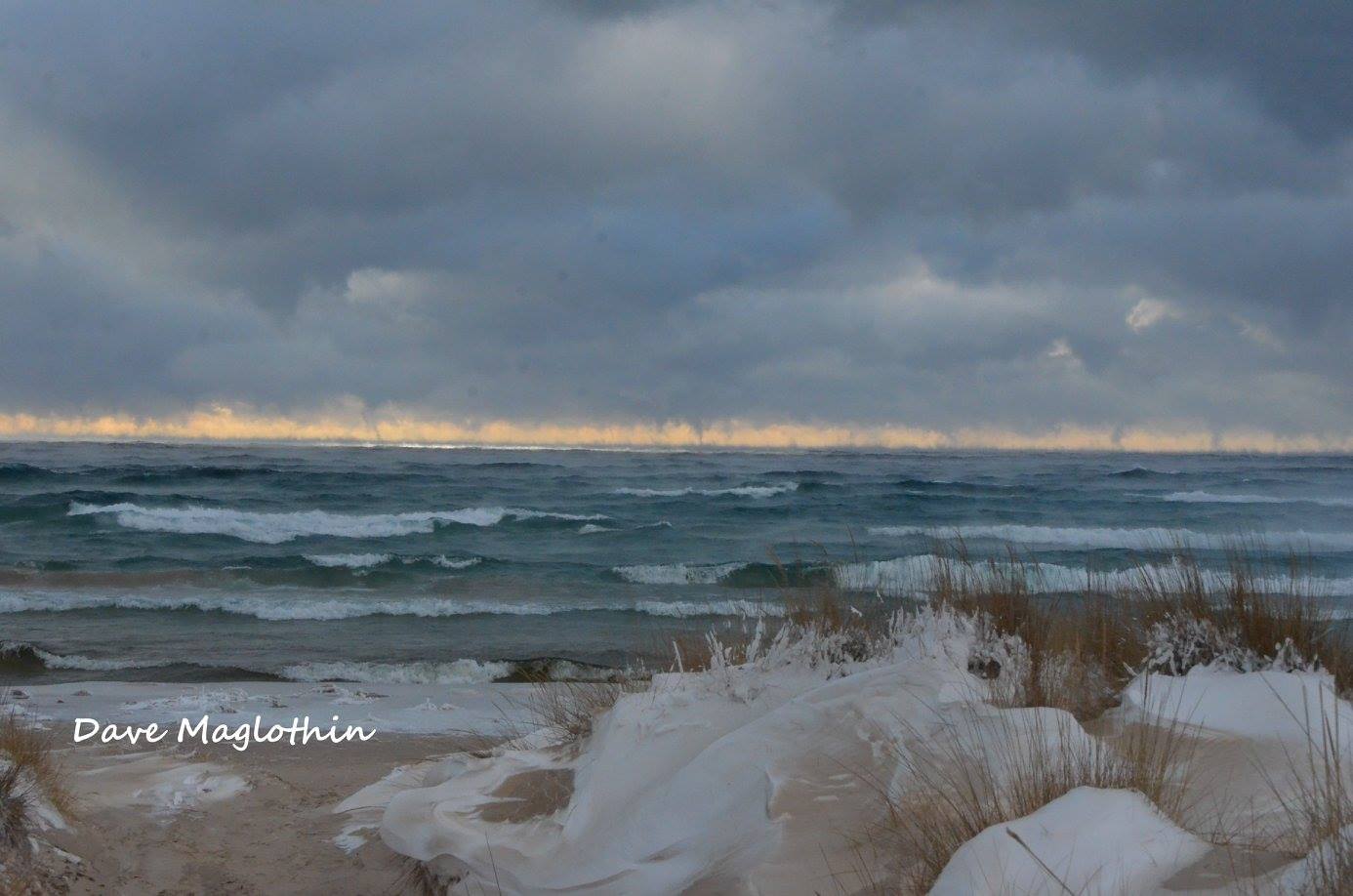
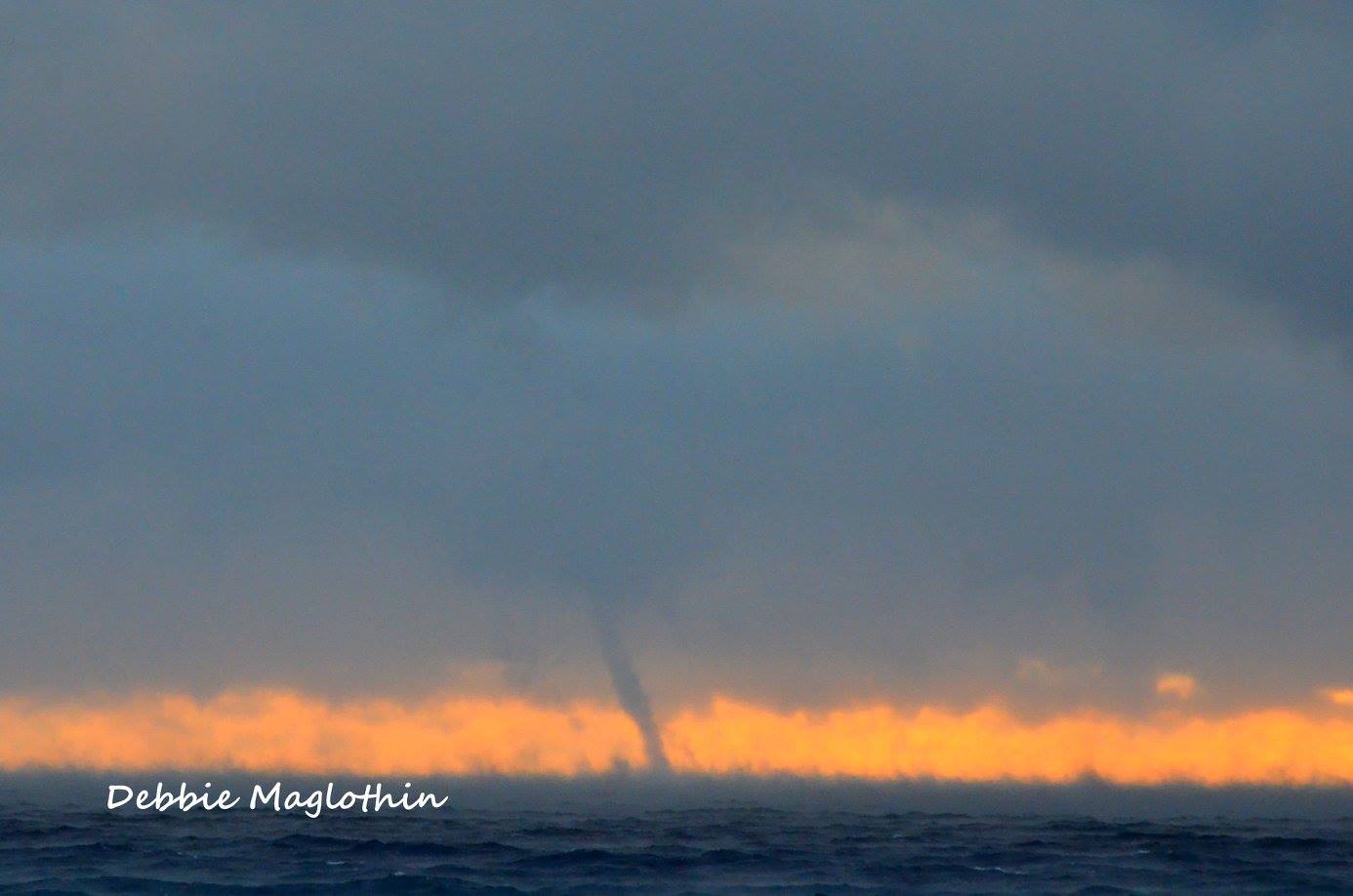
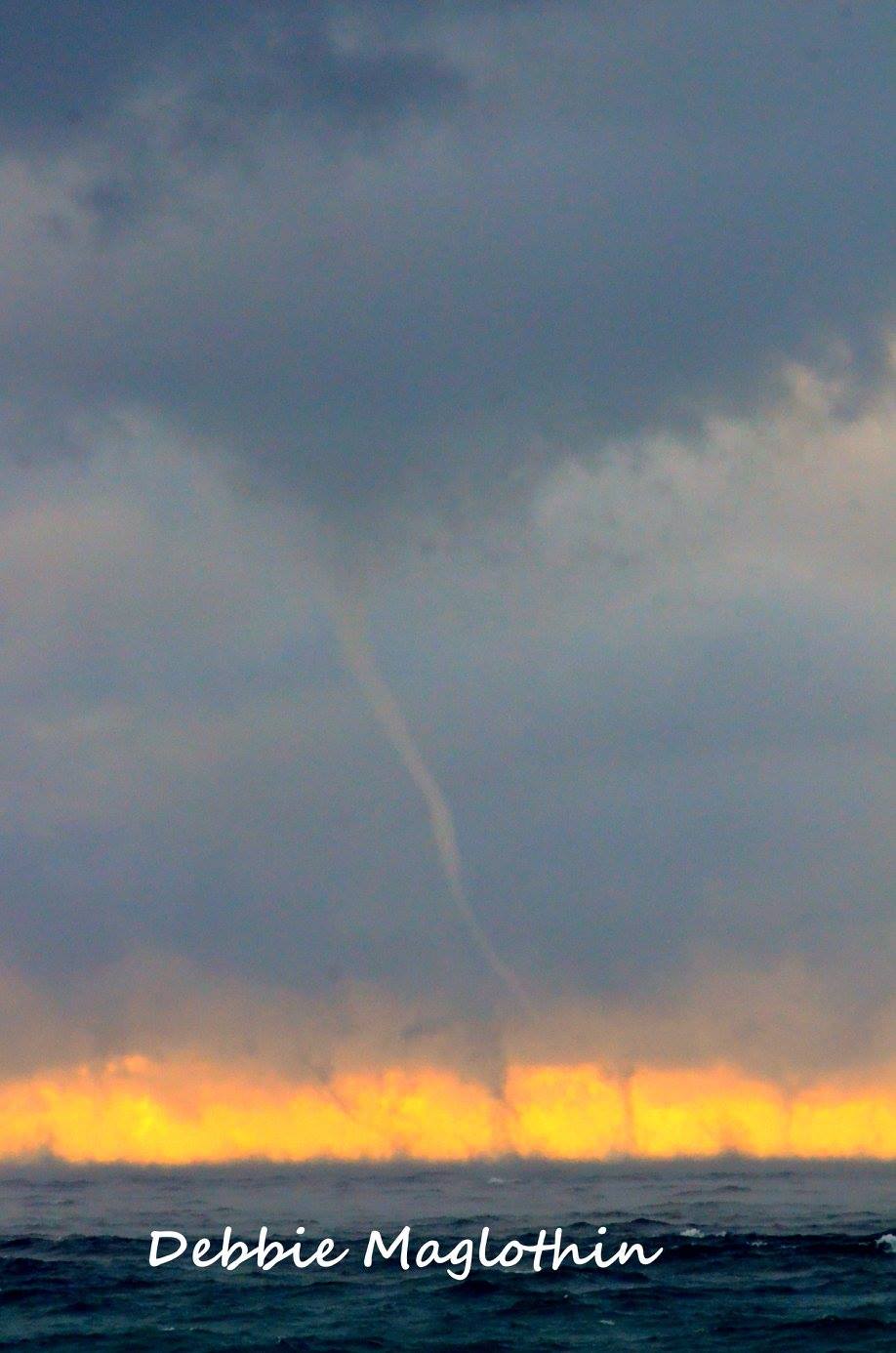
Cold Air Waterspouts, photos by Debbie Maglothin
If you live along the Great Lakes, chances are you’ve seen a waterspout from time to time. While waterspouts are typically formed when cold air moves over warm water in late summer or early fall, occasionally the reverse can happen.
Debbie Maglothin took several photos of cold air waterspouts over Lake Michigan off the Ludington State Park beach. WZZM 13 meteorologist Alana Nehring explains how they form:
A drastic temperature difference between the air an water is required. In the most recent event, water temperatures were near 32 degrees while air temperatures were closer to 10 degrees.
A steady breeze needs to be present to jump-start the process of evaporation.
In most cases, this is also how lake-effect snow is produced but in some unique situations, a slight twisting motion will occur in the steam above the water. If it is maintained long enough, eventually weak funnels will develop.
Click the pics to view them bigger and follow Debbie on Facebook at Cha Bella Photography.
More Michigan weather on Michigan in Pictures.
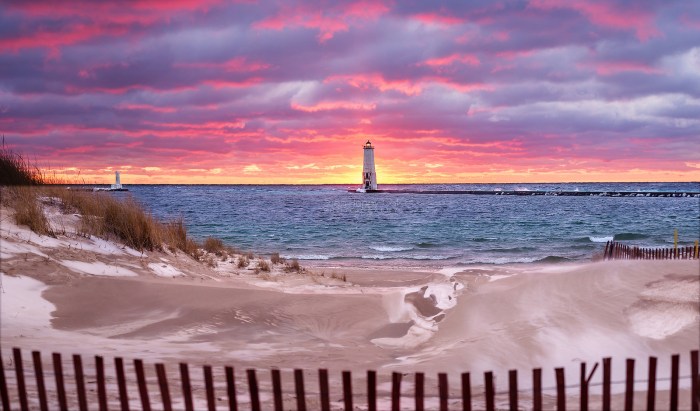
Promise Fulfilled, photo by Heather Higham
Although I just featured a sunset photo by Heather … Wow!
She took this last night and writes: A break at the horizon that spouted god rays all afternoon hinted a the potential for a lightshow at sundown. We were not disappointed, though we were very cold.
View the photo bigger, see more in her Sunsets slideshow, and follow Heather at Snap Happy Gal Photography on Facebook.
Click for more about the Frankfort Pier Lights and a super cool winter photo by Jason Lome.
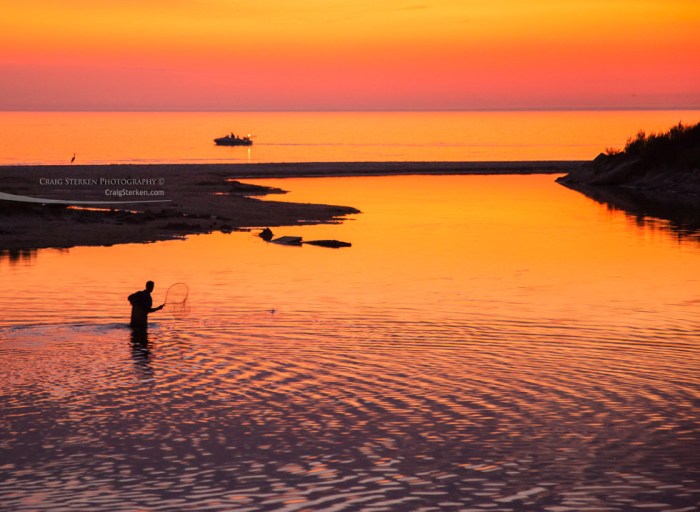
Salmon Fishing on the Sable River Outlet, Ludington Michigan, photo by Craig Sterken
Traverse City based AP Environmental Writer John Flesher is (for my money) one of the best reporting on Great Lakes issues. His latest piece Effort to keep Asian carp from Great Lakes appears stymied begins:
When scientists discovered six years ago that aggressive Asian carp had made their way up the Mississippi River’s tributaries toward the Chicago area, the Obama administration and alarmed state officials pledged swift action to head off an invasion they feared could devastate fishing and boating on the vital Great Lakes.
Since then, federal agencies have spent more than $300 million on stopgap measures, including placing electric barriers on one likely route, a shipping canal that leads to Lake Michigan. But as the carp get closer_some are within 80 miles of the lake— the quest for a surefire deterrent seems to be coming up empty.
An advisory panel that has debated solutions for several years is scheduled to hold what may be its final meeting Thursday, with no sign of a consensus plan, several members said in interviews.
Even if talks continue, chances are growing that the carp will arrive before anything conclusive is done to stop them. At their recent pace, the first young carp could reach Lake Michigan within two years, although a number of obstacles could slow them considerably.
“It’s one of the things that keep me up at night,” said U.S. Sen. Debbie Stabenow, a Michigan Democrat whose state borders four of the five Great Lakes. “Asian carp could devastate our Great Lakes and the hundreds of thousands of jobs that depend on them.”
…Environmental groups and the region’s fishing and boating industries, which generate $23 billion annually on the lakes, are most worried about two varieties of Asian carp: bighead and silver, which weigh dozens of pounds and gorge on the same tiny plant and animal life that feeds the lakes’ other fish. Scientists are still measuring their impact in rivers, but under worst-case scenarios, the large carp could leave popular sport fish to go hungry and suffer population drop-offs. Asian carp are edible but bony, and most Great Lakes fish connoisseurs regard them as a poor substitute for the walleye and whitefish.
Additionally, silver carp are notorious for springing from the water when startled, sometimes ramming boaters with bone-cracking force — a hazard that some fear could damage the Great Lakes’ tourism industry.
Read on for much more, and be sure to follow John on Twitter for more of the story. And please, make it clear to every elected official you interact with how important the health of the Great Lakes is to Michigan!
View Craig’s photo bigger, see lots more Great Lakes goodness in his slideshow and view & purchase photos from him on his website.(this one is in the Ludington collection)
More about the threat of Asian carp on Michigan in Pictures.
 Michigan in Pictures