Happy Halloween … and the Indian Drum

pumpkin-on-the-shore-happy-halloween

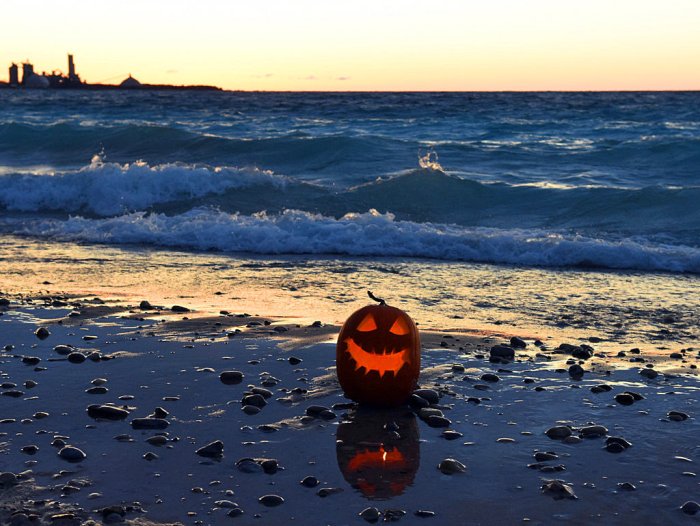
Happy Halloween, photo by Julie

Happy Halloween everyone! I shared this story a few years ago, but since we’re back up on northern Lake Michigan at a time when the witch of November is rousing, why not share it again? In 1915, William MacHarg & Edwin Balmer wrote a book called The Indian Drum. The whole book is available online along with 53,000+ more books at Project Gutenberg. Chapter I begins:

Near the northern end of Lake Michigan, where the bluff-bowed ore-carriers and the big, low-lying, wheat-laden steel freighters from Lake Superior push out from the Straits of Mackinac and dispute the right of way, in the island divided channel, with the white-and-gold, electric lighted, wireless equipped passenger steamers bound for Detroit and Buffalo, there is a copse of pine and hemlock back from the shingly beach. From this copse—dark, blue, primeval, silent at most times as when the Great Manitou ruled his inland waters—there comes at time of storm a sound like the booming of an old Indian drum. This drum beat, so the tradition says, whenever the lake took a life; and, as a sign perhaps that it is still the Manitou who rules the waters in spite of all the commerce of the cities, the drum still beats its roll for every ship lost on the lake, one beat for every life.

So—men say—they heard and counted the beatings of the drum to thirty-five upon the hour when, as afterward they learned, the great steel steamer Wenota sank with twenty-four of its crew and eleven passengers; so—men say—they heard the requiem of the five who went down with the schooner Grant; and of the seventeen lost with the Susan Hart; and so of a score of ships more. Once only, it is told, has the drum counted wrong.

At the height of the great storm of December, 1895, the drum beat the roll of a sinking ship. One, two, three—the hearers counted the drum beats, time and again, in their intermitted booming, to twenty-four. They waited, therefore, for report of a ship lost with twenty-four lives; no such news came. The new steel freighter Miwaka, on her maiden trip during the storm with twenty-five—not twenty-four—aboard never made her port; no news was ever heard from her; no wreckage ever was found. On this account, throughout the families whose fathers, brothers, and sons were the officers and crew of the Miwaka, there stirred for a time a desperate belief that one of the men on the Miwaka was saved; that somewhere, somehow, he was alive and might return. The day of the destruction of the Miwaka was fixed as December fifth by the time at which she passed the government lookout at the Straits; the hour was fixed as five o’clock in the morning only by the sounding of the drum.

The region, filled with Indian legend and with memories of wrecks, encourages such beliefs as this. To northward and to westward a half dozen warning lights—Ile-aux-Galets (“Skilligalee” the lake men call it), Waugaushance, Beaver, and Fox Islands—gleam spectrally where the bone-white shingle outcrops above the water, or blur ghostlike in the haze; on the dark knolls topping the glistening sand bluffs to northward, Chippewas and Ottawas, a century and a half ago, quarreled over the prisoners after the massacre at Fort Mackinac; to southward, where other hills frown down upon Little Traverse Bay, the black-robed priests in their chapel chant the same masses their predecessors chanted to the Indians of that time. So, whatever may be the origin of that drum, its meaning is not questioned by the forlorn descendants of those Indians, who now make beadwork and sweet-grass baskets for their summer trade, or by the more credulous of the white fishermen and farmers; men whose word on any other subject would receive unquestioning credence will tell you they have heard the drum.

Read on at Project Gutenberg.

View Julie’s photo bigger and see more in her Holidays slideshow.

See 700 more Halloween photos in the Absolute Michigan photo group  and more haunted, Halloween fun on Michigan in Pictures.
Find Your Wayve

find-your-wayve

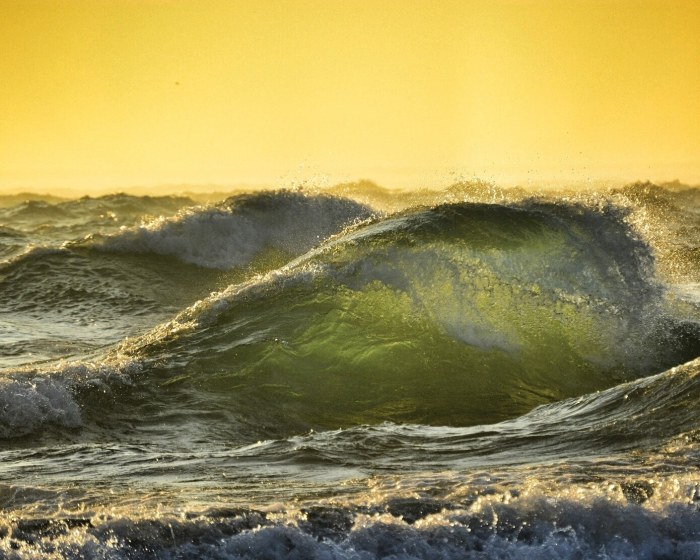
Find Your Wayve, photo by Noah Sorensen

View Noah’s photo from Elberta Beach on Lake Michigan background bigtacular and see lots more from Noah on Flickr.

More fall wallpaper on Michigan in Pictures.

Photo-op gone bad

photo-op-gone-bad

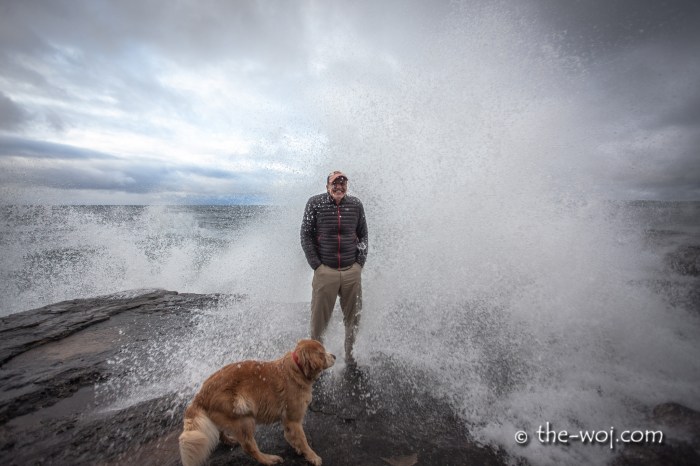
Photo-op gone bad, photo by Paul Wojtkowski

Paul got caught by an unexpectedly large wave on Lake Superior – good thing he had already taken his selfie-stick shots!! :D

View his photo big as the biggest lake, see more including Manabezho Falls in his slideshow, and view and purchase photos on the-woj.com.

On a more serious note, as yesterday and today’s posts show, these big lakes have big and sometimes unexpected power, particularly as we head into fall and winter. Take a moment to see what’s going on, watch for a minute so you know what’s going on, be sure of your footing, and take a buddy or two if you can!

Pier Energy at Frankfort North Breakwater Lighthouse

pier-energy-by-aaron-springer

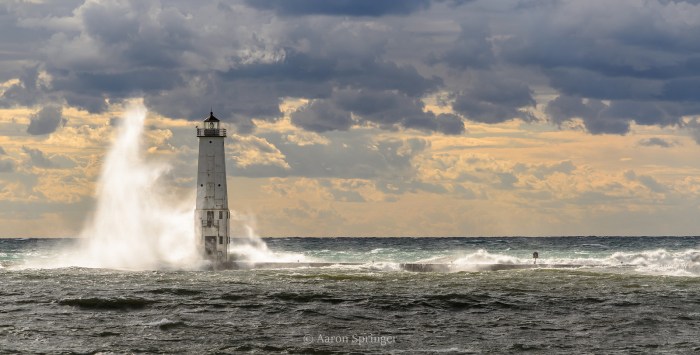
Pier Energy, photo by Aaron Springer

The Frankfort North Breakwater Lighthouse entry at Terry Pepper’s excellent Seeing the Light says the tip of the light is 72 feet off the water, making that spray over 80′ tall!! Click above for a ton more, but here’s something about the light tower:

1912 saw significant a significant change in the lighting of the Frankfort harbor entrance. A new square steel pyramidal tower was erected on the North Pier. Fully sheathed in steel plates, the white painted structure stood 44 feet from its base to the top of the ventilator ball. Outfitted with a fixed red Fourth Order Fresnel lens, the tower’s location on the north pier provided the new light with a focal plane of 46 feet, and a visible range of 12 miles in clear weather. The air siren from the South Pierhead light was relocated into this new structure, and set up to emit a characteristic isophase characteristic of alternating periods of 3 second blasts and 3 seconds of silence. An elevated walkway, similar to that installed on the south Pier, was erected from the new light to the shore.

…By 1924, the total car ferry tonnage through Frankfort Harbor was twenty five times greater than that prior to the establishment of the ferries. To better serve this vital commerce, the Army Corps of Engineers began construction of a pair of reinforced concrete arrowhead-type breakwaters at the harbor entrance in order to create a large stilling basin to protect the opening into the harbor. With the completion of these breakwaters in the early 1930’s, the twin piers at the entry into Lake Betsie no longer served any purpose. With plans in place to shorten them into short stub piers, the North Pierhead Light was lifted from the pier onto the deck of a barge and carried out to the end of the North Breakwater. A square steel base 25 feet in height had been erected on the end of the breakwater to receive it, and the tower was lifted onto the new base. After being bolted into position, the new tower stood 67 feet in height from the upper level of the pier to the top of the lantern ventilator ball. By virtue of its location on the concrete pier, the light stood at a focal plane of 72 feet, and the 17,000 candlepower incandescent electric light within the Fourth Order Fresnel was visible for a distance of 16 miles in clear weather.

Read on for lots more about the lighthouse including some great old photos.

View Aaron’s photo bigger and see more in his slideshow,.

Tons more lighthouses on Michigan in Pictures.

Soaring Saturday: Hang Gliding in Michigan

coming-in-by-david-clark

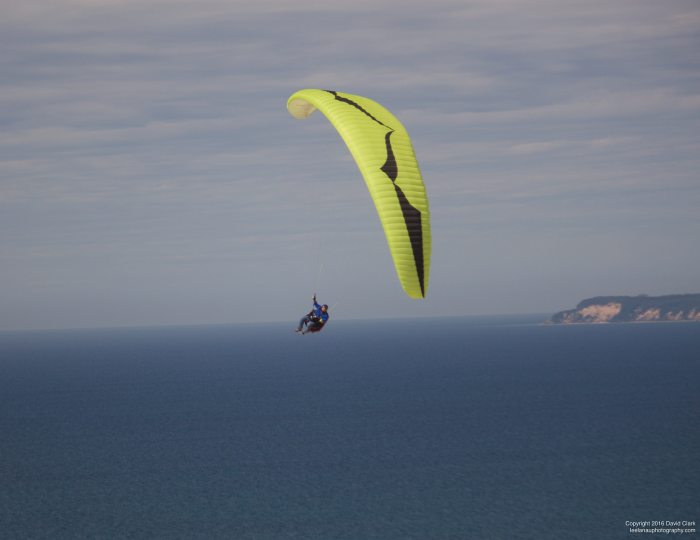
Coming In, photo by David Clark

USA Today has a feature on Hang Gliding Sites in Michigan that says (in part):

Most individuals will need lessons in hang gliding from a certified instructor prior to their first flight. Hang gliding schools provide instructions, gear, permits and safety equipment. The Draachen Fliegen Soaring Club is located in Cloud 9 Field between Detroit and Lansing, with instructors offering “tandem discovery” flights lasting from 15 minutes to one hour. Gliders drift in air space up to two miles high, in tandem with an instructor. Individuals with proven experience and certifications may rent gliders for solo flights. Traverse City Hang Gliders offers full programs of training and instruction in both traditional powerless hang gliding and “the Mosquito” powered hang gliding harness.

Hang gliding enthusiasts can enjoy practicing the sport at national parks within the state of Michigan, including Sleeping Bear Bear Dunes National Lakeshore. Several spots within the park are approved for powerless flight. Hang gliders can take off and land at Empire Bluff, Pyramid Point and Lake Michigan Overlook on the Pierce Stocking Scenic Drive, as well as Dune Climb in the months of November through March. Powerless flight permits are required and can be obtained free of charge at the Visitor Center Information Desk. Launch sites within the park require proficiency ratings established by the U.S. Hang Gliding Association. Gliders must also follow safety and federal regulations. Warren Dunes State Park also issues permits for hang gliding along the coastal dunes, about 14 miles from the state border with Indiana. Favorite launch and return sites within the park include Tower Hill and New Buffalo.

In the 1970s, Elberta Beach and the adjacent city of Frankfort, in Northern Michigan, were popular spots for what was then the new sport of hang gliding. Once referred to as the “Sail Plane Capital,” the area is still a magnet for gliders today. Just south of Frankfort, gliders can experience the thrill of soaring over sand dunes at Green Point Dunes. The Green Point Flyers Association, established in 1978, is a club for both hang gliders and parasailers, with a main flying site that is a sand dune stretching for three miles at a height of 370 feet. Licenses are required to fly at Green Point, and certified instructors are available. Pilots at Green Point also have access to hang gliding sites inside the Sleeping Bear Dunes National Lakeshore, as well as the bluffs of Elberta. Visitors can also team up for a ride with members of the Northwest Soaring Club, which is located in Cadillac, Michigan. Flights depart from the Wexford County Airport, then cruise over Lake Mitchell and Lake Cadillac.

View David’s photo background bigilicious, see more in his Turning 42 slideshow, and view and purchase work at leelanauphotography.com!

If you’d like to get a look at the process, here’s a video of aerial photographer Jim Anderson taking a flight from the Bluffs!

Last Dawn of Summer

last-dawn-of-the-summer

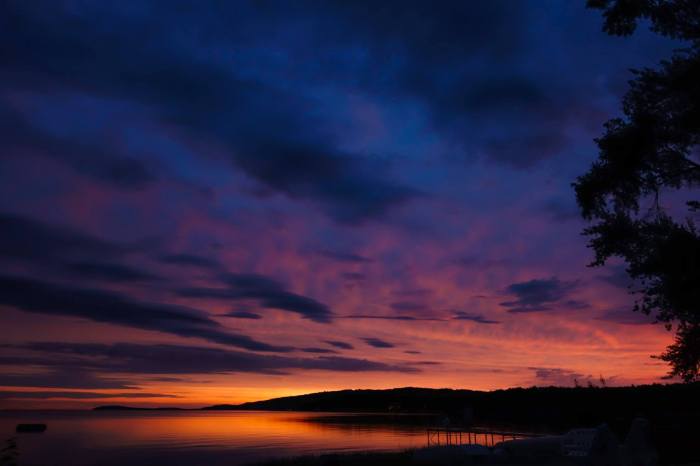
Last Dawn of Summer, photo by John Robert Williams Photography

Since I shared something from the first day of fall, it seems only fitting that I share something from the last day of summer! Here’s a stunning sunrise over West Grand Traverse Bay in Traverse City by my friend John!

Click the pic to view it background bigilicious and get more from John, including professional portraits at jrwpix.com!

More Traverse City and more summer wallpaper on Michigan in Pictures!


Round Island Run

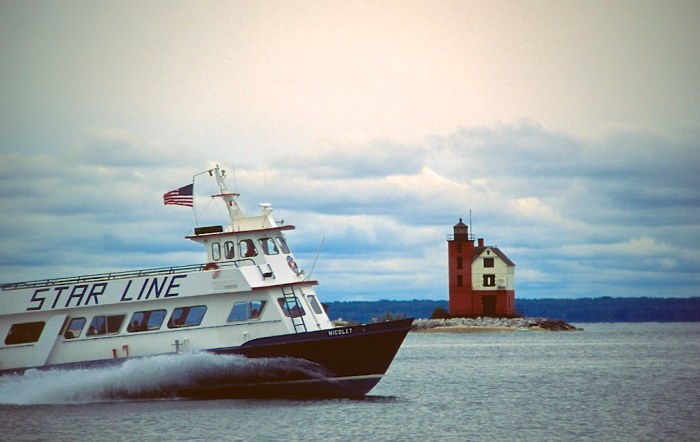
Ferry & lighthouse

Round Island, MI, photo by Bill Johnson

Bill took this photo 21 years ago on September 21, 1995! It shows the Star Line Ferry’s Nicolet speeding past the Round Island Lighthouse. Star Line explains:

Star Line Ferry was started by Tom Pfeiffelmann, Sam McIntire, and others in the late 1970s. They purchased Argosy Boat Line. The company was then renamed Star Line after the 5 original stockholders making up a 5 pointed star. At that time they operated slower ferries including the Nicolet, Treasure Islander and Flamingo.

In 1979 Star Line bought their first fast ferry, Marquette. Over the next few years the old LaSalle and Nicolet were replaced with sisters to the Marquette. In 1987 Star Line decided to take it up a notch with Radisson, an 85-foot fast ferry which was modeled after a luxury yacht.

View Bob’s photo background big and see more in his Lighthouses slideshow.

PS: Check out this cool yesterday and today at Round Island Lighthouse on Michigan in Pictures!

Rockport State Recreation Area on Lake Huron

rockport-state-recreation-area-alpena-lake-huron

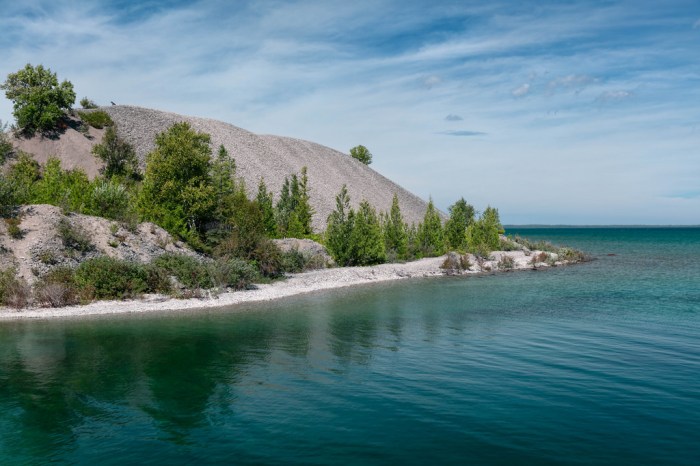
Rockport State Recreation Area – I, Alpena, MI, September, 2016, photo by Norm Powell

The Alpena CVB’s page on Rockport State Recreation Area says:

Rockport State Park, Michigan’s 100th State Park and an official Dark Sky Preserve, has over 4,237 acres of land located on the shores of Lake Huron north of Alpena. The property includes a deep-water protected harbor, an old limestone quarry of approximately 300 acres, a unique series of sinkholes, Devonian Era fossils, the Besser Natural Area, and a broad range of land types, vegetative cover, cultural resources and recreation opportunities. At the harbor the DNR has a boat launch facility, and there is a small park with picnic areas.

If you click through, they have a nifty guide that includes more information on the offerings including the fossils and sinkholes! You can get a map and more info from the State of Michigan’s page on Rockport Recreation Area.

View Norm’s photo bigger, see more in his slideshow, and view and purchase his photos on his website.

Many more Michigan parks on Michigan in Pictures!

What’s in a name: Petoskey Stone Edition

petoskey-stone-on-the-lake-michigan-waterline

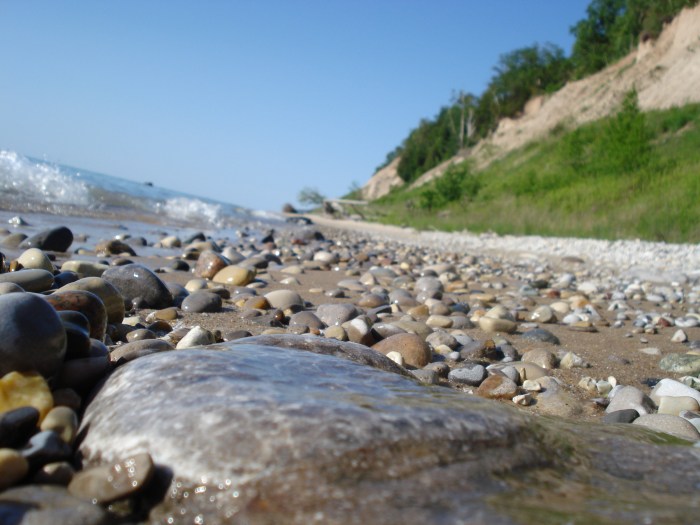
Waterline, photo by Andrew McFarlane

This is one of my photos that I dug up for another project that I wanted to share. Apparently this was taken during in my “tilty” phase. ;)

Here’s something beautiful that a young woman I know named Rose Petoskey wrote about Petoskey stones several years ago.

My name is Noozeen (Rose) Nimkiins (Little Thunder) Petoskey (Rising Sun) and I am Anishinaabek.

Many people would associate the word Petoskey with the souvenir stone found on the northern Lake Michigan shorelines. However, to my family, the word Petoskey represents much more than a souvenir.

In the Odawa language, the word Petoskey (Bii-daa-si-ga) means the rising sun, the day’s first light, or the sun’s first rays moving across the water. The Petoskey stone is a fossilized coral created by impressions made in limestone during the last Michigan ice age. These stones were named “Petoskey” because the impressions resembled the rising sun coming up over the water. Just as the image of the rising sun is implanted within the Petoskey stone, the archaeology of a person’s names is implanted within. All names within our Anishinaabek culture reflect an individual’s personal history. Rocks go deep, but names go much deeper to reveal the stories of the past.

Read on for more of Rose’s thoughts the power and beauty of the Odawa language!

View my photo from 9 years ago background bigilicious and see more in my Leland, Michigan slideshow.

More summer wallpaper and more from the beach on Michigan in Pictures

PS: The other project was for a stone path that a friend is building this year at the Earthwork Harvest Gathering held next weekend near Lake City (September 16-18). It’s a wonderful festival packed with Michigan musicians!

Paddling Home

paddling home

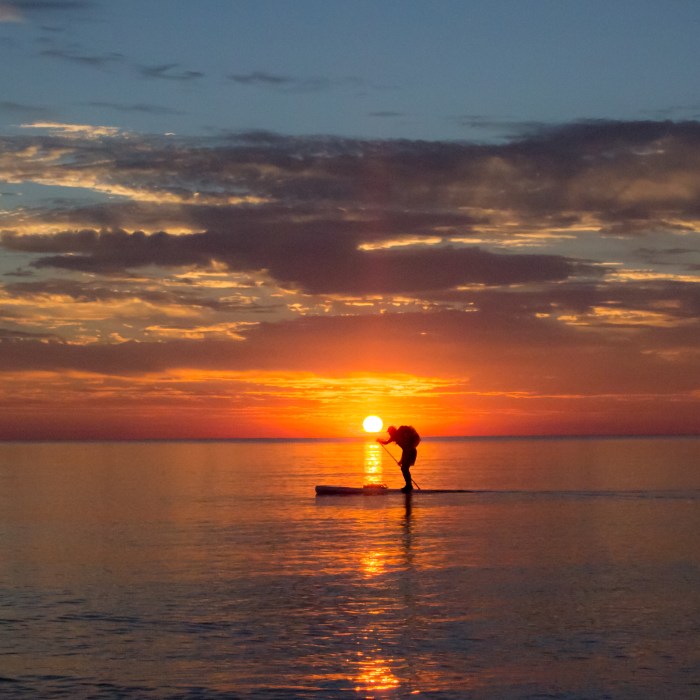
paddling home, photo by Amy

Well, I hope that you had a wonderful weekend, and that if you traveled you are either still on vacation or had as enjoyable a return trip as this fellow.

View Amy’s photo background bigalicious and see more in her slideshow.

More summer wallpaper and more Great Lakes on Michigan in Pictures.