

Summer Dreams, photo by Miss Sydney Marie
Anyone else dreaming of summer?
View Sydney’s photo bigger and see more in her For Sale slideshow and on her website.
Summer Dreams, photo by Miss Sydney Marie
Anyone else dreaming of summer?
View Sydney’s photo bigger and see more in her For Sale slideshow and on her website.
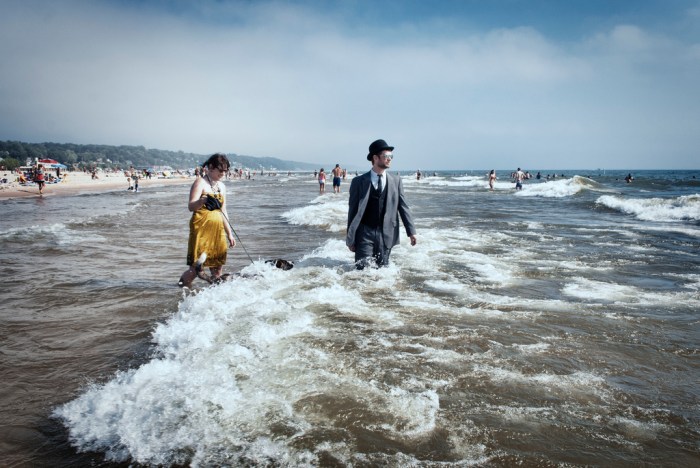
Formal Day at the Beach 2012, photo by flambedude
Staying safe at the beach? There’s an app for that. The Great Lakes Echo recently reported on myBeachCast, a smartphone app that gives you beach information:
Although drownings appear to be on track to fall from a record high in 2012, the overall trend from the past several years have seen consistent increase, according to the Great Lakes Surf Commission. The hazard warnings on the app informs users when and where there is a potential for dangerous rip currents.
In addition to the hazard warnings, the app will continue to feature lake temperature, beach locations and other components.
“The app is GPS enabled to allow a user to discover local Great Lakes beaches based on their location, save favorite beaches and view real-time information [on conditions],” said Christine Manninen, communications director of the Great Lakes Commission.
The app will hopefully reduce drownings, she said.
“Having the information at their fingertips gives people a better chance of making smarter decisions to protect their own health and safety and their family’s.”
Jonathan writes that this photo was taken at Formal Day at the Beach, a yearly event in Grand Haven where people dress up and get into Lake Michigan and swim around looking fabulous. If anyone knows when this is in 2013 please post it in the comments! Jonathan just let me know that Formal Day at the Beach takes place this year on Sunday, July 28th at 2pm.
Check his photo out bigger and see more in his Formal slideshow.
Much more about Michigan’s beaches on Michigan in Pictures!

Grand Haven Shipwrecks, photo by Kevin Ryan
mLive has a feature on how our historically low water levels have revealed a number of shipwrecks in Grand Haven:
Maritime archaeologist and director of the Tri-Cities Historical Museum Kenneth Pott said the area around Harbor Island was an apparent dumping zone for abandoned vessels and 1930s aerials held by the museum and the city of Grand Haven show that additional wrecks exist there. If the water line were to recede even more, then more vessels may be exposed.
“We’re quite sure that there are more in the area,” Pott said. “This is something akin to a graveyard for vessels. This is very unusual.”
The wooden sections of the 290-foot steamer Aurora, once the largest wooden steamer on the Great Lakes, and parts of at least four other shipwreck hulks were exposed recently by the low water levels and area residents alerted maritime historians to the find. The Aurora was identified by members of Holland-based Michigan Shipwreck Research Associates and local historians earlier this week.
Read on for more info including the publicly-accessible location. You can also read more about the Aurora right here and see a photo gallery.
Check this out background big and see a couple more views including a nice one of the rough outline of the wreck in Kevin’s slideshow.
More Michigan shipwrecks on Michigan in Pictures.

“October Gale” Grand Haven lighthouse, Grand Haven Michigan, photo by Michigan Nut
As the eastern seaboard braces for Hurricane Sandy, a storm of possibly unprecedented power, I thought I’d take a look back and see what the strongest October storm ever was. I didn’t have to look far, as it’s actually the Great Lakes storm of late October 2010:
On October 26, 2010, the USA recorded its lowest pressure ever in a continental, non-hurricane system, though its pressure was consistent with a category three hurricane. The powerful system was dubbed the “Chiclone” by the media as it hit the Chicago area particularly strongly, as well as Minnesota, Wisconsin and Michigan. It was also meteorologically referred to as a bombogenesis due to the rapid drop of barometric pressure experienced.
…The storm also produced some of the highest officially recorded waves by weather buoys stationed in Lakes Superior and Michigan. Specifically, on Wednesday, October 27, 2010, buoy no. 45136, operated by Environment Canada, in northern Lake Superior recorded a significant wave height of 26.6 feet (this is average height of 1/3 of the highest waves over an hour), and buoy no. 45002, operated by the National Data Buoy Center (NDBC), recorded a significant wave height of 21.7 feet in northern Lake Michigan. The NDBC and many models indicate that multiplying significant wave height by a factor of approximately 1.3 will equal the approximate average height of the highest 1/10 of waves recorded -here that would translate into such average wave heights of approximately 34.5 feet and 28.2 feet on Lakes Superior and Michigan respectively [please verify]. This would appear consistent with the NOAA forecast for northern Lake Michigan calling for 21-26 foot waves that day. The persistence and strength of the storm’s westerly winds also piled the waters of Lake Michigan along the Michigan shoreline leading to declines in lake levels on the Illinois and Wisconsin side of the lake. Based on NOAA lake level sensors, an updated analysis of Wednesday, October 27, 2010 water levels on Lake Michigan revealed a two-day decrease of 42 inches at Green Bay, WI and 19 inches at Calumet Harbor, IL—while NOAA sensors at Ludington, MI and Mackinaw City, MI measured lake level rises of 7 and 19 inches respectively.
A 78 mph gust was recorded the afternoon of October 27, 2010 at the Harrison-Dever Crib, three miles offshore of Chicago in Lake Michigan.
You can read a detailed account of the damage in the October North American Storm Complex on Wikipedia and also read Dr. Jeff Masters’ analysis of the storm at Weather Underground.
Check this out on black and see more in John’s Grand Haven Lighthouse slideshow.
More Michigan weather on Michigan in Pictures.
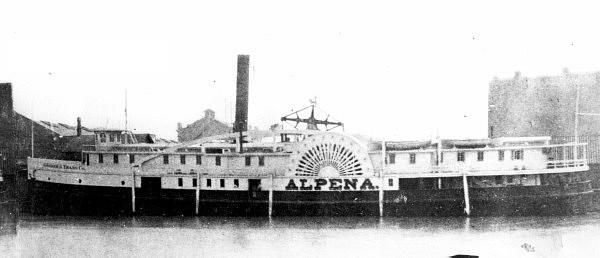
S.S. Alpena, photo from Wikimedia Commons
Over on Absolute Michigan we have a feature from the Archives of Michigan about two Michigan couples who were aboard the Titanic. I thought it would be interesting to see what the worst Michigan maritime disaster was. You might think it would be the immortalized Edmund Fitzgerald but with “only” 29, it’s down on the list. Or perhaps the tragic Carl D. Bradley in which 33 men perished, most from her home port of Rogers City.
It’s actually the sidewheel steamer S.S. Alpena. Michigan Shipwrecks says that this 197 foot Goodrich side wheel steamer was built in Marine City, Michigan in 1866. She was lost with about 80 crew & passengers in the “Big Blow” of 1880.
The Alpena left Grand Haven, Michigan bound for Chicago on Friday evening, October 15, 1880 at 9:30 PM. The weather was beautiful — Indian Summer like. But the barometer was indicating a storm was coming and storm signals were out. She was met on her southwest journey by the steamer Muskegon at about 1:00 AM and everything seemed normal.
At about 3:00 AM Saturday, October 16, 1880 the “worst gale in Lake Michigan recorded history” swept across the lake. The Alpena was seen at 6:00 AM, 7:00 AM and at 8:00 AM by the schooner Irish and by Captain George Boomsluiter of the barge City of Grand Haven about 35 miles off Kenosha, Wisconsin, laboring heavily in the high seas.
She was seen later by several other vessel captains –one of whom reported her lying on her side with one of her paddlewheels out of the water. Ten car loads of apples were stowed on her main deck and some speculate this cargo became unmanageable in the storm, shifted, and led to the capsizing.
…The weekly Holland City News reported on October 23: “The wreck is complete. She is broken into small fragments. The stern part of her hull lies near the harbor. The whole coast for 20 miles is strewn with the debris, freight, etc.” The largest piece to land near Holland was the piano, “it being barely able to float, our sailors concluded that she did not come very far. And the arrival of other heavy pieces of the wreck would seem to corroborate this.”
The wreck has never been found and you can read on for more. FYI, the Great Lakes Shipwreck database pegs the loss of life close to 100 and adds that the first indication that she was lost was when masses of wreckage began washing ashore along the coast near Manistee. It took several days for the magnitude of the disaster to be realized. Her paddlebox nameboard washed ashore at “Alpena Beach” in 1909, after a storm.
The largest loss of life in open water on the Great Lakes was 300 aboard the Lady Elgin that was rammed by the schooner Augusta in September of 1860 off Highwood, IL . An interesting note is that this shipwreck led to the requirement for sailing vessels to carry running lights. The Smithsonian relates that the worst shipwreck on the Great Lakes:
In terms of loss of life, hands down, that’s called the SS Eastland, which went down in the Chicago River on July 24, 1915. For whatever reason, the ship turned over onto its port side right there in the river. Passengers either wanted to see something in the river and they went to port side, or the engineer improperly ballasted the ship, or it wasn’t a stable ship to begin, but she flipped over right into the Chicago River, not terribly deep water maybe 20-30 feet, and killed 844 passengers and crew. It still remains the worst loss of life on any single shipwreck in the Great Lakes.
More shipwrecks on Michigan in Pictures.

Beach, photo by Second Glance Photos Kevin Ryan.
What a crazy weekend, with sunny & 70s recorded all over Michigan on St Patrick’s Day weekend and record temps set in many places yesterday including 82 degrees in my home of Traverse City.
82. In March. Add to that mosquitos biting, forsythia blooming and even spring peepers peeping and it’s clear that March IS the new May!!
Kevin shot this on Saturday in 75 degree weather at the beach in Grand Haven. Check this out bigger and in his pier/sunset slideshow.

January Ice, photo by ER Post.
January ice frames the Grand Haven Pier Light.
Check this out bigger and in Terry’s Michigan Lighthouses slideshow.
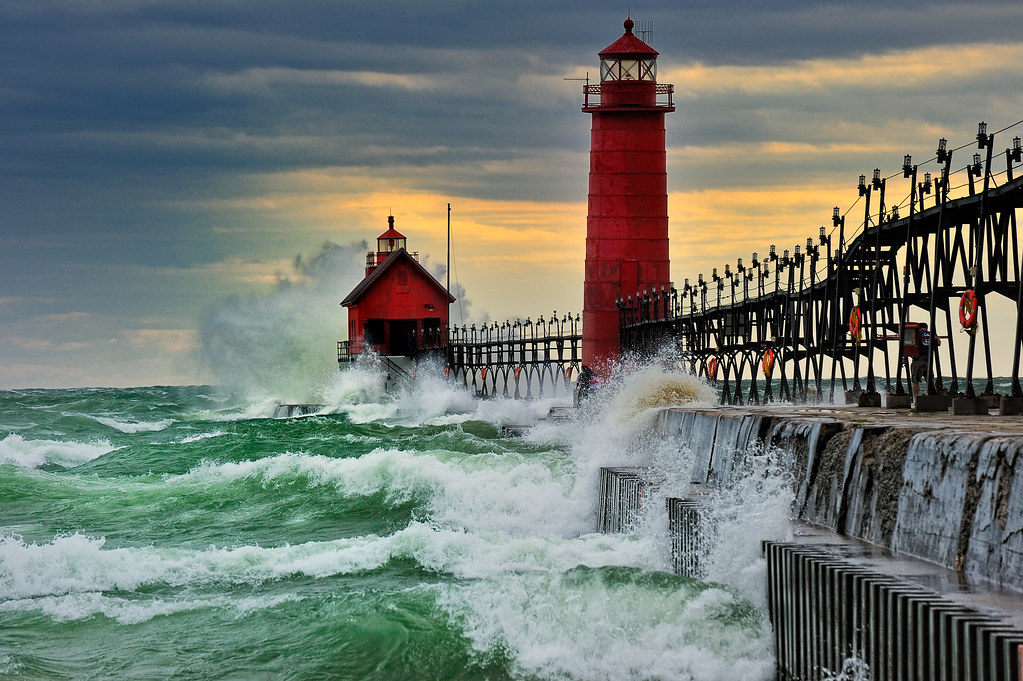
“September Gale” Grand Haven Breakwater Lighthouse is located in the harbor of Grand Haven, Michigan, photo by Michigan Nut.
There is no other festival like it in the United States. The organizers have done a fantastic job of drawing both vendors and lighthouse buffs from around the globe to what has become the largest and best lighthouse festival in the nation. October is a wonderful time of the year to visit Michigan, with the beautiful fall colors, close proximity to Mackinaw City and Mackinac Island and lots of lighthouses, what more could one ask for?
~Tim Harrison, President of the American Lighthouse Foundation
What more indeed? According to Wikipedia’s US Lighthouses page, Michigan has the most lights of any state with over 150 past and present lights.
It’s definitely fitting to use the most popular lighthouse photo (from John McCormick, the most popular lighthouse photographer) in our Absolute Michigan pool on Flickr to let you know about the annual Great Lakes Lighthouse Festival which takes place October 6-9, 2011 in Alpena.
The Fyddeye Guide to America’s Maritime History says that the festival is the country’s largest lighthouse festival, adding:
The four-day event provides activities for the young and old, including lighthouse tours by personal vehicles, a helicopter tour, or boat tour, entertainment, auctions, dining events, lighthouse exhibits, and shopping. The festival boasts more than 75 maritime-related vendors, including lighthouse preservation groups, artists, nautical crafters, photographers, and authors. This year’s featured guest speakers include Terry Pepper, executive director of the Great Lakes Lighthouse Keepers Association, national gold medal award winning photographer and author Larry Wright, and Sandy Bihn, president of the Toledo Harbor Lighthouse Society, which operates the 2011 featured attraction, the Toledo Harbor Lighthouse.
If the name Terry Pepper sounds familiar, he’s the authority we turn to for our lighthouse features and his books on lighthouses are fantastic. Check out Terry Pepper’s Seeing the Light and read much from him in the lighthouse category on Michigan in Pictures including our post on the Grand Haven Pier Light.
John took this photo last September. He says to note the guy with the pink surfboard (then see him in the waves in this shot). Check it out bigger and in his fantastic Michigan Lighthouses slideshow.

Flying Salmon, photo by Mi Bob.
Michigan has two species of salmon, Chinook Salmon (Oncorhynchus tshawytscha) and Coho Salmon (Oncorhynchus kisutch). I’m thinking this is a chinook as it looks like the spots are all the way down the tail fin. The DNR says (in part):
The salmon family, or Salmonidae, includes the salmon, trout, and whitefishes. All are characterized by adipose fin, and have a preference for cold water with a high oxygen content, making the Great Lakes an ideal habitat.
The chinook is a fairly new variety of salmon introduced into the Great Lakes in the 1870s. Sometimes called “King Salmon”, these fish did not reproduce successfully and eventually disappeared. In 1966, Great Lakes states Michigan, New York and Wisconsin, with the help of the province of Ontario reintroduced the Chinook. Great Lakes populations of Chinook are maintained by annual stream stocking programs
Chinook live in Great Lakes shoals or near-shoal waters (less than 100 foot depth(s)) as a rule. In the fall they move into the southern reaches of each of the great lakes, traveling 5-15 miles offshore as they go. In the spring they retrace their route and by the following fall, they congregate at the stream they began their journey at and begin their spawning runs upriver.
…Chinook spawn in streams over beds of large gravel, near riffles. Within two weeks after spawning, adult chinook die. Chinook compete with other salmon and trout for scarce spawning grounds. The following spring the eggs hatch, and the young usually remain in the river for one year before they migrate down to the lake.
Once in the lake, males tend to remain for 1-2 years and females for 3-4 years. The King Salmon average a weight of 30 to 40 pounds and 38 inches in length.
Young chinook in rivers eat insects, insect larvae and crustaceans; adults in the lakes eat fish almost exclusively. In the Great Lakes, smelt and alewives make up their main diet. Predators include rainbow trout, coho salmon smolts and fish-eating birds. The young also compete with trout and other salmon for food.
Anglers prize chinook partly because of their large size and the challenge they present for fishing, and partly because they make a delicious meal. While other pacific salmon species have red flesh, chinook meat is often white.
Speaking of salmon, the annual Grand Haven Salmon Festival takes place this weekend (September 16-18, 2011). It pays tribute to the annual salmon migration and features hands-on learning, education and exhibits about Michigan’s coastal waterways. There’s also arts, crafts, live music, wine, food and all kinds of family fun!
Check this out bigger and in Bob’s slideshow.
More Michigan fish on Michigan in Pictures!

USCGC Mackinaw, photo by loomisman.
The Grand Haven Coast Guard Festival (July 29 – August 7, 2011) has been held every year in Grand Haven. It features a parade of ships and a couple street parades, music, carnival, fireworks and all kinds of events and exhibits about the history of the United States Coast Guard. They explain:
The festival unofficially began in 1924 as a Coast Guard personnel only picnic when the local Coast Guard station held rowing competitions for those service members stationed in Grand Haven. Today the Grand Haven Coast Guard Festival has become a premier event with attendance of over 350,000 people including the nations highest ranking Coast Guard dignitaries from Washington, D.C.
The focus of the annual Grand Haven Coast Guard Festival is the National Coast Guard Memorial Service honoring those who sacrificed their lives in the service of their country while fulfilling their motto “SEMPER PARATUS” (“Always Ready”). Each year since the first picnic in 1924 and the first festival in 1937, we have celebrated our heroes, the men and women of the United States Coast Guard with fun filled family events at the annual Grand Haven Coast Guard Festival. Grand Haven is honored by its designation as “Coast Guard City, USA” by an Act of Congress and signed by the President of the United States on November 13th, 1998.
Check this out bigger in in Drew’s Grand Haven Coast Guard Festival slideshow.
Michigan in Pictures has more about the US Coast Guard Cutter Mackinaw.
 Michigan in Pictures