Hand-building automobile bodies: Michigan’s Automobile Factories, 1900-1961

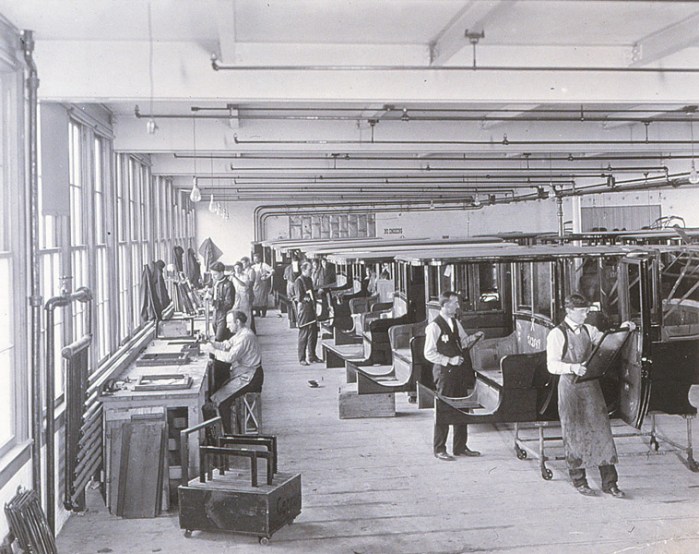
Packard Factory, Detroit, 1910, courtesy of the National Automotive History Collection, Detroit Public Library

The Michigan Radio Picture Project has a new feature titled Michigan’s Automobile Factories, 1900-1961 edited by Doug Aikenhea. It’s a fantastic tour through Michigan’s automobile heritage, that takes you from hand-built wooden auto bodies to sheet metal & assembly lines. It features well known factories in Detroit, Flint & Lansing like Ford, Buick and Chrysler along with lesser known ones such as Durant-Dort, Fisher, Chalmers & Maxwell. They write:

The industrial adventurers and entrepreneurs who launched Michigan’s automobile industry came from various backgrounds. Some of them began as carriage makers, like William C. Durant who would go on to found General Motors in 1908. The earliest automobiles, like their horse-drawn predecessors, were constructed largely from wood and were built individually until the assembly line evolved to accelerate production and incorporate standardized, mass-produced parts. As automobile manufacturing progressed, the role of the worker changed from traditional craftsman to skilled assembly line specialist. This series of historical photographs traces the evolution of Michigan automobile factories from 1900 until 1961.

Click through for more!

The Timber Wolf (canis lupus) in Michigan

2007 0300 Wolf on LakeMIUS2

2007 0300 Wolf on LakeMIUS2, photo by Dennis Raney.

Alexis writes Paw took this one of a wolf on Lake Michigan off US2 on the way back downstate. There was another wolf on the ice, but it didn’t make it into this frame It’s part of her very cool Michimania set (slideshow).

Wikpedia says the timber wolf, gray wolf or simply wolf is the largest member of the Canidae family. From the Michigan DNR page on the Gray Wolf (canis lupus) and a recent DNR release regarding the delisting of the gray wolf, we get a picture of the state of wolves in Michigan:

It is believed that wolves were once present in all 83 counties in the state of Michigan. A combination of European werewolf mythology, fairy tales, views that wolves were incompatible with civilization, and active predator control programs throughout the 20th century virtually eliminated the gray wolf from Michigan: by 1840, they could no longer be found in the southern portion of the Lower Peninsula; by around 1910 they had completely disappeared from the Lower Peninsula; and by 1960, when the state-paid bounty on wolves was repealed, they had nearly vanished from the Upper Peninsula.

In 2008, a minimum of 520 gray wolves lived in Michigan’s Upper Peninsula, part of an estimated population of 4,000 gray wolves living in Michigan, Minnesota and Wisconsin.

(DNR Director Rebecca Humphries) emphasized that while the gray wolf has been removed from the federal endangered species list, it remains on the state’s protection as a species. There currently is no hunting or trapping of gray wolves allowed in Michigan, and starting on April 22, the gray wolf will be listed as a nongame species in Michigan. In order for hunting to occur, the Michigan Legislature would need to pass a law to add the gray wolf to the list of game species in the state, she said.

You can get more about Canis lupus (gray wolf) from the University of Michigan Museum of Zoology’s Animal Diversity Web and check out pictures & sounds of the gray wolf from Wikimedia including this pic of a wolf print and these sounds from a wolf pack.

You might also want to check out this Absolute Michigan “Weird Wednesday” on the Giant Wolf of Flint by the author of Weird Michigan, Linda Godfrey.

Creating Cities in Michigan

Lansing, Detroit, Grand Rapids, Flint, Traverse City, Marquette and Kalamazoo are by no means all of Michigan’s cities (or even the largest). Each, however, seems to be an anchor for its region – a center to which people look to for culture, entertainment and commerce.

October 13-15, 2008, lovers of cities large & small from Michigan and all over the country will head to Detroit for the Creative Cities Summit 2.0 (CCS2), an exploration of what our cities could become and how we can work to make them. Organizers have chosen Detroit, a city so deeply forged in America’s industrial fires that it’s been devastated by the flickering of that flame. I’m headed down there and will try to bring some of the ideas back to you through Absolute Michigan – I hope that some of you can join me there.

The Photos (left to right)

Creative Cities Summit 2.0 in Detroit on Oct. 13-15, 2008

CCS2 will present a dynamic and engaging conversation about how communities around the world are integrating innovation, social entrepreneurship, sustainability, arts & culture and business to create vibrant economies. Full conference registration is $300 for the two and half day event, and there’s also a “no frills” registration that is only $100. There’s also a free “Unconference” at the Museum of Contemporary Art Detroit (MOCAD) on the 12th for designers, urban planners, civic leaders, entrepreneurs, artists, students, community leaders to explore and discuss what’s possible for Detroit.
Keynote speakers include:

  • Bill Strickland, MCG-Bidwell Corp.
  • Richard Florida, Author Who’s Your City
  • Charles Landry, Author The Art of City Making
  • John Howkins, Author The Creative Economy
  • Dean Kamen, Inventor, DEKA
  • Majora Carter, Sustainable South Bronx
  • Doug Farr, Architect and Author Sustainable Urbanism
  • Ben Hecht, Pres. & CEO Living Cities
  • Tom Wujec, Fellow, Autodesk
  • Carol Coletta, CEOs for Cities
  • Giorgio Di Cicco, Poet Laureate, City of Toronto and Author, The Municipal Mind
  • Diana Lind, Editor, Next American City magazine

Breakout sessions on topics such as:

  • Race and the Creative City
  • Cities, Universities & Talent
  • Marketing, Media and the Creative City
  • Measuring New Things – ROI in the Creative Economy
  • Creative (Small) Cities
  • New Ideas in Urban Amenities
  • Community Vitality: The Role of Artists, Gays, Lesbians & Immigrants
  • Midwest Mega-region: How the Midwest Can Compete
  • Transportation Innovation for Cities
  • Making the Scene: Music & Economic Development

Much (much) more at creativecitiessummit.com.

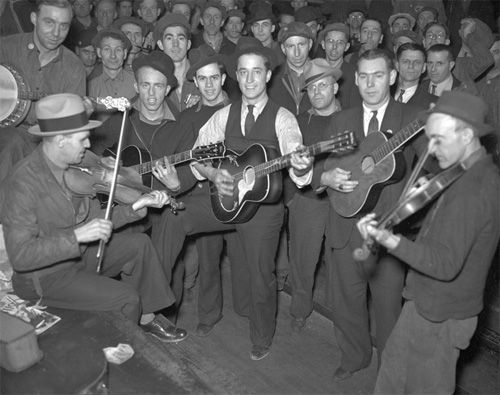
The Reo Ramblers at the 1937 sit-down strike

The Reo Ramblers at the 1937 sit-down strike, March 10-mid April 1937, photo courtesy Archives of Michigan

The Archives of Michigan’s July 2008 Image of the Month comes from the R.C. Leavenworth photographic collection. They write:

Lansing Auto Worker declared during the event, “Reo Strike Is Nation’s Model Demonstration.” Under the stress of wage reductions and layoffs resulting from the nation’s Depression, Reo workers shut down the factory and occupied it for a month. Workers remained peaceful, engaging in activities such as checkers, volleyball, and singing with the Reo Ramblers. The strike was successful and reenergized the local UAW chapter.

Michigan in Pictures has a post titled Remembering the Flint Sit-Down Strike on a Labor Day that has some great info about this landmark strike and – as is often the case – Wikipedia has a nice Flint Sit Down Strike article (with some more photos).

You can click the photo to read about a special Leavenworth exhibit at the Michigan Historical Center and also see another shot by Leavenworth of Jazz Music in Lansing in the 1920s.

Newspaper did get delivered

Newspaper did get delivered

Newspaper did get delivered, photo by wxman1952.

mLive reported that the snowstorm of February 6, 2008 was a whopper, closing over 200 schools in Michigan and dumping up to up to 16 inches of snow fell in the Flint and Saginaw area.

Michael runs the Mid Michigan Weather web site where (among a whole lot of other weather things) you can find a discussion about the impact of the storm all over the state.

Foggy river

Foggy river

Foggy river, photo by kthschsslr.

kthschisser writes that he took this photo of a heron on the Flint River near Flushing while rushing to the airport.

Always good to have eyes open and camera handy…

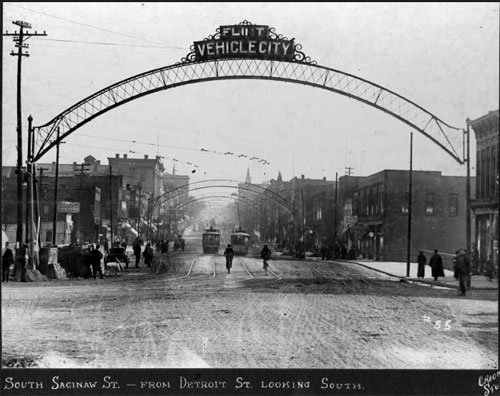
Flint Vehicle City Arch – The Making of Modern Michigan

Flint Vehicle City Arch

Flint Vehicle City Arch, photo by Arthur Crooks (Kettering University Library, Scharchburg Archive)

This photo of Saginaw Street (from Detroit Street looking south) shows the Vehicle City Arch that was erected in 1905 as part of the City’s 50th anniversary. It was taken in 1909 and is one of many photos from Michigan’s past in The Making of Modern Michigan, a collaborative project headed by the Michigan State University Libraries, in partnership with the Library of Michigan, the Michigan Library Consortium, and the 50+ libraries currently participating in the project. It includes local history materials from communities around the state – photographs, family papers, oral histories and genealogical materials on a wide range of subjects.

Many of the images (such as the one above) are part of collections. The Crooks collection includes lots more photos of Flint at the turn of the century like Buick: Made in Flint, The circus comes to town and a shot of the arches lit up at night. The Crooks collection reaches into the 1920s, and you have to check out Bootleg Raid in Flint.

As is often the case, I got curious about those arches. Fortunately, I didn’t have to go any further than Arches Restoration to Celebrate our Heritage (ARCH). Their history page explains:

The Flint arches were erected in 1899 to replace gas lanterns used to illuminate the business district at night. Built by Genesee Iron Works, five arches were placed at intersections along Saginaw Street. Each arch was built with 50 light bulbs to illuminate the City’s main street at night. Half were turned off at midnight. The arches supported decorations for every parade of importance held in the city and colorful lights replaced golden incandescence at holiday times. None of the original arches had the famous Flint Vehicle City crown at its apex.

When Flint celebrated its 50th anniversary in 1905 two additional arches were erected with the famous Flint Vehicle City graphic at the crown. These arches were placed at the south end of the city at the intersection of Fifth and Saginaw Streets and at the north end of the business district at the confluence of Saginaw and Detroit Streets (now M.L. King Boulevard).

Though many believe the arches celebrated Flint’s heritage as a center for automobile manufacturing, the original arches were a salute to Flint as the world’s largest volume manufacturer of horse drawn carriages.

They were successful in their campaign to restore the arches on Saginaw and you can see a photo by day and by night!

(not) Leaving on a jet plane

Plane by dancer85

Plane, photo by dancer85

You hear a lot about the impact of people leaving Michigan for good, but not so much about the impact of folks leaving the state to take their vacations.

I read somewhere that Michigan has a pretty significant travel debt – many more vacation dollars are spent outside of Michigan by Michigan residents than dollars spent in the state by visitors.

It’s kind of baffling to me really.

Detroit’s Penobscot Building – leapable in a single bound?

...leap tall buildings in a single bound. by tEdGuY49

…leap tall buildings in a single bound by tEdGuY49

Narrator: Faster than a speeding bullet. More powerful than a locomotive. Able to leap tall buildings in a single bound… (more)

The plan was to do something on Detroit’s Penobscot Building next week or so … apparently Ted didn’t get the message. Ah well. It looks like May is Detroit Architecture Month on Michigan in Pictures.

To bring things full circle, here’s the intro to the 50s classic Adventures of Superman. Ted just let me know that the intro to Superman was voiced by Bill Kennedy of Bill Kennedy at the Movies fame (on CKLW and later WKBD). Also see this great Detroit News feature The Stars who turned Detroiters into couch potatoes.

Penobscot Building information now here.

Remembering the Flint Sit-Down Strike on a Labor Day

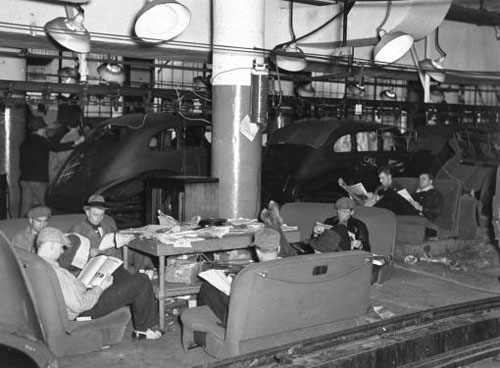
Flint Sit Down Strike

A movie produced by General Motors in 1936 called Master Hands that Christine Barry posted to her blog provided the impetus for today’s Labor Day holiday post. She dedicates it to her grandfather and it’s likely that many of us in Michigan have some relative who took some part (for or against) in the tumultuous labor struggles. Below are several links about Michigan’s most famous strike, the Flint Sitdown Strike of 1936-37 at GM’s Fisher Body #1 plant in Flint.

According to Remembering the Flint Sit-Down Strike at HistoricalVoices.org (an amazing web site that includes recordings of workers recalling the strike):

Working on the line at General Motors in Flint was a job many men needed desperately in the 1930’s, but it was also tremendously difficult. Terrible working conditions, combined with unfair and devious payroll practices, made the auto plants of Depression-era Flint into ripe locations for union organization.

The union was the United Auto Workers. The UAW pages on the 44-day strike that ended Feb. 11, 1937 say that it  was the most pivitol event the early history of the UAW. The result was the first UAW contract with General Motors and the establishment of the UAW as the sole bargaining representative for GM workers. This account has a lot of details on the political events surrounding the strike.

A couple more excellent resources are Michigan Epic’s multimedia exploration of the Flint strike, The historic 1936-37 Flint auto plant strikes from the Detroit News, Wikipedia’s entry on the Flint Sit-Down Strike and this great slideshow of the monument commemorating the strike in Flint Sitdowners Memorial Park.
Note: The above photo is credited to the Walter P. Reuther Library of Wayne State University. The keen of eye will see that the striking workers are sitting on car seats.

Also check out The Reo Ramblers at the 1937 sit-down strike from Michigan in Pictures & the Archives of Michigan.