Sundews!

Sundews!

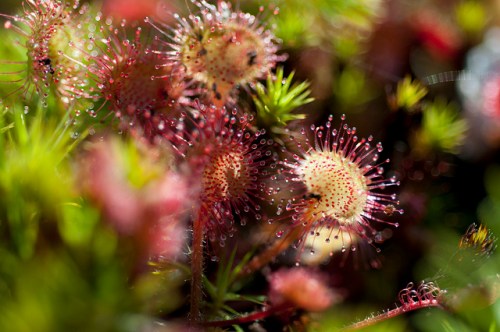
Sundews!, photo by Sundews! by I am Jacques Strappe

English sundew (Drosera anglica) is also known as Great sundew. This sundew guide from MSU says that there are 4 species of sundew in Michigan.

Similar to Sarracenia purpurea (pitcher-plant) and Pinguicula vulgaris (butterwort), sundews are carnivorous plants, capturing insects (primarily) with their nectar-like, mucilaginous secretions to supplement nutrients, such as nitrogen, that are otherwise in low availability in their habitats. Sundew leaves curl around their insect prey, when captured, to digest it.

Sundew are all species of special concern in Michigan so look but don’t dig them! Wikipedia’s Drosera anglica entry has more information including a cool photo of a sundew eating some damselflies.

See Jorie’s photo bigger and in her Native Flora slideshow.

Big Sable Sunset

Big Sable Sunset

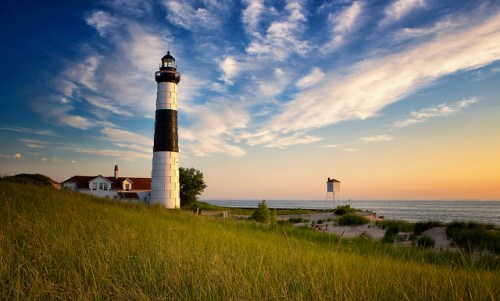
Big Sable Sunset, photo by Robby Ryke

Terry Pepper’s Seeing the Light has all the history on Big Sable Point Light Station. One interesting fact is that it holds the distinction of being the last Great Lakes light to become electrified in 1949.

Terry notes that electrification was always a double-edged-sword, because it paved the way for automation in 1968 which in turned paved the way for vandalism and deterioration. In 1977 waves came perilously close to undermining the tower before the seawall could be replaced, but the Sable Point Lighthouse Keepers Association has helped restore this light to its former glory.

Check this photo out bigger and in Robby’s great Pure Michigan slideshow.

Freedom, Fireworks and the Fourth!

Fireworks!

Fireworks!, photo by Craig – S

My definition of a free society is a society where it is safe to be unpopular.
~Adlai Stevenson, speech in Detroit, 1952

The safety to be unpopular is a freedom we don’t always think of, but something we might well consider. It strikes me that in our relentless drive to get everyone on the same page, we’re not able to get anything done. There is a lot to be done and a lot of places we can find common ground to make our schools and communities better and protect the natural resources that make Michigan the place we love.

If it’s total agreement you’re looking for, that’s probably fascism. Democracy is messy.

Speaking of messy, you’ve no doubt noticed bigger booms over the last few days, That’s due to a new law in Michigan that allows the purchase of any federally allowed firework. The messy democratic process is already at work:

City officials across Michigan have scrambled in recent weeks to try to stymie the party in the sky — limiting when residents can set off fireworks in light of a change in state law that allows a more powerful category of explosives to be sold and used in the state.

Warren Mayor Jim Fouts blasted the state law, saying “pyromaniacs” are terrorizing the community, scaring children, pets, seniors and veterans with post-traumatic stress disorder with the louder explosions caused by the more powerful fireworks.

“The state has legalized these ‘consumer fireworks’ and people are going gung ho,” Fouts said. “People, who were hesitant to do illegal fireworks now are empowered.”

State legislators approved the looser fireworks legislation, which went into effect in January, to keep residents from taking their money to other states to purchase fireworks not available here. The new law forces communities to allow the fireworks on the day before, the day of and the day after federal holidays, such as the Fourth of July.

Warren, Grand Rapids, Ferndale, Novi, Birmingham, Royal Oak and other cities across Michigan are already creating ordinances to ban these fireworks during other times of the year.

Check this out background big and in Craig’s Bay City Michigan slideshow.

Here’s hoping you have an explosively fun and very safe Fourth of July! Here’s many more Fourth of July photos from Michigan in Pictures!

How I feel today…

Andy

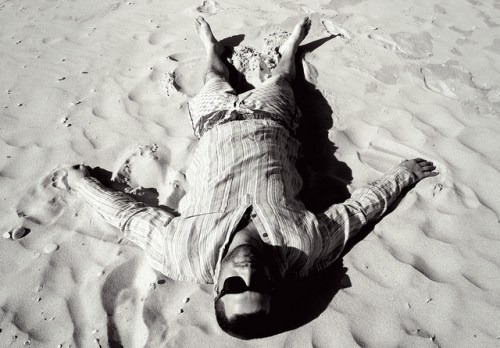
Andy, photo by Emily Flores

Perfect shot for how I feel after last weekend.

Check it out background big and in Emily’s slideshow.

More portraits on Michigan in Pictures.

Sunset over Copper Harbor

Sunset over Copper Harbor

Sunset over Copper Harbor, photo by Xavist on the colorful way

You may remember Xavist from his sweet northern lights shots in April. (he shot some at Yellowstone last week)

Check this out big as the sky or on his map.

Daylily Deliciousness

Daylily

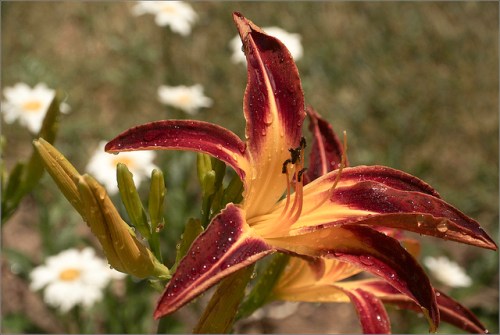
Daylily, photo by joeldinda

Yesterday I was talking with some folks about how tasty a daylily is. I’ve always called them tiger lilies, and last summer I learned that you can eat them so we stuffed the flowers and baked them!!

It’s important to note that these are NOT the poisonous easter lilies, and as with all wild food, know what you’re eating is of supreme importance. This article about harvesting and eating daylilies has some excellent tips and you might also enjoy dining on day lilies by Hank Shaw.

Check this photo out background bigtacular and in Joel’s massive Flowers slideshow.

Take a drive this holiday weekend…

amphicar

amphicar, photo by northernlightphotograph

Gas prices are at an astonishing low – $2.99 at the Lambertville Kroger – and the weekend weather looks hot but amazing. It’s probably time to make a trip to one of Michigan’s great parks or beaches. While I’m guessing that most of you don’t have a sweet boat car like this, it’s a great weekend for boating too!

Check this photo out bigger and in Tim’s 2012 Bay Harbor Car Show slideshow.

Join these grapes at the Traverse City Wine & Art Festival this Saturday

Good Harbor III

Good Harbor III, photo by farlane

We interrupt this blog for a little commercial for a project that I and my co-workers have been hard at work on for the last several months. Like these grapes, it’s a long road from planting the vines to harvesting the fruit to crushing the grapes and making and bottling the wine. It all comes to fruition this Saturday June 30th from 3-10 PM at the Traverse City Wine & Art Festival.

The festival celebrates the wine, food & culture of northwest Michigan with a daylong party on the front lawn of the Grand Traverse Commons in Traverse City. In addition to 27 local wineries with over 150 wines, we’re bringing together 20 artists, 8 restaurants and some incredible music featuring Michigan’s own Orpheum Bell and national headliner Rusted Root! Click the link above for information

I took this photo several years ago at Good Harbor Winery’s vineyard. Click to download it background big and see more in my wine slideshow.

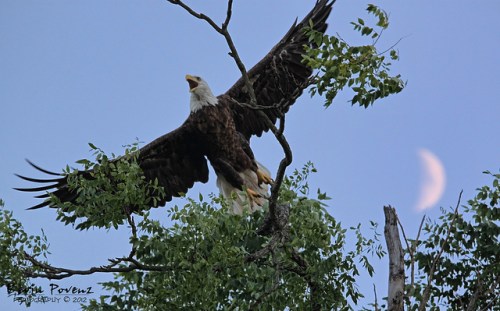
Spread your wings

Bald Eagle

Bald Eagle, photo by Kevin Povenz

This feels like the perfect photo to feature one week from the Fourth of July!

Kevin, his son Aaron and his dog Charlie took a walk in the North Ravines on Grand River to see if they could see the eagles. As you can see, they were not disappointed! Check it out bigger and in Kevin’s awesome Birds of Prey slideshow.

More about the Bald Eagle in Michigan on Michigan in Pictures.

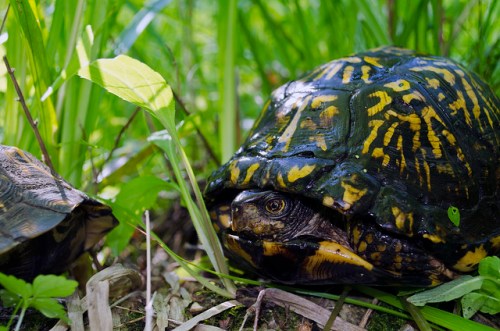
Michigan Turtle Tuesday: Eastern Box Turtle

Eastern Box Turtle

Eastern Box Turtle, photo by DavidGuthrie

According to the oral stories and traditions of the Great Lakes Woodland Indians, the turtle is a powerful symbol. One legend details how the turtle’s back provided a base for the first land that was formed in the midst of the great waters. Mackinac Island takes its name from a word in the Ottawa language meaning “Great turtle”.

So begins the Michigan DNR’s Turtle page. I found it fascinating reading, and I hope you enjoy it as well.

The earliest fossil remains of turtles date back about 225 million years to the late Triassic period. For millions of years they shared the planet with the dinosaurs. Unlike the dinosaurs, turtles survived the ecological and climatic changes that caused the extinction of many forms of life. All this was accomplished with little change to their anatomy: early fossils still closely resemble today’s turtles. Soft bodies were covered by a bony shell, with an oval shaped skull and beaked mouth; however these early turtles had teeth and had not yet evolved a way of pulling their heads into their shells. Today some 260 species of turtles (including the terrestrial tortoises) are found worldwide in nearly all temperate and tropical habitats.

The protective shell is one key to the turtle’s survival. Unlike the turtles in children’s cartoons, real turtles cannot climb out of their shell: A turtle literally wears part of its skeleton on the outside of its body. A turtle’s shell is composed of two parts. The upper portion, or carapace, is formed from the flat dermal bones covered by broad scales (scutes) and is connected to the backbone and ribs. The lower shell is the plastron and includes the abdominal ribs and portions of the shoulder girdle.

The shape and weight of a turtle’s shell can provide clues to its lifestyle. Shells can be helmet shaped, like the Blanding’s and eastern box turtle shells, for better protection against predators. A further adaptation of hinges in the middle of the plastron allows these turtles to partly or fully close their shell, offering even more protection for the head and legs. Shells can also be soft and rubbery like the pan caked shaped shell of the fast swimming spiny soft shell turtle, which is covered by skin instead of hard scales. Snapping and Musk turtles have very small, cross shaped plastrons, probably adapted to facilitate walking on pond and lake bottoms. Land living turtles have heavier shells – while these shells offer extra protection from land predators, their weight makes it more difficult to move quickly. The shell of a turtle that spends most of its life in a water environment is lighter in weight and more streamlined in shape.

Read on for more. Regarding the Eastern Box Turtle, they say that its high, domed carapace is dark with a radiating pattern of yellow or orange. The plastron has a flexible hinge that allows the turtle to completely close its shell. Box turtles are Michigan’s only true land-based turtle. They prefer open woodlands and adjacent meadows, thickets, and gardens, often near shallow ponds, swamps, or streams and eat plants, berries, worms & insects and carrion.

Box turtles’ home range is less than five acres, and they routinely live for several decades, occasionally a century or more! One important note is that the turtle’s life in captivity is MUCH shorter, so please enjoy them in their natural habitat! The box turtle is uncommon to rare in southern and western Lower Peninsula and the southern & eastern UP, and they are protected by Michigan law as a special concern species.

Here’s a (pdf) map of Eastern Box Turtle occurrences and you can get some more info and photos from Wikipedia’s Box Turtle entry and also get some really great information & photos about the Eastern Box Turtle and conservation efforts from the Herping Michigan blog!

Check this out bigger and in David’s Critters slideshow.

More of Michigan’s animals on Michigan in Pictures!