Sturgeon River Gorge: Michigan’s Grand Canyon

Michigan's -Grand Canyon--2

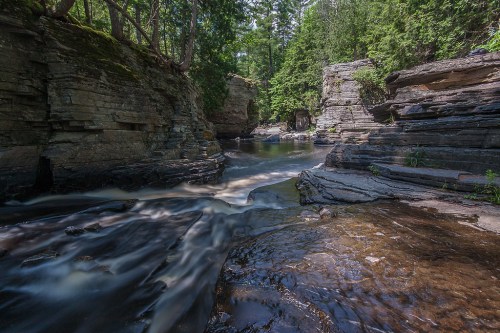
Michigan’s -Grand Canyon–2, photo by ShaneWyatt

The Ottawa National Forest page on the Sturgeon River Gorge Wilderness says:

The Wild and Scenic Sturgeon River rushes out of the northern portion of this wilderness, over the 20 foot volcanic outcroppings of Sturgeon Falls, and through a gorge that reaches 350 feet in depth and a mile in width. Throughout this rugged, steep Wilderness, the Sturgeon and Little Silver Rivers and their tributaries have carved falls, rapids, ponds, oxbows, and terraces. Stunning views are possible from the eastern rim of the gorge. Except for a few naturally bare slopes, most of the land is forested with pine, hemlock, aspen, sugar maple, birch, and basswood. When the leaves of the hardwoods change color in the fall, they form a vivid tapestry.

There are few established trails in Sturgeon River Gorge Wilderness, and the few overgrown logging roads are hard to find and follow. The North Country National Scenic Trail parallels the northern and eastern boundaries for about eight miles. Sturgeon River Campground offers seven sites on the southeastern boundary. In spring and during peak runoff, kayaking and white water canoeing are challenging, and only recommended for advanced paddlers.

Check it out bigger and see more on Shane’s map!

More Michigan rivers on Michigan in Pictures.

Swimming the Straits of Mackinac

Mackinac Dusk

Mackinac Dusk, photo by ShelNf

The Traverse City Record-Eagle reports that Cathy Nagler will be attempting to swim across the Straits of Mackinac tomorrow (Wednesday, July 24):

Worry isn’t a word Nagler uses to talk about the upcoming distance swim, which is expected to take place Wednesday between Michigan’s Upper and Lower Peninsulas, on the west side of the mighty Mackinac Bridge. But she does have legitimate concerns, chiefly hypothermia from the cold water.

“That’s the hard one,” she said. “I went in Lake Michigan on June 12 and the water temperature was 58 degrees.”

Nagler will wear a lightweight wetsuit, of the sort tri-athletes wear, to combat that problem. Combined with dive boots, it should keep her warm enough.

“The heavier wetsuits, like water skiers wear, make me too buoyant in the water,” she said.

Nagler, who summered at her family’s cabin in Northport as a child, has been a life-long swimmer. She has several distance swims to her credit, both in the United States and England. But her goal to swim across Lake Michigan has the most meaning for her.

You can read on for more and also check out Nagler’s crosslakemi.org where she discusses the preparation for the swim.

I thought I would try and figure out how many people have swum the 4.1 mile distance across the Straits of Mackinac, but it appears that the answer is “a lot.” This feature in the St. Ignace News about a group of 5 who swam the Straits in 2011 has some great information about swimming the Straits, and notes that the Coast Guard receives about 10 special marine requests specifically for swimming the Straits.

View ShelNf’s photo bigger and see more from the Straits in their slideshow.

R.E. Olds Transportation Museum and the MotorCities National Heritage Area

1951 Oldsmobile Super 88 and 1962 Oldsmobile F85 coupe  R E Olds Museum Lansing MI 2-9-2008 182 N

1951 Oldsmobile Super 88 and 1962 Oldsmobile F85 coupe R E Olds Museum Lansing, photo by Corvair Owner

The MotorCities National Heritage Area is holding a Sweepstakes on Facebook. The Grand Prize is an Autopalooza Gift Basket that includes a $50 BP Gas Card, MotorCities 1-year Membership, National Park Passport Stamp Book, Henry Ford 150 Celebration Mug, Ford Piquette Avenue T-Shirt, 2013 Cruisin’ Hines T-Shirt, 2013 Clinton Twp. Gratiot Cruise T-Shirt, 2013 Woodward Dream Cruise Calendar, Free Admission passes to The Henry Ford Museum, R.E. Olds Museum, Ford Piquette Avenue Plant, Gilmore Car Museum Edsel & Eleanor Ford House and more! 2 baskets will be raffled off, one at the Concours d’Elegance on July 28, 2013 and the other at the Orphan Car Show on September 22, 2013.

The photo above is from one of the MotorCities National Heritage Area member organizations, the R.E. Olds Transportation Museum in Lansing. From their Facebook page:

The Museum has thousands of irreplaceable items in the archives along with 52 vehicles that range from 1886 through 2003. It is dedicated to Ransom Eli Olds, inventor, entrepreneur, and financier, and one of Lansing’s most notable automotive leaders. He created the principle of the assembly line in the automobile industry and founded two local automobile companies: Olds Motor Works (1897) and REO Motor Car Company (1904).

…The Museum exhibits a significant collection of automobiles, engines, and other materials significant to the transportation history of Lansing, the region, the state and the nation. The R.E. Olds Transportation Museum and the Bates and Edmonds Engine Company offices are resources within the Lansing Stewardship Community of Motor-Cities-National Heritage Area, a cultural heritage area and affiliate of the National Parks Service.

View Joe’s photo bigger and see more in his RE Olds Museum slideshow.

More Michigan museums on Michigan in Pictures!

Sizzle

Sizzle

Sizzle, photo by corinne.schwarz

I think this squirrel accurately reflects the feelings of many of us following a week of sauna-like conditions. The squirrel is heat dumping, shedding maximum heat by flattening its body. You can see some more examples of this in the hilarious Squirrel Pancakes photo group.

Check this out background big and see more (including a couple more shots of this squirrel or a relative) in Corinne’s slideshow.

Moonflower

Moonflower

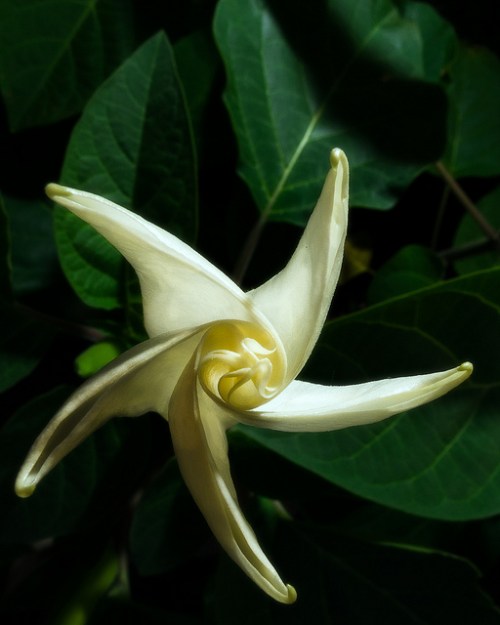
Moonflower, photo by bill.d

WiseGeek’s page on growing moonflowers explains:

For a gardener who doesn’t keep a normal nine-to-five schedule, growing moonflowers may be the perfect hobby. Ipomoea alba, or the common moonflower, is a night-blooming vine from the same family as the morning glory. Growing moonflowers requires very little effort, and the gardener is rewarded with a climbing vine that can reach a height of 10 to 20 feet (3.05 to 6.1 meters) in one season. In its natural habitat of tropical and sub-tropical climates, this vine is considered a perennial, but in colder climates it must be replanted every year.

…As with their daytime cousins, the morning glories, growing moonflowers requires full or partial sun. The plant will begin to bloom in late afternoon and into the early evening hours, and continue to remain open until sunrise. The vines are voracious climbers, and should be planted in a spot where they may spread as needed, such as near a trellis or patio support beam.

Moonflowers produce large white flowers. Some gardeners like to grow them alongside various colors of morning glories, especially the “heavenly blue” strain. This commingling results in an abundance of flowers both day and night in one garden spot, blue in daylight and white by moonlight. The fragrant moonflowers are often considered ornamental, and each flower remains open no longer than one night.

Also see Everything You Wanted to Know About Moonflowers from Local Harvest check out this video of a moonflower opening.

Bill took this shot in his garden and suggests you  check out “moon flower moth” on Flickr. See his photo bigger and see  more great shots of these ephemeral beauties in his Flowers slideshow!

Many (many) more Michigan flowers on Michigan in Pictures!

Tigers’ ace Max Scherzer will start 2013 All Star game!

Max Scherzer

Max Scherzer, photo by Keith Allison

The Detroit Tigers report that Detroit Tiger pitcher Max Sherzer has been given the nod to start the All Star Game tonight by Manager Jim Leyland:

Though Scherzer’s unbeaten season ended Saturday, he remained the perfect fit to start for the American League in this year’s All-Star Game. Manager Jim Leyland took care of the announcement Monday afternoon, naming his young right-hander for the honor.

“I don’t think I need to explain it any more than that,” Leyland said Monday, citing Scherzer’s 13-1 record.

Scherzer will be the second consecutive Tiger to start the All-Star Game, following Justin Verlander’s memorable opening inning from last year’s Midsummer Classic in Kansas City. They become the first teammates to start consecutive All-Star Games since D-backs teammates Randy Johnson and Curt Schilling started in 2001 and ’02, respectively.

“It means so much, especially for being my first All-Star Game, to be in this position,” Scherzer said Monday. “This is what you dream for, to get the nod and get the ball over so many great pitchers.”

For Scherzer, it’s merely the latest bit of history in a season that has forced several references to the history books. His 13-0 start was the best by a Major League pitcher since Roger Clemens in 1986 and the fourth-longest in modern Major League history. He came within a game of becoming the first Major League pitcher to enter the All-Star break with a 14-0 record, losing Saturday to Texas.

As it is, his 13-1 record ties him for the Major League lead in wins alongside fellow All-Star Matt Moore. His 152 strikeouts and 10.55 strikeouts per nine innings rank second to Yu Darvish among AL hurlers, while his 3.19 ERA ranks ninth.

The game starts at 8 PM and though Verlander probably wants to forget his 5 run shelling last year, it definitely shows that Tigers have one of the best pitching staffs in baseball. Check out Max Scherzer page at MLB.com, and here’s hoping the American League can break a three year drought!

EDIT: Scherzer joins Miguel Cabrera in the starting lineup along with Justin Verlander, Prince Fielder, Torii Hunter, Jhonny Peralta giving the Tigers a MLB leading 6 All Stars. Also, because I know that there’s one or two folks as geeky as me reading, Scherzer joins Justin Verlander, Jack Morris (2x), Mark Fidrych, Denny McLain, Jim Bunning and Hal Newhouser as Tiger pitchers who have been selected to start the annual showcase.

Check Keith’s photo out background big and see more in his Detroit Tigers at Baltimore Orioles slideshow.

More Detroit Tigers on Michigan in Pictures!

Battle in the Mist

Battle in the Mist

Battle in the Mist, photo by Anapko

Great shot of the rock formation known as Battleship Row in the Pictured Rocks National Lakeshore. Check Andrea’s photo out big as a battleship and see more in her Pictured Rocks National Lakeshore slideshow.

Many more photos from the Pictured Rocks on Michigan in Pictures!

Detour Reef Lighthouse

DeTour Reef Lighthouse, MI

DeTour Reef Lighthouse, MI, photo by hatchski

Today’s post is from the “What Are the Odds?” category. Some weeks I will sit down on Sunday evening and write a few posts. I wrote this one last Sunday and then on Tuesday, the State Historic Preservation Office announced 2013 recipients of Michigan Lighthouse Assistance Program. Three lighthouses will receive dollars for preservation efforts: the Manistee North Pier Light, the St. Clair  South Channel Range Lights (already profiled on Michigan in Pictures) and the DeTour Reef Lighthouse!

Terry Pepper’s Seeing the Light tells of the history of the DeTour Reef Lighthouse. He begins:

As freighters plying the St. Marys River grew in length and depth, a reef lying 24 feet below the surface off the entrance to the river between Detour Point and Drummond Island became a menace to safe passage between the lake and river. Without funding to erect a lighthouse, an acetylene buoy was placed to mark the reef on September 29, 1897 as a temporary measure.

As part of a major project to improve aids to navigation in the Straits of Mackinac at the end of the 1920’s, the Lighthouse Bureau had proven its ability in the efficient construction of offshore crib-based lights at Martin Reef in 1927, and Poe Reef 1929. With success already in its back pocket, after receiving an appropriation for the construction of a first-class light station on Detour Reef, the Bureau was immediately able to focus its attention on construction of the new station.

The first order of business was the establishment of a land-based camp as close as possible to the reef. Here, the crib which would form the submarine foundation for the structure could be built, and housing could be obtained for the construction crew. By the twin virtues of having deep water close to its shore and its proximity to the construction site, Detour Village was selected as the best location for the base of operations.

You can read on at Seeing the Light for details and photos of the fascinating construction process of this “crib lighthouse” that culminated with the official lighting of the new tower on the night of November 10, 1931. In 1974 the light was automated and in 1997 the lighthouse was declared excess property by the U.S. Coast Guard, but community members were able to come together to for the DeTour Reef Light Preservation Society (Facebook). This successful partnership renovated the lighthouse and now offers YOU the chance to be a volunteer keeper and stay at the lighthouse!

View Mark’s timely photo background big and see more in his massive Mark’s lights slideshow.

Many more Michigan lighthouses on Michigan in Pictures.

History Lost at White’s Covered Bridge

History Lost

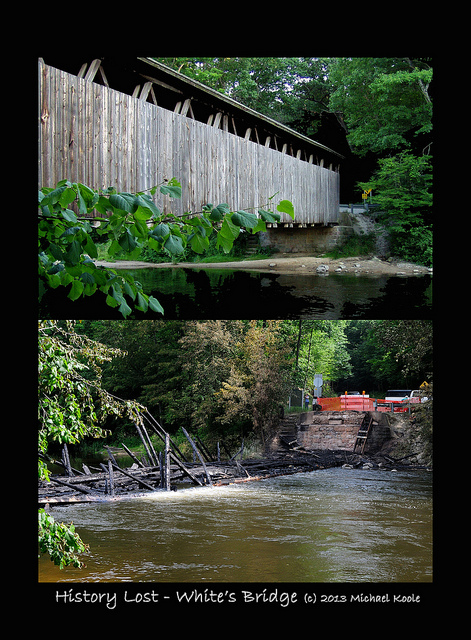
History Lost. photo by Michael Koole – Vision Three Images

Today’s photographer, Michael Koole wrote to let me know that last Sunday (July 7, 2013) the oldest continuously operating covered bridge in Michigan burned and collapsed into the Flat River. Arson is suspected, and you can also see mLive’s coverage and history of the bridge. Michael noted that it was one of less than a dozen in Michigan (see also this page) and the oldest covered bridge still in use in Michigan.

The West Michigan Tourism Association says White’s Covered Bridge:

…was the third bridge built across Flat River at or near the same site, originally called White’s Crossing in honor of a prominent pioneer family. The first was a primitive log-corduroy bridge built in 1840. A second bridge, built around 1856 for a mere $250, was demolished by an ice jam in the spring of 1869. Residents of nearby Smyrna decided they must erect a more substantial structure, despite having no means of immediate payment. The current White’s Covered Bridge was built in 1869.

Jared N. Bresee, who built the covered bridge at Fallasburg, along with Joseph H. Walker, were contracted to build the 120- foot long bridge for a deferred payment of $1000 due in 1870, plus $700 due in 1871. They planked the floor with second-hand lumber in an effort to finish the job quickly. When the townspeople discovered auger holes in the planks, they deducted $25 from the first payment. The bridge was built in just 84 days with only man, ox and horse power.

White’s Bridge is a frame structure with a gable roof. Its construction is of the through-truss type, and the trusses are completely sheeted over with rough pine boards. The floor is 14 feet wide and 116.5 feet long. All of the truss members and dimension lumber are hand hewn and secured with wooden pegs. The sheeting and roof boards are fastened to the rafters with hand cut nails. The abutments are made of local fieldstone. After repair of the abutments in the fall of 1955, White’s Bridge was reopened to automobile traffic.

Except for occasional siding replacement and a new cedar shingle roof, White’s Bridge is much the same today as it was a century ago. It is built with the Brown truss, a type of construction which enjoyed a brief popularity, only in Michigan.

Invented and patented in 1857 by Josiah Brown of Buffalo, New York, the Brown truss resembles the Howe arrangement of “X” bracing and counter bracing, but uses lighter and less timber. It contains no upright members and no iron except for bolt connectors at the timber intersections. Bresee and Walker used the Brown truss successfully in at least four covered bridges in Michigan, three of which are still in existence.

White’s Covered Bridge was listed with the Michigan State Register on February 17, 1965 and awarded a Michigan Historical Marker on July 2, 1965.

See this photo bigger and see more in Michael’s Bridges slideshow.

Michigan in Pictures has profiled a few of Michigan’s remaining covered bridges – they are filed (predictably) under bridge.

Sleeping Bear Dunes Concert

Dune Shift

Dune Shift, photo by farlane

Today on Leelanau.com I posted about one of my favorite Michigan musical events – the Glen Arbor Art Association’s 15th annual Dune Climb concert. The FREE concert takes place this Sunday, July 14 at 7:00 pm.

The setting is the incomparable natural amphitheater of the Sleeping Bear Dunes, and I heartily encourage you to join thousands of others at this free concert that has become a summer tradition in Leelanau.

This year one of Michigan’s premier jazz ensembles, the Grand Rapids Jazz Orchestra, will present big band and original compositions. Some of the area’s finest musicians will be performing, including vocalist Edye Evans-Hyde. There is no charge for the concert, but a National Park pass is required for parking. Free shuttle buses will provide transportation to overflow parking lots. Bring chairs or (better) blankets to sit on. Some folding chairs are also provided in front of the stage. In the event of rain, the show will go on at the Glen Arbor Town Hall.

The Dune Climb concert is an amazing experience for folks young and old (sand dune = good fun for energetic kids) and is part of the Glen Arbor Art Association’s Manitou Music Festival.

If you regularly follow Michigan in Pictures, you know that I don’t often feature my own photos but this one really captures the amazingness of the dune concert! The ladies at the top are actually hundreds of feet up the dune yet still getting amazing sound flowing up to them. Check it out background big and see more from the show including the unmodified version of this photo in my Music Makes Me Smile slideshow. The photo uses a technique called “tilt-shift” created using a simple photoshop technique.

More dunes on Michigan in Pictures!