Know Your Michigan Turtles: Eastern Box Turtle

Eastern Box Turtle

Eastern Box Turtle, photo by Mark Swanson

It’s been a while since I posted a turtle pic, and while I have a couple more Michigan turtles left to profile, this photo caught my eye today. The Herping Michigan Blog page on the Eastern Box Turtle says (in part) that:

Of all Michigan turtles, the Eastern Box Turtle is by far the most charismatic. A Species of Special Concern in Michigan, this species has declined drastically from its former distribution in the state. Nest predation, habitat fragmentation, road mortality, and illegal collection are the catalysts for the decline of the Eastern Box Turtle. Today, populations persist in pockets where grassland and mature woodlands still exist without fragmentation. Michigan individuals are often brightly colored with yellow or orange and have much broader carapaces than individuals of the same species which exist farther south in the range. This summer, my internship has allowed me to get direct involvement with the study and management of this species through captive head starting programs and aiding in telemetry studies.

…Farther south in their range, Box Turtles are traditionally known as a woodland species. But in Michigan, they prefer a mosaic of community types. Michigan Turtles often are found along woodland edges in grasslands but they occasionally wander into wetlands such as fens. They are often found in some sort of cover and are rarely out in the open except after summer rainstorms.

Box Turtles have a wide diet which includes worms, insects, plants, berries, and fungi. In the late summer when wildberries fruit out and drop to the ground, Box Turtles can often be found concentrated under or around large berry patches. Sometimes the evidence of Box Turtles is hard to miss.

Click through for lots more from Herping Michigan including a bunch of photos of the Eastern Box Turtle in action!

View Mark’s photo bigger and see more in his Michigan – Color slideshow.

Lots more Michigan turtle goodness on one of Michigan in Pictures most popular posts: Know Your Michigan Turtles, where this post has now become the definitive Eastern Box Turtle entry.
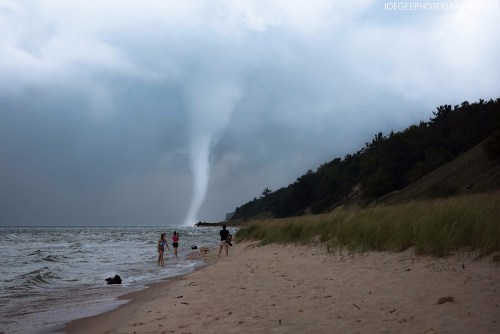

Waterspout at Muskegon State Park

Lake-Michigan-Waterspout Muskegon Beach

Waterspout at Muskegon State Park, photo by Joe Gee Photography

Summer of 2015 has definitely featured some wild weather. Photographer Joe Gee captured this dramatic photo last Monday at Muskegon State Park. mLive featured Joe’s waterspout photo along with an explanation of the phenomenon by meteorologist Mark Torregrossa:

This is the waterspout season on the Great Lakes, but tonight’s waterspout did not occur in the classic waterspout weather pattern.

Waterspouts form mostly due to a large temperature difference between the water surface and the air a few thousand feet above. So the classic waterspout weather pattern would have a large, cold upper level storm system moving over the Great Lakes. That storm system is still well to our west, and won’t pass through until Wednesday.

This waterspout still most likely formed due to a temperature difference between the water and the air. The cold air aloft wasn’t really detectable because it was so isolated.

The other weather feature probably contributing to the development of this waterspout was a lake breeze or even possibly an “outflow boundary” from another storm. The lake breeze blows a different wind direction into the storm and can cause additional rotation. An outflow boundary coming off another thunderstorm can do the same thing.

So this waterspout is a less threatening rotation as compared to a tornado. Usually these waterspouts dissipate before they come onshore.

This time of year is the typical time for waterspouts because of two weather features. First, the Great Lakes water temperatures are usually warmest right now. Secondly, we have to mention the word fall. Cooler, fall-like air starts to move in at this time of year. The temperature difference is largest now through September.

You can purchase a print right here and follow Joe and his work at joegeephotography.com and on Facebook.

More wild weather on Michigan in Pictures!

The Indian Drum

petoskey-breakwall-wave

Petoskey Breakwall, photo by Julie A. Christiansen

Earlier this week I posted about The Crooked Tree. While August isn’t yet shipwreck season in Michigan, the post reminded me of the 1915 novel by William MacHarg & Edwin Balmer set in the same region called The Indian Drum. The whole book is available online at Project Gutenberg (hooray for free books!). It begins:

Near the northern end of Lake Michigan, where the bluff-bowed ore-carriers and the big, low-lying, wheat-laden steel freighters from Lake Superior push out from the Straits of Mackinac and dispute the right of way, in the island divided channel, with the white-and-gold, electric lighted, wireless equipped passenger steamers bound for Detroit and Buffalo, there is a copse of pine and hemlock back from the shingly beach. From this copse—dark, blue, primeval, silent at most times as when the Great Manitou ruled his inland waters—there comes at time of storm a sound like the booming of an old Indian drum. This drum beat, so the tradition says, whenever the lake took a life; and, as a sign perhaps that it is still the Manitou who rules the waters in spite of all the commerce of the cities, the drum still beats its roll for every ship lost on the lake, one beat for every life.

So—men say—they heard and counted the beatings of the drum to thirty-five upon the hour when, as afterward they learned, the great steel steamer Wenota sank with twenty-four of its crew and eleven passengers; so—men say—they heard the requiem of the five who went down with the schooner Grant; and of the seventeen lost with the Susan Hart; and so of a score of ships more. Once only, it is told, has the drum counted wrong.

At the height of the great storm of December, 1895, the drum beat the roll of a sinking ship. One, two, three—the hearers counted the drum beats, time and again, in their intermitted booming, to twenty-four. They waited, therefore, for report of a ship lost with twenty-four lives; no such news came. The new steel freighter Miwaka, on her maiden trip during the storm with twenty-five—not twenty-four—aboard never made her port; no news was ever heard from her; no wreckage ever was found. On this account, throughout the families whose fathers, brothers, and sons were the officers and crew of the Miwaka, there stirred for a time a desperate belief that one of the men on the Miwaka was saved; that somewhere, somehow, he was alive and might return. The day of the destruction of the Miwaka was fixed as December fifth by the time at which she passed the government lookout at the Straits; the hour was fixed as five o’clock in the morning only by the sounding of the drum.

The region, filled with Indian legend and with memories of wrecks, encourages such beliefs as this. To northward and to westward a half dozen warning lights—Ile-aux-Galets (“Skilligalee” the lake men call it), Waugaushance, Beaver, and Fox Islands—gleam spectrally where the bone-white shingle outcrops above the water, or blur ghostlike in the haze; on the dark knolls topping the glistening sand bluffs to northward, Chippewas and Ottawas, a century and a half ago, quarreled over the prisoners after the massacre at Fort Mackinac; to southward, where other hills frown down upon Little Traverse Bay, the black-robed priests in their chapel chant the same masses their predecessors chanted to the Indians of that time. So, whatever may be the origin of that drum, its meaning is not questioned by the forlorn descendants of those Indians, who now make beadwork and sweet-grass baskets for their summer trade, or by the more credulous of the white fishermen and farmers; men whose word on any other subject would receive unquestioning credence will tell you they have heard the drum.

Read on at Project Gutenberg.

Julie took this shot back in November of 2013. You can view it bigger, see more in her This & That slideshow and also check out this video from the day.

More Michigan shipwreck lore on Michigan in Pictures.

Twenty … and Twenty One

Barry Sanders 20 by Detroit Derek Photography

Twenty, photo by DetroitDerek Photography

Today is my little brother Shep’s birthday. He loves sports, the Detroit Lions and most definitely #20 Barry Sanders.

While Lions rookie #21 Ameer Abdullah has a long, long way to go to get into Barry Sanders territory, he made some runs that certainly remind you of someone. Check out this highlight reel from Ameer’s first pre-season game.

Derek took this photo of the statue of Barry Sanders outside the Detroit Athletic Club. View it bigger and see more in his massive Detroit slideshow.

More sports, more Detroit Lions and more Barry Sanders on Michigan in Pictures!


Legend of the Crooked Tree

The Crooked Tree Petoskey

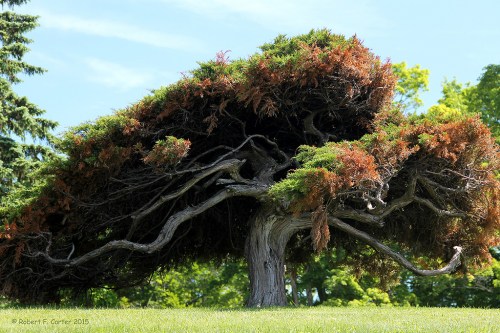
The Crooked Tree, photo by Robert Carter

Robert writes: Huge and ancient . . . this locally famous ‘Crooked Tree’ sits beside one of the roads near my home. “Crooked Tree”: “Crooked Tree Arts Center”, “Crooked Tree Breadworks”, “Crooked Tree Golf Club”, “Crooked Tree Septic Service”, “Crooked Tree This and Crooked Tree That”. This may not be the actual tree from which they take their names . . . but it is the most crooked tree I’ve come across in my travels, and it jumps out at everyone as they drive past.

Robert is correct that this isn’t the original. The Crooked Tree; Indian legends and a short history of the Little Traverse Bay region is available online and tells the story of the original Crooked Tree:

A tall, crooked pine tree overhanging a high bluff, served to designate what was probably the most important Indian village in the north, prior to the advent of the white man. “Wau-go-naw-ki-sa” the Crooked Tree could be seen for many miles by the occupants of approaching canoes. After rounding the northwestern extremity of what is now Emmet county, in the state of Michigan, on their way south, it was a familiar sight, and one that never failed to bring exultations of joy from the brave and daring Ottawas.

Just where the Crooked Tree stood we have been unable to ascertain; but tradition says it was in the vicinity of Middle Village of the present day. According to the legend it was bent by Na-na-bo-jo. Formerly it was straight, but as the great hunter and chieftain was climbing the hill one day at this point, with his canoe over his head, the end of the boat caught on the tree and gave him a bad fall. In anger he struck the tree a blow with his fist and bent it over. Where he hit the trunk a large swelling came out, and henceforward every knot or growth protruding from a tree was called “Na-na-bo-jo’s Fist.”

Read on for some cool stories from the area including some about the tree-punching Na-na-bo-jo!

View Robert’s photo bigger and see more in his My Petoskey slideshow.

“A” Shaft at Cliff Shaft Mine Museum

A Shaft at Cliff Shaft Mine Museum, Ishpeming, Mi

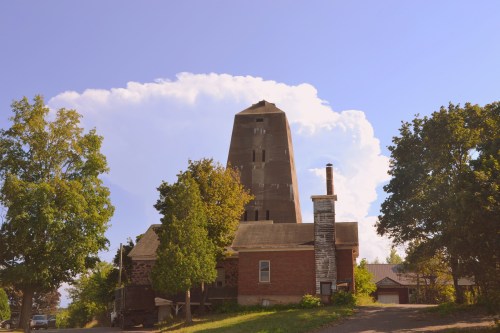
“A” Shaft at Cliff Shaft Mine Museum, Ishpeming, Mi., photo by Thom Skelding

The Cliffs Shaft Mine Museum page at Pure Michigan says that the Ishpeming museum is open June – September Tuesdays through Saturdays from 10 am to 4 pm:

Walk back in history to see local historical artifacts representing the local community during the great mining era. View historical displays of miners and mines past and present, headgear & other safety equipment available to miners of yesteryear, and displays on blasting and diamond drilling equipment. Stop in the Ishpeming Rock and Mineral Club’s room and view over 500 minerals from the local area, the Upper Peninsula, Midwest and the world.

Take a guided tour of the tunnels that the miners walked to the base of the C-Shaft and listen to the history of mining from those who worked the mines. Follow up the stairs past old underground iron ore cars with a stop at the blacksmith shop. Go outside to view towers 97’ to 174’ high which were used to lower miners 1250’ into the bowels of the earth. Stand beside a 170-ton Iron Ore Truck with tires 12 feet high.

Don’t forget your camera so you can have a memento of your visit standing inside the 30 ton shovel bucket in front of the Dry building or in front of the 170-ton Iron Ore truck. End your tour in the gift shop to pick up memorabilia of your visit. The museum open with a nominal admission.

Sounds pretty cool to me! Follow the museum on Facebook for the latest (and some old photos).

View Thom’s photo background big and see more in his slideshow.

Lots more Michigan museums and more mining on Michigan in Pictures.

Epic Sable Point

epic-northern-lights-at-big-sable

Epic Sable Point, photo by Jamie MacDonald

NOAA’s Space Weather Advisory Center is a go-to resource for early alerts on potentially good nights for viewing the Northern Lights in Michigan. The Aurora Borealis made an appearance over the weekend, and Space Weather suggests that tonight holds some promise:

The CME (coronal mass ejection) that produced G3 (Strong) geomagnetic storms on August 15th, 2015 seems to have moved past the Earth. However, we are still under the influence of a high speed solar wind stream from coronal hole 88 (CH 88) and G1 (Minor) geomagnetic storms are possible in the evening to overnight hours. A G1 Watch has been issued for the UTC day of August 17th to reflect this activity.

Head over to NOAA Space Weather for lots more including images of solar activity and all kinds of cosmic goodness.

Jamie says that he went to shoot the Milky Way over the lighthouse and was treated to the Aurora Borealis too! View his photo bigger and see more in his Landscapes slideshow.

Lots more about Big Sable Point Lighthouse and tons more northern lights on Michigan in Pictures!

Sea Cave on Superior

Sea Cave by Craig

Sea Cave on Lake Superior, photo by Craig

The Pictured Rocks National Lakeshore geology page says (in part) that:

During the Nipissing “high stand,” Chapel Rock and Miners Castle as well as many less prominent features (such as perched sea caves near Little Beaver Lake Campground) were carved into the Cambrian sandstone by wave action.

Quite the whittling job by Gitche Gumee!

View Craig’s photo bigger on his Facebook page and see more jaw-dropping Lake Superior pics on Craig’s Flickr.

Enjoy your weekend everyone!

Farm Market Friday: Red Haven Peaches

Red Haven Peaches

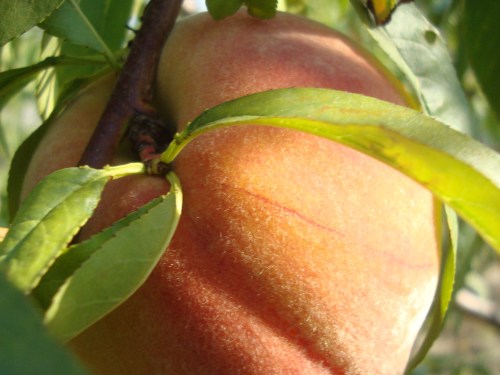
Peaches, photo by alyssa g

I’ve shared the story of the Redhaven peach before on Michigan in Pictures. Strangely enough, it featured a photo by a photographer named Alissa!

Peaches are rolling in at farm markets all across Michigan.  A favorite article that Michigan History Magazine shared on Absolute Michigan tells the story of A Peach of a Man:

Many people have contributed to Michigan’s fruit industry, but Stanley Johnston stands above the rest. Johnston not only developed a new peach that is the most widely grown peach in the world today. He also made Michigan the nation’s leading producer of blueberries.

Johnston was the superintendent of Michigan State University’s (MSU) experiment station in South Haven from 1920 to 1969. There, he developed a better peach. Johnston took peaches that had good features, like ones that ripened at different times or did not turn brown when canned or frozen. He took pollen from the male plant and joined it to the flower of the female plant. When the fruit grew, he collected seeds and started a new tree. When the tree produced fruit five years later, he could see if he made a better peach.

During his career, Johnston grew and studied more than 20,000 peach trees. Eight different types, called “havens” (for South Haven), were planted by farmers. Havens ripened earlier, so the peach-growing season was longer, which meant more peaches could be grown and sold. One of these peaches, named Redhaven for its nice red color, is the most popular peach in the world today.

Read on at Absolute Michigan and definitely get down to your local farmer’s market for some peachy goodness!

View Alyssa’s photo background bigalicious and see more in her Blake Farms slideshow.


#TBT Michigan Asylum for Insane Criminals … and a Postcard Show!

Ionia Michigan Insane Asylum

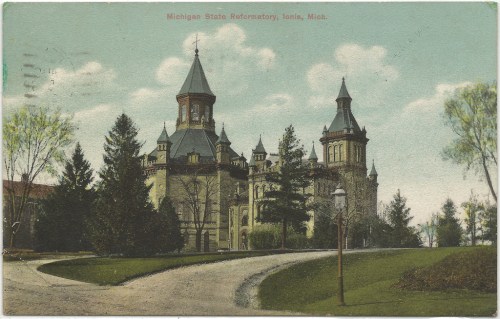
Michigan Asylum for Insane Criminals, photo by Don (the UpNorth Memories Guy) Harrison

Don wanted me to be sure to let everyone know about this weekend’s annual Traverse City Antique Postcard & Rare Paper Show on August 16 from 10 AM – 4 PM at Northwestern Michigan College’s Hagerty Center. It’s a great chance to view some incredible pics of Michigan’s history … and from all over!

Speaking of history, Asylum Projects page on the Ionia State Hospital says:

The building of the Ionia State Hospital was authorized in 1883 and was opened under the name of the Michigan Asylum for Insane Criminals in 1885. It was found that this name was objectionable as not all of the patients in the hospital were criminals, so the name was changed by legislative action to Ionia State Hospital. The patients committed to this hospital were insane felons, criminal sexual psychopaths, insane convicts from other prisons, patients transferred from other state institutions that had developed dangerous or homicidal tendencies and persons charged with a crime but acquitted on the grounds of insanity. Initially the hospital patients were housed at the site of the Michigan Reformatory.

The hospital was called the North Branch and the farm located on Riverside Drive was called the South Branch. When a large fire broke out at the hospital, all of the rooms were needed to house prisoners, so all of the hospital patients were sent to the South Branch farm. Since that time, the hospital has been located on the grounds of the Riverside Correctional Facility. The hospital was used to treat the mentally ill as well as the criminally insane until 1972, when civilians were removed from the hospital. In 1977, the Legislature transferred the operation to the Department of Corrections when it began operation as a correctional facility. The facility was closed with the reopening of the Michigan Reformatory.

Click through for some pics including a couple of cool panoramas!

View the photo background big and see more from UpNorth Memories on Flickr!