

Mid Michigan on the 4th of July – Imlay City, photo by Mike Boening
View Mike’s photo background big, see more in his slideshow and if you want to want to purchase prints, visit his website.
More summer wallpaper on Michigan in Pictures!
Mid Michigan on the 4th of July – Imlay City, photo by Mike Boening
View Mike’s photo background big, see more in his slideshow and if you want to want to purchase prints, visit his website.
More summer wallpaper on Michigan in Pictures!
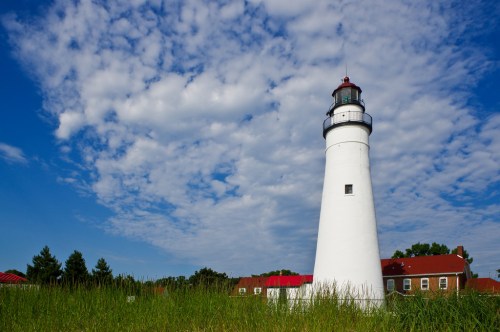
Fort Gratiot Lighthouse, photo by charles hildebrandt
Terry Pepper’s Seeing the Light is the go-to resource for Michigan lighthouses. His Fort Gratiot Lighthouse page begins:
The entrance into the St. Claire River from Lake Huron had long been deemed of strategic importance. Named after General Charles Gratiot, the engineer in charge of its construction, the Fort Gratiot military outpost was established at the entrance to the river in 1814, and ensured the security of vessels making the passage.
With the surge in vessel traffic on Lake Huron in the early 1800’s, the need for a lighthouse to guide vessels into the river and away from the shallows at the River entrance became a matter of increasing importance. In response to this need, Congress appropriated $3,500 to construct a lighthouse “near Fort Gratiot, in Michigan Territory” on March 3rd of 1823.
The contract for construction of the lighthouse and keepers dwelling was awarded to Captain Winslow Lewis of Massachusetts. Lewis was the inventor of the patented Lewis Lamp, which the Fifth Auditor had universally adopted as the primary source of illumination in the nation’s growing inventory of lighthouses. A staunch supporter and ally of the Fifth Auditor, Lewis had branched out into the business of lighthouse construction, and as the frequent low bidder, was being awarded a growing number of contracts to fulfill the nation’s need for navigational aids on the East Coast.
Lewis sub-contracted the construction of the tower and keepers dwelling that would become known as the “Fort Gratiot Light” to Mr. Daniel Warren of Rochester New York. Work commenced on the structure, but appears to have been running far beyond the scope of the original bid, since Congress appropriated an additional $5,000 for the project’s completion on April 2, 1825.
With the completion of construction on August 8th of that year, Fort Gratiot Light held the honor of becoming the first lighthouse in the State of Michigan.
Read on for much more including a couple of old photos of the light.
View Charles’ photo background big and click for more of his lighthouse photos.
Many more Michigan lighthouses on Michigan in Pictures!
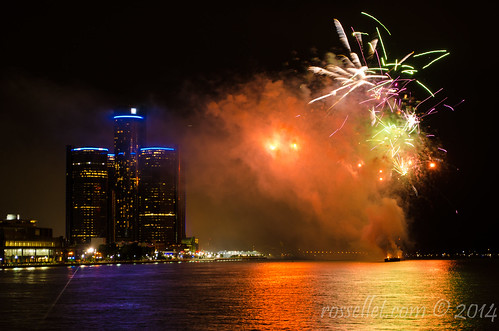
Bombs of Smoke And Confetti, photo by Ross Ellet
Happy 4th of July everyone!
View Ross’s photo background big and see more in his Night Photography slideshow.
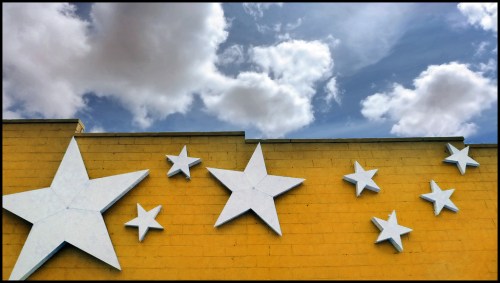
Starry Sky, photo by Steve
BBQ items? Check! Fireworks plan? Check!! Wall o’ stars? Check!!! Have a happy 4th of July weekend everyone!!!!
View Steve’s photo bigger and see more in his LX7 slideshow.
PS: Check out Detroit News feature 50 fun things to do for the Fourth.
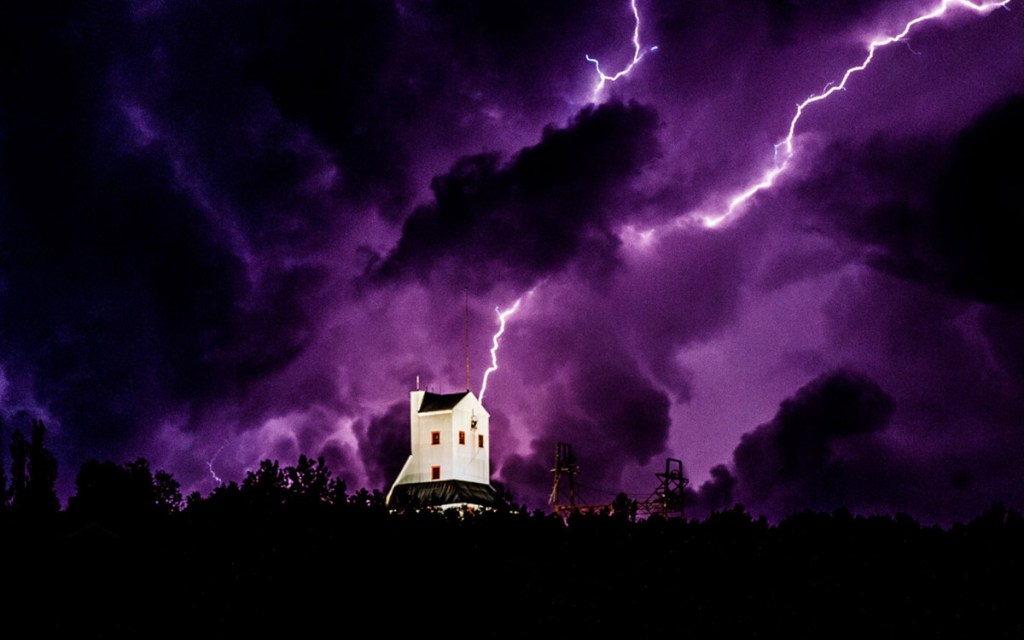
2014-houghton-blitz-2978 by Christopher Schmidt
“Our children were born here and now we have five grandchildren to celebrate also. We have proud geological roots here. We think the shaft should be bright on our birthdays, and this would be a good way to support geoheritage and the QMHA. We hope other local families will consider doing this.”
~Bill and Nanno Rose
Apparently, you can make a donation and have the Quincy Mine Shaft lit up in honor of a loved one. Click the link for details!
The photo above shows the Quincy Mine Hoist, part of the Quincy Mine complex, an extensive set of copper mines near Hancock. The mine was owned by the Quincy Mining Company . The Quincy Mine was known as “Old Reliable,” paying a dividend to investors every year from 1868 through 1920 and operated between 1846 and 1945. The Quincy Mine page on Wikipedia says (in part):
The Quincy Mine was founded in 1846 by the merger of the Northwest Mining Company and the Portage Mining Company. Due to poor communication between government offices, these two speculative mining companies had purchased the same tracts of land during the mining rush of the early 1840s. The directors met and decided to merge, with significant investment coming from Massachusetts (the town of Quincy, Massachusetts lent the mine its name). While many other copper mines were founded at the same time, the Quincy Mine became the most successful of the 1840s-era mines, and was the country’s leading copper-producing mine from 1863 (when it exceeded the production of the Minesota Mine) through 1867 (after which it was exceeded by the Calumet and Hecla).
The mine was the first Michigan copper mine to switch from fissure mining to amygdaloid mining, when the recently discovered Pewabic amygdaloid lode was found to cross Quincy property in 1856. High-grade fissure veins contained large, pure masses of copper, but the masses could take days or even months to extract, at high cost. Amygdaloid mining consisted of extracting lower-grade strataform orebodies in the “amygdaloid zones,” the upper portions of basalt lava flows. Rock bearing small pockets of copper could be blasted out immediately and processed elsewhere at much lower cost. Amygdaloid mining proved much more productive than fissure mining, and the size and richness of the Pewabic lode in particular allowed the Quincy to produce profits for 53 consecutive years. The Quincy company expanded laterally along the lode by buying out adjacent properties. The company bought the Pewabic mine in 1891, the Mesnard and the Pontiac in 1897, and the Franklin mine in 1908. This helped the mine survive longer than almost all other Keweenaw copper mining companies, except the Calumet and Hecla Mining Company and the Copper Range Company.
To attract a better class of worker, the Quincy Mining Company built and maintained housing for the workers. Over the course of operations, the types of housing ranged from simple tents in the early days, to complete three story houses shortly before the mine’s shutdown. The executives on the east coast wanted to build more elaborate and fancy homes with amenities such as electricity and running water. However, the on-site managers didn’t think it was necessary for the miners to have such high-class dwellings. But the east coast executives realized that if they offered nicer homes to the workers, the miners were more likely to stay, raise families, and be less likely to leave the area or transfer to another mining company. This strategy proved effective and helped the Quincy Mining Company retain its status as one of the premier mining companies in the region.
View Chris’s photo background bigatacular and see more in his Keweenaw Lightning slideshow.
More about the Quincy Mine on Michigan in Pictures including the second picture posted!
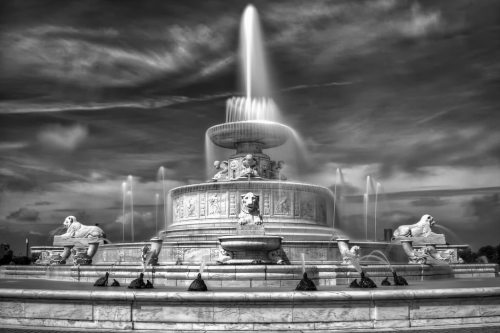
Rising Above, photo by Tom Hughes
“Mr. Scott never did anything for Detroit in his lifetime and he never had a thought that was good for the city.”
~ J.L. Hudson
Sometimes when you peer into history, you see things you didn’t expect, and that’s definitely the case with today’s subject. The Cass Gilbert Society’s page on the James Scott Memorial Fountain on Belle Isle explains that the fountain was completed in 1925, designed by noted architect Cass Gilbert (designer of the US Supreme Court Building in DC), and executed by sculptor Herbert Adams
The fountain was the result of a bequest from millionaire playboy James Scott, a figure of much controversy in Detroit at the turn of the century. Detroit’s fountain of mirth from the excellent Rearview Mirror series in the Detroit News (removed, but see The Wayback Machine) tells of the opposition from prominent citizens and clergy like J.L. Hudson and Bishop Williams that a playboy, loafer, gambler and vindictive practical joker like Scott be memorialized solely because he was able to plunk down a vast sum for his own monument. While public opinion kept the project scuttled for years after Scott’s death, influential Alderman David Heineman and others took up the charge, likely seeing how a vastly expensive fountain could enhance Detroit’s island park.
Speaking to reporters gathered in the office of Mayor Philip Breitmeyer, Heineman said: “I can look around this office and see pictures of men who played poker with Jim Scott. I say the bequest should be accepted.” He also recalled that “Jim always liked Belle Isle and loved to see the children there.”
The mayor agreed with Heineman. “I don’t believe the city has a right to insult any of her citizens by refusing a gift for such a good cause,” he said.
In the end, their view prevailed. It took more than 15 years, but Breitmeyer lived to attend the fountain’s dedication in 1925. Cass Gilbert, the New York architect who planned the Detroit Public Library, won a competition for design of the glistening white memorial at the lower end of the city’s pleasure island.
Read on at archive.org and see Wikipedia for more on Belle Isle.
Tom took this shot on Sunday. See it bigger and see more including a detail view in his slideshow.
EDITOR’S NOTE: This post previously appeared but sadly the photo was deleted by the owner. It’s one of my favorites so I re-blogged it!
More black & white photography and more Belle Isle on Michigan in Pictures!

Reflection, photo by Bill VanderMolen
Bill took this photo in the Lake Erie Metropark (aka Brownstown Park). View his photo bigger and see more in his Birds slideshow.
More about Great Egrets on Michigan in Pictures.
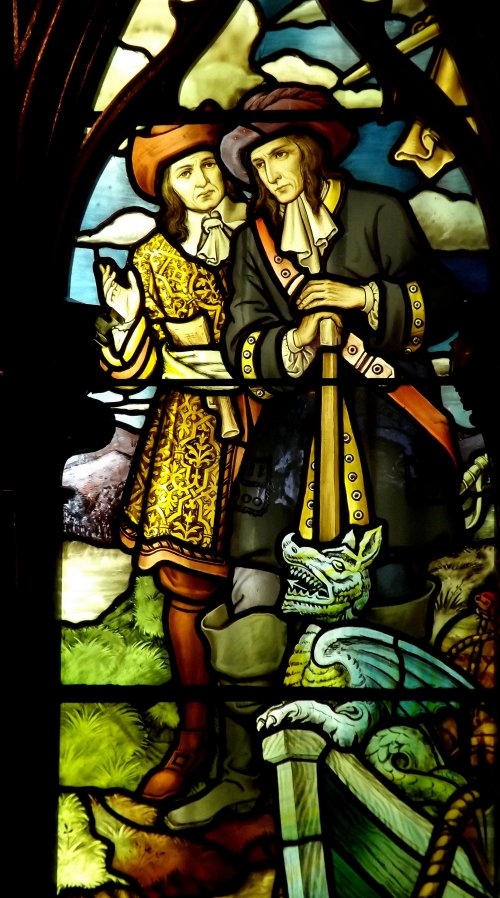
Detail: The LaSalle Stained Glass Window, Installed at Dossin Great Lakes Museum, Belle Isle Park–Detroit MI, photo by pinehurst19475
John Flesher of the Associate Press has a feature on NBC News about the possible discovery of the Holy Grail of Great Lakes shipwrecks, Le Griffon, the ship of French explorer Rene-Robert Sieur de La Salle. The article says (in part):
A wooden beam embedded at the bottom of northern Lake Michigan appears to have been there for centuries, underwater archaeologists announced Tuesday, a crucial finding as crews dig toward what they hope is the carcass of a French ship that disappeared while exploring the Great Lakes in the 17th century.
Expedition leaders still weren’t ready to declare they had found a shipwreck or the long-lost Griffin. The ship, commanded by the French explorer La Salle, was never seen again after setting sail in September 1679 from an island near the entrance of Green Bay, in what is now northern Wisconsin, with a crew of a six and a cargo of furs.
…Scientists and divers began excavating last week at the base of the wooden beam, hoping to determine whether it is part of the Griffin. Steve Libert, a diver and shipwreck enthusiast who has searched three decades for the Griffin, discovered the timber in 2001 and recently obtained state and federal permits to probe beneath the muddy surface.
Read on for more. Libert is president of Great Lakes Exploration Group started the Lasalle-Griffon Project with the state of Michigan and the Republic of France in July of 2010. He’s definitely obsessed with finding the ship, and their Expedition page explains:
If the wreck Libert has found is Le Griffon, it will be a find of tremendous historical significance. Le Griffon was built by Rene-Robert Sieur de La Salle, one of the first French explorers of the Great Lakes Region. He would later claim the Mississippi River watershed for France, a vast expanse of land that extended from the Allegheny Mountains to the Rocky Mountains and North of the Great Lakes, a portion of which became what is presently known as the Louisiana Purchase.
Exploration and study of the ship will tell us much about the history of our country and how our ancestors lived. “The ship is a time capsule that will fill the missing gaps of La Salle’s early exploration of North America,” says Libert. In particular, the wreck is a record of ship construction of that period, about which relatively little is known. La Salle constructed Le Griffon on the banks of the Niagara River, about three miles above the falls. There is strong documentation to support the view that Le Griffon was built on what is now the U.S. side of the Falls. If the wreckage is Le Griffon, however, it may be possible to use samples to establish definitively which side it was built on.
The fact that Le Griffon was built in the wilderness, as opposed to a shipyard, will reveal the circumstances La Salle and his men faced and the tools and technology they possessed. The ship was built with timber cut on site. The exact dimensions of the vessel are not known. It is however known to have been a 40 tun* vessel with three masts, a foremast, main and mizzen, and several square sails.
*Tun is an old French word for a large cask used in shipping wine, equivalent to 33.7 cubic feet or 252 gallons. Read on for a whole lot more.
Regarding the stained glass above, pinehurst19475 writes:
This is a full view of part of a panel that depicts two cavaliers in discussion. They are part of a scene that depicts Robert Cavalier Sieur de la Salle’s voyage through the Detroit River in 1678-9. The small boat in the foreground is the “Griffon,” the vessel that made the voyage.
The five-part stained glass window was originally installed in the Gothic Room of the “City of Detroit III.” At the time it was built (1912), it was the world’s largest side-wheeler. The Edward F. Lee Glass Company of Detroit designed the stained glass window.
View his photo background big and see more in his Stained Glass slideshow.

Splash-in 2014, photo by Gary McCormick
Every year in mid-June Grand Marais holds their annual Splash-in where seaplanes/float planes come from the US and Canada for a weekend of fun. Gary was there two weeks ago and got some cool shots!
View Gary’s photo background bigtacular and see more in his Grand Marais slideshow.
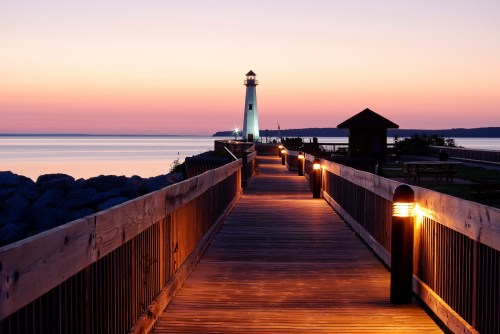
Wawatam Lighthouse, photo by charles hildebrandt
While many of Michigan’s historic lighthouses have been decommissioned and are mostly ornamental, Pure Michigan tells the story of how the Wawatam Lighthouse started out as an ornamental lighthouse and now actually has a job! Thinking there’s a children’s story here…
This classic lighthouse started life in 1998 as a Michigan Welcome Center travel icon at Monroe, Michigan. In 2004, the Monroe Welcome Center was being revamped and the lighthouse was put up for relocation. The City of St. Ignace was the lucky recipient and the structure was trucked north in five pieces. It stayed on the Chief Wawatam Dock for a time, awaiting the construction of its new platform. The red, white and green lighthouse was repainted in bright white with red accents. In June 2006, a crane reassembled the tower on its new site. Everything was in readiness, just waiting for U.S. Coast Guard certification. Wawatam Lighthouse takes its name from the late railroad ferry Chief Wawatam, which used this same dock from 1911 through the mid-1980s.
When you visit the lighthouse, you will pass right by the Chief’s old lift gate. Wawatam Lighthouse’s beacon was first lit on August 20, 2006. Visible for more than 13 miles out over Lake Huron, it is now an official aid-to-navigation. The 250 millimeter Fresnel lens casts its light in a 152 degree arc. Though the lighthouse’s GPS location is 45-051-19.700 N by 084-42-09.000 W, it will most likely be easier for you to find it straight out east of McCann Street. The tower is 52 feet tall, but the Coast Guard looks at it in a different way. They rate it as 62 feet tall from the water. It is even lit in the winter to guide snowmobiles across the frozen lake.
View Charles’ photo background big and see more in his slideshow.
More Michigan lighthouses on Michigan in Pictures!
 Michigan in Pictures