urban playgrounds & vanishing acts

bike

bike, photo by vanessamiller.

About a month ago Vanessa was interviewed by Michigan Radio’s Jennifer Guerra about her Ruins of Detroit urban explorations project. Vanessa says:

The Detroit ruins project has been in progress in some form or another for six years. During that time we have seen Detroit grow and change. It started in High school when we treated the city’s abandoned buildings as playgrounds. We were a group of photographers that spent every day shooting. In college, some people move out of state, some just moved on, but we stayed, we kept coming back to the same places and began documenting their changes over time. We saw our favorite buildings burn to the ground and found new ones along the way. Each building has its own mysteries, that we tried to solve and its own beauty.

Check out more photos from Vanessa and others of the Detroit that just isn’t there anymore in her photostream and in the Vanished Detroit group on Flickr.

Mackinac Bridge Tower

Mackinac Bridge Tower

Mackinac Bridge Tower, photo by A. Runyon.

Amanda assures us that she wasn’t driving.

Head over to Absolute Michigan for a cool look inside the Mackinac Bridge towers and click the button below for lots more Mackinac Bridge info.

The Mackinac Bridge

Yesterday in Jackson, Michigan

main_street_looking_east_part2_9_27

main_street_looking_east_part2_9_27, photo by jacksonista.

Looking east, looking west, this set of old Jackson postcards is the best (you can also view the slideshow).

From the roller coaster at Hague Park to the casino at Wolf Lake to cell block 11 at the “new” state penitentiary to things that it’s hard to even describe, this set of over 150 old photos will take you way back.

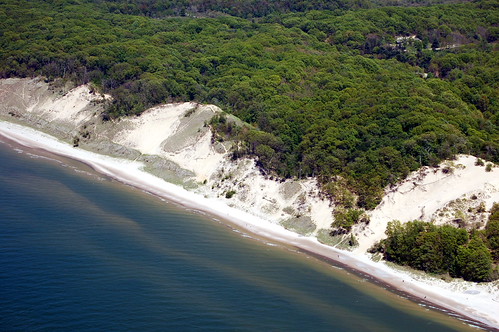
Michigan Shoreline Tour: Van Buren State Park

Van Buren State Park

Van Buren State Park, photo by Paladin27.

A little over a year ago, I blogged another photo from Paladin27’s Flying to South Haven set.

It might be cheating to go to the well twice, but it’s hard to find a way to convey the awesome scope of Michigan’s shoreline dunes without getting above them (and moving along them). Be sure to check out Part 1 and Part 2 of his video on YouTube of the flight.

The official page on Van Buren State Park (which makes the park look like it recently escaped from prison) says:

Van Buren State Park offers approximately 400 acres of land located along the Lake Michigan shoreline in northern Van Buren County. The focal points of the park are its high dune formations and one mile of sandy beach. Van Buren became a state park in May of 1965 when the original 167-acre plot was purchased from the Harry LaBar Drake family. Since then two other land purchases have been made to make up the current park.

The Wikipedia entry for Van Buren State Park needs some help as well. Anyone have some knowledge about the park and a little time?

The park has camping on over 200 sites, hiking on miles of trails and great sandy beaches. Here’s a Flickr photo map and also the Google Map for Van Buren State Park (looks like they caught a boat on the satellite flyover!)

Standing behind all those Michigan graduates…

The World Is Your Oyster Now

The World Is Your Oyster Now, photo by mischiru.

This great photo of Spring Commencement at the University of Michigan in Ann Arbor made me think about the tens of thousands of Michigan students who graduated from high school or college this year, the teachers who taught them and the administrators who helped to keep it all running.

At commencement ceremonies across the state, the graduates were congratulated and the teachers and administrators were thanked, but there’s another group of people whose contribution is oftentimes overlooked.

As a parent, school board member and business owner who depends upon an educated workforce, I’d like to extend a very heartfelt thanks to the Michigan taxpayers who have helped to fund our state’s fine system of public schools, colleges and universities.

This photo is part of a cool set of Michigan photos.

Vintage Base Ball and the Kent Base Ball Club

2002 (213)

2002 (213), photo by xman12.

I think it’s pretty cool that just hours after Brian H got me interested in the Kent Base Ball Club, Detroit Tiger pitcher Justin Verlander hurled a no-hitter.

The Vintage Base Ball Association says that base ball (two words prior to the 1880s) is a re-creation of the game based on rules of the late 1850s, 1860s and 1880s. Michigan boasts 13 base ball teams – more than any state.

The Kent Base Ball Club of Grand Rapids is a founding member of the Vintage Base Ball Association.

Grand Rapids’ first team, the Kent Base Ball Club of Grand Rapids was formed on April 4, 1867, when a group of Civil War veterans formed a club to continue playing the game they had learned while in the army. Silas K. Pierce, who had recently moved to the city from Ionia, was elected as the club’s first president…

One hundred and twenty-three years later, in 1990, a group of local enthusiasts led by city historian, Gordon Olson, decided to reorganize the Kents and play the game of base ball as it had originally been done in the 1860s. Olson had found the original constitution and by-laws of the Kent Base Ball Club in the Grand Rapids History and Special Collections Center at the public library, and was curious to see how the old game compared to its modern counterpart. The newly reconstituted Kents now play an average of 12-15 games per summer, and have appeared in Columbus, Ohio; Fayette State Park, Greenfield Village, Old Kent Park (all in Michigan), and Doubleday Field at Cooperstown, New York. In period uniforms, they do their best to live up to the enthusiasm and dedication to sportsmanship and fair play that motivated the original Kents.

Every year in early June they play the Silas K. Pierce Cup (State of Michigan Championship) at John Ball Park in Grand Rapids and you can get a schedule, more history and links at their site.

xman12 has over 1200 photos of the Kent Base Ball Club in action.

Michigan Shoreline Tour: Silver Beach, St. Joseph, MI

Silver Beach, St. Joseph, MI

Silver Beach, St. Joseph, MI, photo by lucasseidenfaden.

Lucas has a panorama of Silver Beach in St. Joseph that you have to check out, and you better have a look at his other beach and landscape photos too.

You can view more photos from St. Joseph on this Flickr map and there’s also a whole bunch of St. Joseph information posted today in the Berrien County, Michigan article on Absolute Michigan.

Biking the Big M in the Udell Hills

aDSC_7407.jpg

aDSC_7407.jpg, photo by cyoas55.

Craig writes that this photo is from the outer loop at Big M ski and bike trails (and that recent high winds littered the trail with debris, so keep that in mind).

The Big M Ski & Mountain Bike Trail System is located in the nearly million acre Huron-Manistee National Forest. Information online is pretty scant, with the Big M trail page at the Michigan Mountain Bike Association pointing to the now vanished Udell Hills Trail Network web site.

Fortunately, the Internet Archive Wayback Machine was created to handle just such an eventuality, and you can get the Udell Hills Trails System site as it appeared in May of 2005. It says:

The Udell Hills Trail system is located in Manistee County just north of the border with Mason County. It is a lush area that is predominantly covered in hardwoods and is sandwiched between the Little and Big Manistee Rivers. It is a big pile of glacial poop and includes sandy/loamy soil and some interesting rocks and boulders. At one point, Udell Hills was the home of downhill ski area. Now it is a Mecca for mountain biking and cross country skiing.

There’s also a great trail system page that describes all the trails and their features in entertaining fashion.

View a map.

The Shiawassee River

Shiawassee River

Shiawassee River, photo by naokomc.

Poked around the map of Michigan this morning, looking for a place I hadn’t been. That turned out to be the Shiawassee River. (Shiawassee River slideshow)

The very good (if staggeringly bright yellow) page on the Shiawassee River basin from Shiawassee History says:

The Shiawassee River Basin plays a major role in the mid-Michigan area. Its drainage area is approximately 1,200 square miles and portions of the river touch at least 7 counties.

The river is about 110 miles long and generally flows in a northerly direction, which is one of only two or three in the world. The Flint River, Cass River and Titabawassee River join the Shiawassee just southwest of the City of Saginaw and together form the Saginaw River which drains into the Saginaw Bay.

Shiawassee History also explains that Shiawassee may come from the Chippewa term for straight running river; Shiawassee (straight, or straight ahead) wassee. Then again, you can find other sources saying that the name means “river that twists about”.

The Nature Conservancy has a nice page on the Shiawassee River Watershed and the threats it faces from development pressures.

I’ll link to Wikipedia’s brief entry on the Shiawassee River because it had a link to Headwater Trails proposed Shiawassee River Water Heritage Trail (and in hopes that someone can go there and make the entry better).

Update (6/12/07): I just found the Saginaw Basin Land Conservancy who relate that the Saginaw Bay Watershed is the largest contiguous freshwater coastal wetlands system in the United States, featuring more than 175 inland lakes and about 7,000 miles of rivers and streams that are home to large populations of waterfowl, birds, snakes, turtles, amphibians, and more than 138 endangered or threatened species. They’re having a photo contest too – see the comments for details!

Michigan Shoreline Tour: Warren Dunes State Park

Warren Dunes State Park

Warren Dunes State Park, photo by mizjellybean

Heading up the shoreline from New Buffalo, we come to the Warren Dunes State Park. I think that the first thing you need to do is check out this slideshow of the Warren Dunes. Go ahead, we’ll wait.

Wikipedia’s entry for Warren Dunes State Park is a 1,952 acre state park, located along the shore of Lake Michigan in Berrien County, Michigan (near Sawyer). The park’s dunes include Mt. Fuller, Pikes Peak, Mt. Edwards and (the tallest) Tower Hill which rises 250′ above Lake Michigan. Warren Dunes was designated as a state park in 1930 and draws around one million visitors annually. The page on the village of Sawyer from the Harbor Country Chamber of Commerce adds that although most in the area saw the land as worthless, businessman Edward K. Warren had a vision to preserve them and bought the land at the turn of the century.

Speaking of Wikipedia – something we seem to do fairly often – they have a massive page of map data and hacks for Warren Dunes including a Flickr map of photos from the Warren Dunes area and the Google map to Warren Dunes State Park.

I should add that the DNR page for Warren Dunes State Park notes that due to an infestation of the Emerald Ash Borer beetle, over 4,000 ash trees have been removed from the modern campground unit, dramatically changing the appearance of that campground.