

Dairy King., photo by Arace.
Nothing really left to do but link to a map to Eva’s Dairy cafe of Lake Orion and say “yow!”
Dairy King., photo by Arace.
Nothing really left to do but link to a map to Eva’s Dairy cafe of Lake Orion and say “yow!”
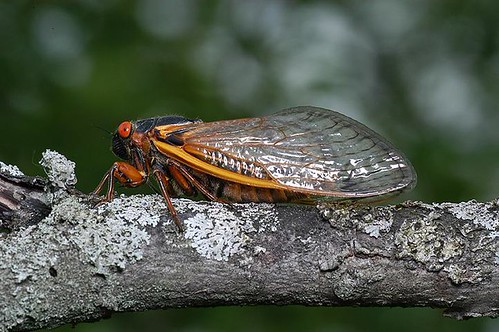
After 17 years?, photo by mfophotos.
The Magicicada are the genus of the 13- and 17- year periodical cicadas of eastern North America who display a unique combination of long life cycles, periodicity, and mass emergences. They are classified according to “Brood” and 2007 is the year of Brood XIII, on a 17-year cycle and also known as the Northern Illinois Brood. Wikipedia’s Brood XIII page has a nice picture of the cicadas of this brood.
While Wikipedia and the U-M’s Museum of Zoology cicada page say that Brood XIII has a presence in southwest Michigan, retired University of Michigan entomologist and cicada expert Thomas Moore says (Freep article) that overeager graduate students and sloppy work by a 19th-Century government scientist and irresponsible replication are responsible for the erroneous perception that Brood XIII may make an appearance in Michigan.
Mark O’Brien comments that it’s unfortunate that Tom Moore was quoted as dismissing the work by former UMMZ graduate students John Cooley and David Marshall (who created the useful pages and did state that the maps are “approximate”). On his blog, Six-legged Wonders, Mark has a post about Brood XIII in Michigan where he says:
What needs to be done is to get modern records. Researchers tend to go to where previous records show emergences. So, if you know that Lake County, Illinois has 17-yr cicadas, that’s where you go if you have limited time to do experiments, etc. I don’t doubt that there may have been 17-yr cicadas at some point in SW Michigan — especially inland away from the sand dunes. However, the area has been heavily agriculturized over the past 100 years, and some areas have also gone back to woods. Have small pockets of Magicicada survived? The only way to know is to go and traverse the area and listen. Lacking that… if you live in that area of the state, tell me that you have them and show me the specimens. It would be nice to know, either way. The next emergence would be in 2024. I’m going to be an old man by then.
You can get a ton more information about the cicadas of Brood XIII (and others) including lots of photos and video and all your Brood XIII gear at Cicada Mania.

Detroit Scribe Tribe Space Monkey, photo by Detroit BikeBlog
At the risk of producing a vortex of self-referentiality, I wanted to link over to Mac at DetroitBike Blog, who is linking to Absolute Michigan, which is linking to his blog as the latest “Blog We Dig” (you see the danger). Here’s what he posted last Friday:
Flickr: One thing that’s cool about the Flickr photo site is its sense of community. Not only virtual communities but groups of people who find each other through Flickr, decide to meet-up, and then go out shooting photos together. If you’re reading this and aren’t on Flickr I’d recommend the Exposure Detroit and AbsMich groups as starting points. One of the latest get togethers the ExpDet group organized was a walk along the dequindre cut. Closed for 10 years this abandoned rail cutting has become a graffiti haven with some amazing work that has been posted here before. The ExpDet group took some great shots, well worth exploring.
Now this is where things get interesting. The old rail line (still a few abandoned rail cars along the route) runs from midtown beneath and between the street structure to the river. It’s now inhabited by a few folk who have built shacks and the graff community. But it could also serve as a great bike route between the river and midtown. Detroit has virtually no bike lanes and some of the things I’ve seen on Detroit streets make me wince (the guy with the 6ft plank stuck out of his trunk like a guillotine for example). While there are serious personal safety issues to be considered it’s good to see that work has begun into converting this route into a non-vehicle corridor through the city.
Check his links out and be sure to also view this slideshow of photos from Exposure.Detroit’s April 29, 2007 photo safari to the Dequindre Cut.
While you’re reading and looking, you might think about how $5/gallon gas will require us to rethink the layout of our cities and transportation … and also what fascinating cave paintings these “vandals” are producing in an abandoned space.

Sunset over Lake Michigan, photo by briethe.
There’s not much doubt that as we head up Michigan’s west coast in our shoreline tour, we’ll see a lot of breakwalls and sunsets.
The New Buffalo Township’s excellent history tells us (among other things):
The city of New Buffalo came into being because of a violent October storm in 1834, when Captain Wessel D. Whittaker grounded his schooner Post Boy in the mouth of a small stream called State Creek near the present village of Grand Beach. The ship was destroyed, but Captain and crew survived the disaster and walked to Michigan City, where there were taverns that could provide food and shelter. There Whittaker hired a rig and headed north for St. Joseph to report the ship’s loss to its underwriters. On his way up the coast, he was struck by advantages and beauty of the spot where the Galien River passed through Lake Potawatomi into Lake Michigan. Lake Potowatomi, since drained by the sawmills, was, by varying accounts, two miles long, a half mile wide and up to ninety feet deep or four miles long by a mile wide and fourteen feet deep. It is now just “a lazy bend in the river.”
In addition to all kinds of visitor and business information, The New Buffalo Business Administration has a nice timeline of the history of New Buffalo and a cool old photos of the C&O Railroad Roundhouse that I would very much like to see larger. Maybe it can be found at the New Buffalo Railroad Museum. I also learned at NewBuffalo.com that the nation’s first Highway Travel Information center opened on May 4, 1935, on US-12 at New Buffalo. New Buffalo’s Wikipedia entry is on the lame side, and I would encourage any enterprising New Buffaloeans to spruce it up a little.
You can View a map of photos from New Buffalo and nearby, and explore more of our Michigan Shoreline tour pictures.

Caber Toss, photo by BearlyWorking
This photo is part of a set of 2006 Alma Highland Festival photos featuring kilt-clad competitors lifting and hurling heavy objects.
The Alma Highland Festival and Games take place May 26 & 27, 2007 on the campus of Alma College (2007 is the 40th annual). In addition to the Great Lakes Scottish Heavyweight Athletic Events, the festival includes piping, drumming and traditional Scottish fiddling and dancing competitions. There’s also games for children, the Parade of Tartans, and lessons and Scottish clan tents when you can learn about Scottish culture.
In addition to explaining the dance and band competitions, Wikipedia’s entry on the Highland Games lists the Heavy Events as stone put, Scottish hammer throw, weight throw, weight over the bar, sheaf toss and:
Caber toss: A long tapered pine pole or log is stood upright and hoisted by the competitor who balances it vertically holding the smaller end in his hands. Then the competitor runs forward attempting to toss it in such a way that it turns end over end with first, the upper (larger) end striking the ground and then the smaller end, originally held by the athlete, following through and in turn striking the ground in the 12 o’clock position measured relative to the direction of the run. If successful, the athlete is said to have turned the caber. Cabers vary greatly in length, weight, taper, and balance, all of which affect the degree of difficulty in making a successful toss. Competitors are judged on how closely their throws approximate the ideal 12 o’clock toss on an imaginary clock.

Twilight Wishes, photo by suesue2.
I saw this photo and my first thought was to wish for “more time”.
That led me to remember “dandelion clocks” which in turn led me (as many idle wonderings do) over to Wikipedia, specifically the page on dandelions. The entry says that the globe of seed-containing achenes are called the “dandelion clock,” and blowing it apart is a popular activity for children worldwide (cool macro of the dandelion clock).
I also found this gorgeous dandelion illustration from Elizabeth Blackwell’s flora Herbarium Blackwellianum… published in 1757.
An astute observer might well point out that were I not so prone to wondering and then wandering and then writing it all down, I might have more of that time I’m wishing for.
In my defense, I also found a link to dandelion folklore which quotes Alexander Chamberlain as saying “the dandelion is called the rustic oracle; its flowers always open about 5 A.M. and shut at 8 P.M., serving the shepherd for a clock.” I also learned:
“The dandelion is an excellent barometer, one of the commonest and most reliable. It is when the blooms have seeded and are in the fluffy, feathery condition that its weather prophet facilities come to the fore. In fine weather the ball extends to the full, but when rain approaches, it shuts like an umbrella. If the weather is inclined to be showery it keeps shut all the time, only opening when the danger from the wet is past.”
-Source: “Camping For Boys,” by H.W. Gibson
So there you go.

You can see Chicago from 42 miles away! by TRVentura
This summer, Absolute Michigan will be taking a tour of Michigan’s shoreline, looking at the heritage and attractions of the communities along Michigan’s Great Lakes shoreline.
Michigan in Pictures will be going along, trying to point out some of the beauty along the way.
We’d really like it if you’d help us by telling us what not to miss. If we do miss something – and with 3000+ miles of coastline, that’s pretty likely – then please feel welcome to post a comment or a link at the place where we missed it.
And if you want to climb in the car (or on the bike or in the kayak) and join the tour and let us know what you found, well that would be very cool too.
The above photo was taken at the beach in Michiana, Michigan (and Yahoo/Flickr geotagged photo map). I’m always a little surprised to find that you can’t see the state line from space.

underground, photo by puja
2002 detroit electronic music festival at hart plaza … Movement 07: The Detroit Electronic Music Festival is next weekend.

Blair and the Capitol, photo by Apocaplops.
On the statue of Austin Blair “War Governor of Michigan” at the Michigan Capitol in Lansing it says “He gave the best years of his life to Michigan and his fame is inseparably linked with the glorious achievements of her citizen soldiers.” (check it out in the super-biggie-sized view and Michigan Governor Austin Blair on Wikipedia)
It’s hard to ask that anyone give the best years of their life to anything as large as a state, but it might be good to take a few moments sometime during Michigan Week (May 19 – 25, 2007) to consider the massive challenges that people of our state have fought through in the past. From hundreds of thousands of lives given to preserve the Union to hundreds of thousands of hours labored to carve farms from forest, Michiganians have a history of standing tall and staring down and battling through adversity.
While saving our state from today’s troubles is beyond any one of us, there’s little doubt that each one of us has some measure of the solution with our grasp.

 Michigan in Pictures

