Boyne Mountain & Michigan ski industry pioneer Everett Kircher

Snowmaking on Victor @ Boyne Mountain

Snowmaking on Victor @ Boyne Mountain, photo by Boyne Michigan

If you’re a skier in Michigan, chances are you’ve heard the name of Everett Kircher. Boyne Resorts history page says that this Detroit native moved to northern Michigan in 1947 to build a ski resort, buying the land for what has become Boyne Mountain for just one dollar. Boyne founder Everett KircherIn addition to founding one of the world’s largest ski empires in Michigan, Kircher (who passed away in 2002) was one of the ski industry’s leading innovators:
Kircher had many firsts including the world’s first triple chair installed in 1964 at Boyne Highlands Resort, and the world’s first four-person chair, installed in 1969 at Boyne Mountain. In 1990 Kircher installed Michigan’s first high-speed detachable quad chairlift at Boyne Highlands Resort. And in 1992, Boyne Mountain unveiled America’s first 6-seat high-speed chairlift.

Kircher’s ski innovation also included the introduction of snowmaking. He invented the Boyne Snowmaker, the first efficient snowmaker widely accepted as the standard for marginal temperature snowmaking. It combines small amounts of air and electricity with large quantities of water to provide a high efficiency snowmaking system with energy savings, and minimum noise level. He also pioneered the design of much of the snow grooming equipment and techniques in use today.

Be sure to take a moment to watch this 2001 interview of Everett Kircher by Michigan Skier TV’s Jim Neff about the growth of Boyne, snowmaking and the ski industry.

Ski Jump

Ski Jump

Ski Jump, photo by boeke.

Jonathan writes that the title of this photo is better understood if you know that Paul is also known as Ski. It was taken at the Sleeping Bear Dunes and yes, it makes awesome wallpaper!

I will add that this post is better understood if you understand that I spent an hour working on a post about skiing that’s gonna take two hours – happy weekend everyone!

Dream

Dream

Dream, photo by rckrawczykjr.

Ralph writes: 59°F + Sunny + Mid-November = Photo Safari.

The Heidelberg Project in Detroit

More from the Heidelberg Project

More from the Heidelberg Project, photo by DetroitDerek.

I have been planning to write something about The Heidelberg Project in Detroit for quite a while now. This morning, I read an unsettling report about fires at the project from Derek that tipped my hand.

At heidelberg.org you can learn all about this amazing project:

The Heidelberg Project, bearing the name of the street on which it exists, was started in 1986 by Tyree Guyton. He was assisted by his grandfather, Sam (Grandpa) Mackey (deceased), and his former wife, Karen Guyton. Tyree was raised on Heidelberg Street and, at the age of 12, witnessed the tragic effect of the Detroit riots – from which he claims the City of Detroit never recovered. Though once racially integrated, many neighborhoods have become segregated urban ghettos characterized by poverty, abandonment, and despair

Armed with a paintbrush, a broom, and neighborhood children, Guyton, Karen, and Grandpa began by cleaning up vacant lots on Heidelberg and Elba Streets. From the refuse they collected, Guyton began to transform the street into a massive art environment. Vacant lots literally became “lots of art” and abandoned houses became “gigantic art sculptures.” Guyton not only transformed vacant houses and lots, he integrated the street, sidewalks, and trees into his mammoth installation and called his work on Heidelberg Street, the Heidelberg Project.

I don’t think there’s any way that you can get a sense of this from one photo. Fortunately Derek has more photos from the Project (slideshow) and you can see a whole lot more photos of the Heidelberg Project on Flickr including those in the Heidelberg Project pool.

Be sure to also check out the video of Tyree Guyton explaining the Heidelberg Project and the new book from Wayne State University Press, Connecting the Dots: Tyree Guyton’s Heidelberg Project.

The Sun will rise.

The Sun will rise.

The Sun will rise., photo by Hooks Pix.

About this photo of an October sunrise in Northern Michigan Hooks Pix writes:

A fall shot that I just got around to, I have been scanning negatives for a while now. Thought this was nice, added a ND filter, that’s it. Best seen large.

Well, here’s the large view and (in case you were wondering) here’s information about Neutral Density filters (aka ND filters).

More fall wallpaper on Michigan in Pictures

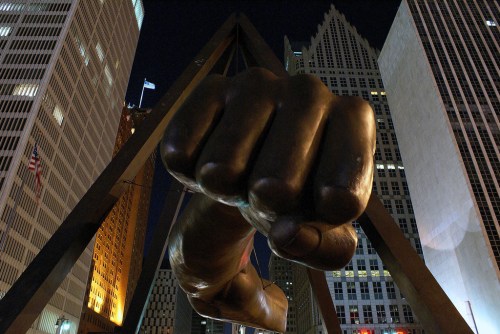
Fist of a Champion – Detroit’s Monument to Joe Louis

Joe Louis 2

Joe Louis 2, photo by buckshot.jones.

Scott writes I simply love this piece of art work. It says so much about the heart and soul, the toughness, about the town and the people who live here and have built this area. Joe Louis Barrow, aka “The Brown Bomber” is one of the all-time great boxers. The 24 x 24 x 11.5 feet Monument to Joe Louis was commissioned by Time Inc. for the City of Detroit to honor Joe Louis. It was created by sculptor Robert Graham and installed at Jefferson Avenue at Woodward, Detroit on October 16, 1986.

Robert Graham’s page on the Joe Louis Memorial says:

The monument is a 24-foot long arm and fist held in balanced suspension from a pyramidal support of bronze poles. Weighing approximately 8,000 lb., it rises 24 feet above a major downtown intersection.

The initial arm was modeled in clay at 14 inches in length. With the aid of a computer, a full-scale steel armature, 24 feet in length, was made and wrapped with wire and covered with clay. The final clay model was divided into eight sections and cast in bronze, then assembled. The pyramid structure was fabricated out of steel, and faced with bronze plates. A tribute to Joe Louis is inscribed on the arm.

Detroit Yes writes in Downtown Montage that he may be the only person in Detroit (other than Scott) who likes the Fist:

So great was Joe Louis that is difficult to measure the historical contribution of this immense figure who, without a close second, is by far the greatest sports figure to ever arise from Detroit and assume center stage on the world theater. It was he who helped shatter the Nazi myth of racial superiority with his dramatic defeat of German champion Max Schmeling during the rise of Nazism. In doing so and then serving his country nobly in the segregated army of World War II, he laid bare the disgraceful hypocrisy that denied Afro American athletes access to the major leagues of American sport, not to mention all Afro Americans who were and are denied the basic birthrights of American citizenship.

He did this with his fists and determination. So it is fitting that he is honored with a place at the center of his hometown with an artwork as powerful and controversial as he was.

You can get a birds eye view of the Joe Louis Memorial on the Absolute Michigan map of Michigan. Also see Monuments of Detroit from the Detroit News, a slideshow of photos of the Fist and a video look at the Joe Louis Fist Statue. For more about Joe Louis, Wikipedia’s Joe Louis entry and the Official site of the Joe Louis Estate.

Foggy river

Foggy river

Foggy river, photo by kthschsslr.

kthschisser writes that he took this photo of a heron on the Flint River near Flushing while rushing to the airport.

Always good to have eyes open and camera handy…

A Herd of Turkeys

A Herd of Turkeys

A Herd of Turkeys, photo by curlyson.

The thought of two guys in the woods chasing turkeys around for a photo is pretty funny.

You can learn more about Michigan turkeys (both wild & plattered) at Absolute Michigan.

Happy Thanksgiving folks.

Fiborn Quarry and the Michigan Karst Conservancy

Portal for the locomotives.jpg

Portal for the locomotives, photo by smartee_martee.

In addition to taking some great pictures, Marty does a wonderful job of digging up and presenting background information. Fiborn Quarry was one of the largest early 20th century quarry operations in the Upper Peninsula, and Marty’s Fiborn Quarry set (slideshow) begins:

Fiborn Quarry was created by a partnership of the Duluth, South Shore & Atlantic Railroad in 1904. This small company town was built to house the workers (homes and a boarding house), offer a school and a general store. The operations consisted of the quarry plant, crusher house and steam engine shop.

Marty goes on to tell you about the role of limestone in the history of the UP, and he also links over to the Michigan Karst Conservancy. In addition to extensive information on the history of Fiborn (be sure to click the little photos at the bottom of the pages too), the MKC tells you about karst:

Karst is a term that was first applied to a plateau region of the Dinaric Alps in Yugoslavia. It is now used to describe similar regions throughout the world that have features formed largely by underground drainage. Karst terrains are characterized by caves, steep valleys, sinkholes, and a general lack of surface streams because drainage is underground…

What does this have to do with Michigan, a land literally scoured by glaciers, a land covered with glacial clay, sand and gravel? Surprisingly, Michigan contains some areas of true karst. They are limited in extent, but this rarity increases their interest and importance. There is also considerable variety in Michigan karst areas: gypsum karst is found in Kent and Iosco counties; a significant amount of surface drainage goes underground in Monroe County, and reappears at “blue holes” in Lake Erie; spectacular sinkholes and earth cracks are found in Alpena and Presque Isle counties; and the broad band of outcrops of the Niagara Escarpment in the Upper Peninsula hosts a number of karst sinks, springs and caves.

platte lake

platte lake

platte lake, photo by johnhoneyman.

John has some more beautiful photos of Northern Michigan and he’s thankfully uploaded them large enough to make great backgrounds for your computer!

The Platte River entry on Wikipedia gives you a pretty confusing look at the river’s watershed, so let’s turn to the Platte Lake Improvement Association which says that Big Platte Lake is located in Benzie County near the Village of Honor in northwest lower Michigan. It is approximately 3.3 miles long and 1.6 miles wide, covers approximately 2550 acres, has a maximum depth of 95 feet and an average depth of 24 feet. The primary source of water for Platte Lake is the inflow from the Upper Platte River. With an average inflow of about 4 million gallons per hour, water in the lake has a “residence time” of just 6 months – quite a bit faster than the 10 years most other lakes in the area average.

The site also includes a link to a 1901 article on from The Amateur Sportsman describing the fishing in the lake at the turn of the last century (pdf). I’m told that it’s still pretty darn good!

I’ve added Platte Lake to our Absolute Michigan map of Michigan.