stacked

stacked

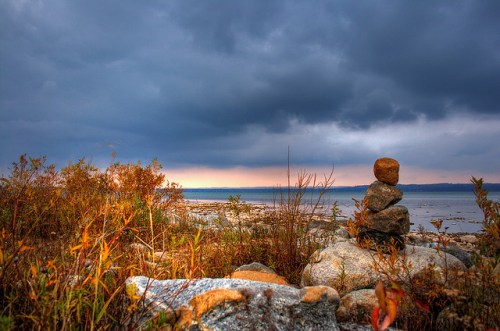
stacked, photo by The Real Ferg.

Ferg took this @ Deepwater Point Natural Area. The Grand Traverse Regional Land Conservancy says Deepwater Point is a 15 acres property is owned by Acme Township on East Bay, north of Traverse City. The plaque reads:

In memory of Clyde H. Reed
Who along with his neighbors fought to protect Acme Township’s Deepwater Point Area – a place precious and dear to him. May we follow his example by being good stewards of this beautiful land for the benefit of future generations.

When I saw this photo, I realized that I had never shared on Michigan in Pictures something that I saw this summer. We called it the Amazing Frankfort Rock Gallery. I spend a ton of time on Michigan’s beaches, but this summer I seemed to see these rock structures everywhere. I wasn’t the only one either.

Anyone in the audience have any idea what’s behind this rock-stacking mania in Michigan?

A foggy morning over Detroit

Foggy morning by MiSkyPig

Foggy morning, photo by MiSkyPig

Here’s a unique view of the city of Detroit, the Detroit River and Lake St. Clair on a misty September morning from (more or less) above Fort Wayne. Here’s a Google Map to help you orient.

Bob has several more aerial photos you might want to check out.

Afield

Afield

Afield, photo by Voxphoto.

Ross writes:

…In the LeFurge woods preserve. This is one of Matt’s pinhole stomping grounds, and I have to give him all the credit for bodily dragging me to this spot, saying “there’s a better view from over this way… “

The Ultimate Sacrifice

The Ultimate Sacrifice - Black and White

The Ultimate Sacrifice – Black and White, photo by DarrinW.

Darrin took this photo at Veterans Cemetery in Grand Rapids, Michigan. I think it’s a good idea for everyone to take a pause in their activity this weekend to consider the profound sacrifices that so many have made on the behalf of our nation … and also that there are people today making those same sacrifices.

Of the nearly 4000 US Iraq War casualties listed at icasualties.org are 145 Michigan residents from Alpena to Ypsilanti and points in between. Take a moment to read the names listed under Michigan on this page.

I am reminded of a brief comment by former Governor William Milliken in this 2006 WKAR interview where he briefly touched on the war in Iraq, saying he was gravely concerned that Americans are not called upon to sacrifice personally in this war as we have been in past conflicts. Food for thought.

Speaking of WKAR, they are have a pretty cool Michigan Voices from World War II program airing at 7 PM Sunday night (Nov 11). Their web site includes stories shared by veterans – here’s a couple from Michigan WW II veterans and you can add your own story. There’s also a link to The War by Ken Burns on PBS that includes a number of online segments.

The Freep has a number of Detroit area Veteran’s Day observances and we received details on the Detroit Veteran’s Day March held today (Saturday, Nov 10) at noon from Grand Circus Park to Campus Martius. I suppose your local paper has more because there doesn’t seem to be a statewide listing to be found.

You might also appreciate the Michigan Soldiers & Sailors Monument on Michigan in Pictures, photos for “veteran” in the Absolute Michigan pool on Flickr (slideshow), and many of the items at Absolute Michigan keyword veteran including Michigan Veterans and Veterans Day from last year.

metropolis

Metropolis

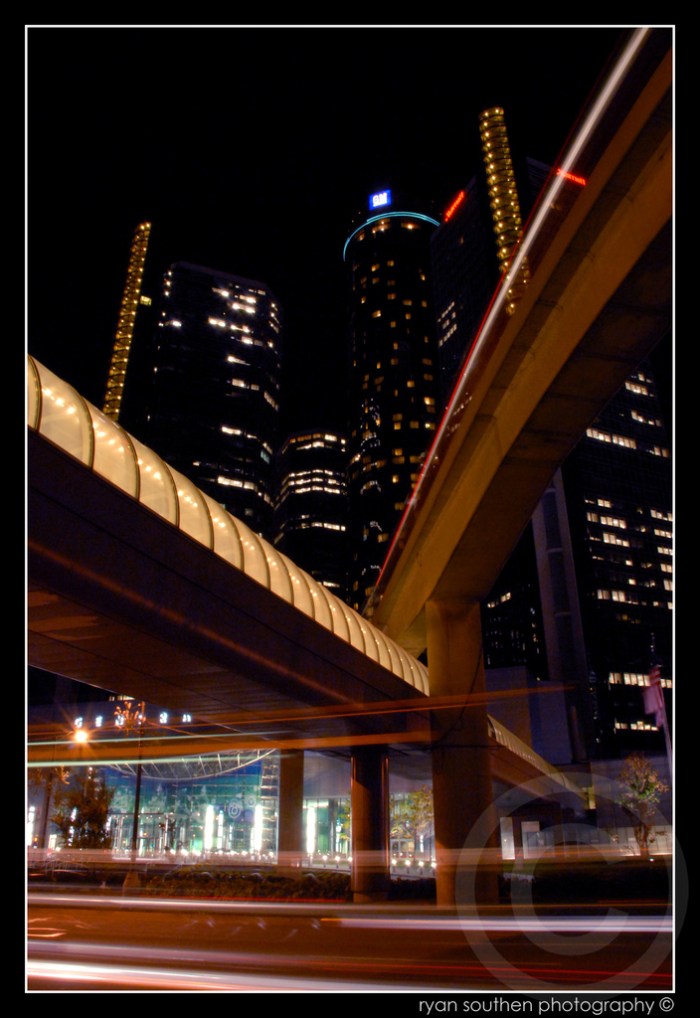
metropolis, photo by SOUTHEN.

Ryan writes:

This is the Renaissance Center in Detroit. The views of this place across Jefferson Avenue often have a futuristic look to them, especially at night. I like the streaks of the cars in the foreground with the streak of the people mover from above on the track.

You can metropolis on black and see other photos from his Nights in DETROIT set (slideshow). He has photos for sale through his Ryan Southen Photography web site.

“Detroit” and “Night” reminds me that there’s something to do with Detroit photography tonight.

100 years of Faygo Pop

Faygo Pop

Faygo Pop, photo by -anna-.

Anna shot this photo of Faygo Orange, Redpop, Black Raspberry, and Rock & Rye – 4 old school Faygo flavors for sure.

I apparently slept through Faygo’s 100th birthday on Sunday and failed to raise a bottle of Michigan’s own in celebration. You can get a timeline and lots of Faygo fun (including recipes – Faygo Rock & Rye Burger Bean Pie anyone?) at Faygo.com. Faygo’s history is easier to read over at the Soda Museum’s Faygo Room that begins:

Ben and Perry Feigenson, formerly bakers in Russia, began Feigenson Brothers Bottling Works on November 4, 1907. Their original flavors, Fruit Punch, Strawberry and Grape, were based upon their own frosting recipes. That is why these, and the flavors they developed later, were (and still are) so unique. They produced the soda one day, closed the factory the next day, loaded the product on a horse drawn wagon, and sold it for three cents or two for a nickel. They and their families lived above the plant. In the winter, when little soda was sold, they supplemented their incomes by selling bread and fish.

Later, when the Feigenson families moved into individual homes, they hired their first employees, bought their second horse and added Lithiated Lemon and Sassafras Soda (Root Beer) to their product line. They began calling the product “pop,” because of the sound made when opening the bottle.

There’s a big old list of Faygo flavors at Wikipedia and you can watch the Faygo Boat Song TV commercial on YouTube. If you want to go really old school, check out The Faygo Kid over at detroitkidshow.com (scroll to the bottom to see the commercial!).

Avalon

Avalon

Avalon, photo by Mac Girl.

…or Millenium Park, Grand Rapids. Katie says it’s one of her favorites.

Diving the Wreck of the Vienna off Whitefish Point

Vienna - 19

Vienna – 19, photo by mschout.

Global Underwater Explorers page on diving the Vienna says that although extended range divers often use the Vienna as a “blow-off dive because it’s shallow and near shore, it’s also one of the finest wrecks to dive in Michigan’s Upper Peninsula. They write that this 191′ wooden steamer:

…came to her demise the same way that many do in Lake Superior, by collision. On 16 September 1892, she was down bound from Marquette, Michigan, with a load of iron ore. In tow was the schooner Mattie C. Bell. At Whitefish Point, the Vienna met up with the Nipigon. The Nipigon also had schooners in tow. Without warning, the Nipigon suddenly veered and struck the Vienna. Despite the efforts of both crews to save the Vienna, the vessel sank approximately one mile from shore. It was never fully understood why the Nipigon veered off course.

You can get more information about this wreck and others near Whitefish Point including a great photo of the Vienna at the ore docks in Marquette at Nordic Diver’s page on the wreck of the steamer Vienna.

Michael Schout has more photos of diving the Vienna (slideshow) and from diving more Great Lakes wrecks including the William Young, Panther, Minneapolis, Northwest, Sandusky and the Eber Ward in his very cool Diving set.

Much more shipwreck info (along with another great photo from Michael) can be found at the Absolute Michigan word of the week: Shipwreck!

Along the Graveyard Coast

Keel at Au Sable

Keel at Au Sable, photo by swaneesimpalass.

The Pictured Rocks National Lakeshore says that the shipwrecks of Lake Superior’s “Graveyard Coast” represent many eras of shipping. They are relatively well preserved because they have been spared from the human pressures of population and industry.

Some of them have lost their names, while others like the Mary Jarecki or the Annie M Peterson retain some of their stories:

The Annie M. Peterson was a 2-masted wooden schooner-barge built in 1874. She sank in a storm on November 19, 1914 off the mouth of Two-Hearted River on Michigan’s Upper Peninsula, when she was lost from her towline, and broke up offshore in heavy seas.

Winter storms in 2003 revealed her ice-encased remains, embedded in the Lake Superior shoreline, about 6 miles east of Grand Marais. Last I heard, she had disappeared again.

Click over to Bruce Moore’s site for the a map to the wreck and stay tuned to Absolute Michigan keyword shipwreck (there’s already a ton of stuff there!) and Michigan in Pictures all November for tales of the wrecks and information about museums, preserves and web sites to learn more about the unfortunate side of Michigan’s rich maritime history.

River of Mystery – exploring the St. Joseph River

St. Joseph River Valley

St. Joseph River Valley, photo by mojophiltre.

Mojophiltre took this photo of the St. Joseph River, just above the Buchanan Hydro-Electric Dam. He has a view of the water going over the Buchanan Dam that you’ll want to check out too.

As usual, Wikipedia has an entry on the St. Joseph River – I like to include these so that people who are passionate and knowledgeable can add to the phenomenal resource that Wikipedia offers. The St. Joseph River Watershed site (which has some cool maps of the watershed but some rather annoying Java) says:

The St. Joseph River Watershed is located in the southwest portion of the Lower Peninsula of Michigan and northwestern portion of Indiana. It spans the Michigan-Indiana border and empties into Lake Michigan at St. Joseph, Michigan. The watershed drains 4,685 square miles from 15 counties (Berrien, Branch, Calhoun, Cass, Hillsdale, Kalamazoo, St. Joseph and Van Buren in Michigan and De Kalb, Elkhart, Kosciusko, Lagrange, Noble, St. Joseph and Steuben in Indiana). The watershed includes 3,742 river miles…

The Friends of the St. Joseph River has a nifty historical photo of the Buchanan Dam and a great article about the history of the names of the St. Joseph River by Bob Owens & Scott Null. The river was important to native peoples – all the way from the enigmatic Hopewell Mound Builders who made their home all along the Saint Joseph River valley to the Fox & Sauk who moved in as mercenaries for the English. This very interesting page lists various names for the river and I think it’s fascinating how one river can provide such a wealth of insight into Michigan’s history:

  • The Miami called it Sauk-Wauk-Sil-Buck (which The Google thinks means “River of Mystery”).
  • The Iroquois, who apparently conducted a nasty genocidal campaign on the Algonquian in the region, called the river The Illinois – maybe because the first Algonquian tribe they met were the Illinois.
  • In spring of 1672, Explorer Rene-Robert Cavalier De La Salle (searching for the best route between Quebec and the mouth of the Mississippi) ran into the Miami (who by this time were in the pay of the Iroquois against their Algonquin brethren), so naturally he christened it The River of the Miamis.
  • Jesuit Missionary Claude Allouez (who earlier had named Lake Michigan “Lake Saint Joseph” after first sighting it on Catholic Feast Day of Saint Joseph) founded a mission at the rail junction at Bertrand. It’s noteworthy that when LaSalle returned later, he still called it the River of the Miami.
  • North and east, the French built Fort St. Joseph near Niles in 1691. At that time the Potowatomi (who called the river Sohg-Wah-Se-Pe – also Mystery River) were friendly with the French.
  • Around 1700, the Fox & Sauk tribes, who were allied with the English and named the river O-Sang-E-Wong-Se-Pe (Mystery River again), began to tangle with the Potowatomi and French.

The authors advocate for naming the river the Sagwa. I don’t know about that, but I do know that time seems to mysteriously disappear when I run into cool Michigan history like this!

More from the Michigan Fall Wallpaper series