First Bloom of Spring, 2010

First Bloom of Spring
First Bloom of Spring, photo by Kevin’s Stuff

While Northern Michigan still has lots of snow, Kevin says that with the over 40 degree temperatures of the past few days, the snow has been melting pretty steadily in West Michigan and the crocus have been coming up, presenting actual flowers yesterday afternoon!

Check it out bigger in his slideshow.

See more crocus on Michigan in Pictures and if you want to go all spring on your desktop, we have that too!

US Coast Guard Cutter Bramble: A Ramblin’ Gal

USCGC Bramble

USCGC Bramble, photo by k.l.macke.

Wikipedia says that the USCGC Bramble (WLB-392) is one of the 39 original 180-foot  seagoing buoy tenders built between 1942-1944 for the United States Coast Guard. Bramble is currently a museum ship, part of Port Huron Museum. The museum’s page on the USCG Cutter Bramble says:

The Coast Guard Cutter Bramble was commissioned in 1944 at a cost of just over $925,000. Following World War II, the Bramble participated in “Operation Crossroads,” the first test of an atomic bomb’s effect on surface ships, at Bikini Island. In 1957, along with the cutters Spar and Storis, it headed for the Northwest Passage, traveling through the Bering Straits and Arctic Ocean. Traveling for 64 days through 4,500 miles of partially uncharted waters, the vessels finally reached the Atlantic Ocean. These three surface vessels were the first to circumnavigate the North American Continent, an ambition mariners have had for more than 400 years.

In 1962, the Bramble transferred to Detroit to perform the missions of search and rescue, icebreaking, and law enforcement throughout the Great Lakes, in addition to aids to navigation. In 1975, the Bramble reported to Port Huron. The cutter’s areas of responsibility included eastern Lake Erie, southern Lake Huron and Saginaw Bay, and maintaining 187 buoys, one NOAA weather buoy, and three fog signals. During winter months, its capabilities as an icebreaker enabled it to escort ships through ice and assist ships in distress. The Bramble was decommissioned in 2003 to be used as a museum.

Check this out bigger and in Keith’s Ships, Boats & Water Toys set (slideshow).

March in Michigan

Lake Superior In March (3)

“Springtime is the land awakening. The March winds are the morning yawn.” – Lewis Grizzard

Every month we post an event calendar on Absolute Michigan that highlights some events from all over the state of Michigan. Our Michigan March Event Calendar features music & entertainment including the Metro Times Blowout in Hamtramck, the Ann Arbor Film Festival and the Brew-Ski Festival in Harbor Springs, celebrations of spring like Foremost’s Butterflies Are Blooming in Grand Rapids, reminders that winter isn’t quite over including the Annual Great Bear Chase Ski Marathon in Calumet and (of course) the Detroit St. Patrick’s Day Parade. March is also the season for shows, including the West Michigan Home & Garden Show in Grand Rapids and the Lansing Home & Garden Show and the The Michigan Golf Show in Novi.

Jim took this shot of an ice formation on Lake Superior taken near Little Girl’s Point in the far western end of the Upper Peninsula of Michigan. He says to check it out bigger, so do, and also see it in his Winter slideshow.

bright

bright

bright, photo by smartee_martee.

This is about the time of year when you need a little shot of summer.

Marty found this old farmhouse in July of 2009 on Kinde Rd. in the heart of the “Thumb” on the edge of Huron Township in Huron County. See more in his Kinde Rd set (slideshow). If you want to widen the frame a bit, check out his Huron County or Broken Souls sets!

Way Back When… (we had a chance to stop Asian Carp)

Way Back When...

Way Back When…, photo by oliviaburger08.

Grand Traverse Band of Ottawa and Chippewa Indians tribal chairman Derek Bailey had this Op-Ed in the Traverse City Record-Eagle this week. I know it’s kind of long but I wanted to share it with you

Forum: Work together against Asian carp
By Derek Bailey

Three decades ago many thought that the Great Lakes fisheries resources would be ruined by American Indian tribes exercising “treaty-fishing” rights. After the federal courts confirmed these treaty-reserved rights, the tribes demonstrated their primary concern is protection of the Great Lakes fisheries.

Ironically, these “treaty-fishing” rights now might prove crucial in protecting fisheries resources for all of Michigan’s citizens against the Asian carp invasion.

The United States Supreme Court has denied Michigan’s request for an injunction closing the shipping locks outside of Chicago to prevent any further migration of Asian carp into the Great Lakes. In the midst of the competing claims debating the economic losses of closing shipping to the Mississippi River system compared to potential harm to Great Lakes fisheries, all parties — Attorney General Cox, Gov. Granholm, the Army Corps of Engineers and other federal agencies — agree that the damage to the Great Lakes fisheries will be profound.

It has been almost six years since the U.S. Fish and Wildlife Service estimated that “Asian carp could have a devastating effect on the Great Lakes ecosystem and a significant impact on the $7 billion fishery.” During this time the Army Corps of Engineers failed to act promptly, in effect fiddling while Rome burned. To the extent the Army Corps is responsible for the impending disaster, the tribes may be better situated than the state to challenge the federal government.

In the scramble to stop Asian carp, the issue of American Indian “treaty-fishing” rights has not been considered at all. The 1836 Treaty tribes (the Bay Mills Indian Community, the Grand Traverse Band of Ottawa and Chippewa Indians, the Little River Band of Ottawa Indians, the Little Traverse Bay Bands of Odawa Indians and the Sault Ste Marie Tribe of Chippewa Indians) retain rights to fish for commercial and subsistence purposes in vast areas of lakes Michigan, Superior and Huron.

Historically, fishing played a central role in the spiritual and cultural framework of American Indian life. As the Supreme Court noted a century ago, access to fish and wildlife was “not much less necessary to the existence of the Indians than the atmosphere they breathed,” United States v. Winans, 198 U.S. 371, 381 (1905).

The precedent for American Indian tribes intervening to protect their property interests in disputes between states was clearly established in 1960’s California v. Arizona litigation involving allocation of Colorado River water rights, and confirmed in the Grand Traverse Band’s 1990s litigation assuring access to fishing grounds.

Given the Supreme Court’s refusal to act in the state’s litigation filed against Illinois, the tribes are considering an alternative litigation strategy to combat the latest and perhaps most serious threat to the Great Lakes from invasive species.

The issue isn’t just protecting tribal property rights. It’s past time for the state and tribes to put aside perceived differences, and to begin concentrating on how together we can cooperate to preserve the Great Lakes for all Michigan citizens.

I hope that we don’t look back on what we had for a fishery, recreational resource and amazing gift from whatever powers who bestow gifts on people bestowed upon us and say “Way Back When…”

Check this out on black and in Olivia’s Let’s Go Exploring set (slideshow).

Saginaw, Michigan … and Happy Birthday to Johnny Cash

Saginaw Bay-Michigan

Saginaw Bay-Michigan, photo by mark5032001.

The song Saginaw, Michigan was written by Bill Anderson and Don Wayne and famously covered by Johnny Cash, who was born on February 26, 1932.

I was born in Saginaw, Michigan.
I grew up in a house on Saginaw Bay.
My dad was a poor hard working Saginaw fisherman:
Too many times he came home with too little pay.

I loved a girl in Saginaw, Michigan.
The daughter of a wealthy, wealthy man.
But he called me: “That son of a Saginaw fisherman.”
And not good enough to claim his daughter’s hand.

Now I’m up here in Alaska looking around for gold.
Like a crazy fool I’m a digging in this frozen ground, so cold.
But with each new day I pray I’ll strike it rich and then,
I’ll go back home and claim my love in Saginaw, Michigan.

I wrote my love in Saginaw, Michigan.
I said: “Honey, I’m a coming home, please wait for me.
“And you can tell your dad, I’m coming back a richer man
“I’ve hit the biggest strike in Klondyke history.”

Her dad met me in Saginaw, Michigan.
He gave me a great big party with champagne.
Then he said: “Son, you’re wise, young ambitious man.
“Will you sell your father-in-law your Klondyke claim?”

Now he’s up there in Alaska digging in the cold, cold ground.
The greedy fool is a looking for the gold I never found.
It serves him right and no-one here is missing him.
Least of all the newly-weds of Saginaw, Michigan.

We’re the happiest man and wife in Saginaw, Michigan.
He’s ashamed to show his face in Saginaw, Michigan.

Much more in Wikipedia’s Johnny Cash entry and on the official Johnny Cash web site.

Unfortunately, I couldn’t find Johnny playing Saginaw, Michigan, but here’s Lefty Frizzell (who had the original hit) and one of my favorites, Leo Kottke singing the song.

Check this photo out bigger in Mark’s slideshow.

Michigan Snowhenge in Grand Rapids

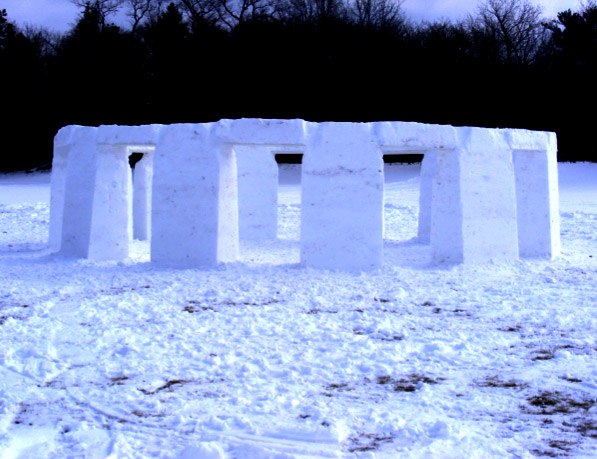
Michigan Snowhenge, photo by Michigan Druids

On February 13th, 2010 they were successful in completing a 1/3rd scale replica of Stonehenge at the MacKay Jaycees Family Park in Grand Rapids, Michigan. They write (in part):

The monument built out of Michigan’s most abundant natural raw material is appropriately named Snowhenge.

Standing 6.5 feet tall and 30 feet in diameter and consisting of nearly 1000 cubic feet of packed snow, Snowhenge’s 12 pillars and 12 lintels are perfectly aligned astronomical markers. Looking directly through the hole in the center of pillar 3 soon after sunset on Winter Solstice extraordinarily reveals an almost equilateral triangle formed by the visible planets Saturn (left), Mars (top), and Venus (right). A curious carving on pillar 4 shows four stars inside a trapezium which matches the Trapezium Star Cluster in the Orion Nebula. The imaginary end point of a line dissecting the trapezium matches the coordinates of the star Sirius, the brightest star in the Milky Way. An obelisk inside the snow circle marks the passage of the sun as its shadow moves in a figure eight on the ground below. Stone plaques strategically placed on the ground display the constellations of the zodiac. Outside the circle, three pairs of standing snowmen show where the sun rises and sets for each of the solstices and equinoxes.

Every key point also has a rock plaque denoting its seasonal significance engraved with a simple phrase like “Midsummer Solstice Sunrise”. Others describe local area seasonal events such as “Blandford Sugarbush”, “Grand Rapids Festival of the Arts”, “28th Street Metro Cruise” and “Celebration on the Grand”. The 12 lintels, supported by 144 rods of ice rebar, also contain markings that coincide with the orbital patterns of Earth and Venus which are designed to forecast solar eclipses, the appearance of comets, and the end of the world on December 23rd of 2012, exactly matching the Mayan calendar prediction. What’s most truly remarkable, pillar 1 is precisely parallel with 28th Street! Curiously, the phenomenon known as global warming which has created isolated heat zones around the globe inversely causes cold spots on the opposite side of the globe. Numerous consecutive years of record heat spikes in Perth, Australia are directly responsible for the extraordinary cold snaps at MacKay Jaycees Family Park which will amazingly keep Snowhenge frozen all year round.

Read more and see pictures at snowhenge.blogspot.com, and also check out this picture of Snowhenge at night.

Not enough Michigan weirdness for you? The last Wednesday of every month is a Weird Wednesday on Absolute Michigan!

Snow day!

Snow day!

Snow day!, photo by Larry the Biker.

Larry writes that Clinton Township received 7.5 inches of snow yesterday and the sledders took advantage of it.

Check it our bigger and see more in his snow day slideshow or his Winter set (slideshow).

You can also check out Snow Days past on Michigan in Pictures.

winter mist … and winter wallpaper

winter mist

winter mist, photo by aimeeern.

Check it out bigger and in Aimee’s winter slideshow.

More winter wallpaper on Michigan in Pictures.

Rough-legged Hawk (Dark Morph)

Rough-legged Hawk (Dark Morph)

Rough-legged Hawk (Dark Morph), photo by Michigan James.

Wikipedia says that the Rough-legged Buzzard (Buteo lagopus) is called the Rough-legged Hawk in North America:

It is between 50 and 60 centimetres long with a 130 cm wingspan. Its breeding range is northernmost Europe, Asia, and North America, but it migrates further south in winter..

It breeds on cliffs, slopes or in trees, laying about four eggs, but more in good lemming years. It hunts over open land, eating small mammals and carrion. This species, along with the Osprey, is one of the few large birds of prey to hover regularly.

There’s more information and pictures on All About Birds.

James took this photo in Carsonville in Sanilac County. Check it out bigger and in his hawk slideshow.