

irish pub in irish hills, photo by buckshot.jones.
…and may you find yourself in a pub much less lonely than this one!
Check it out bigger in Scott’s A Trip Down Historic US-12 slideshow.
More St. Patrick’s Day from Michigan in Pictures.
irish pub in irish hills, photo by buckshot.jones.
…and may you find yourself in a pub much less lonely than this one!
Check it out bigger in Scott’s A Trip Down Historic US-12 slideshow.
More St. Patrick’s Day from Michigan in Pictures.
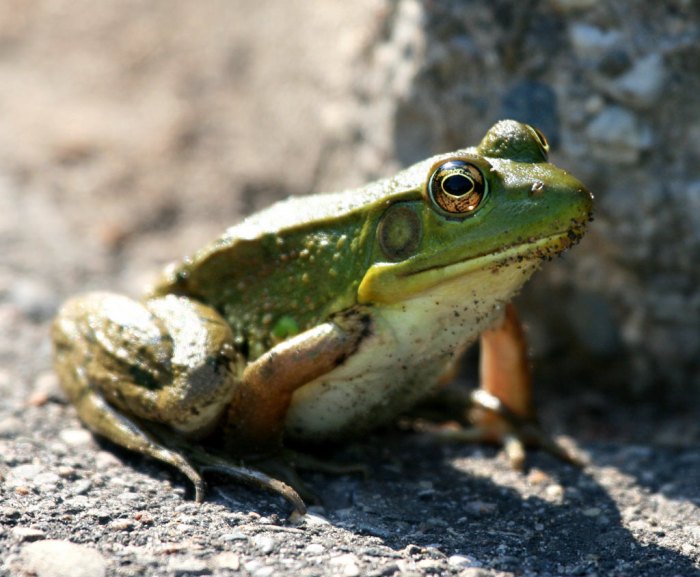
Frog!, photo by StormchaserMike Photography.
I nearly misidentified this guy as an American Bullfrog, likely confusing a whole new generation of readers just as they were recovering from Turtlegate.
The Michigan Herps page on Michigan’s Frogs & Toads says that misidentification is common – the trick is the fold of skin running from their eardrum to their back. The UM Animal Diversity Web entry for Lithobates clamitans (green frog) says you can find them all over the eastern US and that:
Green frogs are found in a wide variety of habitats that surround most inland waters, such as: swamps, wooded swamps, ponds, lakes, marshes, bogs, banks of slow moving rivers and streams, oxbow lakes, sloughs, and impoundments. Juveniles may disperse into wooded areas or meadows during times of rain. Green frogs overwinter in the water usually buried in the substrate.
Green frogs produce as many as six different calls. Males attracting a mate give an advertisement call and a high-intensity advertisement call. Their advertisement call has been compared to the pluck of a loose banjo string. Male frogs defending a territory from an intruding male usually give aggressive calls and growls. The release call is given by non-receptive females and by males accidentally grabbed by another male. Finally, the alert call is given by males and females when startled or attacked by a predator.
Green frogs have an excellent sense of vision and use this to detect and capture prey.
You can hear one of their calls at the link above and also read about them at Wikipedia and the MIchigan DNR’s page on the Green Frog.
Check this out bigger and see it in context in Mike’s Cass Lake set (slideshow).
More about Michigan’s animals from Michigan in Pictures.

U.F.O, photo by GH Patriot.
We’re getting reports of Unidentified Flying Objects over the Grand Haven Ski Bowl.
Be sure to check it out bigger and in Kevin’s snowboarding slideshow, which features more of the same.

moments that make you stop and take it all in, photo by zakzorah
Earlier this week on Absolute Michigan we had a little tribute to ice on Michigan’s four Great Lakes that you might enjoy. Hopefully you are also enjoying the hopefully final departure of the ice of 2009/2010.
Cris and some friends went to Holland, which was apparently this exciting. More in her Holland set and still more in her ice slideshow.

Nancy Love in a B-17, photo courtesy Air Force Historical Research Agency/Wikipedia
Wikipedia says that Nancy Harkness Love was born (appropriately enough) on Valentine’s Day in 1914. Love was interested in aviation from an early age, took her first flight at 16 and earned her pilot’s license within a month. In 1942 her husband Robert Love was called to active duty as the deputy chief of staff of the Ferrying Command, and Nancy convinced Col. William H. Tunner that experienced women pilots could be used to deliver aircraft from factories to airfields. Although Tunner’s original proposal for female pilots to be be commissioned into the WAACs was rejected, he appointed Love to his staff as Executive of Women’s Pilots.
Within a few months, she had recruited 29 experienced female pilots to join the newly created Women’s Auxiliary Ferrying Squadron (WAFS). Nancy Love became their Commander. In September, 1942, the women pilots began flying at New Castle Army Air Field, Wilmington, Delaware, under the 2nd Ferrying Group.
By June, 1943, Nancy Love was commanding four different squadrons of WAFS at Love Field in Texas, New Castle in Delaware, Romulus in Michigan and Long Beach in California. The WAFS’ number had greatly increased because of the addition of graduates of the Women’s Flying Training Detachment (WFTD) at Avenger Field, Sweetwater, Texas, an organization championed and headed by Jacqueline Cochran.
On August 5, 1943, the WAFS merged with the WFTD and became a single entity: the Women Airforce Service Pilots (WASP). Nancy Love was named as the Executive for all WASP ferrying operations. Under her command, female pilots flew almost every type military aircraft then in the Army Air Force’s arsenal, and their record of achievement proved remarkable.
She was the first woman to be certified to fly the North American P-51 Mustang, C-54, B-25 Mitchell, and along with Betty Gillies, the B-17 Flying Fortress. She was certified in 16 military aircraft, including the Douglas C-47 and the A-36.
In 1944, after the WASPs were disbanded, Love continued to work on the Air Transport Command’s Report. She set a record of being the first woman in aviation to make a flight around the world. She flew the plane at least one-half of the time, including crossing over the Himalayas.
You can learn more about Nancy Harkness Love in the Michigan Women’s Hall of Fame. In Wednesday, the roughly 1000 women from the WASP service were awarded the Congressional Gold Medal for their service. Here’s a fantastic feature from NPR titled Female WWII Pilots: The Original Fly Girls.

Miller Bro, photo by jack quinlin.
I heard it opens this weekend. Make mine Mr. Monkey from Moomers.
Yes, it’s film. Check it out bigger in Jack’s Fisheye slideshow.
If you want to geek out on gear, check Wikipedia’s Fisheye lens entry or a little Fisheye Projection theory or settle back for the Fisheye show from the Absolute Michigan pool.

Kitchi-Gummi, photo by Holkeboer.
The Great Lakes Information Network has this to say about the world’s largest lake:
The first French explorers approaching the great inland sea by way of the Ottawa River and Lake Huron referred to their discovery as le lac superieur. Properly translated, the expression means “Upper Lake,” that is, the lake above Lake Huron. Kitchi-gummi, a Chippewa Indian translation, signifies Great-water or Great-lake. A Jesuit name, Lac Tracy, was never officially adopted.
An Indian name for Lake Superior was “Kitchi gami” (or “Kitchi-gummi”).
Be sure and check this out bigger or in John’s Feb. Munising Trip set (slideshow).
The rock in the picture is Miner’s Castle, which you can learn more about from Michigan in Pictures.

River Reflections, photo by Mike Darga.
Mike writes:
My days are filled with the hustle and bustle of a busy school building with 1200+ students. When I have the opportunity to relax, I enjoy going outside, spending time in nature taking pictures. It’s peaceful, I’m alone with my thoughts and my camera. You never know what you might find, what might be around the next corner. When I saw this shot, I took my time, set up my composition, and smiled.
Hope your life has a little recharge built into it.
Check this out bigger in Mike’s Michigan Parks slideshow.

Ice in the Sky, photo by evenstar22.
X marks the spot … where winter is weakening.
Check this out bigger in Kate’s Michigan slideshow and I hope you have a springlike weekend!

 Michigan in Pictures