spirit of detroit redux

spirit of detroit redux

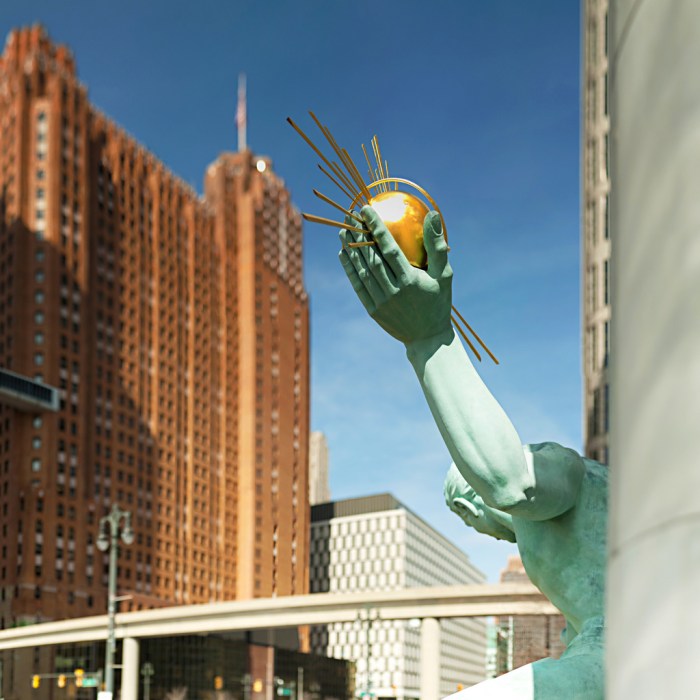
spirit of detroit redux | detroit, michigan, photo by s o u t h e n

Michigan in Pictures has more about the Spirit of Detroit by Marshall Fredericks and you can take a step inside the lobby of the Guardian Building.

You can see Ryan’s photo bigger, in his Detroit slideshow or purchase it right here!

jurrasic station

jurrasic station

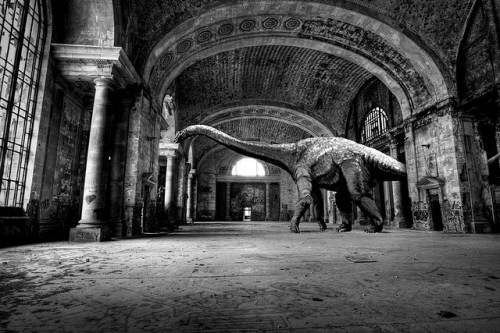
jurrasic station, photo by hardyc

You never know what you might find when urban exploring these days. More photographic fun today on Absolute Michigan.

Make sure to check this out big as a brontosaur and see some of Chris’s other work in his creative – modified slideshow!

Detroit Tigers Opening Day 2011

Opening Day

Opening Day, photo by Dave Hogg.

“You look forward to it like a birthday party when you’re a kid. You think something wonderful is going to happen.”
~Joe DiMaggio on Opening Day

Today the Tigers open the 2011 Major League Baseball season in New York at Yankee Stadium at 1 PM. Get all the details on Detroit Tigers Opening Day 2011: Play Ball! from Absolute Michigan.

See this  big as baseball and see more in Dave’s Opening Day 2008 slideshow.

There’s a whole bunch more Detroit Tigers photos from Michigan in PicturesPlay ball!

Get (April) Foolish at Festifools in Ann Arbor

tibihxE deeF toN oD esaelP

tibihxE deeF toN oD esaelP, photo by jenny murray.

This Sunday (April 3, 2011) is the Festifools parade in Ann Arbor. It’s annual street festival of “HUGE PUPPETS and random acts of April Foolishness”. New this year is FoolMoon – April 1 from dusk to midnight. It’s a FREE event that invites you to bring your luminary (or kazoo / chicken suit / saxophone / what have you) to one of their three “Constellation Stations” and join fellow frolickers for the Foolish stroll! More updates about this Foolish weekend on Facebook!

If you’re not already familiar with FestiFools, you can get a sense of what we’re about by watching some videos on the YouTube FestiFools channel and at photographer Myra Klarman’s blog that includes a neat look behind the scenes at Festifools!

Jenny says that this was Anorexicsaurus or TyrAnorexicsaurus … from the Starvaceous Period. Check it out big as a bulemiasaur and in her Festifools slideshow.

There’s a ton more foolishness to be found in the flickr FestiFools group!

Big Sable Point Lighthouse in Ludington State Park

Big Sable Point Lighthouse  (Ludington State Park, Ludington Michigan)

Big Sable Point Lighthouse (Ludington State Park, Ludington Michigan), photo by Michigan Nut.

I’ve featured Big Sable Point Lighthouse before on Michigan in Pictures, but most of you probably didn’t see that post. Besides, it was done on a day when the Great Lakes’ premier resource for lighthouse information, Terry Pepper’s Seeing the Light, was down! Terry’s Big Sable Point Light Station page begins:

In its report to Congress in 1865, the Lighthouse Board presented the case that “the interests of commerce demand that Grand Point Au Sable be suitably lighted” Congress responded favorably on July of the following year with an appropriation of $35,000 on July 28 of the following year. The State of Michigan responded by providing the Federal Government with fee deed to nine hundred and thirty-three acres for the station later that year.

Construction began in early 1867 with the arrival of Lighthouse Board and Army Corps of Engineers workers, who immediately began the construction of a dock at which to unload the necessary supplies for the project. Next, a temporary cofferdam was constructed to keep waster from entering the foundation, which consisted of tightly fitted cut stone blocks beginning a depth of six feet below grade and extending three feet above.

On this sturdy foundation, the skilled masons began to raise the tower. Constructed of cream city brick, the walls were laid five feet thick at the foundation, tapering to a thickness of two feet thick immediately below the gallery. Within the tower, a circular inner wall, eight feet in diameter supported the cast iron spiral staircase. On its vertical climb, the stairway passed through three landing areas.

Read on for the history of the Big Sable Light and see many more Michigan lighthouses on Michigan in Pictures.

See this photo bigger and in John’s jaw-dropping Michigan lighthouses slideshow. He says that it’s a two mile hike to see Big Sable, so bring a flashlight if you plan to see a sunset!

Charlevoix Railroad Depot

Charlevoix Depot.........

Charlevoix Depot………, photo by smiles7.

The Charlevoix Railroad Station to the Charlevoix Historical Society in June 1992 on the 100th anniversary of the first train arriving in Charlevoix.

When I was a kid, a friend of mine’s dad shot dealership posters for car companies. I couldn’t find the one we were in (fog machines and white clothes made it look like England as I recall) but I did find a 1957 Dodge Royal Lancer at the station.

Check this out bigger and in Julie’s Charlevoix slideshow.

The Belle Isle Bridge | Detroit, MI

The Belle Isle Bridge | Detroit, MI

The Belle Isle Bridge | Detroit, MI, photo by .brianday..

Wikipedia notes that the official name of the bridge across the Detroit River to Belle Isle from Detroit is the MacArthur Bridge. The bridge uses nineteen arches to span the 2,193 feet to Belle Isle. Completed in 1923 for $2,635,000, it replaced a mostly wooden bridge that was destroyed by fire in 1915. See The day the bridge to Belle Isle burned down for more on that. While it was once known as the Belle Isle Bridge, was renamed in honor of General Douglas MacArthur in 1942.

Belle Isle Bridge “Douglas MacArthur Bridge” at HistoricBridges.org explains:

This is an extremely long multi-span concrete arch bridge that gives people access to Belle Isle, and the structure is the longest arch bridge in the state of Michigan.

This bridge is extremely significant not only because of its length, but because it is a very early example of a cantilevered concrete arch. A cantilevered concrete arch does not function like a traditional arch. Traditional arch bridges require the arch to be a complete and connected arch to function. This arch bridge does not function in that way. Each half of each arch spans is a cantilever arm that is structurally independent from the other half of the arch in that span. Standing under a span of this bridge, a clear gap at the center of the span is visible. Indeed, on the outermost part of the arch, a decorative “keystone” was placed for aesthetic reasons to cover up this gap.

Wayne County Road Commission was among Michigan’s counties, an innovative and creative road commission and they apparently made significant use of concrete cantilever arch structures. Other examples of concrete cantilever bridges in the county remain. These other examples are different from the Belle Isle Bridge, and feature a third central “suspended” span between the cantilever arms.

Check it out bigger and in Brian’s Long Exposure slideshow.

Slumpy, Michigan Central Station and Reflections on Ruin Porn

still standin

still standin, photo by paulhitz.

The other day I noticed a big spike on one of the most popular posts of all time on Michigan in Pictures, slumpy … the William Livingstone Mansion in Detroit’s Brush Park which tells the story of the fall of this iconic ruin in 2007.

The culprit for this increased traffic was Haunting Images Of Detroit’s Decline by Nicole Hardesty on Huffington Post, a photographic tour of Detroit’s ruins produced in response news that:

…census data indicates Detroit’s population dropped by a startling 25 percent in the last decade, from 951,270 in 2000 to 713,777 last year. That’s a 60 percent decline from its 1950 peak population — 1.85 million — and the lowest count since the 1910 Census put the then-promising Motor City’s population at 285,704.

Definitely shocking numbers, and like many media outlets, they chose to drive the numbers home with pictures of some of the many ruins of the Motor City: United Artists Theater, Michigan Central Station (MCS), the Whitney Building and (of course) Slumpy. The images are drawn from the new photographic book Ruins of Detroit from Yves Marchand and Romain Meffre. The photographs are no doubt gorgeous and there’s no denying that ruin photography provides some powerful commentary on what has happened to Detroit in the last 40 years.

In looking at them, however, I was struck by the thought that seems to always come to mind when I research and write about Slumpy, Michigan Central Station and even the ruin in redevelopment where my office is, the former Traverse City State Hospital. That thought is “Am I adding something positive to the discussion and struggle to redefine Michigan or am I just exploiting the pain behind these ruins?”

There’s two really excellent essays that look at roughly two sides of the ruin porn/ruin photography coin. The first is Detroitism by John Patrick Leary in Guernica Magazine. It’s a probing and critical look at ruin porn that is well worth your consideration that asks “What does ‘ruin porn’ tell us about the Motor City, ourselves, other American cities?” The second is a thoughtful response to Leary’s article On ‘Ruin Porn’ by photographer and historian Ian Ference. Ference takes issue with the assertation that ruin photography cannot help but exploit a city’s misery and takes you through the work of some earlier ruin photographers.

I still don’t know where I come down in this whole debate, but I think that I prefer the work along the lines of Johnny Knoxville to the reporting that he mocks in the opening of his great video about the D. How about you? Add a comment below.

Check this out bigger and in Paul’s My Detroit slideshow.

Harry Houdini and the American Museum of Magic in Marshall

The big guy

The big guy, photo by santheo.

The Google reminded me that today (March 24, 1874) is the birthday of legendary magician Harry Houdini.

Houdini’s main Michigan connection is that he gave his last performance and died in Detroit, but that’s a story for another day. In their Rearview Mirror, the Detroit News tells the story of Houdini’s first visit to Detroit:

In November 1906, Houdini came to Detroit for a two-week engagement at the Temple Theater. Houdini regularly performed publicity stunts to fill the theaters he was playing, and Detroit was no exception.

Handcuff King Jumps Manacled From Bridge

Handcuff King Houdini Performs Remarkable Feat and Comes Out Safely, Had a Rope Tied Around his Waist and Tied to Bridge to Safeguard Against Accidents

Tied to a lifeline a hundred and thirteen feet long, handcuffed with two of the best and latest model handcuffs in the possession of the Detroit police department, nerved by the confidence of a lion in his own powers … Houdini, the wonder worker at the Temple Theater, leaped from the draw span of the Belle Isle Bridge at 1 o’clock this afternoon, freed himself from the handcuffs while under water, then swam to a waiting lifeboat, passed over the unlocked and open cuffs and clambered aboard.

This story was wildly embellished by Houdini and turned into an 8 minute scene under the ice of the Detroit River in the Tony Curtis movie about Houdini.

You can learn more about Houdini and see some of his equipment and playbills in the collections of the American Museum of Magic in Marshall. The museum is home to the largest collection of magic open to the public, with thousands of artifacts that tell the tales of Houdini, Blackstone, Thurston and other greats of magic.

See this photo bigger and in Sandor’s Michigan slideshow.

See more shots of the museum in this slideshow and more museums on Michigan in Pictures!

Remembering Jeff Lamb

Music is what life sounds like.
~Eric Olson

Leelanau Shore, photo by Jeff Lamb

A photographer I have long admired and was fortunate enough to spend a little time with passed away yesterday.

Jeff Lamb took photos of urban landscapes and landscapes that were not urban, blending a love of his fellow humans with his love of the structures they created in his work.

New Orleans to Northern Michigan, Ann Arbor to Amsterdam, he took so many photos that he needed two Flickr accounts, jeff lamb and leylabunny and a photo blog.

See this bigger in Jeff’s Leelanau slideshow and explore his work through the links above.