It’s a Free (ice) Fishing Weekend!

Vintage Ice Fishing Michigan

Vintage Ice Fishing Michigan, photo by UpNorth Memories – Donald (Don) Harrison.

Two times a year, the State of Michigan has free fishing weekends, once in the summer (Jun 9 & 10, 2012) and once this weekend (Feb 18 & 19). All fishing regulations still apply, but fishing license fees are waived for residents and out-of-state visitors who can fish on both inland and Great Lakes’ waters for all species of fish.

All over the state there are special fishing events including the Ellsworth Shiverfest in Antrim County, the Winter Festival at the Bay City State Recreation Area, the Dam to Dam Ice Fishing Contest in Newaygo, the Higgins Lake WinterFest and the Free Fishing Weekend Special Event at Brighton Recreation Area.

You can get more on the weekend and some ice fishing videos on Absolute Michigan.

Check this out on black and see a lot more cool old photos, ice fishing decoys and memorabilia in Don’s ice fishing slideshow.

Catch more fish & fishing on Michigan in Pictures!

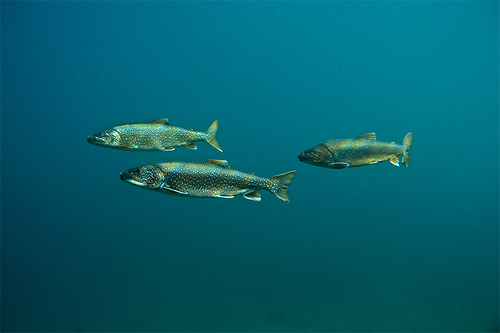
Three Trout

Three Trout, Photo by Christopher Morey

The Watershed Center advocates for clean water in Grand Traverse Bay and protects its 1,000-square-mile watershed across Grand Traverse, Leelanau, Antrim and Kalkaska counties. Today’s photo by Christopher Morey was the winning shot from their 2011 photography contest. You can see a few at that link and see all of them and meet the photographers at the Art of the Watershed opening reception next Thursday (Dec 1) from 5-8 PM.

More of Christopher’s work can be seen at MichiganFreediving.com and at Michigan Freediving on zenfolio. About this photo, he writes:

This picture was taken near the end of October off the north breakwall of Clinch Marina. In fall, as water temps drop into the upper forties, the Lake Trout come in to spawn. They are quite challenging subjects for photography, requiring very long, completely motionless breathholds in cold water.

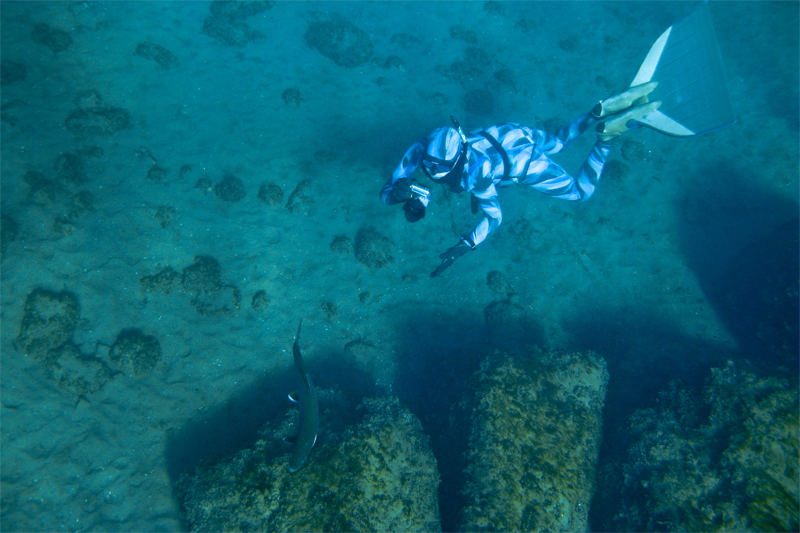
I spent quite a bit of time observing these fish before I finally figured out how to get near them with some consistency. My first attempt at implementing my strategy took place at the cooling intake cribs from the old power plant, about 300 yards off the open space and about 33 feet deep.

With a school barely in sight near one of the cribs I dove directly down. Kicking perhaps 3 times with my monofin, I let myself slowly glide the remaining distance; like a carp settling to the bottom. The sight of me disappearing behind the crib was too much for them and two large Lake Trout appeared overhead, quickly swimming very close. (click this photo by Alicia Higham to see it bigger)

The one I got the best shot of was so close it would not fit in my wide-angle lens.

Since then I’ve noticed, usually about once a year, that they sometimes inexplicably come very close, as if recognizing me. I wonder about this, since these are always older fish and since they live to be nearly 30.

More fish on Michigan in Pictures.

Michigan Wild & Scenic Rivers: Sturgeon River

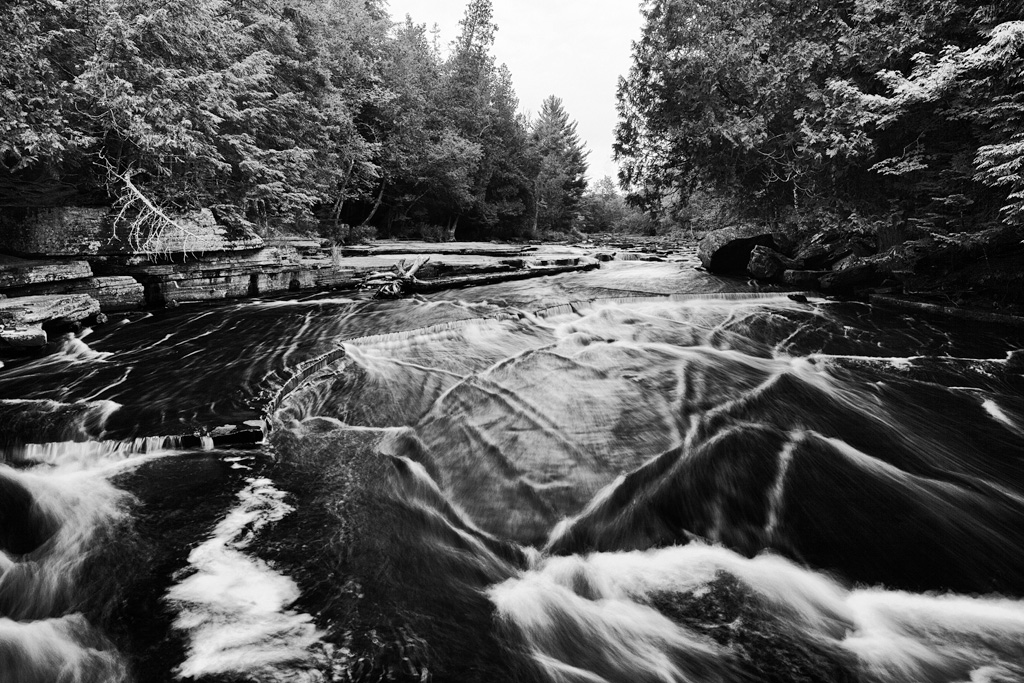
Along the Sturgeon River by Coder

Along the Sturgeon River by Coder

It is hereby declared to be the policy of the United States that certain selected rivers of the Nation which, with their immediate environments, possess outstandingly remarkable scenic, recreational, geologic, fish and wildlife, historic, cultural or other similar values, shall be preserved in free-flowing condition, and that they and their immediate environments shall be protected for the benefit and enjoyment of present and future generations.
~Wild & Scenic Rivers Act, October 2, 1968

Michigan has 16 nationally designated Wild & Scenic Rivers (management plan pdf) and tw of them are called the Sturgeon River: this one in the Ottawa National Forest in the eastern UP and the Sturgeon River in the Hiawatha National Forest in the western UP. This Sturgeon River is even the photo on the main page at rivers.gov, so it’s clear that they really liked it!! (note it’s now the Ontonagon River but still in the UP!)

Also note that Field & Stream tapped Michigan #1 for flyfishing in the USA in 2011. One of the reasons is the portion of the Sturgeon River within the Ottawa National Forest is classified as a Blue Ribbon Trout Stream!

Coder shot this in 2010 along the Sturgeon River on the way to Canyon Falls. Click to his map to see where the photo was taken. See more in his ‘Scapes gallery on Flickr.

More Wild & Scenic Rivers on Michigan in Pictures.

Support Michigan in Pictures with Patreon

Chinook Salmon … and the Grand Haven Haven Salmon Festival

Flying Salmon

Flying Salmon, photo by Mi Bob.

Michigan has two species of salmon, Chinook Salmon (Oncorhynchus tshawytscha) and Coho Salmon (Oncorhynchus kisutch). I’m thinking this is a chinook as it looks like the spots are all the way down the tail fin. The DNR says (in part):

The salmon family, or Salmonidae, includes the salmon, trout, and whitefishes. All are characterized by adipose fin, and have a preference for cold water with a high oxygen content, making the Great Lakes an ideal habitat.

The chinook is a fairly new variety of salmon introduced into the Great Lakes in the 1870s. Sometimes called “King Salmon”, these fish did not reproduce successfully and eventually disappeared. In 1966, Great Lakes states Michigan, New York and Wisconsin, with the help of the province of Ontario reintroduced the Chinook. Great Lakes populations of Chinook are maintained by annual stream stocking programs

Chinook live in Great Lakes shoals or near-shoal waters (less than 100 foot depth(s)) as a rule. In the fall they move into the southern reaches of each of the great lakes, traveling 5-15 miles offshore as they go. In the spring they retrace their route and by the following fall, they congregate at the stream they began their journey at and begin their spawning runs upriver.

…Chinook spawn in streams over beds of large gravel, near riffles. Within two weeks after spawning, adult chinook die. Chinook compete with other salmon and trout for scarce spawning grounds. The following spring the eggs hatch, and the young usually remain in the river for one year before they migrate down to the lake.

Once in the lake, males tend to remain for 1-2 years and females for 3-4 years. The King Salmon average a weight of 30 to 40 pounds and 38 inches in length.

Young chinook in rivers eat insects, insect larvae and crustaceans; adults in the lakes eat fish almost exclusively. In the Great Lakes, smelt and alewives make up their main diet. Predators include rainbow trout, coho salmon smolts and fish-eating birds. The young also compete with trout and other salmon for food.

Anglers prize chinook partly because of their large size and the challenge they present for fishing, and partly because they make a delicious meal. While other pacific salmon species have red flesh, chinook meat is often white.

Speaking of salmon, the annual Grand Haven Salmon Festival takes place this weekend (September 16-18, 2011). It pays tribute to the annual salmon migration and features hands-on learning, education and exhibits about Michigan’s coastal waterways. There’s also arts, crafts, live music, wine, food and all kinds of family fun!

Check this out bigger and in Bob’s slideshow.

More Michigan fish on Michigan in Pictures!

Michigan’s State Fish: The Brook Trout

MI Brookie

MI Brookie, photo by mickey-finn.

Last week on Absolute Michigan I posted a sobering article on how we are losing the battle to control sea lamprey in Michigan.

One of the fish that lamprey prey upon are brook trout. Brook Trout Salvelinus fontinalis from the Michigan DNR says:

Brook trout have a long, streamlined body with a large mouth that extends past the eye. Color variations include olive, blue-gray, or black above with a silvery white belly and wormlike markings (vermiculations) along the back. They have red spots sometimes surrounded by bluish halos on their sides. The lower fins have a white front edge with black and the remainder being reddish orange. The tail fin is square or rarely slightly forked. During breeding time in the fall male brook trout can become very bright orange-red along the sides.

The brook trout is native to Michigan’s waters and is the state fish of Michigan. They can be found throughout most of the state in many creeks, streams, rivers, lakes, and in the Great Lakes. Brook trout require cool, clear, spring-fed streams and pools. They can be found under cover of rocks, logs, and undercut banks and have been described as stationary. Larger brook trout often inhabit deep pools moving to shallow water only to feed. They prefer temperatures from 57–60 degrees F.

…Brook trout have been described as voracious feeders with the potential to consume large numbers of zooplankton, crustaceans, worms, fish, terrestrial insects, and aquatic insects. Ephemeroptera, Trichoptera, and Diptera often make up a large component of their diet. However, they will often feed on whatever is most readily available.

Brook trout are avidly sought after by sport anglers, for food as well as for the sport. They can be caught by using various bait and lures including worms, crickets, grasshoppers, wet and dry flies, spoons, and spinners.

Also see Brook Trout at Wikipediaand also Brook Trout from Trout Unlimited, where they add that brook trout:

…are the only trout native to much of the eastern United States. Arguably the most beautiful freshwater fish, brook trout survive in only the coldest and cleanest water. Brook trout serve as indicators of the health of the watersheds they inhabit. Strong wild brook trout populations demonstrate that stream or river ecosystem is healthy and that water quality is excellent. A decline in brook trout populations can serve as an early warning that the health of an entire aquatic system is at risk.

If you have the time, Saving Michigan’s Coaster Brook Trout from Jeff Smith at MyNorth.com is a great read about a strain of brookies that grow to massive size that are probably one of the world’s most endangered fish that aren’t protected.

Mike writes that this is a typical brook trout from Michigan’s Au Sable River system. Check it out bigger and in his big old Fly Fishing slideshow.

More fish & fishing on Michigan in Pictures.

Sunset for Fishing on the Great Lakes?

Fishing

Fishing, photo by kevindooley.

On this photo Kevin writes:

I think one of our best indicators of the planet’s health is the price of a fish sandwich. Notice how much the price has gone up in last 5 years? It’s because we’re depleting our fisheries.

Seems to me an Earth without fish is not a good sign.

Here in the Great Lakes we are waging a desperate battle against invasive species including Asian Carp and zebra & quagga mussels. Today on Absolute Michigan I featured a sobering article about how we are losing the battle to control sea lamprey, a longtime invasive that we once had under control due to funding cuts that are projected to get even worse in the years to come. Click through to check it out and to go up close with the US Fish & Wildlife Service’s lamprey control efforts via Michigan Radio and also Mike Rowe of Dirty Jobs.

View this big as the Great Lakes and in Kevin’s Lake Michigan Sunsets slideshow.

Many fish will bite if you got good bait…

Fishing in Bay

Fishing in Bay, photo by ETCphoto.

Betcha goin’ fishin’ all of your time, baby’s goin’ fishing too
Bet your life, your sweet life, catch more fish than you
Many fish bites if ya got good bait, here’s a little tip i would like to relate

Big fish bites if ya got a good bait, I ‘a goin’ fishin’
Yes i’m goin’ fishin’, and my baby’s goin’ fishin’ too.

~Taj Mahal (check out this sweet video)

There’s a boatload of Michigan fishing information at www.michigan.gov/fishing. They note that Michigan has about 146 kinds of fish, ranging from tiny minnows to giant lake sturgeon – hope you get a chance to tell a couple fish stories this year!

Check this out bigger than the one that got away and in Terry’s West Bay slideshow

End Of the Day … for fishing on the Great Lakes?

End Of the Day

End Of the Day, photo by Rob the Photog.

This week is Invasive Species Week on Absolute Michigan and Michigan in Pictures and today on Absolute Michigan we took a long look at the 800 pound gorilla of invasive species in Michigan, the Asian carp. These frightening fish have made their way up the Mississippi River and can weigh up to 100 pounds, grow to four feet in length, eat voraciously and make rabbits look like pikers when it comes to reproduction. Via TIME Magazine:

“They just eat so much,” says David Ullrich, executive director of the Great Lakes and St. Lawrence Cities Initiative. “They’re like the locusts of the river.”

That’s what makes them so dangerous to the lakes. Asian carp aren’t direct predators, but they eat plankton, which knocks out the bottom layers of the food chain. If they were to successfully establish themselves in the Great Lakes and start breeding, they could utterly disrupt the existing ecosystem, potentially starving out the trout and other native fish that make the Great Lakes a tourism hot spot.

Estimates put the Great Lakes sport and commercial fishery at $2.5 to $7 billion. While the loss of this would be a terrible shame, the thought that one day you wouldn’t see photos like this of a parent and child enjoying Michigan’s amazing fishery seems worse to me.

Rob feels this is one of the best photos he’s ever taken. Check it out bigger and in his slideshow.

And if you can, make sure you write your representatives to tell them how important it is to stop the Asian carp in Chicago!

Fish Dinner: Blue Heron Style

Fish Dinner

Fish Dinner, photo by Mario.Q.

Mario took this great shot of a blue heron fishing on the Red Cedar River.

Check it out bigger in his Great Outdoors slideshow.

Much more about blue herons on Michigan in Pictures.

Way Back When… (we had a chance to stop Asian Carp)

Way Back When...

Way Back When…, photo by oliviaburger08.

Grand Traverse Band of Ottawa and Chippewa Indians tribal chairman Derek Bailey had this Op-Ed in the Traverse City Record-Eagle this week. I know it’s kind of long but I wanted to share it with you

Forum: Work together against Asian carp
By Derek Bailey

Three decades ago many thought that the Great Lakes fisheries resources would be ruined by American Indian tribes exercising “treaty-fishing” rights. After the federal courts confirmed these treaty-reserved rights, the tribes demonstrated their primary concern is protection of the Great Lakes fisheries.

Ironically, these “treaty-fishing” rights now might prove crucial in protecting fisheries resources for all of Michigan’s citizens against the Asian carp invasion.

The United States Supreme Court has denied Michigan’s request for an injunction closing the shipping locks outside of Chicago to prevent any further migration of Asian carp into the Great Lakes. In the midst of the competing claims debating the economic losses of closing shipping to the Mississippi River system compared to potential harm to Great Lakes fisheries, all parties — Attorney General Cox, Gov. Granholm, the Army Corps of Engineers and other federal agencies — agree that the damage to the Great Lakes fisheries will be profound.

It has been almost six years since the U.S. Fish and Wildlife Service estimated that “Asian carp could have a devastating effect on the Great Lakes ecosystem and a significant impact on the $7 billion fishery.” During this time the Army Corps of Engineers failed to act promptly, in effect fiddling while Rome burned. To the extent the Army Corps is responsible for the impending disaster, the tribes may be better situated than the state to challenge the federal government.

In the scramble to stop Asian carp, the issue of American Indian “treaty-fishing” rights has not been considered at all. The 1836 Treaty tribes (the Bay Mills Indian Community, the Grand Traverse Band of Ottawa and Chippewa Indians, the Little River Band of Ottawa Indians, the Little Traverse Bay Bands of Odawa Indians and the Sault Ste Marie Tribe of Chippewa Indians) retain rights to fish for commercial and subsistence purposes in vast areas of lakes Michigan, Superior and Huron.

Historically, fishing played a central role in the spiritual and cultural framework of American Indian life. As the Supreme Court noted a century ago, access to fish and wildlife was “not much less necessary to the existence of the Indians than the atmosphere they breathed,” United States v. Winans, 198 U.S. 371, 381 (1905).

The precedent for American Indian tribes intervening to protect their property interests in disputes between states was clearly established in 1960’s California v. Arizona litigation involving allocation of Colorado River water rights, and confirmed in the Grand Traverse Band’s 1990s litigation assuring access to fishing grounds.

Given the Supreme Court’s refusal to act in the state’s litigation filed against Illinois, the tribes are considering an alternative litigation strategy to combat the latest and perhaps most serious threat to the Great Lakes from invasive species.

The issue isn’t just protecting tribal property rights. It’s past time for the state and tribes to put aside perceived differences, and to begin concentrating on how together we can cooperate to preserve the Great Lakes for all Michigan citizens.

I hope that we don’t look back on what we had for a fishery, recreational resource and amazing gift from whatever powers who bestow gifts on people bestowed upon us and say “Way Back When…”

Check this out on black and in Olivia’s Let’s Go Exploring set (slideshow).