Clare Union Station

tracks pano

tracks pano, photo by scott.gosnell.

Click the photo to see this excellent panorama larger and to see it on a map. Michigan in Pictures often features stories of historical structures that are being preserved. As near as I can tell, this is not one of those.

The Michigan Passenger Stations page on Clare Union Station begins:

The Clare depot was built by the Pere Marquette and Ann Arbor Railroads in 1898 at a total cost of $6585. The Queen Ann style depot has wings paralleling each set of tracks. There are two bay windows, presumably for agents of both railroads. The door and window arrangement suggests waiting rooms and freight rooms for both roads also.

The Pere Marquette built through Clare around 1870. This was part of the original PM land grant railroad…

Passenger service on the Ann Arbor ended in 1950 and after being used for many years for storage, the building was abandoned. Click to read more and see some more views of the station, including historical photos.

For more photos of the station you can check out Clare, Michigan at Michigan’s Internet Railroad History Museum.

Fallpaper

Untitled, photo by jacalynsnana.

Every day about 50 people wander over to Michigan in Pictures looking for “fall backgrounds” and “fall wallpaper”. The Google sends them to our Michigan fall … and the Michigan Fall Wallpaper Series page, which is a good place to go as the flames of autumn begin to lick at the leaves.

See more fall photos from jacalynsnana has more in her Autumn in Michigan set and at her autumn tag.

Michigan Plums and Slashfood

P1020310.JPG

P1020310.JPG, photo by benderbending.

Yesterday we did a feature on Michigan Plums on Absolute Michigan. As I was searching for information, I came across this photo on the uber-foodie blog Slashfood.

In his post, I’m on Slashfood!, Brian explained:

One of my pics from my travels in Michigan is on Slashfood today! Neat!

The plums are from Bargy’s Farm Market in Kewadin, Michigan.

The bowl was made by a good friend and excellent potter, Emily Murphy.

He has uploaded it wallpapery-big, so click through to check it out!

Big Sable Point Lighthouse in Ludington State Park

Big Sable Point Lighthouse

Big Sable Point Lighthouse, photo by photoshoparama.

Dan has a number of photos from Big Sable Point Lighthouse and you can see them bigger by checking out the slideshow.

Terry Pepper’s Seeing the Light is down (I fervently hope temporarily) so I can’t get the crunchy details on from his Big Sable Lighthouse page. Wikipedia’s Big Sable Point Lighthouse entry says that the historical marker reads:

Called Grande Pointe au Sable by French explorers and traders, Big Sable Point was an important landmark for mariners traveling a treacherous stretch of Lake Michigan shoreline between Big Sable Point and present-day Ludington. In 1855, twelve ships wrecked in that area. Commerce linked to the burgeoning lumber industry required that Big Sable Point be suitably lighted. State senator Charles Mears pressed the legislature to ask the federal government for a light station at Big Sable. In 1866 the U.S. Congress appropriated $35,000 for a lighthouse, which was built the following year. As the lumbering era waned, steamers carrying coal, foodstuffs, and tourists continued to rely on the lighthouse for navigation.

The Big Sable Point Lighthouse is one of the few Michigan lights with a tower reaching 100 feet. Completed in 1867, Big Sable’s tower measures 112 feet high. In 1902 the deteriorating brick tower was encased in steel. The keeper’s dwelling, which once housed a single family, has been enlarged over the years, resulting in the present three-family residence. Indoor plumbing and heating and a diesel electric generator were added in 1949. In 1953, power lines were extended to the Point. In 1968 the tradition of light-keeping begun in 1867 by Alonzo A. Hyde and his wife, Laura, ended when the station was fully automated. Big Sable Point Light Station is listed in the National Register of Historic Places.

The light is located in Ludington State Park (Wikipedia) and is open for tours May – October (see bigsablelighthouse.org for details). The Sable Points Lighthouse Keepers Association maintains several lighthouses on the east coast of Lake Michigan: Big Sable, Ludington North Breakwater, and Little Sable.

For more views of the lighthouse and the area, check out Big Sable Point on Flickr, some Big Sable Point Lighthouse panoramas (go to full screen!) and these rocking aerial photos of Big Sable Lighthouse at marinas.com – be sure to use the zoom!

You can check out Big Sable Point Lighthouse on the Absolute Michigan map (satellite view).

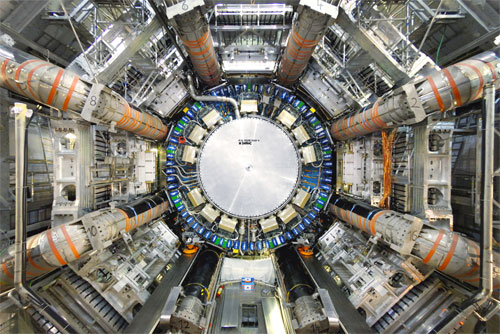
The Atlas Experiment and the Large Hadron Collider

Large Hadron Collider

ATLAS instrument (Large Hadron Collider), courtesy University of Michigan

The Large Hadron Collider (LHC) is the world’s largest and highest-energy particle accelerator, involving over eight thousand physicists from over eighty-five countries as well as hundreds of universities and laboratories. University of Michigan physicists and students were heavily involved in designing and building major components of ATLAS instrument which is one of two main particle detectors in the LHC. In Michigan integral to world’s largest physics experiment, the UM relates that tomorrow:

After 20 years of construction, a machine that could either verify or nullify the prevailing theory of particle physics is about to begin its mission.

CERN’s epic Large Hadron Collider (LHC) project currently involves 25 University of Michigan physicists and students. More than 100 U-M researchers have been involved in the project over the years. CERN is the European Organization for Nuclear Research, located in Geneva, Switzerland.

…The collider will, in essence, recreate the conditions of the earliest universe. It will tear apart particles so physicists can study their components and observe as the particles put themselves back together.

You can see the Atlas being built in this video and also take a video tour of the LHC on YouTube. There’s some cool large photos at the Boston Globe. For more photos of Atlas and other components of the LHC, visit the official LHC web site and (highly recommended) The Atlas Experiment, where you can see movies, watch webcams, read about the experiment and even check out a virtual tour of the Atlas instrument.

When writing about the LHC, it’s pretty much required that you note concerns about the safety of the experiment, and then say that the chances are infinitesimal (1 in 50,000,000 or less) that Earth-devouring black holes, strangelets or quantum gates will be created.

You’ll be able to tune into a live webcast of the Large Hadron Collider almost certainly not destroying the world at 4 a.m. Eastern Time on Wednesday, September 10, 2008.

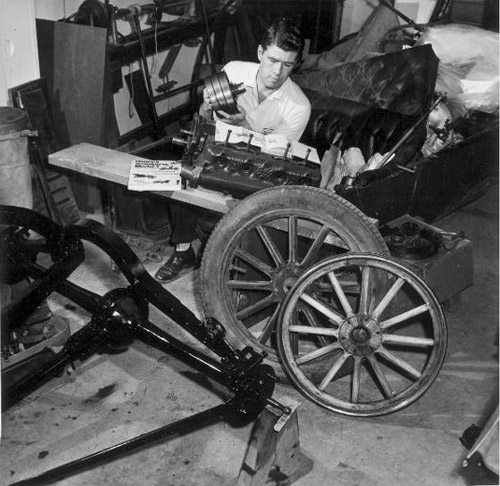
100 Years of the Model T

Assembling the Model T

Assembling the Model T, photo courtesy Archives of Michigan

The September 2008 Image of the Month from the Archives of Michigan (click through for more pictures) says that the first production Model T was completed Sept. 27, 1908, at Ford’s Piquette Avenue plant in Detroit.

…Henry Ford wanted a car that the average American could afford. The Model T initially sold for $850. The price continued to drop as Ford’s assembly line technology improved production efficiency. According to Willis F. Dunbar and George S. May’s third revised edition of Michigan: A History of the Wolverine State, a Model T touring car cost only $360 by 1916.

The Model T also proved remarkably easy to maintain. Dunbar and May note, for example, that it “was so easy to repair that almost anyone could fix something … with a pair of pliers and a screwdriver.” Gasoline seldom proved an onerous expense, either. On page 45 of The Ford Century author Russ Bahnam notes that the Model T averaged twenty-five miles per gallon – with a gallon of gas typically costing only twenty cents!

The Ford Motor Company produced over 15 million Model Ts between 1908 and 1927. According to The Henry Ford of Dearborn, Mich., the Volkswagen Beetle is the only model with a greater production record!

For more in the Model T check out the Model T Automotive Heritage Complex, Inc. (aka the T-Plex) and the Model-T Centennial exhibit at The Henry Ford.

Linden Mills on the Shiawassee River

Linden Mill, photo by Patrick T Power

MichMarkers.com has the text from the historical marker at Linden Mills in the village Linden (also a map).

The Linden Mills were a vital source of this village’s economic growth. The first mill, located on land granted to Consider Warner, was used to cut lumber. From 1845-1850 Seth Sadler and Samuel W. Warren, local residents, erected both a saw and grist mill. Operating along with the earlier facility, this complex was called the Linden Mills. The grist mill continued to function for over a century until the machinery was dismantled and sold at auction in 1956. The village then purchased the building for municipal offices and a public Library.

Today the mill is the site of the Linden Mills Historical Museum.

Edsel

Big Rear Edsel (IMGP2057h)

Big Rear Edsel (IMGP2057h), photo by norjam8.

September 4, 1957: It’s E-day, as Ford Motor Company introduces its newest make, the Edsel.

In an industry celebrated for its spectacular failures, the Edsel still takes the cake. Although as mechanically sound as other Ford products, the car was criticized from Day One for being too ugly, too expensive and vastly overhyped.
Short, Unhappy Life of the Edsel, WIRED

The Edsel was named for Henry Ford’s son Edsel Bryant Ford, president of Ford Motor Company from 1919 to 1943. Edsel was responsible for making the design & styling of automobiles a key consideration at Ford in their manufacture before he died in 1943 at the age of 49. (also see this great bio of Edsel Ford)

While Edsel was never a very popular name (peaking at 400th behind names like Kermit, Buford and Elvin in 1927), Edsel Agonistes in TIME Magazine says that a quick check of demographic records suggests that a convention of Americans first-named Edsel could be held in a hotel linen closet. Why?

The Edsel had been frantically ballyhooed for months ahead of its arrival with a new kind of highly scientific marketing, an alchemical blend of psychology, mass media and old-fashioned hucksterism. Call it the iEdsel. By the time the silk was pulled off the Edsel in hundreds of showrooms around the country, people were panting to see their automotive deliverance, the plutonium-powered, pancake-making supercar they’d been promised. What they saw was a large, relatively expensive, curiously styled Mercury–curious insofar as the vertical grille looked like a midwife’s view of labor and delivery.

A thorough article in Failure Magazine about the Edsel relates how the Edsel drew scorn from reviewers as “an Oldsmobile sucking a lemon” and “a Pontiac pushing a toilet seat” and nowhere near the forecast sales. If you click through, you’ll see that it was impacted by the same faulty assumptions that have lots full of SUVs today. You can get 1000% of the minimum RDA of Edsel at edsel.com.

Norm has some sweet Edsel photos in his Rusty Cars & Trucks set (slideshow). You can find even more in the Edsel group and some of my friends have some pretty sweet Edsel photos too!

Paint the Sky

Paint the Sky (3).jpg

Paint the Sky (3).jpg, photo by smartee_martee.

Part of Marty’s The Assortment of Moments set (slideshow).

The Badger – steaming out of summer

The Badger -- Steaming out of the harbor

The Badger — Steaming out of the harbor, photo by Diann*.

Diann says that the SS Badger leaving its home port of Ludington en route to Manitowoc, Wisconsin was the grand finale of a great Labor Day weekend.

It’s one of a number of cool shots in her Trains, Tugs, and Ferries set (slideshow) and she has posted it in big, beautiful, background-class glory!

More about this Lake Michigan car ferry at the SS Badger web site and from Michigan in Pictures.