Run away to summer

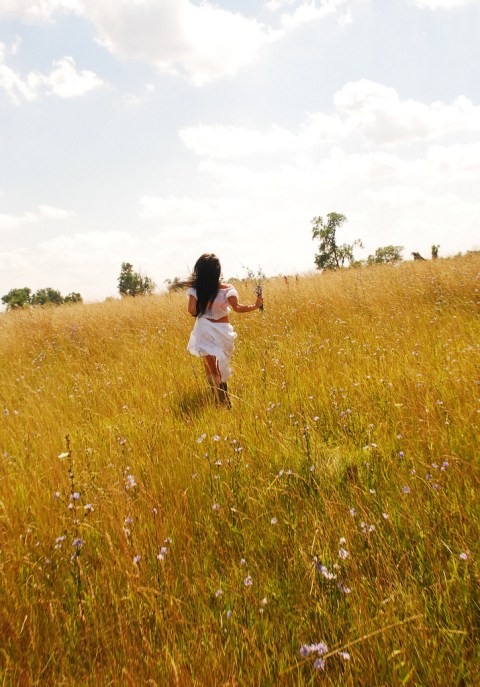
Untitled, photo by lolamarcia

A number of summertime photos have been showing up in the Absolute Michigan pool and on our Michigan in Pictures Facebook, telling me that it must be February! This photo seems to capture the impulse to flee February perfectly.

Check it out bigger and in Franise’s slideshow.

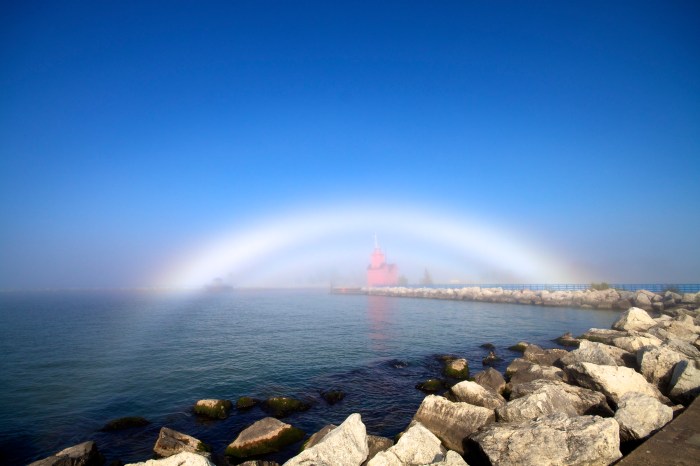
Fogbow: a White Rainbow over Big Red

fogbow-at-big-red-by-steven-karsten

White Rainbow, photo by stevedontsurf.

Today’s photo shows a fogbow. According to the Fogbow entry from Atmospheric Optics:

Fogbows form in the same way as rainbows. A small fraction of the light entering droplets is internally reflected once and emerges to form a large circle opposite the sun.

But… …beyond that there are major differences. Rainbows are formed by raindrops which are so large that rays passing through them follow well defined ‘geometrical optics’ paths. Fogbows are formed by much smaller cloud and fog droplets which diffract light extensively.

…Fogbows are almost white with faint reds on the outside and blues inside. The colours are so washed out because the bow in each colour is very broad and the colours overlap.

Read on for more, including some photos and get a little more at Wikipedia’s page on fog bows.

Steven shot this at the Holland Harbor Lighthouse aka Big Red and writes that he’s still amazed he was able to stumble upon one of these. Check his photo out big as the sky and in his Holland slideshow.

Jump into Valentine’s Day!

Rockford Sweetheart Splash 2012

Rockford Sweetheart Splash 2012, photo by DJ Wolfman.

Happy Valentine’s Day Michigan! Here’s hoping that you find someone in your life who will stick with you in times hot and cold.

Check this out bigger and see more in Daniel’s Rockford Sweetheart Splash slideshow.

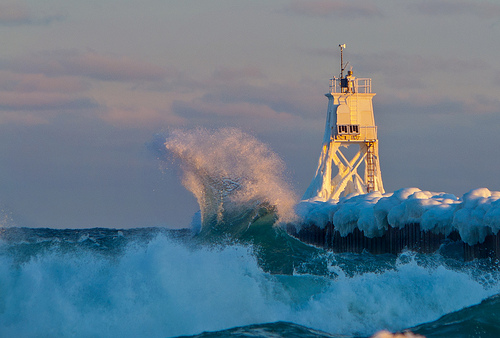
Sunrise at Copper Harbor Lighthouse

Bounded Light - Copper Harbor Lighthouse (Copper Harbor, MI)

Bounded Light – Copper Harbor Lighthouse (Copper Harbor, MI), photo by Aaron C. Jors.

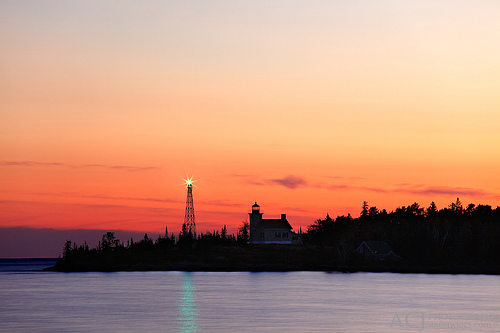
The Freep had a feature on the most romantic places to visit in Michigan. I was happy to see that two of their 5 sunset spots were in my native Leelanau Peninsula. There’s bunches of Leelanau on Michigan in Pictures, so I figured I’d pick another. Since there are also a whole lot of sunsets, how about a romantic sunrise over the Copper Harbor Lighthouse on the Keweenaw Peninsula?

Terry Pepper’s Seeing the Light says that the discovery of copper in the Keweenaw drew so many immigrant Cornish and Finnish miners seeking their fortunes that one pioneer observed that “the shores of the Keweenaw became whitened with tents.” Terry’s entry on the Copper Harbor Lighthouse says that the original light from 1849 was exemplary of the poor planning and tight budgets of the administration of Stephen Pleasonton. Pleasonton was also the man who saved the original copy of the Declaration of Independence, so you win some and lose some I guess. In any case:

By the early 1850’s a cry arose in the maritime community, voicing concern over Pleasonton’s tight-fisted administration of the nation’s aids to navigation. A clerical administrator, Pleasonton had no maritime experience, and it showed-up in the sub standard workmanship and poorly chosen locations of many of the lighthouses erected under his administration. A study commissioned by Congress recommended the establishment of a nine-member Board to oversee the administration of aids to navigation. Staffed with Navy officers and Engineers from the Army Corps of Engineers, the Lighthouse Board was established in 1852, relieving Pleasonton from any further involvement. One of the Board’s first orders of priority was the upgrading of illumination systems from the dim and poorly performing Argand lamps to the far more efficient and powerful Fresnel lenses manufactured in Paris. However, with the Copper Harbor Light not being of major importance in the greater scheme of things, it would be some time before its lens would be upgraded, and thus the Argand lamps continued to light the way into the harbor.

…In 1856, a work crew finally arrived in at the station and removed the Argand lamps from the lantern, and replaced them with a single fixed white Sixth Order Fresnel lens, thus increasing the station’s range of visibility to ten miles at sea. Three years later, the Light was upgraded further through the replacement of the Sixth Order lens with a more powerful fixed white lens of the Fourth Order.
As was the case with virtually all of the lighthouses built on the Great Lakes during the Pleasonton administration, the true costs of inferior materials and shoddy workmanship began to show. After his 1864 visit to the station, the Eleventh District Inspector remarked that the Copper Harbor lighthouse required “extensive repairs.” On subsequent investigation, the condition of the tower was determined to be beyond repair, and the following year the decision was made to raze the old tower and erect a completely new structure.

Read on for more on the construction of the new light and to see some great old photos. Also see Terry Pepper’s explanation of Argand and Fresnel lamps.

Check this out on black and in Aaron’s Great Lakes Lighthouses slideshow.

Happy Birthday to you, Thomas Edison

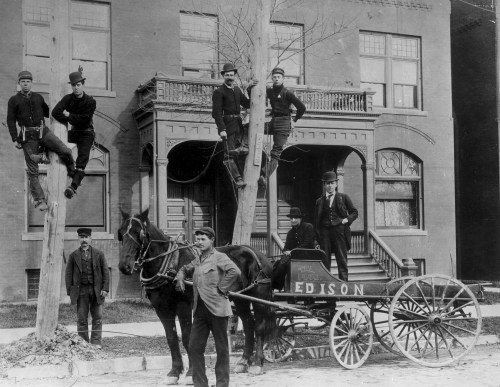
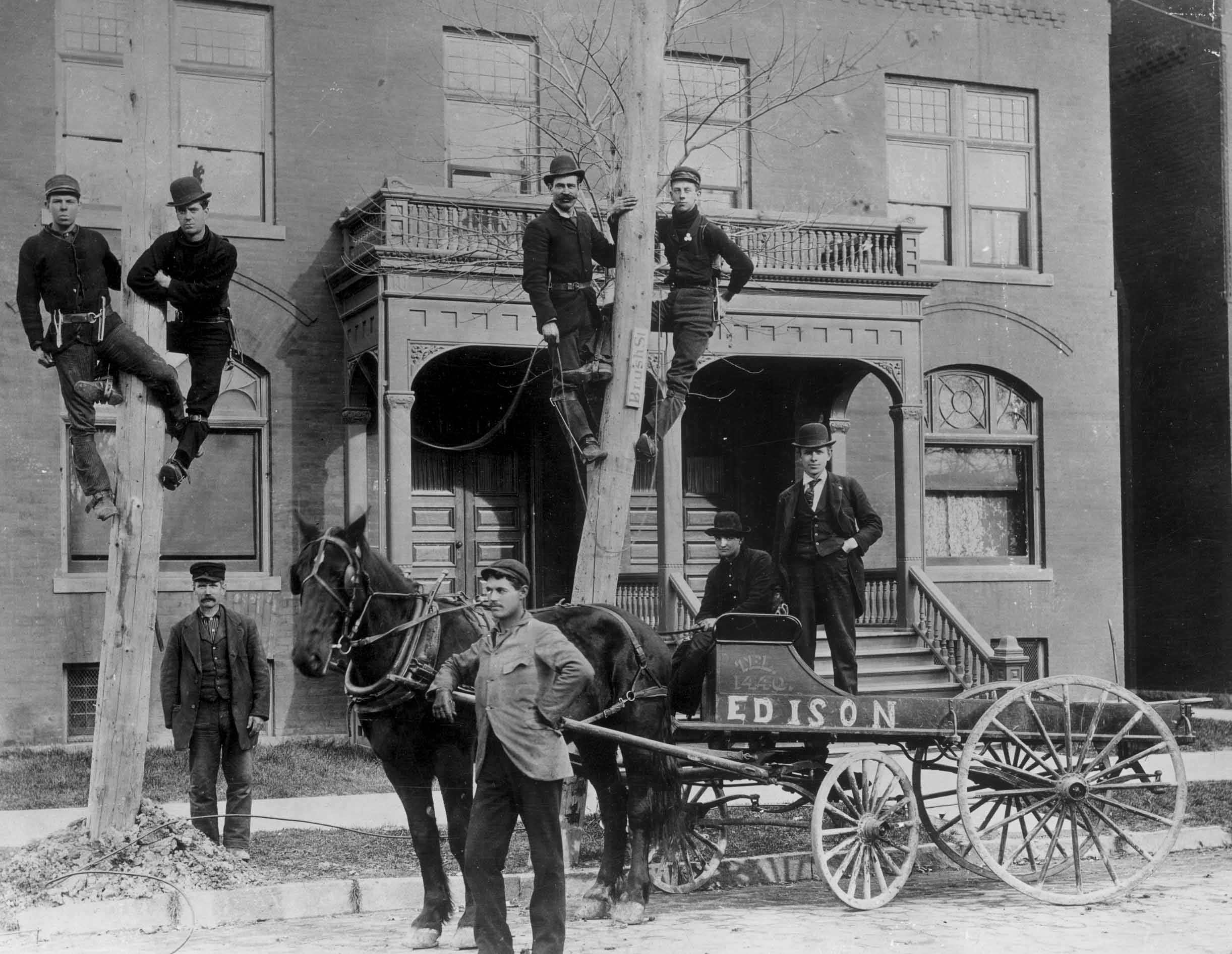
Detroit - Edison Illuminating Company high line crew

Detroit – Edison Illuminating Company high line crew, photo courtesy Seeking Michigan

The Life of Thomas Edison from American Memory at the Library of Congress says that:

Thomas Alva Edison was born to Sam and Nancy on February 11, 1847, in Milan, Ohio. Known as “Al” in his youth, Edison was the youngest of seven children, four of whom survived to adulthood. Edison tended to be in poor health when young.

To seek a better fortune, Sam Edison moved the family to Port Huron, Michigan, in 1854, where he worked in the lumber business.

Edison was a poor student. When a schoolmaster called Edison “addled,” his furious mother took him out of the school and proceeded to teach him at home. Edison said many years later, “My mother was the making of me. She was so true, so sure of me, and I felt I had some one to live for, some one I must not disappoint.”(1) At an early age, he showed a fascination for mechanical things and for chemical experiments.

In 1859, Edison took a job selling newspapers and candy on the Grand Trunk Railroad to Detroit. In the baggage car, he set up a laboratory for his chemistry experiments and a printing press, where he started the Grand Trunk Herald, the first newspaper published on a train. An accidental fire forced him to stop his experiments on board.

Read on for much more, and also see Thomas Edison at Wikipedia. While Edison’s life in Michigan didn’t include much of what one of the architects of our modern lifestyle was famous for, there’s some great places to visit to learn more about him. Two of the best are the Thomas Edison Depot Museum in Port Huron and Edison’s Menlo Park Laboratory at Greenfield Village.

Get this photo from Seeking Michigan big as the 20th Century and see a few more Edison-related photos from Seeking Michigan.

Post #350 on Michigan in Pictures!

Break Wall Sunrise

Break Wall Sunrise

Break Wall Sunrise, photo by Gary of the North.

Here’s yesterday’s sunrise in Grand Marais, Michigan … it’s pretty clear that Lake Superior was wide awake.

Check it out background bigtacular and see a lot more photos from the area on Gary’s map.

More winter wallpaper from Michigan in Pictures!

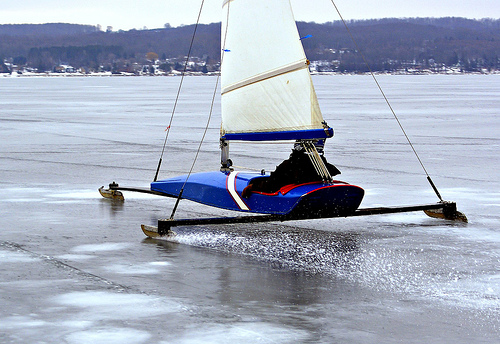
Ice Boating on Lake Charlevoix

Gordon in his Nite- Lake Charlevoix, Boyne City, Michigan

Gordon in his Nite- Lake Charlevoix, Boyne City, Michigan, photo by rickrjw.

Yesterday we took a trip under the ice of Lake Charlevoix, so it was very fitting that this morning Rick shared a photo from the other side of the ice on Lake Charlevoix! Our recent warm spell has cleared the snow and smoothed the ice on many lakes in Michigan, and that has brought ice boaters out in force.

Sail Michigan’s Michigan iceboating page explains

There are some peculiarities to ice boating (ice yachting) which are not seen with “soft water” sailing. First, most iceboats carry a single individual (so the need for crew is removed), however two or more person boats do exist. Second, because of the speeds involved (iceboats in general can travel 5-10x wind speed), ice sailors wear protective gear, including helmets. Third, iceboats do not require standard ramps for launching. And lastly, an intimate knowledge of ice conditions and lake topography is essential for a safer experience (although ice boating cannot be made 100% “safe”).

The iceboating season can’t start until snow-free hard ice is established on the lakes, usually after Christmas.

Check this photo out background big in in Ricks Iceboating 2012 slideshow!

Here’s one of our favorite iceboating videos: Ice boat vs Chevy on Lake St. Clair!

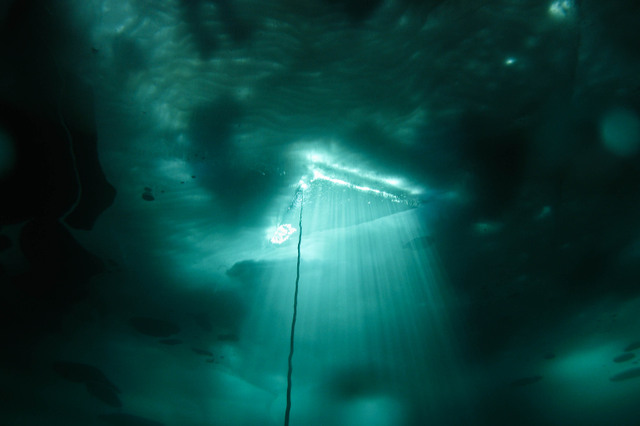
Under the Ice

Under the Ice, photo by Christopher Morey

In First Dive Under the Ice, Christopher writes that he went to the local scuba shop:

I got into a conversation with Jack – the former owner of the shop, who still works there. He invited me to join a bunch of scubies for an ice dive on a wreck called the Keuka – which is up in Lake Charlevoix – about 50 miles north of where I live. I’ve never done a serious through-the-hole ice dive before.

While we were talking – he told me the story of the Keuka – which is a wooden freighter from the late 1800s and is about 180 feet long.

Read on for the story of the Keuka and see more photos in his Zenfolio gallery.

Snow Moon, Hunger Moon, Trapper’s Moon, February Full Moon

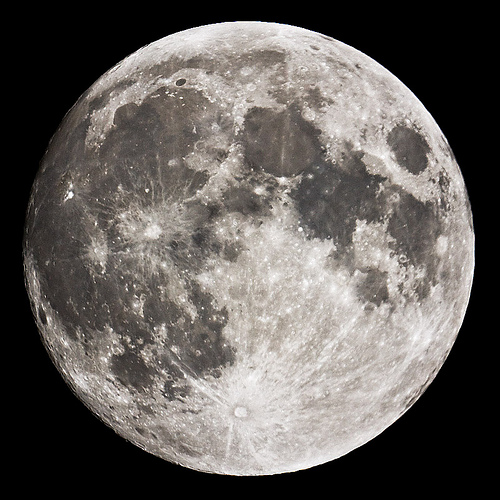
February Full Moon

February Full Moon, photo by Kevin’s Stuff

Tonight is February’s full moon. The Old Farmer’s Almanac says that Full Snow Moon was the common name of February’s full moon:

Since the heaviest snow usually falls during this month, native tribes of the north and east most often called February’s full Moon the Full Snow Moon. Some tribes also referred to this Moon as the Full Hunger Moon, since harsh weather conditions in their areas made hunting very difficult.

Colonial Americans knew it as the Trapper’s Moon. Some other names from the Moon Names page are Budding Moon (Chinese), Moon of Ice (Celtic), Storm Moon (Medieval English), Little Famine Moon (Choctaw), and the Moon of the Raccoon or Moon When Trees Pop (Dakotah Sioux).

Check this out on black and in Kevin’s The Moon slideshow.

Power House Falls on the Fall River

n2c_111-8241

n2c_111-8241, photo by sgowtham.

GoWaterfalling.com says that Power House Falls is located on the Falls River:

It is the largest of many falls to be found on the aptly named river. The river is about 40 wide here and drops 15 feet. The falls is named for the old power house that stands next to it.

Reaching this waterfall is easy. From US-41 about 1 mile south of L’Anse head west on Power Dam Road. There is a sign for the falls. Follow the road for about a mile. When it crosses the train tracks it branches. There is another sign for the falls. There is a small park at the falls.

There are a number of small drops just above the falls, and there are supposed to be a dozen or so more between Power House Falls and the Middle Falls in L’Anse.

Check this out bigger and also see this photo on Gowtham’s map!

Many more Michigan waterfalls can be found on Michigan in Pictures!