Gypsum & Alabaster

Old Off Shore Alabaster Loading facility

Old Off Shore Alabaster Loading facility, photo by hz536n/George Thomas

One of the neatest features for me about Michigan in Pictures are the many things I learn from the photos that are posted. Today’s photo of the Lake Huron loading platform for US Gypsum is a perfect example. The Iosco County Historical Society explains that:

The tramway of the U. S. Gypsum Company at Alabaster has long been a tourist attraction. Built in 1928 the tramway stretches 1.3 miles out into Saginaw Bay. Like a horizontal ski-lift, the cable system carries 72 “buckets” of gypsum to a waiting ship or to the storage bin. Each bucket holds more than two tons. The tramway includes 6,450 feet of one and three-quarter inch steel cable and 14,000 feet of three-quarter inch cable. At a length of 6,350 feet it is the longest over-water bucket tramway in the world.

…Until 1898 when the railroad spur was installed, all shipments were made by sailing vessels that tied up to a 600 foot dock. Marine shipments were resumed in 1929 after the building of the tramway enabled the larger ships to load in deeper water at the end of the tramway. Rail shipments were then made when the boat season was closed.

The tramway was dismantled (though concrete pads which may house wind turbines remain). You can also read an interesting account detailing the history of the town of Alabaster. While I knew that gypsum was used in drywall, I had no idea of its versatility (or Michigan’s status as a leading gypsum producer). You can learn about in great detail from MSU Geology’s page on gypsum:

If you were given a chance to win a jackpot by correctly naming a material that was used in the pyramids and in your toothpaste; that helps peanuts grow and makes movie snow; and that is used in mushroom beds and the walls of your house, chances are at least 100 to 1 that the quizmaster would holler “Sorry, your time is up,” before you could say “hydrous calcium sulphate.”

But, don’t feel badly.

Even though more than 12 1/2 million tons of gypsum were used in the USA last year, and even though the average person is surrounded by gypsum products from dawn to dusk, from the cradle to the grave, people do not know much about gypsum.

Gypsum can be ground up and “boiled” (calcined) at a comparatively low temperature until 75% of its moisture content has evaporated. When that happens, the rock becomes a fine powder, commonly known as Plaster of Paris. By returning the water to the powder, one can make a pliable mortar that can be formed into any shape and hardened. Gypsum is the only natural substance that can be restored to its original rock-like state by the addition of water alone.

Check this photo out background big and see more in George’s Fall 2009 slideshow.
Hot Times for a Cold Lake

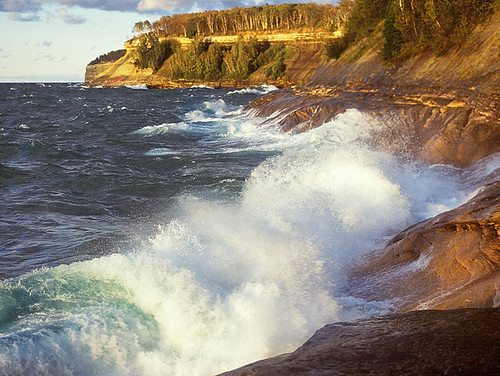
Lake Superior waves

Lake Superior waves, photo by ER Post

Hot times for a cold lake; Lake Superior headed for record temp from the Great Lakes Echo says that Lake Superior is already the warmest it’s been at this time of year in at least a century. The group Climate Central recently reported that Lake Superior began warming earlier than normal because of low lake ice cover, the March heat wave and warm temps have kept the heat on.

“It’s pretty safe to say that what we’re seeing here is the warmest that we’ve seen in Lake Superior in a century,” said Jay Austin, a professor at the University of Minnesota at Duluth, who has researched the lake’s water temperatures back to the beginning of the 20th century.

The lake’s record temperatures are yet another consequence of the record heat so far in 2012. The contiguous U.S. had its warmest January-to-June period since records began in the late 19th century. Manmade global warming will likely result in more years with very warm water temperatures, which could have significant adverse consequences for marine life. In a rare benefit from the ongoing drought, this summer has been so dry that the warm water temperatures are not resulting in major harmful algal blooms, such as one that occurred on Lake Erie last year.

Instrument data from three buoys in Lake Superior provide a reliable record of water temperatures since about 1980, and the information also shows that, with water temperatures running in the mid-to-upper 60s (and even warmer closer to shore), “we are at record temperatures for this time of year,” according to Austin.

When the 2nd biggest lake on the planet is sounding alarm bells, it might be a good idea to listen.

See this photo bigger and in Ed’s Michigan Scenery slideshow.

Blue Moon: Apollo 15 and the University of Michigan

Apollo 15: Irwin Scoops up Soil

Apollo 15: Irwin Scoops up Soil, photo by NASA on The Commons

Over on Absolute Michigan we have a feature on the all-UM crew of the Apollo 15 that includes a great video. You can see a lot more images from the Apollo 15 mission from NASA. Here’s their caption for this photo:

This frame from Dave’s Station 8 pan shows Jim standing wide-legged as he digs the partially-completed trench in front of him. He sticks the scoop into the wall opposite where he is standing and propels the scoop-load of regolith back between his legs. The narrow fan of throwback can be seen behind him and, indeed, there seems to be some material still in motion at the far end of the throwback pattern just above the two fiducials at mid-thigh height. Mt. Hadley (14,765 feet tall) is in the background.

Check it out big as the moon and in NASA’s Happy Moon Day! slideshow.

More University of Michigan on Michigan in Pictures.

Sorry folks – the spammers took a liking to this post for some weird reason so I had to close comments!!

Waterfall Wednesday: Rock River Falls

Rock River Falls

Rock River Falls, photo by PaulWoj

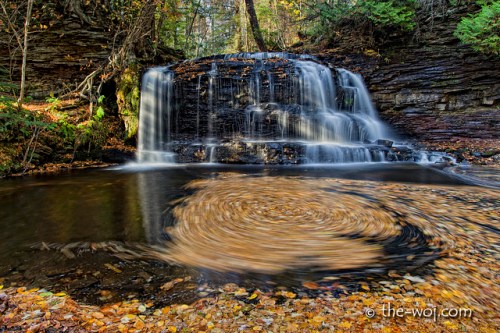
Rock River Falls is located in the Rock River Canyon Wilderness Area in Alger County which is s administered as a part of the Munising Ranger District of the Hiawatha National Forest:

The canyon area itself has been relatively undisturbed by humans. Little evidence of prior human activity can be found, except for an occasional old skid road or decaying stump. Dense undergrowth and brush covers most of the land. The canyons are points of interest because few such landscape features exist in the eastern Upper Peninsula of Michigan. Foot travel is difficult along the steep walls and through the densely vegetated and wet canyon floor. High ground around the canyons is covered by northern hardwoods and is easily traveled.

At the edge of the canyons are sandstone outcrops which water and weather have transformed into caves 10 to 40 feet deep. During winter, ice curtains formed by water seeping over the canyon edge hang in front of the caves. Large cedar trees also hang over the rim of the canyon. Rock River Falls is a notable feature in spring, when its waters cascade over a sandstone ledge into a pool 15 feet below.

Check this photo out background bigtacular and in Paul’s Especially in Michigan slideshow. Also see Paul’s cool Tumblr photo blog.

More Michigan waterfalls on Michigan in Pictures.

Great Lakes Warriors follows tug boat captains in winter

Tug John Selvick in Bay Ship Canal

Tug John Selvick in Bay Ship Canal, photo by boatnerd06

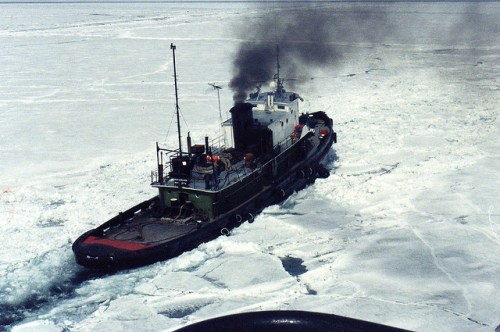
The Great Lakes Echo tipped me off to the new History Channel series Great Lakes Warriors. The show follows five captains battling winter storms on the Great Lakes as they break up ice, tow barges into port and try to stay alive. The second episode airs at 10:00 PM on Thursday, and the History Channel will rebroadcast the first episode, “The Lethal Season,” at 11:00 PM tonight. You can also watch it online at the History Channel.

That episode features the tug above – The John M. Selvick captained by John Selvick. Check it out background big and in Nathan’s massive Family Collections slideshow.

More boats on Michigan in Pictures.

Peaches in Michigan

Peaches

Peaches, photo by Alissa Holland

Peaches (like everything else) are ripening earlier this year and South Haven peaches are starting to show up at farm markets across the state. This nice Michigan Peach Industry History article from the Michigan Peach Sponsors begins:

The first peach tree in western Michigan was probably planted by William Burnett, who established a trading post on the west bank of the St. Joseph River a mile upstream from Lake Michigan in the 1780s. Burnett planted an orchard near his post and was credited with having taken great pains in caring for it. When the first permanent settlers reached the area in the late 1820s they found Burnett’s orchard healthy and still bearing fruit. Besides a few peach trees, the settlers also found a few seedling peach trees growing along the east bank of Hickory Creek and at the future site of the community of St. Joseph.

The next peach trees planted in Berrien County were at the Carey Mission in present-day Niles Township. In 1826 the Reverend Isaac McCoy, founder of the mission, had a peach orchard of “two or three hundred” trees.

Berrien’s earliest permanent settlers brought seedling fruit trees with them and planted enough trees to provide for their personal needs. Because trees took a long time to mature, some of the more resourceful pioneers budded their fruits on the roots of wild plum trees to acquire crops more quickly. Most early settlers planted apple and pear trees that were hardy and relatively disease resistant. They also planted a considerable number of the more delicate peach trees. Nearly every pioneer family had at least one. The growing of peaches was slow to catch on, but when settlers realized the region was suited for successful cultivation of the climate-sensitive fruit, peaches quickly gained popularity.

Read on for more and also see Ready to Pick: Peaches on Absolute Michigan.

Check Alissa’s photo out bigger and see more in her slideshow.

More great Michigan foods on Michigan in Pictures!

The Descent

The Decent

The Descent, photo by J.M.Barclay

Here’s hoping that the equivalent of the Fun Slide passes through your weekend!

View it on black and in J.M.’s slideshow.

More great black & white photos on Michigan in Pictures.

On the lookout for rain

Big Red

Big Red, photo by [DennisT]

Bloomberg is reporting that the Midwest drought is now affecting nearly 80% of the corn crop, over half of the US and is a factor in heat waves that have set or tied a whopping 6,639 daily high temperature records since June 1. The drought is already affecting southern and west Michigan and parts of the UP and appears likely to expand into northern Michigan as well.

This Detroit News article reports that the percentage of the state affected by severe drought has jumped to 21% from just 2% a week ago. The State Drought Monitor shows the level of drought severity in Michigan, and you can see more with the Midwest region map and the Michigan Interactive Drought Conditions map. This report on Yahoo lists some of the highlights (lowlights?) of Michigan’s 2012 drought:

  • Rainfall shortages since May 1 are up to six inches in some areas. The average rainfall at this time of year is eight to nine inches.
  • Last week, the Michigan State University Extension (of the Department of Geology) reported that across Michigan, particularly in the southwestern part of the state, there was evidence of plant water stress.
  • MSU Extension says that the extreme heat from the first week of July exacerbated crop concerns. Temperatures rose to high 90s and topped 100 degrees in some areas.
  • The Michigan DEQ has issued several ozone alerts already this year. Michigan cities of Ann Arbor, Detroit, Ludington and Benton Harbor have been under air quality alert for 14-15 days since late May. Grand Rapids, Mich., has been under ozone alert for 17 days.
  • MSU Extension says the intense drought across Michigan’s southern, central and eastern Corn Belt region has similar conditions to the great drought of 1988.
  • …and the bad news: Continued dryness in Michigan is predicted for the rest of July, says the National Oceanic and Atmospheric Administration’s Climate Prediction Center.

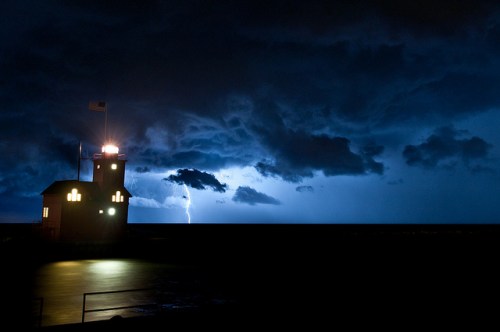
Check out this great capture from the other day on black and in Dennis’s thunderstorm slideshow.

More about Holland’s Big Red Lighthouse on Michigan in Pictures.

Photographic Proof of the Michigan Cougar!

Marquette County Cougar, photo by Michigan Wildlife Conservancy

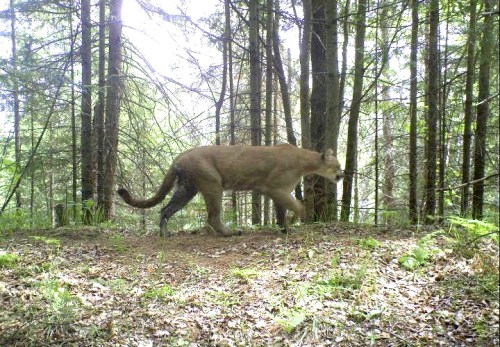
A trail cam in southern Marquette County operated by the Michigan Wildlife Conservancy (MWC) recently captured the above photo of a cougar. Dr. Patrick Rusz, Director of Wildlife Programs for the MWC and retired DNR forester Michael Zuidema verified the trail camera’s location on a well-worn wildlife trail atop a wooded ridge. The camera has also photographed wolves, coyotes, fishers and numerous other species at the same site over a four year period.

The MWC is publicizing this photograph because it may be the best, clearest photograph of a wild Michigan cougar ever taken. It is also unusually interesting because Mr. Zuidema has recorded over twenty credible cougar sightings in the same vicinity since the 1970s. These include several sightings within a few miles of the trail camera location.

Dr. Rusz stated that “the long history of sighting reports in the area indicates the cougar photographed on June 1 may be part of a resident population rather than a wandering cat from a western state.” Dr. Rusz has studied cougars for the Conservancy for 14 years and is co-author of a peer-reviewed study that confirmed cougars in both peninsulas of Michigan by analyses of DNA in droppings. He has also identified a long list of additional physical evidence dating back to 1966, and notes that Michigan State College zoologist Richard Manville documented several cougar sightings or incidents when he inventoried the fauna of Marquette County’s Huron Mountains from 1939 to 1942.

“The MDNR cougar team should now look at the very good evidence of a remnant cougar population collected before 2008,” said Bill Taylor, President of the Conservancy. “They could still easily verify cougar photos taken in the 1990’s in Alcona and Oscoda Counties in the Lower Peninsula and some others. The vegetation and other landmarks needed to confirm the photos are still there.”

You can compare the photograph above with photos of a wolf, coyote, raccoon, and porcupine taken by the same camera in the same location at the MWC website at www.miwildlife.org.

The Michigan Wildlife Conservancy is a non-profit citizens group established to restore Michigan’s wildlife legacy. They have restored more than 8,200 acres of wetlands, 2,500 acres of prairies and grasslands, and hundreds of miles of trout streams, and helped with several rare species recoveries and the creation of many backyard habitats.

More about cougars in Michigan on Michigan in Pictures and weigh in with your comments below or on the Absolute Michigan Facebook!

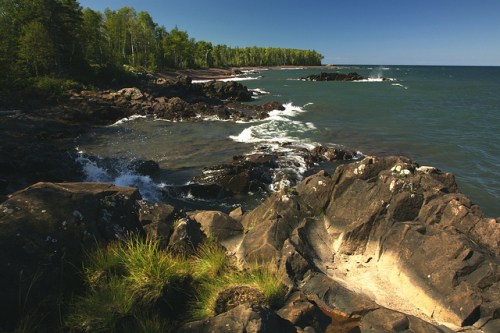
Seven Mile Point on the Keweenaw Peninsula

Untitled

Untitled, photo by North Woods Conservancy

When someone with the commitment to jump into the icy waters of Lake Superior in February asks you to take a look at something she thinks is important, my feeling is that you darn well do it.

Kate shared news that the Keweenaw-based North Woods Conservancy owns a piece of property called Seven Mile Point. It’s 32 acres with 1,854’ of sand, basaltic bedrock and volcanic cobble beach located on Lake Superior about 5 miles from Eagle River. The Michigan Natural Features Inventory listed it for high-priority protection due to the unique plant and animal communities associated with the 1.1 billion-year-old basaltic lava flow lakeshore.

While they were able to get going with the purchase, they haven’t been able to raise enough funds to make the payments. They’re seeking folks to help with one-time or monthly donations. Click for more information and photos of this gorgeous spot and also follow them on Facebook!


You can get this photo background big and in their Seven Mile Point slideshow.

More of Lake Superior on Michigan in Pictures.