Belle Isle Bolt!

Belle Isle View1D

Belle Isle View1D, photo by TroyMich (fferriolo)

BLAM!! Who’s ready for some spring storms? FYI, this is actually not a lighthouse off Belle Isle, it’s the Detroit Waterworks Intake Crib. You can have a look at on Google Maps.

Check this out big as the sky and in see more Frank’s slideshow.

More wicked weather on Michigan in Pictures!

West Michigan’s Rogue River

Rogue River Reflection

Rogue River Reflection, photo by MichellePhotos2

Wikipedia’s Rogue River entry says that this 48 mile long river is a major tributary of the Grand River that runs through Kent and Newaygo counties and the Rogue River State Game Area.

Its headwaters are a series of ditches that drain the old Rice Lake bed near Grant for agricultural purposes.

…Originally named “Rouge River”, the river’s appellation was altered in the 19th century due to the printing error of a Wisconsin mapmaker. As a frontier waterway, the historic Rogue River was of major importance to local tribes and traders. During the lumber era in the latter 19th century its waters floated timber to the mills of the Grand River valley, and the riverboat Algoma plied its way northward along Rogue giving its name to the Kent county township of Algoma.

Rogue River is designated as “Country Scenic” under Michigan’s Natural Rivers Act. It is popular with trout fishers and local youth who have floated the river by innertube since the mid-20th century. It is intersected in parts by the White Pine Trail. It varies from 15 feet (4.6 m) wide in the upper sections to 80 feet (24 m) wide near its end and is 1 to 4 feet (0.3 to 1.2 m) deep. There are “holes” in the river up to 15 feet (4.6 m) in depth.

You can get the management plan, maps and more from the DNR’s Rogue River Page.

View Michelle’s photo on black and see more in her slideshow.

More Michigan rivers on Michigan in Pictures.

Locally Known as “the Bowl”

Locally Known as "the Bowl"

Locally Known as “the Bowl”, photo by karstenphoto

EDIT: Wow I really messed this one up, sleepily citing an article that gave the dune’s age in the millions of years. Thanks to Tom Burrows for the catch. Let’s see if this information on coastal dunes from the DNR makes more sense:

Michigan’s glacial history provides an explanation for the formation of dunes. The Great Lakes dune complex is relatively young, in terms of geological time. As recently as 16,000 years ago, Michigan was covered with glacial ice thousands of feet thick. This glacial ice contained a mix of boulders, cobbles, sand, and clay. During glacial melting, this deposit was left and is known as glacial drift.

This glacial drift is the source of sand in most of Michigan’s dunes. The sands were either eroded from glacial drift along the coast by wave activity or eroded from inland deposits and carried by rivers and streams. Only the hardest, smallest, and least soluble sand grains were moved. Waves and currents eventually moved these tiny rocks inland, creating beaches along the Great Lakes shoreline.

…Blowouts are saddle shaped or U shaped (parabolic) depressions in a stabilized sand dune, caused by the local destabilization of the dune sands. Blowouts, which originate on the summit or windward face of a dune, are often rapidly formed by the wind, creating narrow channels and exposing plant roots. Blowouts can create interruptions in the shape of parallel dunes that may result in deeply carved indentions called parabolic dunes. It is the combination of interwoven parallel dune ridges and U shaped depressions, including parabolic dunes, that characterizes the classic dunes from Indiana, northward to Ludington, in Michigan.

Awesome Michigan wrote a little about The Bowl at Holland saying:

The Bowl is an gigantic sand bowl, resembling a sort of concave desert. Along with the other dunes and Lake Michigan itself, The Bowl was carved out of the earth by glaciers millions of years ago and was likely a small lake before drying up. Standing at the center of The Bowl and being surrounded on all sides by enormous walls of sand is quite breathtaking. The landscape is truly like no other. This awesome sight alone makes a trip to Laketown a summer necessity and a great, relaxing place to bring friends and family.

You can also check in there on Foursquare. Here’s another shot from the bowl from all the way back in 2007. Amazing to me how long Michigan in Pictures has endured – thank you all for staying with me!

Check Stephen’s photo out big as the Bowl and see this and many more in his FILM! slideshow.

More dunes on Michigan in Pictures.

Algae Blooms threaten Lake Erie

like an oil slick

like an oil slick, photo by 1ManWithACamera

I’d like to offer an apology of sorts for this photo. It goes like this: “I’m really, really sorry that I sometimes have to blog photos of the ugly things that threaten what’s beautiful in Michigan. I wish I didn’t have such a good reason to!”

Michigan has only the tiniest sliver of Lake Erie shoreline, so little that we sometimes forget that it is one of the lakes that define our Great Lakes State. Lake Erie served once at the canary in the coal mine for pollution of the Great Lakes, and it may once again be sounding a warning call. A recent front page of the New York Times featured scary news about algae blooms on Lake Erie:

For those who live and play on the shores of Lake Erie, the spring rains that will begin falling here soon are less a blessing than a portent. They could threaten the very future of the lake itself.

Lake Erie is sick. A thick and growing coat of toxic algae appears each summer, so vast that in 2011 it covered a sixth of its waters, contributing to an expanding dead zone on its bottom, reducing fish populations, fouling beaches and crippling a tourism industry that generates more than $10 billion in revenue annually.

…Dead algae sink to the lake bed, where bacteria that decompose the algae consume most of the oxygen. In central Lake Erie, a dead zone now covers up to a third of the entire lake bottom in bad years.

“The fact that it’s bigger and longer in duration is a bad thing,” said Peter Richards, a senior research scientist at the National Center for Water Quality Research at Heidelberg University in Ohio. “Fish that like to live in cold bottom waters have to move up in the thermocline, where it’s too warm for them. They get eaten, and that tends to decrease the growth rates of a lot of the fish.”

Read on for a whole lot more including how farming practices are intersecting with invasive zebra mussels and climate change to magnify the dangers.

Larry’s photo is from Lake Huron and shows a different kind of algal bloom. I got some similar ones on Lake Michigan, and the folks at Michigan Sea Grant have a whole album of them.

See it on black, view happier shots in his Caseville & Port Austin slideshow and see more of Larry’s work on Michigan in Pictures.

More Lake Erie on Michigan in Pictures.

Twice as Sweet: Michigan & Michigan State both make the Sweet Sixteen!

Tim Hardaway Jr. Oop vs. MSU

Tim Hardaway Jr. Oop vs. MSU, photo by Robbie Small

USA Today notes that Michigan and Michigan State have combined to make hoops history this year:

For the first time in the 75-year history of the NCAA tournament Michigan and Michigan State have advanced to the Sweet 16.

The Big Ten’s Wolverines and Spartans earned their tickets right in their backyard, in dominating fashion, in a supercharged atmosphere Saturday at the Palace.

Michigan, just 36 miles from its Ann Arbor campus, started the celebration, dissecting Virginia Commonwealth’s vaunted press 78-53 in the opener.

Michigan State, 81 miles from East Lansing, made it a historic day, slamming the front door on Memphis 70-48.

They were also the first two teams into the Sweet Sixteen. Michigan will face #1 seed Kansas on Friday while MSU squares off against #2 Duke.

Robbie took this shot at a March 3rd meeting between Michigan and Michigan State in which the Wolverines eked out a 57-56 win thanks to a game-saving steal & slam by Trey Burke. (click that link for Robbie’s photo) Check this out background bigtacular or view a great gallery from the game at  robbiesmallphotography.com!

More basketball on Michigan in Pictures.

Can you feel the summer?

Can you feel it.

Can you feel it., photo by Majestic View Photography

I can tell when winter is wearing on folks when the spring & summer pictures start to flood in. I love the fact that we’re having the first normal Michigan winter in years but I can’t wait until the blues & greens and warm days return!

Check this out on black and see more in Dan’s Water’s View slideshow.

More islands on Michigan in Pictures.

The crocuses are coming, the crocuses are coming!

The crocuses are coming, the crocuses are coming!

The crocuses are coming, the crocuses are coming!, photo by Alissa Holland

Felt a little bad for failing to post anything about the spring equinox this year. As we are still under a blanket of snow up here in Traverse City and since I shared this hopeful sign, maybe I get a pass?

Alissa took this last Saturday, and she cautions you not to mistake the background for sky – it’s snow! See it on black and get your garden on in her how my  garden grows slideshow.

More Michigan spring on Michigan in Pictures.

Sunset & Sequestration

"Lake Michigan Overlook" Pierce Stocking Scenic Drive - Sleeping Bear Dunes National Lakeshore

“Lake Michigan Overlook” Pierce Stocking Scenic Drive, photo by Michigan Nut

The other day on Leelanau.com I posted Sequestration and the Sleeping Bear Dunes detailing cuts that will be made at the Sleeping Bear Dunes National Lakeshore to meet their 5% budget requirement. The Pictured Rocks National LakeshoreIsle Royale and the Keweenaw National Historical Park will all be forced to trim budgets as well. Due to the fact that the NPS fiscal year ends in September, the cuts end up being closer to 10% than 5%.

All of the officials quoted stress that the parks remain open and (mostly) accessible, but when Michigan is spending millions of dollars promoting Pure Michigan nationwide with these parks at the center of our offerings, there’s no question that this is bad news for tourism!

John took this photo about a year ago – view it bigger and see more in his Sleeping Bear Dunes National Lakeshore slideshow. He is a frequent guest on Michigan in Pictures – view more of his posts right here.

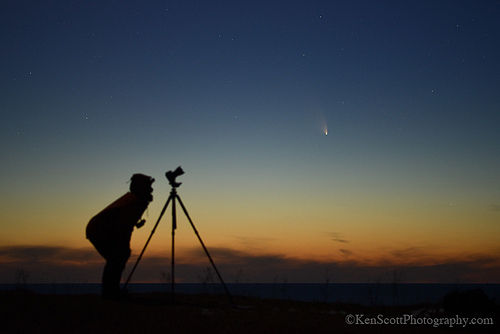
Capturing Comet PANSTARRS

Comet Pan-Starrs ... 3-17-13

Comet Pan-Starrs … 3-17-13, photo by Ken Scott

EarthSky.org is a fantastic site for all things astronomical, and their post detailing everything you need to know about Comet PANSTARRS has great info on the first of 2013 major comets. The comet was discovered by the PANSTARRS telescope in Hawaii and they explain that:

Comet PANSTARRS is still visible through binoculars in the Northern Hemisphere, if you know right where to look. Note where the sun sets in the west. Some 60 to 75 minutes after sundown, seek for the comet about two to three binocular fields to the right, or upper right, of the sunset point on the horizon. Comet PANSTARRS now sets at nightfall or very early evening at mid-northern latitudes. From here on out, the comet will dim a bit day by day, while the waxing moon will brighten daily. So it’s hard to say how much longer Comet PANSTARRS will be readily visible through binoculars. Each day, Comet PANSTARRS goes a few degrees northward (to the right) on the sky’s dome, toward the constellation Cassiopeia the Queen.

…No matter how bright it gets in March, the comet will surely fade as April arrives, as it moves away from the sun and back out into the depths of space. But it will be located far to the north on the sky’s dome and will be circumpolar for northerly latitudes in the Northern Hemisphere. That means it might be visible somewhere in the northern sky throughout the night for northern observers. What’s more, the comet will be near in the sky to another beautiful and fuzzy object in our night sky, the Andromeda Galaxy (M31), the nearest large spiral galaxy to our Milky Way. If the comet truly is bright then, and if it still has a substantial tail, it’ll be an awesome photo opportunity!

Read on for more and also check out the michpics post on Comet ISON which has the possibility of  being so bright that you can see it in the daytime!

Ken shot this last weekend. You can see it on black, check out the sunset he captured before this and see more great work in his Night Sky slideshow. If you’re looking to purchase this or other shots, definitely head over to KenScottPhotography.com!

More nighttime photography on Michigan in Pictures.

crashing to Earth

crashing to Earth

crashing to Earth, photo by .brianday

Brian suggests the Cinematic Orchestra’s Outer Space to accompany this photo. View it on black and might I suggest queuing up the song above and digging into his Gray Matter slideshow.

More amazing work from Brian Day on Michigan in Pictures.