Your Peach is Ready … thank Stanley Johnston for that

U-Pick peach

U-Pick peach, photo by Alissa Holland

“Life is better than death, I believe, if only because it is less boring, and because it has fresh peaches in it.”
― Alice Walker

Peaches are rolling in at farm markets all across Michigan.  A favorite article that Michigan History Magazine shared on Absolute Michigan tells the story of A Peach of a Man:

Many people have contributed to Michigan’s fruit industry, but Stanley Johnston stands above the rest. Johnston not only developed a new peach that is the most widely grown peach in the world today. He also made Michigan the nation’s leading producer of blueberries.

Johnston was the superintendent of Michigan State University’s (MSU) experiment station in South Haven from 1920 to 1969. There, he developed a better peach. Johnston took peaches that had good features, like ones that ripened at different times or did not turn brown when canned or frozen. He took pollen from the male plant and joined it to the flower of the female plant. When the fruit grew, he collected seeds and started a new tree. When the tree produced fruit five years later, he could see if he made a better peach.

During his career, Johnston grew and studied more than 20,000 peach trees. Eight different types, called “havens” (for South Haven), were planted by farmers. Havens ripened earlier, so the peach-growing season was longer, which meant more peaches could be grown and sold. One of these peaches, named Redhaven for its nice red color, is the most popular peach in the world today.

Johnston received much praise for his work with peaches. Comparing him to an artist, one man called Johnston a “Picasso among peach breeders-a plant breeding artist.”

Read on at Absolute Michigan and definitely get down to your local farmer’s market for some peachy goodness!

Check Alissa’s photo out bigger and see more in her Michigan’s west lakeshore slideshow.

More food on Michigan in Pictures.

Manitou Stormcloud and the Earth Science Picture of the Day

Manitou Stormcloud

Manitou Stormcloud, photo by ShaneWyatt

One of my favorite photoblogs is the Earth Science Picture of the Day (EPOD), and sometimes you’ll see photos from Michigan in Pictures there and vice versa. The EPOD is produced by the NASA Earth Sciences Division, and every day their stalwart blogger Jim Foster works with photographers all over the planet to highlight amazing things. In June the EPOD posted a cool photo of a roll cloud over Calgary, explaining:

Roll clouds are a type of arcus cloud often associated with turbulent weather. As is the case here, they sometimes look like a horizontal tornado. Although these cylindrically shaped clouds look quite fierce and may be observed to roll about their horizontal axis, they don’t usually generate dangerous winds. Roll clouds are typically found behind outflow boundaries but unlike shelf clouds are detached from any close-by cumulonimbus cloud.

I know that I featured a photo from Shane last Thursday, but this one was just too cool to hold back! Check his photo out bigger and see more in Shane’s slideshow.

More wild Michigan weather on Michigan in Pictures!

Happy 150th Birthday, Henry Ford

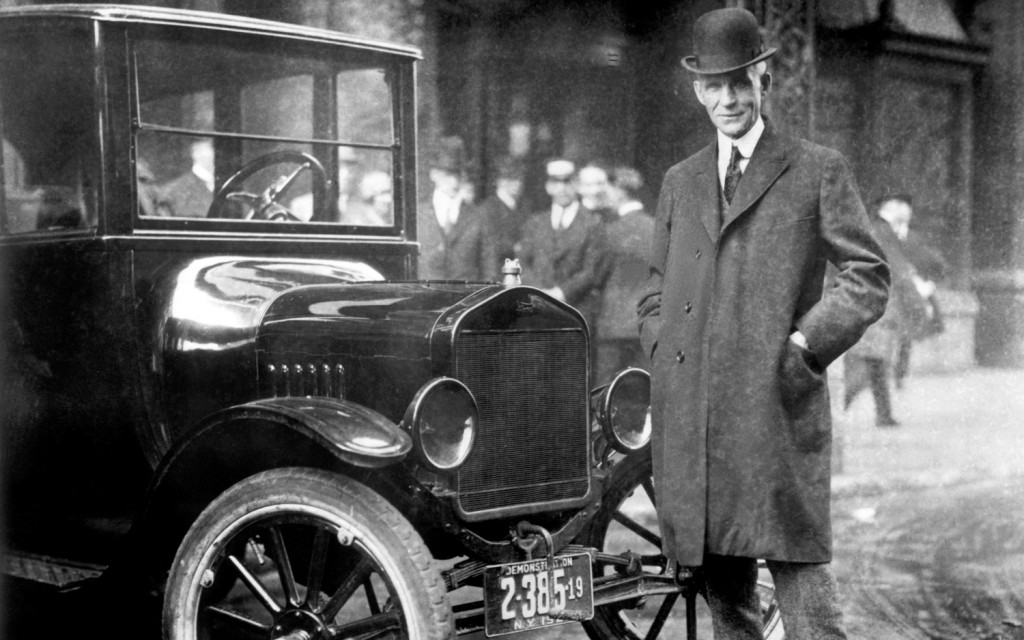
Henry Ford 1921 Model T

Henry Ford poses with 1921 Model T, photographer unknown

150 years ago today, on July 30, 1863, American industrial icon Henry Ford was born in Greenfield Township. The museum that he founded, The Henry Ford, says that Ford was a complex man who was ultimately responsible for transforming the automobile from an invention of unknown utility into an innovation that profoundly shaped the 20th century and continues to affect our lives today. A sampling of some of the facts about Ford they offer bear that out:

  • As a child, he was inspired by his mother, who encouraged his interest in tinkering. His father was a farmer. He encouraged Henry’s interest in the use of machines on the farm.
  • Thomas Edison was Henry Ford’s role model and later his close friend. (here’s a photo of Edison & Ford)
  • He built and drove race cars early in his career to demonstrate that his engineering designs produced reliable vehicles.
  • He financed a pacifist expedition to Europe during WWI, but during WWII Ford mobilized his factories for the war effort and produced bombers, Jeeps, and tanks. (more about that check out Willow Run on Absolute Michigan)
  • He owned a controversial newspaper, The Dearborn Independent, that published anti-Jewish articles which offended many and tarnished his image.
  • Henry Ford built Village Industries, small factories in rural Michigan, where people could work and farm during different seasons, thereby bridging the urban and rural experience.
  • The idea for using a moving assembly line for car production came from the meat-packing industry. Ford sought ways to use agricultural products in industrial production, including soybean-based plastic automobile components such as this experimental automobile trunk.
  • He was one of the nation’s foremost opponents of labor unions in the 1930s and was the last automobile manufacturer to unionize his work force. (not really a surprise there)

Read on for a full bio and if you ever have a chance definitely visit – it’s pretty amazing!

NASA turns 55

Milky Way - Silos

Milky Way – Silos, photo by eddy.matt

“To reach for new heights and reveal the unknown so that what we do and learn will benefit all humankind.”
~NASA’s Vision

On July 29, 1958, President Dwight D Eisenhower signed the  National Aeronautics and Space Act that established the National Aeronautics and Space Administration aka NASA. While I don’t think that we’ve seen quite the advances we expected after making it to the moon in just over a decade, NASA has evolved into a science agency that is engaged in an incredible range of operations from theoretical research (warp drive is my current favorite) to monitoring our planet, solar system and the visible universe (measuring Northern Lights and roving Mars) to a permanent presence in space (I watched NASA TV live from the International Space Station this morning) and plans for a manned Mars mission.

Check Matthew’s photo out bigger and see more in his slideshow. This photo is a still from a gorgeous time-lapse on the Leelanau Peninsula that he did last year in July.

More space on Michigan in Pictures!

Grace Dickinson & Leelanau County’s Female Photographers

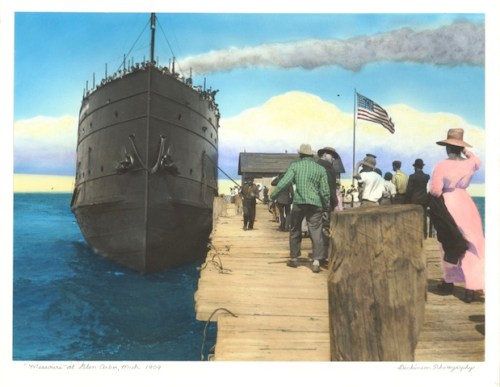
WomenPhotographers-GraceDickinson-SteamerMissouri

Steamer “Missouri” docked in Leland in 1919, photo by unknown, hand colored by Dickinson Photography

This week’s Glen Arbor Sun has a terrific feature by my friend Kathleen Stocking on Six Leelanau County Women Photographers. She profiles Barbara Nowinski, Kathleen (Dodge) Buhler, Meggen Watt Peterson, Ashmir McCarthy, Marty Schilling and Grace Dickinson. Here’s Grace:

Grace Dickinson has a photo studio across the road from the place her grandparents first came to on the south shore of Little Glen Lake in the summer of 1912. Her grandparents traveled to the Leelanau Peninsula by steamer, from the Navy Pier in Chicago up Lake Michigan to Glen Haven. In 1942 her parents met and fell in love while her mother was a writer/editor at the Leelanau Enterprise and soon after became year-round residents. Grace’s father, Fred, a broker who worked from home, spent his free time photographing the dunes and the islands. One unusual photo shows a cloud the exact size of one of the Manitou Islands, above the island, a rare phenomenon caused by condensation when the temperature of the island is colder than that of the surrounding waters of Lake Michigan.

From an early age, Grace followed in her father’s footsteps, quite literally, accompanying him and sometimes photographing the same scenes. Grace left her studies at Northwestern Michigan College to go on a year-long sailing adventure in the Bahamas, and followed this with a two-decade-sojourn out in Montana where she married a rancher and finished college. Grace returned to the Leelanau Peninsula in the late 1980s and became a mapmaker for the Leelanau County Planning Commission. She began taking photos of the Leelanau Peninsula and opened her own studio out of which she sold her own and her father’s photos and maps. In the mid-1990s she revived the 1930s art of photographic hand-coloring, laboriously hand-tinting her father’s black and white photos of earlier years, photos which evoke the shadows and starkness of some of the photos of Diane Arbus, but as applied to nature, not people. In the medium of hand-coloring Grace discovered a way to keep her father’s legacy alive and express her own love of Leelanau. Her photo studio is on Glenmere (M-22) west of the bridge over the Glen Lake Narrows.

Head over to the Glen Arbor Sun for more! The photo above is labeled as having been taken in Glen Arbor in 1909, but former Leelanau Historical Museum Director Laura Quackenbush identified it as Leland’s dock. The photo was hand-colored by Grace from an old negative on glass found in the Leelanau Enterprise office during the time her parents (briefly) owned it.

If you’re interested in more work bu Grace and her father, head over to Dickinson Photography. I’ve also featured several photos from Fred Dickinson on Michigan in Pictures, and you can click that link to read a little about the coloring process.

To Be In Green

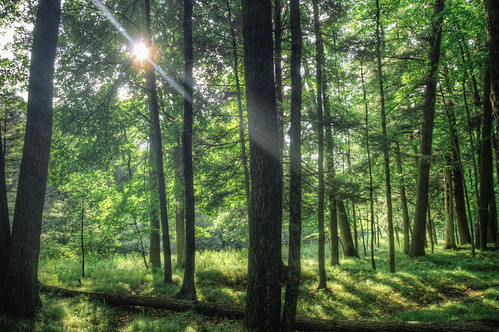
To Be In Green

To Be In Green, photo by MightyBoyBrian

This photo is the current background for Absolute Michigan and cover photo for the Absolute Michigan Facebook. Brian shared it in our Michigan Cover Group on Flickr and I encourage you to do the same and also to get out and enjoy some of Michigan’s green glory this weekend!

Check this out background bigtacular and see more in Brian’s Nature slideshow.

More trees on Michigan in Pictures.

Great Lakes Waves offer beauty, power & danger

DSC01071P

Untitled, photo by Scott Glenn

“These are not lakes, these are the world’s eighth seas, and her bottom is littered with the wreckage of over six thousand ships.”
~The Three Sisters, Song of the Lakes

This gorgeous shot of the St. Joseph Pier Lighthouses demonstrates the incredible power of Great Lakes waves. I live in Traverse City, and this summer it feels like Lake Michigan has claimed the lives of more people than normal. Whether or not that’s true (it’s not), I thought this photo offered the perfect opportunity to share some tips and tools for staying safe on Lake Michigan, Lake Huron, Lake Superior and Lake Erie!

  • Thinking of any of the Great Lakes as anything like any lake you’re familiar with is a mistake. They are freshwater seas that can pack  incredible power. They are stronger than you and can end your life in an instant if you don’t respect them.
  • The Great Lakes Surf Rescue Project is a nonprofit dedicated to drowning prevention that keeps track of drowning statistics: 74 in 2010, 87 in 2011, 101 in 2012 and 39 so far in 2013. (you can also keep up with them on Facebook)
  • Life jackets can save your life.  U.S. Coast Guard statistics show that 90% of the people who drown in a boating or water accidents would survive with a life jacket.
  • Cold kills! Hypothermia is a danger all year round on the Great Lakes. Click that link for tips on how to stay alive if you do end up in the water.
  • Rip Currents (sometimes called “undertow” or “rip tide”) are a big danger on Michigan beaches accounting for the majority of drownings. Michigan is 4th in rip current related fatalities behind Florida, California, and North Carolina – we have “ocean force” rip currents. Learn how to beat them in this video.
  • The National Oceanic and Atmospheric Administration (NOAA) offers comprehensive Great Lakes marine forecasts.
  • The MyBeachCast smarthphone app can predict waves and warn you of hazardous conditions.
  • Do you have more tips? Share them in the comments!

Check it out bigger and see more in Scott’s Lighthouses slideshow and also check out a winter view of the pier that Scott shot.

Catch a Michigan wave on Michigan in Pictures!

Sturgeon River Gorge: Michigan’s Grand Canyon

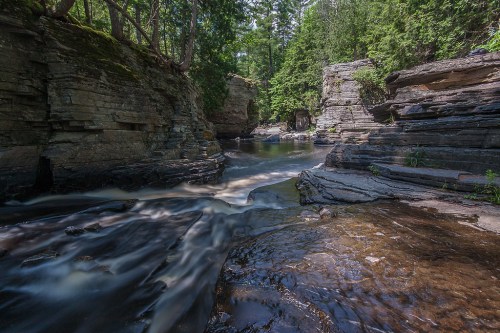
Michigan's -Grand Canyon--2

Michigan’s -Grand Canyon–2, photo by ShaneWyatt

The Ottawa National Forest page on the Sturgeon River Gorge Wilderness says:

The Wild and Scenic Sturgeon River rushes out of the northern portion of this wilderness, over the 20 foot volcanic outcroppings of Sturgeon Falls, and through a gorge that reaches 350 feet in depth and a mile in width. Throughout this rugged, steep Wilderness, the Sturgeon and Little Silver Rivers and their tributaries have carved falls, rapids, ponds, oxbows, and terraces. Stunning views are possible from the eastern rim of the gorge. Except for a few naturally bare slopes, most of the land is forested with pine, hemlock, aspen, sugar maple, birch, and basswood. When the leaves of the hardwoods change color in the fall, they form a vivid tapestry.

There are few established trails in Sturgeon River Gorge Wilderness, and the few overgrown logging roads are hard to find and follow. The North Country National Scenic Trail parallels the northern and eastern boundaries for about eight miles. Sturgeon River Campground offers seven sites on the southeastern boundary. In spring and during peak runoff, kayaking and white water canoeing are challenging, and only recommended for advanced paddlers.

Check it out bigger and see more on Shane’s map!

More Michigan rivers on Michigan in Pictures.

Swimming the Straits of Mackinac

Mackinac Dusk

Mackinac Dusk, photo by ShelNf

The Traverse City Record-Eagle reports that Cathy Nagler will be attempting to swim across the Straits of Mackinac tomorrow (Wednesday, July 24):

Worry isn’t a word Nagler uses to talk about the upcoming distance swim, which is expected to take place Wednesday between Michigan’s Upper and Lower Peninsulas, on the west side of the mighty Mackinac Bridge. But she does have legitimate concerns, chiefly hypothermia from the cold water.

“That’s the hard one,” she said. “I went in Lake Michigan on June 12 and the water temperature was 58 degrees.”

Nagler will wear a lightweight wetsuit, of the sort tri-athletes wear, to combat that problem. Combined with dive boots, it should keep her warm enough.

“The heavier wetsuits, like water skiers wear, make me too buoyant in the water,” she said.

Nagler, who summered at her family’s cabin in Northport as a child, has been a life-long swimmer. She has several distance swims to her credit, both in the United States and England. But her goal to swim across Lake Michigan has the most meaning for her.

You can read on for more and also check out Nagler’s crosslakemi.org where she discusses the preparation for the swim.

I thought I would try and figure out how many people have swum the 4.1 mile distance across the Straits of Mackinac, but it appears that the answer is “a lot.” This feature in the St. Ignace News about a group of 5 who swam the Straits in 2011 has some great information about swimming the Straits, and notes that the Coast Guard receives about 10 special marine requests specifically for swimming the Straits.

View ShelNf’s photo bigger and see more from the Straits in their slideshow.

R.E. Olds Transportation Museum and the MotorCities National Heritage Area

1951 Oldsmobile Super 88 and 1962 Oldsmobile F85 coupe  R E Olds Museum Lansing MI 2-9-2008 182 N

1951 Oldsmobile Super 88 and 1962 Oldsmobile F85 coupe R E Olds Museum Lansing, photo by Corvair Owner

The MotorCities National Heritage Area is holding a Sweepstakes on Facebook. The Grand Prize is an Autopalooza Gift Basket that includes a $50 BP Gas Card, MotorCities 1-year Membership, National Park Passport Stamp Book, Henry Ford 150 Celebration Mug, Ford Piquette Avenue T-Shirt, 2013 Cruisin’ Hines T-Shirt, 2013 Clinton Twp. Gratiot Cruise T-Shirt, 2013 Woodward Dream Cruise Calendar, Free Admission passes to The Henry Ford Museum, R.E. Olds Museum, Ford Piquette Avenue Plant, Gilmore Car Museum Edsel & Eleanor Ford House and more! 2 baskets will be raffled off, one at the Concours d’Elegance on July 28, 2013 and the other at the Orphan Car Show on September 22, 2013.

The photo above is from one of the MotorCities National Heritage Area member organizations, the R.E. Olds Transportation Museum in Lansing. From their Facebook page:

The Museum has thousands of irreplaceable items in the archives along with 52 vehicles that range from 1886 through 2003. It is dedicated to Ransom Eli Olds, inventor, entrepreneur, and financier, and one of Lansing’s most notable automotive leaders. He created the principle of the assembly line in the automobile industry and founded two local automobile companies: Olds Motor Works (1897) and REO Motor Car Company (1904).

…The Museum exhibits a significant collection of automobiles, engines, and other materials significant to the transportation history of Lansing, the region, the state and the nation. The R.E. Olds Transportation Museum and the Bates and Edmonds Engine Company offices are resources within the Lansing Stewardship Community of Motor-Cities-National Heritage Area, a cultural heritage area and affiliate of the National Parks Service.

View Joe’s photo bigger and see more in his RE Olds Museum slideshow.

More Michigan museums on Michigan in Pictures!