Appreciating the Michigan Mayfly (Ephemeroptera)

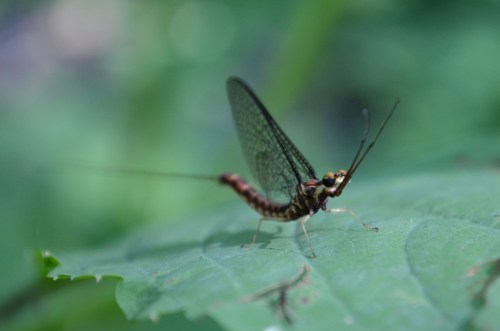
Mayfly (Ephemeroptera)

Mayfly (Ephemeroptera), photo by Todd Marsee, Michigan Sea Grant

Last year Steve Stewart of Michigan State University Extension shared The Mayflies are coming – time to celebrate!:

It’s summer, so it’s time for the mayfly hatch! There are hundreds of species of mayflies (also commonly referred to as fish flies) in North America, representing a number of Families in the Order Ephemeroptera. Ephemeroptera comes from the Greek word for “short-lived” (as in “ephemeral”), and it’s a good name because as winged adults, mayflies only live a few days. The most widespread burrowing mayfly species in the Great Lakes is Hexagenia limbata, the Giant Mayfly.

Mayflies have a very interesting life cycle. They are the only insect to have two “adult” molts, and begin life as eggs laid on the surface of the water that sink to the bottom. The aquatic nymphs of mayflies are called naiads, and creep around rocks and vegetation. After months or years (depending on the species), they float to the surface and molt to a winged, but sexually immature, sub-adult. Often within hours, another molt occurs and the final stage emerges—the winged, reproductive adults, which possess only vestigial mouth parts and cannot eat or drink and, depending on the species, live for only days or, in some cases, mere hours.

One of the most obvious characteristics of the adults is their large numbers. They can emerge in huge numbers from a body of water. So huge, in fact, that their swarms can be seen on Doppler radar! This image is from June 14 showing a mayfly swarm over western Lake Erie, pushed ashore in Monroe County by an easterly breeze. Once ashore, mayflies tend to sit on upright objects and can completely cover the surfaces of posts, sheds, and light poles. At night, they are attracted to lights.

Some people think of mayfly hatches as a nuisance, and they can be a bit annoying when they are swarming. But mayflies are a good thing. Some people think of mayfly hatches as a nuisance, and they can be a bit annoying when they are swarming. But mayflies are a good thing. They are rarely found in degraded bodies of water because their external gills in the nymph stage are very vulnerable to silting and pollution. Mayflies are, therefore, used as an indicator species when testing for environmental quality, and their presence reflects the good quality of the habitat from which they hatched.

Read on for more including photos and school lessons on the Mayfly.

View this photo from the Michigan Sea Grant background bigtacular and see more of their mayfly photos on Flickr.

PS: Thanks to Absolute Michigan pool member Steve Brown for posting the first Mayfly of the season and alerting me.
Stormy Monday

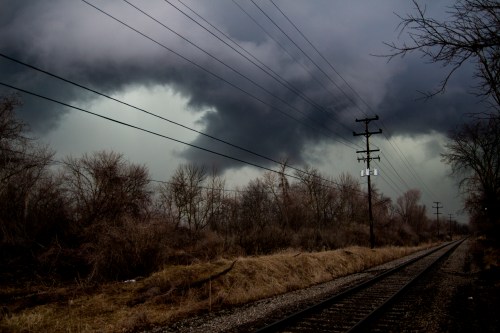
Tornado Warning

Tornado Warning, photo by Jeffrey Smith

WZZM says that severe weather is becoming more likely Monday afternoon as a cold front sweeps through the state:

Monday will begin with sun but storms will develop to the west and advance quickly into West Michigan by late afternoon/early evening time frame. Models are suggesting the atmosphere will be unstable with abundant moisture by Monday afternoon, meaning storms will have a favorable environment to grow.

The NOAA Storm Prediction Center has most of Lower Michigan in the ‘enhanced risk’ area (orange) on Monday meaning several thunderstorms could reach severe levels. To read more about the convective outlook Monday, click here.

Threats from this round of thunderstorms include damaging wind, hail, lightning, isolated tornadoes, and brief heavy downpours. Thunderstorms reach severe criteria when winds are at least 58 mph, hail is one inch in diameter, or a tornado is produced.

Read the detailed forecast for severe weather and you’d like to get more alarmed, check in with Fox 17 West Michigan’s Kevin Craig.

View Jeffrey’s photo bigger and click for more of his clouds photos.

Stormy Monday, T Bone Walker…. and for good measure, B.B. King.

Storming the Harbors of Darkness: DH Day Barn Edition

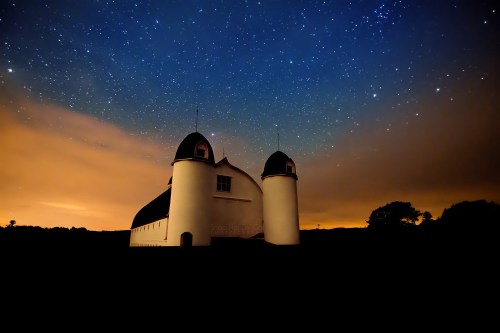
Night and DH Day Barn

Night and DH Day Barn, photo by Heather Higham

This shot of the iconic D.H. Day barn in the Sleeping Bear Dunes National Lakeshore from a couple of days ago is beautiful, dramatic and … wrong. While the orange looks cool against the deep blue, it’s a very visible reminder that our night skies suffer from serious light pollution, even in our most preserved spaces. I encourage everyone to learn about night-sky friendly outdoor lighting options and to advocate in your community for better lighting decisions.

On a less preachy note, if you’re in the Traverse City/Sleeping Bear area tonight, the National Lakeshore is hosting the latest in their “Find Your Park After Dark” night sky events from 9-11 PM at the Pierce Stocking Scenic Drive #3 Overlook. They write:

All sky programs offered by the National Lakeshore are free. Participants need only purchase the Park Entrance Pass or have an Annual Pass displayed in their vehicle to join in the fun. Programs will be cancelled if the sky is not visible due to weather conditions. The decision to cancel is usually made three hours in advance. Please call 231-326-4700, ext. 5005, for a voicemail message with the decision. For all evening astronomy events, bring a flashlight for the walk back to your car and bug spray, if needed. Park rangers and Grand Traverse Astronomical Society (GTAS) staff will wear red glow bracelets at the events.

Each special event takes place at a different location throughout the National Lakeshore to take advantage of strategic viewing opportunities. You can come for star-gazing, eclipses, meteor showers, solar viewing, and storytelling. These events are the perfect opportunity to Find Your Park in the stars. Starry night skies and natural darkness are important components of the special places the National Park Service protects. National parks hold some of the last remaining harbors of darkness and provide an excellent opportunity to experience this endangered resource.

“Harbors of darkness” – what a cool turn of phrase! Head over to the National Lakeshore’s website for more about this and upcoming events.

Over at her blog, the Rapid City Recess, Heather writes about her experience shooting at night with two other photographers – I encourage you to read it.

View Heather’s photo bigger, see more in her Night Sky slideshow and definitely follow her at Snap Happy Gal on Facebook!

More night photography and more Michigan barns on Michigan in Pictures.

Soo Locks, Sault Ste. Marie Michigan

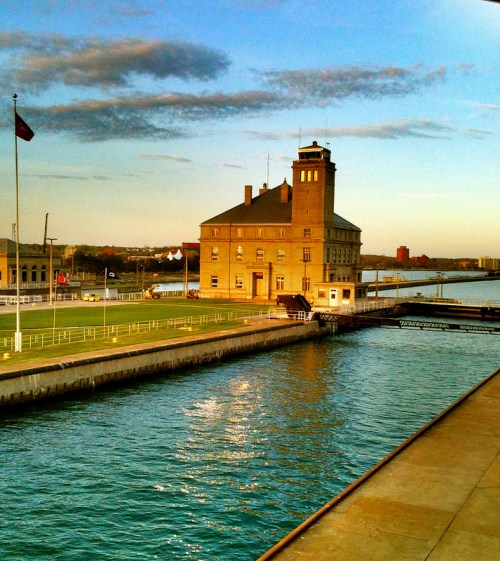
Sunset at the Soo Locks

Sunset | Soo Locks, photo by Camaeleo

While I’ve shared numerous photos from the Soo Locks, I’ve never provided the history of one of Michigan’s defining marvels. The Sault Ste. Marie Convention & Visitors Bureau has a brief Soo Locks history:

In 1797, the Northwest Fur Company constructed a navigation lock 38 feet long on the Canadian side of the river for small boats. This lock remained in use until destroyed in the War of 1812. Freight and boats were again portaged around the rapids.

Congress passed an act in 1852 granting 750,000 acres of public land to the State of Michigan as compensation to the company that would build a lock permitting waterborne commerce between Lake Superior and the other Great Lakes. The Fairbanks Scale Company, which had extensive mining interests in the Upper Penninsula, undertook this challenging construction project in 1853.

In spite of adverse conditions, Fairbanks’ aggressive accountant, Charles T. Harvey, completed a system of two locks, in tandem, each 350 feet long, within the 2 year deadline set by the State of Michigan. On May 31, 1855, the locks were turned over to the state and designated as the State Lock.

The federal government took control of the property and the lock system in the 1870’s. Their stewardship continues today, administered by the U.S. Army Corps of Engineers. The Soo Locks are the busiest locks in the world, and include the largest lock in the Western Hemisphere, completed in 1968.

You can click through for some more information and pictures, but definitely head over to the Detroit Army Corps of Engineers Soo Locks History page for a timeline of all the locks that have been built. You can also get an animated demo of how the locks work and look in on the locks via the Soo Locks Webcams.

View Camaeleo’s photo bigger and see more in their Sault Ste. Marie slideshow.

#TBT: Apple Island in Orchard Lake

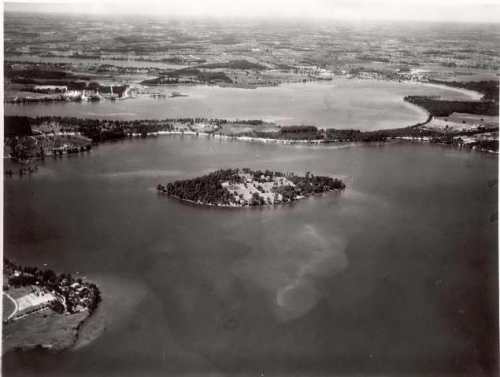
Apple Island

Apple Island Aerial, photo via MSU Michigan History Student Publication

I was fascinated with the Farmer’s Almanac weather history tool this morning, so I went looking for notable Michigan happenings on June 18th…

Wikipedia’s Apple Island entry says that this 35-acre island was formed during the region’s last ice age (10,000 to 12,000 years ago) and lies in the middle of Orchard Lake. The West Bloomfield Historical Society has a nice article on Apple Island that says (in part):

Apple Island’s first admirers were Stone-Age Indians, who may have discovered it as early as 2,000 years ago. They were probably drawn to the site for its unique combination of land- and water-based resources, and the fact that their personal security was also enhanced on an island. It is not known exactly which Native Americans frequented Apple Island over the centuries before white settlement, but each group left clues to its way of life, including those which were raising crops at the time of Carpenter’s 1817 survey. In fact, the entire West Bloomfield lakes area has yielded many beautiful hammerstones, chert spearheads and birdstones – finely polished pieces of slate resembling stylized birds – left by their Native American owners long ago.

The treaty of November 17, 1807, negotiated with the Odawa, Ojibwe, Wyandot, and Potawatomi, ceded a tract of land comprising roughly the southeast quarter of the lower peninsula of Michigan and a small section of Ohio to the United States government. In time this land was surveyed, subdivided and offered for sale. Early settlers in what would become West Bloomfield Township noted that Native Americans visited the island often. In their language they reportedly referred to the area as “apple place” – a name which evidently stuck.

Read on for much more including the possibility that Chief Okemos was born on the island, its first purchase on June 18, 1827 by James Galloway and its current status as the Marjorie Ward Strong Woodland Sanctuary. Definitely check out Michigan History at MSU’s West Bloomfield – Apple Island feature for more photos & info and some really cool hand-drawn maps from the early 1900s.

The source of the “apple place” name is from Dr. Samuel M. Leggett’s epic poem The Legend of Me-nah-sa-gor-ning first circulated in 1909.

More Throwback Thursdays on Michigan in Pictures!

Above the Fog at the Mackinac Bridge

Mighty Mac in Fog

Mighty Mac in the Fog, photo by Lake Superior Photo

Shawn writes that she crossed a very mysterious looking Mackinac Bridge on Sunday – no shortage of fog lately!

View the photo bigger on Facebook and see more & purchase prints in Lake Superior Photo’s Mackinac Bridge Gallery.

More fog & mist on Michigan in Pictures.

Know your Michigan Birds: Eastern Screech Owl

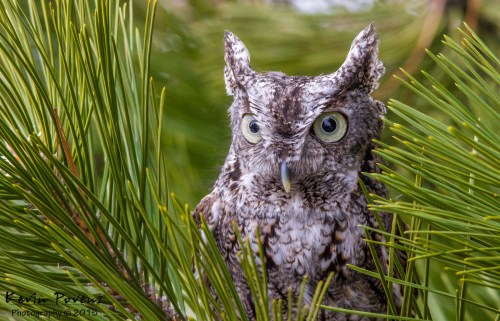
Eastern Screech Owl by Kevin Povenz

Eastern Screech Owl, photo by Kevin Povenz

The Owl Pages says (in part) that the Eastern Screech Owl (Megascops asio):

…is a small, nocturnal woodland Owl with short ear-tufts and yellow eyes. There is a greyish-brown, red and grey morph, with intermediates also occurring. The word “asio” is Latin for ‘Horned Owl’. Eastern Screech Owls have also been called the Common Screech Owl, Ghost Owl, Dusk Owl, Little-eared Owl, Spirit Owl, Little Dukelet, Texas Screech-Owl, Whickering Owl, Little Gray Owl, Mottled Owl, Red Owl, Mouse Owl, Cat Owl, Shivering Owl, and the Little Horned Owl.

…A nocturnal bird, with activity beginning after sunset. The Eastern Screech-Owl flies fairly rapidly with a steady wingbeat (about 5 strokes/second). They rarely glide or hover, but may fly with erratic movements, when manoeuvring through wooded areas. Their wings are broad and the head is held tucked in giving the bird a stubby appearance when flying.When threatened, an Eastern Screech Owl will stretch its body and tighten its feathers in order to look like a branch stub to avoid detection, but will take flight when it knows it has been detected. In open roosts, gray-phase birds tend to roost next to a tree trunk, whereas red-phase birds tend to roost in outer foliage, possibly because of thermal requirements.

…Eastern Screech Owls hunt from dusk to dawn, with most hunting being done during the first four hours of darkness. They hunt mainly from perches, occasionally hovering to catch prey. This Owl mainly hunts in open woodlands, along the edges of open fields or wetlands, or makes short forays into open fields. When prey is spotted, the Owl dives quickly and seizes it in its talons. They will also capture flying insects on the wing.

…Breeding season for Eastern Screech Owls is generally around mid April, but may range from mid March to mid May. They have an elaborate courtship ritual. Males approach females, calling from different branches until they are close. The male then bobs and swivels his head, bobs his entire body, and even slowly winks one eye at the female. If she ignores him, bobbing and swivelling motions intensify. If she accepts him, she moves close and they touch bills and preen each other.

… Eastern Screech Owls inhabit open mixed woodlands, deciduous forests, parklands, wooded suburban areas, riparian woods along streams and wetlands (especially in drier areas), mature orchards, and woodlands near marshes, meadows, and fields. They will avoid dense forests because Great Horned Owls use that habitat. They will also avoid high elevation forests. Eastern Screech Owls roost mainly in natural cavities in large trees, including cavities open to the sky during dry weather. In suburban and rural areas they may roost behind loose boards on buildings, boxcars, or water tanks. They will also roost in dense foliage of trees, usually on a branch next to the trunk, or in dense scrubby brush.

Read on for lots more about screech owls and definitely make owlpages.com your go-to for all things owlish (including screech owl gear).

View Kevin’s photo bigger on Flickr, see a lot more in his fantastic Birds of Prey slideshow and follow him at Kevin Povenz Photos on Facebook.

Requiem for a Spruce: Spruce Budworm in Michigan

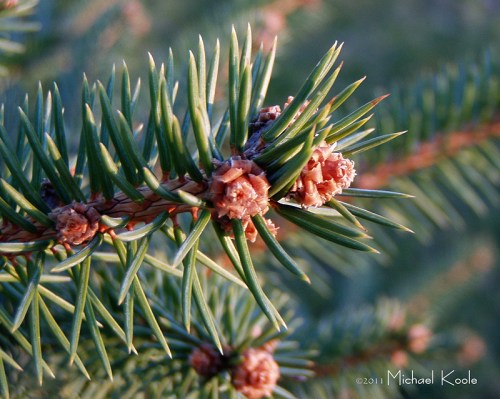
April 11, photo by Michael Koole

April 11, photo by Michael Koole

Garret Ellison of the Grand Rapids Press & mLive writes that the Michigan Department of Natural Resources expects spruce budworm to inflict heavy damage on white spruce and balsam fir trees across the Upper and northern Lower Peninsulas this year:

The budworm is “one of the most destructive native insects” in the northern spruce and fir forests of the eastern U.S. and Canada. The worms drop as caterpillars from treetops on webs and feed on tree growth in the spring.

Repeated budworm defoliation can cause top-kill and death in older and stressed trees. Balsam fir older than 60 and spruce over 70 years are prime targets. Younger trees infested with budworms lose much new growth but generally survive.

Read on for more, including how to protect your trees. The U.S. Forest Service has more about the spruce budworm:

The spruce budworm Choristoneura fumiferana (Clemens) is one of the most destructive native insects in the northern spruce and fir forests of the Eastern United States and Canada. Periodic outbreaks of the spruce budworm are a part of the natural cycle of events associated with the maturing of balsam fir.

The first recorded outbreak of the spruce budworm in the United States occurred in Maine about 1807. Another outbreak followed in 1878. Since 1909 there have been waves of budworm out breaks throughout the Eastern United States and Canada. The States most often affected are Maine, New Hampshire, New York, Michigan, Minnesota, and Wisconsin. These outbreaks have resulted in the loss of millions of cords of spruce and fir.

Balsam fir is the species most severely damaged by the bud-worm in the Eastern United States. White, red, and black spruce are suitable host trees and some feeding may occur on tamarack, pine, and hemlock. Spruce mixed with balsam fir is more likely to suffer budworm damage than spruce in pure stands.

If you’re intrigued by the “natural cycle” as I was, head over to Wikipedia’s entry on Choristoneura fumiferana, the Eastern Spruce Budworm for an explanation and some pics of these (for a change) native pests.

View Michael’s photo bigger and see more (including lots of tasty macro) in his Around the Yard slideshow.

PS: Sorry about the Monday morning novel … sometimes I over share. ;)

Shipwreck Saturday: The Wreck of the Minnehaha

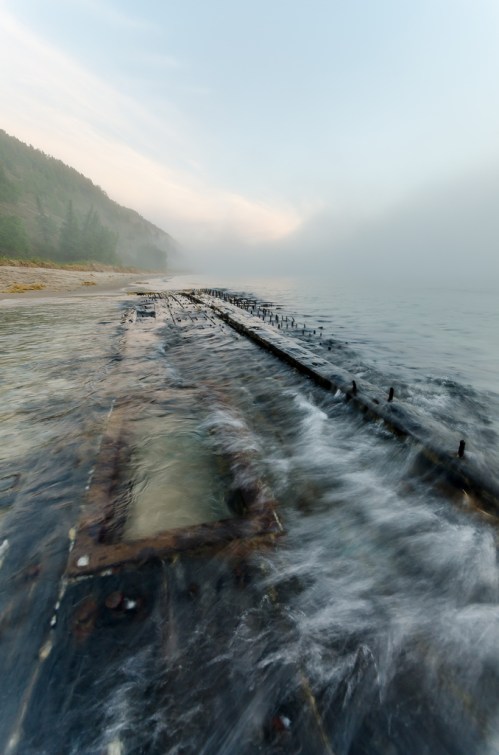
Taking on Water

Taking on Water, photo by Aaron Springer

“She was built in 1880 [by Linn & Craig in Gibralter, Michigan] and has been unfortunate from the start. Two years ago [in 1891] she was wrecked near Detour [at the north end of Lake Huron], and remained on the rocks all winter, being abandoned to the underwriters, who finally rescued the wreck and sold it.”
~ Buffalo Evening News Monday, October 16, 1893

Historic Arcadia Michigan tells the tale of The Wreck of the Minnehaha:

In October of 1893, the steam barge Henry J. Johnson was towing the Minnehaha from Chicago bound for Point Edward at the south end of Lake Huron with 58,000 bushels of corn. At 7:30 PM on October 13, the two ships found themselves off Point Betsie facing 90 mile per hour gale force winds. They tried to find shelter behind the Manitou Islands, but at dawn the next day, they were still south of Sleeping Bear Point fighting high winds and waves to stay out of shallow water.

Captain Benniteau of the Johnson decided to turn the ships south and head to Frankfort, the nearest refuge. However, somewhere near Frankfort high waves crashed over the Minnehaha’s deck, smashed two hatch covers, and began filling the hold with water. William Parker, captain of the Minnehaha, realizing his ship was in serious trouble, sent up distress signals, released the tow lines, and headed for the beach. There was nothing the crew of the Johnson could do but avoid the same shallow water.

The Minnehaha ran aground about a quarter of a mile offshore between Burnham and Arcadia. To avoid the waves sweeping the decks, all but one member of the crew, who drowned trying to swim to shore, climbed into the ship’s rigging. As the ship was breaking up, the captain called to the crew to grab whatever would float and go over the side anyway. But only the captain made it to shore safely. One crew member made it to a pier, but was too tired to hold onto a pole used to try to pull him to safety.

Read on for much more including photos of the Minnehaha.

Check out Aaron’s photo bigger where he also has a pic of the wreck in calm water and see many more of his great photos of Lake Michigan.

More Michigan shipwrecks on Michigan in Pictures!

Game on for Michigan’s Strawberry Season

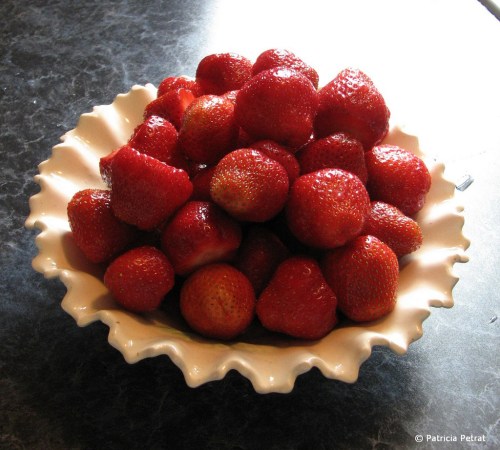
First Michigan Berries of the year. Early Glow variety. Yum!

First Michigan Berries of the year…, photo by Trish P.

Westview Orchards in Washington Township north of Detroit let me know yesterday that they’ll have strawberries to pick this weekend. Real Time Farms agrees strawberries are starting to roll into southern Michigan farm markets from farmers including Prochaska Farms of Tecumseh, who had some at the Saline Farmers Market last Saturday. If picking your own is more your speed, U-Pick Michigan has up-to-date reports.

I should add that we got some organic ones yesterday at the Sara Hardy Downtown Farmers Market in Traverse City​. I believe they came from Ware Farm​ of Bear Lake – you can see them right here!

The Michigan Ag Council’s page on strawberries says that:

Michigan’s strawberry season starts in early June and can extend into mid July. Look for Michigan strawberries in-store or find them where they’re largely produced, in Berrien, Leelanau and Van Buren counties.

Michigan Strawberry facts:

  • Michigan grows strawberries for both fresh and processed uses
  • In 2009, Michigan produced 43,000 tons of fresh strawberries and 3,000 tons of processed strawberries, generating $6.6 million
  • Most of the fresh Michigan strawberries were picked by consumers at “u-pick” operations around the state
  • Strawberries contain 80 percent of the recommended daily allowance of vitamin C
  • They are an excellent source of potassium, which can help control blood pressure and fight strokes
  • They are an excellent source of fiber, which help reduce total cholesterol levels

In kind of a neat little coincidence, my friend Trish snapped this photo five years ago on June 12, 2010! She’s got a great blog entry on making strawberry preserves, something that’s definitely a Michigan tradition.

View her photo of Early Glow strawberries from the Bardenhagen Berry Farm on the Leelanau Peninsula bigger and see more in her delicious Michigan harvest slideshow.