2016 Michigan Morel Season Underway!

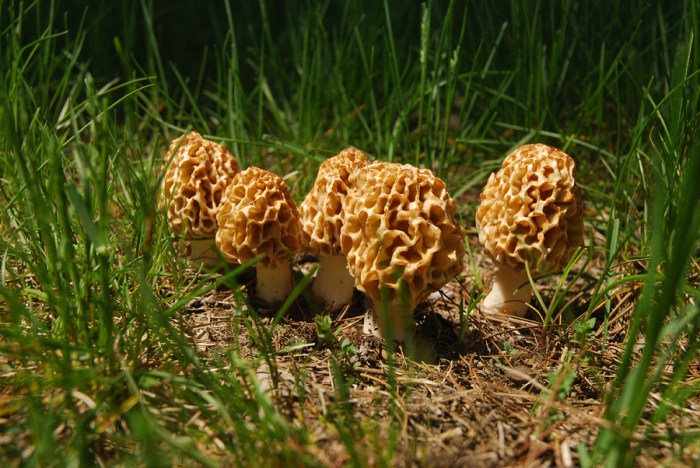
Backyard Morels

backyard morels, photo by Jason Rydquist

I’ve been getting word from various parts of the state that morel mushrooms are being found! They’re one of my favorite Michigan foods, and over on Absolute Michigan today I’ve put together Five Things you need to know about Michigan Morels. It includes a new online tool that could be of use to morel hunters so check it out!

View Jason’s photo bigger and see more in his slideshow.

Lots more morels on Michigan in Pictures.

Skyline Trail at Ludington State Park

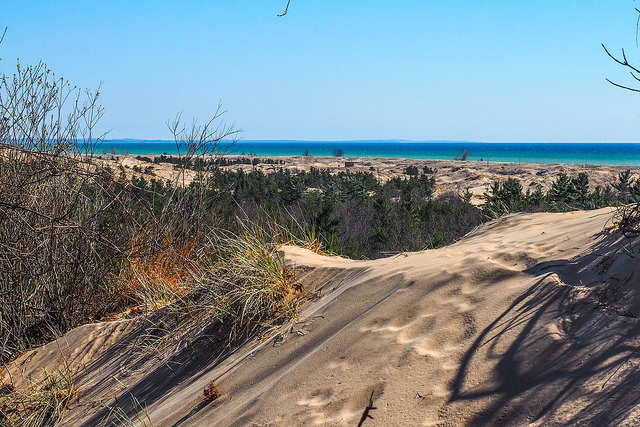
Ludington State Park Skyline Trail

Ludington St. PK, Skyline Trail 2, photo by Jerry Herrendeen

Visit Ludington’s page on Ludington State Park’s trails says:

The Skyline Trail runs along a tall sand dune ridge, on the south side of the river between the footbridge and Hamlin Dam. The trail begins at the west end of the parking lot and exits onto the Sable River Trail. This trail is completely elevated, made even higher by an extensive wooden boardwalk system. Several vistas let you look out over miles of sand dunes and Lake Michigan. On a clear day, you can see 20 miles to the Silver Lake State Park Sand Dunes. On the back side is an area where you can leave the boardwalk and run up and down the steep slope of this sand dune.

Read on for more about other trails at the park and click for the official Ludington State Park page.

View Jerry’s photo background big and see lots more in his Moods of Lake Michigan slideshow.

More Ludington and more spring wallpaper on Michigan in Pictures.

Purple Rain: Colors of the Northern Lights

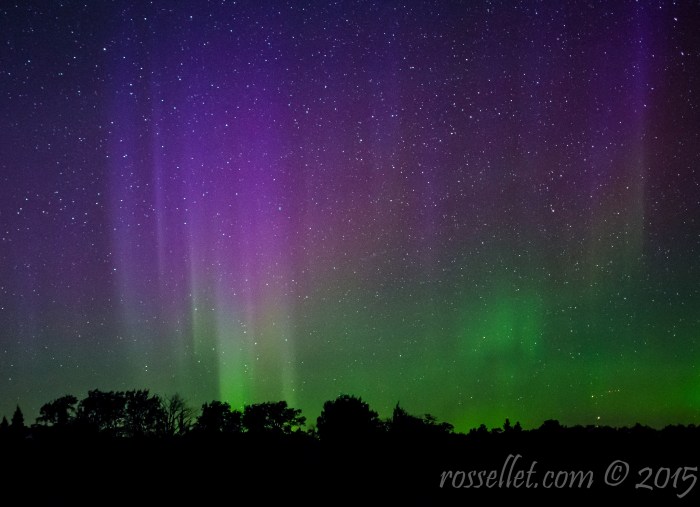
Purple Aurora

Isle Royale Aurora, photo by Ross Ellet

Music is music, ultimately. If it makes you feel good, cool.
~Prince

Prince was a musician who had a huge effect on my life. I went to school near Minneapolis when he was transforming music through his own work and what he did with a host of artists. I’m very sad at his passing. Down at the bottom I have one of my favorite clips of Prince.

I’ve been lucky enough to see the northern lights dozens of times but have probably only seen purple auroras three or four times. Causes of Color explains the colors of the northern lights:

The sun radiates all visible colors, which is why sunlight appears white. The spectrum of visible light associated with the aurora is much more restricted. The aurora is caused by charged particles in the solar wind colliding with atmospheric atoms and ions. The collisions cause the electrons of the atmospheric atoms to become excited. As the electrons return to their original energy levels, these atoms emit visible light of distinct wavelengths, to create the colors of the display we see.

The color of the aurora depends on the wavelength of the light emitted. This is determined by the specific atmospheric gas and its electrical state, and the energy of the particle that hits the atmospheric gas. The atmosphere consists mainly of nitrogen and oxygen, which emit the characteristic colors of their respective line spectra. Atomic oxygen is responsible for the two main colors of green (wavelength of 557.7 nm) and red (630.0 nm). Nitrogen causes blue and deep red hues.

Most of the auroral features are greenish-yellow, but sometimes the tall rays will turn red at their tops and along their lower edges. On rare occasions, sunlight will hit the top part of the auroral rays to create a faint blue color. On very rare occasions (once every 10 years or so) the aurora can be a deep blood red color from top to bottom. Pink hues may also be seen in the lower area of the aurora. In addition to producing light, the energetic auroral collisions transmit heat. The heat is dissipated by infrared radiation, or transported away by strong winds in the upper atmosphere.

Read on for more and also check out more about the Northern Lights on Michigan in Pictures.

Ross took this on August 10th last summer. He says “The Northern Lights over Moskey Basin in Isle Royale National Park. This is the first time in my life I have seen a bright purple aurora develop.

View his photo background bigilicious and see more in his Aurora slideshow.

Lapeer Courthouse, oldest in Michigan

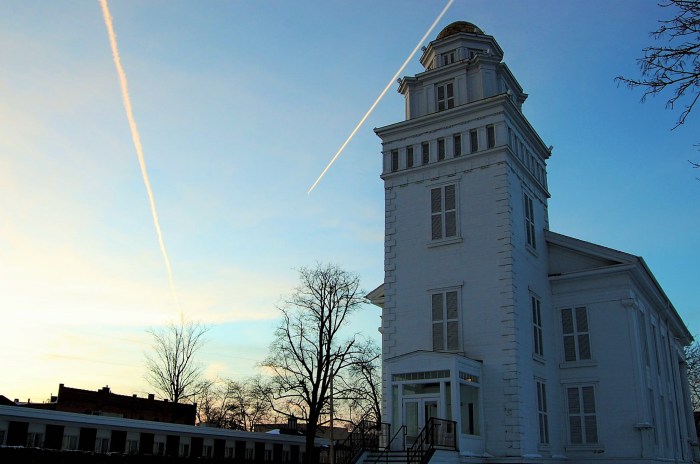
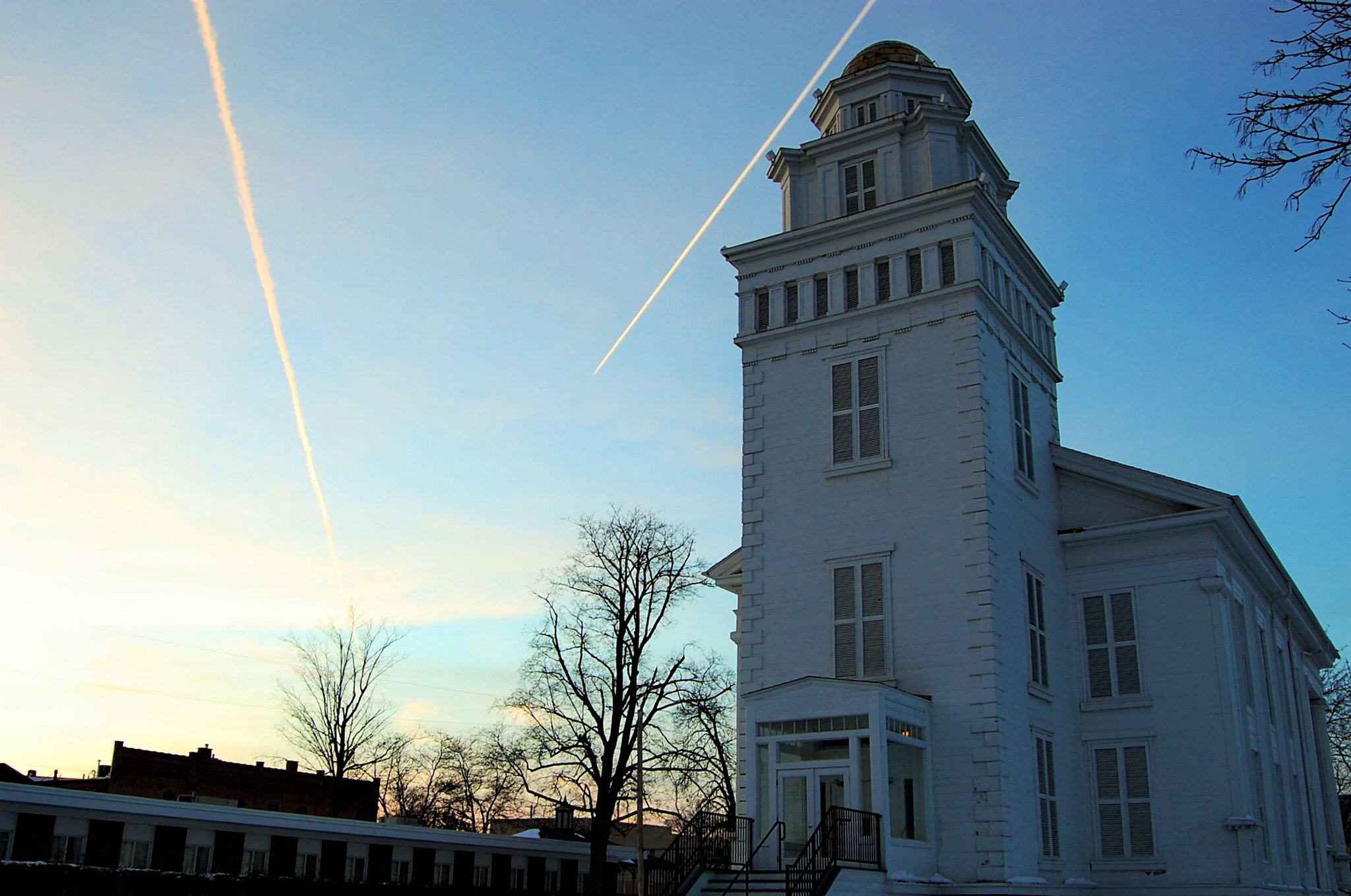
Downtown Lapeer MI

Downtown Lapeer MI, photo by paula liimatta

Wikipedia says that the the Lapeer County Courthouse is the oldest original courthouse structure still in use in the state of Michigan, and one of the ten oldest in the nation.

The City of Lapeer’s history page adds:

Folklore claims Lapeer was derived from the naming of the south branch of the Flint River, which flows northwestward over quite a long distance of rocky bed in Lapeer County. French and Indian traders frequently passed over this section of the county and through the river, ultimately naming our city for the stone that lay at the river bottom. The translation of stone in French is “LePierre”; the English translation of Canadian French accent of this word is “Lapeer”. The river was named Flint, synonymous with stone.

Lapeer County was once part of the Northwest Territory. By an ordinance of the Congress of the United States passed July 13th, 1787, the whole of the territory of the United States lying northwest of the Ohio River, though still occupied by the British, was organized as the Northwest Territory. In January of 1820 the County of Oakland was formed. Governor Lewis Cass set Lapeer County’s boundaries on September 18th, 1822, although it remained part of Oakland County until it was organized. Lapeer County officially became a county on February 2nd, 1835.

Read on for more and click for information about renting the courthouse.

View Paula’s photo background big and see more in her 2016 slideshow.

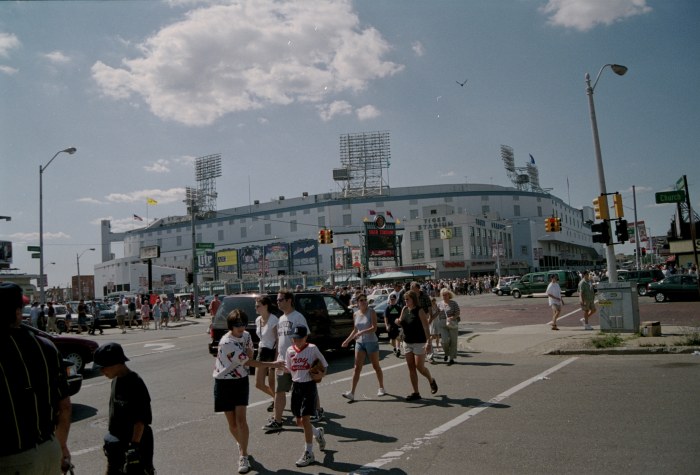
Happy Birthday, Tiger Stadium

Michigan and Trumbull

Michigan and Trumbull, photo by Joel Dinda

Over on Absolute Michigan there’s a feature entitled 100 (plus) years at Tiger Stadium. It has a ton of photos and links including this excellent column written four years ago by Eric Adelson of Yahoo Sports about the 100th anniversary of Tiger Stadium passing relatively unnoticed:

Tiger Stadium opened on the same day as Fenway Park – April 20, 1912. It was 100 years ago this weekend. Ty Cobb scored the first run by stealing home. From that day until 1999, this very spot rumbled with din and greatness.

…Lou Gehrig sat himself down for the first time in 2,130 games here, ending his incredible ironman streak. Babe Ruth hit his 700th home run here. Reggie Jackson hit one into the right field light tower here during the ’71 All-Star game. The Tigers won World Series titles here in 1968 and again in 1984, with Kirk Gibson launching a late-inning home run off Goose Gossage that no Tigers fan alive to see it will ever forget. Fair to say this was the most exciting place in the history of Michigan.

Read on for more.

View Joel’s photo background bigtacular and see more in his 7/11/1999 – Brewers vs Tigers slideshow.

Here’s a great video from PBS’s America’s Ballparks hosted by Jeff Daniels and featuring many Detroit Tigers greats.

More Detroit Tigers on Michigan in Pictures.

Lynx rufus, Bobcat in Michigan

It’s feeling like Wild Kingdom week at Michigan in Pictures. An update on the eagle nest from yesterday is that one of the eggs is now an eaglet – click to view!!
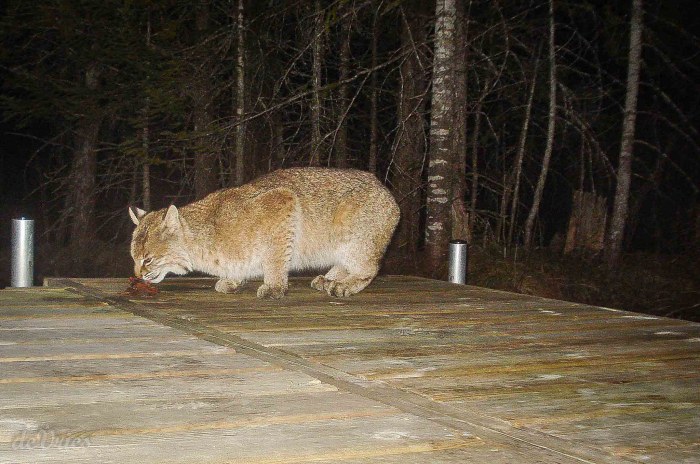
Bobcat on the Dock

Close Encounter…, photo by Dale DeVries

Dale writes that this close encounter was…

Of the Kitty Cat kind! Around dusk last night I saw the flash from my trail cam go off, so I grabbed binoculars to see what was on the dock. It was so dark I really could not make out what was there, I assumed it to be a raccoon or two. I was quite surprised to see this beautiful Bobcat patrolling the water’s edge!

The UM Animal Diversity Web’s entry for Lynx rufus, the bobcat says (in part):

Bobcats can be found in a variety of habitats, including forests, semi-deserts, mountains, and brushland. They sleep in hidden dens, often in hollow trees, thickets, or rocky crevices.

…Bobcat fur can be various shades of buff and brown, with dark brown or black stripes and spots on some parts of the body. The tip of the tail and the backs of the ears are black. They have short ear tufts, and ruffs of hair on the side of the head, giving the appearance of sideburns.

Like many felids, bobcats are solitary animals. The male and female interact almost exclusively during the mating season. These cats rarely vocalize, although they often yowl and hiss during the mating season. Bobcats are basically terrestrial and nocturnal, although they are good climbers and are often active at dusk as well as during the night.

Bobcats are strictly meat eaters. Stealthy hunters, they stalk their prey, then pounce and (if successful) kill with a bite to the vertebrae of the neck. They hunt rodents, rabbits, small ungulates, large ground birds, and sometimes reptiles. They occasionally eat small domesticated animals and poultry.

Bobcats live up to 12 years in the wild. In captivity, they may live up to 32 years.

Read on for more including photos and bobcat calls and in case you’re trying to figure out what you’re looking at, here’s page on distinguishing Michigan cougars & bobcats and another on the difference between bobcat & lynx (Lynx canadensis) that includes their distinct profiles.

View Dale’s photo background big and see more in his Fern Ridge Pictures slideshow.

More Michigan animals on Michigan in Pictures.

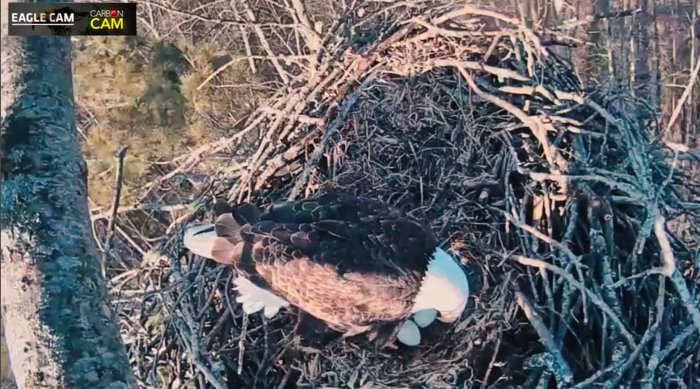
Platte River Bald Eagle Nest Cam

Platte River Eagle Cam

Michigan Eagle Cam, photo via Carbon TV

Carbon and the Michigan Department of Natural Resources are collaborating on a cool webcam of a nesting pair of bald eagles in Benzie County. mLive explains:

Cameras are pointed at a pair of nesting bald eagles in residence at the Platte River State Fish Hatchery. The large nest is 100 feet above the ground, along the Platte River in Benzie County.

Carbon Media Group alerted viewers earlier this week that incubation time is almost up, and that small holes called “pips” that parents make in the shells can be seen on two of the eggs.

“This pair of eagles have been regular visitors to this nest for the past three years,” Ed Eisch, DNR fish production manager, has said.

Click to view the live camera – which makes a really soothing background soundtrack – and also to check out video clips including an eagle adjusting the eggs from the photo above and visits by owls and pine martens!

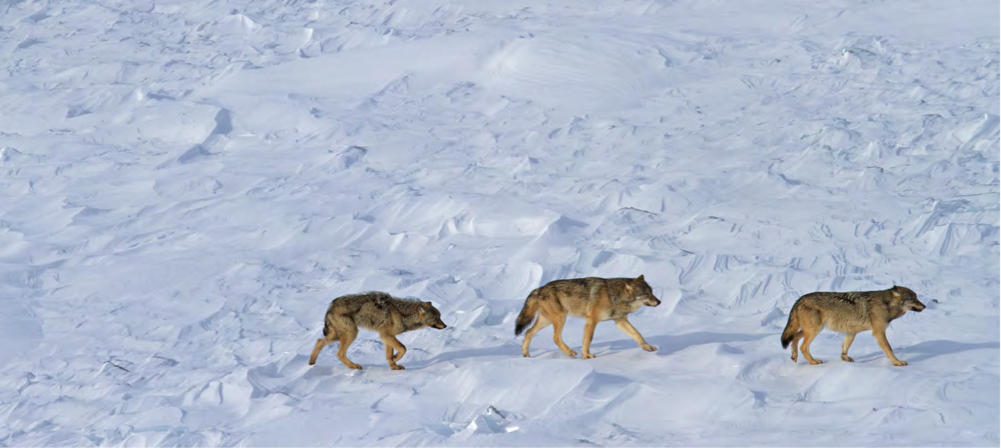
Making Decisions about Wolves on Isle Royale


3 Isle Royale wolves 2015

Three Wolves, photo by Vucetich & Peterson

With only a handful of wolves left in Isle Royale National Park, the National Park Service is currently taking public comment on the management of wolves at Isle Royale. They write:

The NPS began this planning process by considering a broad range of potential management actions as part of determining how to manage the moose and wolf populations for at least the next 20 years. However, based on the public comments we received and additional internal deliberations, the NPS has determined that it will revise and narrow the scope of this EIS to focus on the question of whether to bring wolves to Isle Royale National Park in the near term, and if so, how to do so.

Although wolves have not always been part of the Isle Royale ecosystem, they have been present for more than 65 years, and have played a key role in the ecosystem, affecting the moose population and other species during that time. The average wolf population on the island over the past 65 years has been about 22, but there have been as many as 50 wolves on the island and as few as three. Over the past five years the population has declined steeply, which has given rise to the need to determine whether the NPS should bring additional wolves to the island. There were three wolves documented on the island as of March 2015 and only two wolves have been confirmed as of February 2016. At this time, natural recovery of the population is unlikely.

The potential absence of wolves raises concerns about possible effects to Isle Royale’s current ecosystem, including effects to both the moose population and Isle Royale’s forest/vegetation communities. The revised purpose of the plan, therefore, is to determine whether and how to bring wolves to Isle Royale National Park to function as the apex predator in the near term within a changing and dynamic island ecosystem.

The photo above from the 2014-2015 Annual Report from the Vucetich & Peterson Ecological Studies of Wolves on Isle Royale shows three wolves observed at winter study 2015. More on their website at isleroyalewolf.org and definitely follow Wolves and Moose of Isle Royale on Facebook for updates!

More wolves on Michigan in Pictures.

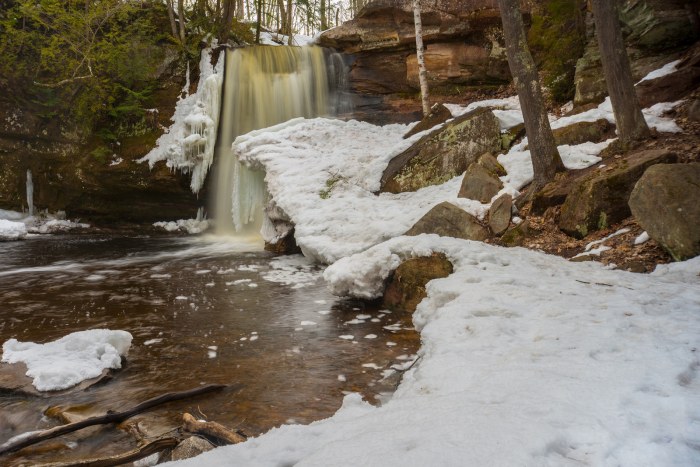
Breaking Through at Middle Hungarian Falls

Breaking Through at Middle Hungarian Falls

Breaking Through, photo by Eric Hackney Photography

The Hungarian Falls page from GoWaterfalling says:

Dover Creek tumbles overs a series of falls on its way down to Torch Lake. Two of the falls are around 20 feet high, and the last is a 50 foot drop, which is spectacular when the water is flowing. Unfortunately these falls are often nearly dry in the summer.

There are three falls 15 feet or higher on a half mile stretch of Dover Creek, plus a couple of smaller drops. In the spring time, or after some good rains, these waterfalls are very impressive. Unfortunately the creek has a very small watershed, and the falls are often reduced to trickles.

The three main drops are usually referred to as the upper, middle and lower falls. The upper falls is around 20 feet high. The water spills over an irreguarly shaped cliff into a small gorge.

Downstream of the upper falls is a dam and artificial lake. Below the dam are a couple of smaller drops, and the middle falls. The middle falls is also about 20 feet high, and is perhaps the most scenic in lower water. The cliff face here is smoother, and the water is not segmented the way it is at the upper falls. The middle falls is also the easiest to reach and there are plenty of good viewing spots.

Head over to GoWaterfalling.com for directions and info about the other falls!

Eric says that this photo shows that that Spring is at least trying to show up. Check it out bigger and definitely follow Eric Hackney Photography on Facebook!

More waterfalls on Michigan in Pictures!

Double Rainbow

Double Rainbow

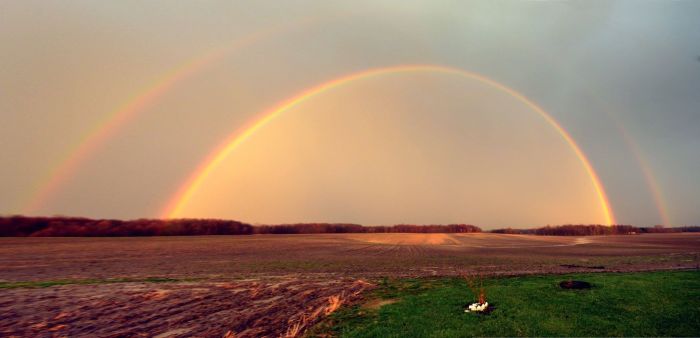
Double Rainbow, photo by Your Hometown Photography 

I simply love Atmospheric Optics for nearly everything about lights in the sky. Regarding secondary rainbows or “double rainbows” they say that the secondary is nearly always fainter than the primary, with colors reversed and more widely separated:

Light can be reflected more than once inside a raindrop. Rays escaping after two reflections make a secondary bow.

The secondary has a radius of 51º and lies some 9º outside the primary bow. It is broader, 1.8X the width of the primary, and its colours are reversed so that the reds of the two bows always face one another. The secondary has 43% of the total brightness of the primary but its surface brightness is lower than that because its light is spread over its greater angular extent. The primary and secondary are are concentric, sharing the antisolar point for a center.

About this particular rainbow from April 2, 2016, Gerry writes: “Double rainbow from the other night after the storms. The weather in Michigan can change quickly, from rainbows to snow. Yep, that’s Michigan.” 

Indeed. View her photo bigger and follow Your Hometown Photography on Facebook for more.

More rainbows on Michigan in Pictures.