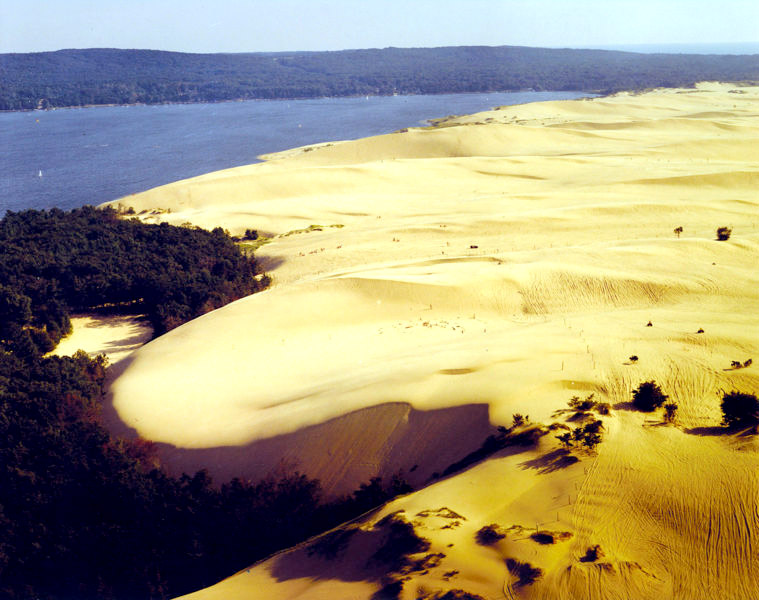
Parasailing at the Sleeping Bear Dunes National Lakeshore

IMG_0021

IMG_0021, photo by ansonredford.

Shot back before digital in the Sleeping Bear Dunes National Lakeshore. Here’s some information about parasailing and powerless flight in the Sleeping Bear Dunes.

Check this out bigger and in his Sleeping Bear Dunes Nat’l Lakeshore set (slideshow).

More dunes on Michigan in Pictures,

lost

lost

lost, photo by bealebo (bitten by strobist bug).

Check this out bigger in her slideshow.

I hope you’re finding ways to fill your time now that Lost is lost.

Silver Lake Dunes and the Silver Lake State Park


Silver Lake Dunes State Park, photo by Dale Fisher, US Army Corps of Engineers

Unlike the Sleeping Bear Dunes, the Silver Lake Sand Dunes allow private motorized vehicles. The Think Dunes area info site says that in fact, they’re the only dunes East of Utah that allow you to drive a private motorized vehicle (April 1st through October 31st). There are fees and restrictions that you’ll probably want to read about. You can also have Mac Woods Dune Rides drive you through the dunes! Driving not your cup of tea? Fear not – in the middle of the Silver Lake State Park there is a non-vehicle area they call the Walking Dunes.

The State of Michigan’s Dunes Information Page says that the Silver Lake Dunes are a type known as:

Parallel dunes are series of low, linear dunes formed parallel to the shores of large shallow bays. The parallel dunes along the eastern shore of Lake Michigan were formed about 4,000 years ago during the Lake Nipissing stage of Lake Michigan, when water levels were 25 to 30 feet higher than present day Lake Michigan water levels. Rivers entering the bays carried abundant sand, which was then moved along the shore by lake currents.

On shore winds formed these sands into low lying dunes. As the water level of ancient Lake Nipissing dropped, a series of parallel dunes were created. They occurred in areas that were formerly wide bays in Lake Nipissing.

Today, some examples of parallel dune complexes can be seen at the mouth of rivers, including the Muskegon, Kalamazoo, and Grand. Remnants of several ancient bays now are coastal lakes, such as Hamlin Lake in Mason County, Silver Lake in Oceana County, and White Lake in Muskegon County.

Check the photo above out bigger. Dale also had this great shot of the Sliver Lake Dunes from high above Lake Michigan.

More about Michigan dunes on Michigan in Pictures!

November on Old Indian Trail

November - Old Indian Trail

November – Old Indian Trail, photo by cedarkayak.

Last November Todd wrote:

In November, the Michigan sun has dropped low to the horizon, and the first hints of snow are starting to lace the ground. The forest belongs to the deer hunters who have waited all year for hunting season. The approaching Winter is getting hard to ignore.

It’s a little sunnier and warmer now, but you can feel winter approaching almost every day. If you decide to head out to the amazing Old Indian Trail in the Sleeping Bear Dunes National Lakeshore, do be aware that the Park allows hunting in most areas. FYI, this trail offers amazing views of Sleeping Bear Point and Platte Bay all year long!

You can see this photo bigger. It’s also part of Todd’s cool One Year in Michigan set and his Sleeping Bear Dunes set (slideshow).

Here’s a few more shots of Old Indian Trail from the Sleeping Bear Dunes group and here’s a video from the trail.

TC 350 at the Sleeping Bear Dunes

KAScott_20090926_5415_cb

KAScott_20090926_5415_cb, photo by Ken Scott.

Head over to 350 is something you need to know, Michigan on Absolute Michigan to see the amazing time-lapse video Ken Scott created and to learn more about the 350 movement and TC 350.

This photo is part of Ken’s movie clips from stills set (slideshow) and you can see much more of his work at kenscottphotography.com!

Silver Lake Sunset

DSC_0387

DSC_0387, photo by Jennifer Kleinheksel.

Like many lakes along the Lake Michigan shore, Silver Lake is a bay of the prehistoric Lake Nipissing that was closed in by coastal sand dunes. The Silver Lake Dunes Area’s fishing page says that Silver Lake is great fishing hole for Walleye, Largemouth and Smallmouth Bass, Northern Pike, Bluegill, and Black Crappie, while you enjoy the scenic beauty of the Sand Dunes. It’s part of Silver Lake State Park and you can see the view looking back at the lake from the air on Wikipedia.

Be sure to check this out bigger and also Jennifer’s Silver Lake set (slideshow).

Atmospheric Illusion – Fata Morgana

Atmospheric Illusion - Fata Morgana #1/3

Atmospheric Illusion – Fata Morgana #1/3, photo by jimflix.

I’ll turn Michigan in Pictures over to Jim today to talk about a phenomenon that we see on the Great Lakes.

This strange visual / atmospheric effect was going on that early May evening above the Manitou Islands — like a double reflection at a certain height above the water. That’s the South Manitou Lighthouse.

It turns out this is a Fata Morgana — “an atmospheric mirage, commonly seen in frigid Polar regions, caused by complexly arranged thermal gradients, within a temperature inversion. The word, from Italian, means ‘Fairy Morgan’, and alludes to Morgan LeFay, King Arthur’s sorceress half sister, who legendarily had the power to create crystal palaces in the air.” See here for more details.

This was taken standing on the shore at Sleeping Bear Point. In this photo, noise was reduced and the color enhanced, but otherwise it’s unaltered. Here are two more photos taken the same night: one and two.

Be sure to check out the other photos Jim has linked above, see this bigger and explore his Manitou Islands set (slideshow)

Read more about the South Manitou Island Lighthouse from the Sleeping Bear Dunes National Lakeshore and also about the South Manitou Island Lighthouse Project.

Fog Bank at Grand Sable Dunes

Fog Bank

Fog Bank, photo by siskokid.

Jim writes:

Fog rolls off of Lake Superior and up the Grand Sable Dunes on the Pictured Rocks Lakeshore as seen from the Log Slide Overlook west of Grand Marais in the Upper Peninsula Of Michigan. The Grand Sable Dunes are located on a five mile stretch between the Sable River and Au Sable Point in Alger County. The banks rise up to 275 feet high, created during the last ice age when sand and gravel filled in a deep rift in the glacier. Atop the gravelly banks, sand dunes rise another 80 feet. These are “perched dunes” because they are perched on top of another landform. They were probably formed when wind and waves piled up sand at the edge of Lake Nipissing, the forerunner of Lake Superior.

If you click through to Flickr you can see a few other shots from one of the most amazing vantages in Michigan. Be sure to check this out bigger or in his Lake Superior Slideshow.

For more, check out Grand Sable Dunes on Michigan in Pictures.

Jumping into summertime

Camping - P.J. Hoffmaster State Park

Camping – P.J. Hoffmaster State Park, photo by plounsbury.

Summer is here – jump off!

Memorial Day, Michigan Style on Absolute Michigan has lots of Memorial weekend fun.

Check it out bigger and on the P. J. Hoffmaster State Park entry on the Absolute Michigan map.

Grand Sable Dunes In Winter

Grand Sable Dunes In Winter

Grand Sable Dunes In Winter, photo by mandj98.

James says they rode his brother’s snowmobiles back along H58 to this overlook of Grand Sable Dunes in the Pictured Rocks National Lakeshore last weekend.

Grand Sable DunesHe has more photos from Pictured Rocks in winter & all seasons in his tremendous Pictured Rocks National Lakeshore set (slideshow) with tons of photos including the pic to the right of the same scene in August.

I was a little surprised to find that I hadn’t written anything about Grand Sable Dunes on Michigan in Pictures. In my opinion, it’s one of the most amazing vistas in Michigan, a broad sweeping dune that arcs along the shore of Lake Superior. It’s a great hike, either from the drive-up overlook (where you can view or visit the Au Sable Light Station) or by walking along the base on the Superior shore just a mile west from Grand Marais. Michigan Tech has a nice writeup on the history, geology and natural character of the Grand Sable Dunes. They’re a perched dune like the Sleeping Bear Dunes in lower Michigan that were formed when:

Glacial ice that melted within the Superior Basin produced many large rivers after the last major readvance, The Marquette readvance, in North America. These rivers deposited millions of tons of debris into many different configurations south of the Superior Basin. The Grand Sable Banks may have originated as a glaciofluvial kame terrace along one of these glacial rivers during deglaciation.

Pictured Rocks then became very dry about 9500 years before present due to the Lake Superior basin draining to the north. The outlets to the east were now the low spots. A north facing ice contact bluff and a platform to the south of it remained in place for 4500 years after deglaciation right around the area where Grand Marais is located today.

Isostatic rebound then occurred about 4000 to 6000 years before present. North Bay began to rise which caused water levels to rise rapidly. In fact, Lake Superior rose to about 40 feet higher than it is today! The rise in lake levels formed Lake Nipissing. Lake levels of Lake Nipissing also began to rise which caused the Grand Sable Banks to become unstable. From this point the formation of a perched dune can explain how the dunes formed from the Grand Sable Banks.

When Lake Nipissing water level rose it caused the Grand Sable Banks to become unstable. In turn, the high water eroded the bluffs which left them exposed to wind. A dominant northwesterly wind blew through the Grand Sable Banks which carried the wind from the bluff to the top of the flat upland. This sand was “perched” on top of the upland, hence the name, “perched dune system.”

You can check out Grand Sable Dunes on Absolute Michigan’s Map of Michigan and check out the Grand Sable Dunes slideshow on Flickr. I have written a fair amount on Pictured Rocks that you might enjoy.