
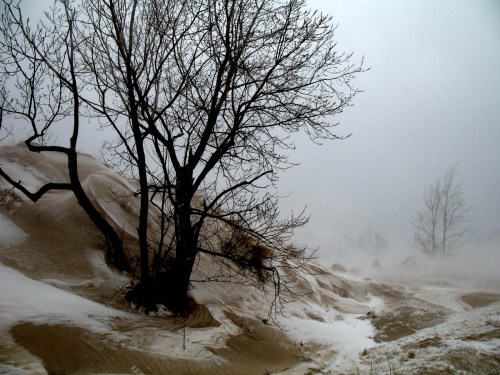
Earth Wind and Snow, photo by Beth
One of the lesser known bands of the 70s…
View Beth’s photo from the beach at Holland background bigtacular and see more in her Winter slideshow.
More winter wallpaper on Michigan in Pictures!
Earth Wind and Snow, photo by Beth
One of the lesser known bands of the 70s…
View Beth’s photo from the beach at Holland background bigtacular and see more in her Winter slideshow.
More winter wallpaper on Michigan in Pictures!

Grand Mere Dunes, photo by mswan777
Grand Mere State Park is located on the southwestern shore of Lake Michigan near Stevensville. The Environmental Protection Agency’s Sand Mine Restoration Plan explains that Grand Mere:
…contains some of the most unique sand dune features in the world. The park also contains three lakes, called North, Middle, and South Lake, and has over one mile of Lake Michigan frontage. The sand dunes within the park are part of the largest freshwater dune system in the world, lining the shores of the Great Lakes. These dunes historically supported a wide array of natural communities, including dry-mesic southern (oak-hickory) forest, rich conifer (cedar) swamp, southern (mixed hardwood) swamp, wetpanne and interdunal wetland (shrub swamp/emergent marsh), open dunes, and a wooded dune and swale complex.
The dunes at Grand Mere fall within a state-designated “Critical Dune Area.” The area containing the present-day park was also designated a National Natural Landmark in 1968. The park was first created on 393 acres of land in 1973, and more than doubled in size with the acquisition of 490 additional acres in 1986. The master plan for Grand Mere State Park, approved in 1986, cited “sand dune preservation” as the primary management objective for the park. A highly diverse flora exists at Grand Mere, with over 550 species of plants documented within the park. Furthermore, Grand Mere lies in a unique place on the southern shore of Lake Michigan where plants typical of both northern and southern temperate latitudes grow together in the same community. Because of the unique flora, fauna, and geology of the dune and wetland features at Grand Mere, the park has long been used as an “outdoor laboratory” for natural resource teaching and research.
…Within the park, the dominant landforms are the sand dunes along the shore of Lake Michigan. A large bay of the glacial Great Lakes was present where Grand Mere State Park is today. During Algonquin Great Lakes time (roughly 12,000 years ago), a large spit formed from the south along the west side of the bay, nearly cutting it off from the glacial lake (Tague 1947). Most of the dunes at Grand Mere formed on this Algonquin sand spit during the later Nipissing Great Lakes period, approximately 4,500 years ago. During the more recent post-Algoma period (3,000 years ago until present), a smaller spit from the north merged with the larger, dune covered southern spit, closing off the bay. As water levels fell, five lakes formed in this bay. The two southern lakes have subsequently filled in and have become the present-day tamarack swamp south of South Lake. While the lakes were forming in the bay as water levels fell, some smaller foredunes were formed along the shoreline of Lake Michigan. The topography and sandy soils of the park can be attributed to this glacial history.
Read on for more about the history & geology of this unique park, and check out Grand Mere State Park on the Absolute Michigan Map.
View Mark’s photo background big and see more in his Michigan – Color slideshow.
More dunes on Michigan in Pictures.
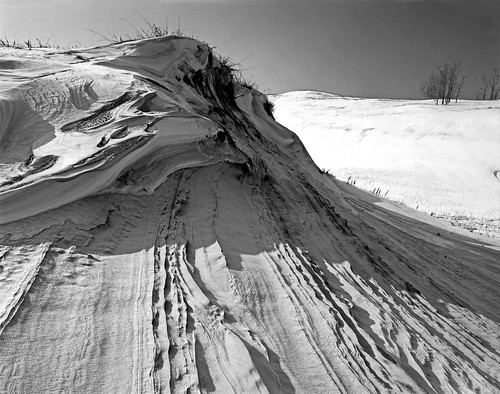
Sleeping Bear Winterscape, photo by ManualFoci
We interrupt this summer to check in with winter. James writes:
I’ve been visiting Sleeping Bear Sand Dunes all my life but it wasn’t until I was an adult photographer that I hazarded a trip up to our northern Michigan National Lakeshore landmark in the depths of Winter. I was confident it would be awesome and I wasn’t disappointed. Driving north on Route 22 from the little town of Empire I turned left onto South Dune Highway and soon could see Glen Lake to my right and Sleeping Bear Sand Dunes to my left. The Visitors Bureau is officially closed in Winter and so I parked my Cherokee at the side of the road and proceeded on foot along Hunter Road to the base of the mountainous dunes. Ahead of me was the leeward side of the dunes and as such they are steep. Part way up I saw an ominous sign that read “Avalanches Stay Off”. I noticed that there were other brave souls already on the dunes and so I figured it was safe to climb.
With Linhof camera on Gitzo tripod and a 35 pound Domke camera bag the climb up the dune was a challenge. Flat, and with small undulating hills punctuated by the occasional tuft of intrepid dune grass, the top of the dunes resemble the high desert plains of the southwest. As if trying to brave the frigid gale winds of nearby Lake Michigan, the sandy hills had solidified into rows of spiny ridges with the top of the hill resembling a marble cake with layer upon layer of sand and ice. In the distance the luminous midday sun lit a gently sloping bank upon which a barren stand of trees proudly stood. I moved my gloveless hands frantically over tilt and swing controls and finally turned the aperture ring to F22. The wind chill was well below zero. I snapped off but two 4 X 5 exposures and quickly donned my Baxter gloves to venture off in search of another Sleeping Bear winterscape.
Check this out background bigtacular and in his A Great Lakes Love Affair slideshow.
You can check out the Sleeping Bear Dunes National Lakeshore website and see more black & white photography on Michigan in Pictures.

Dune Shift, photo by farlane
Today on Leelanau.com I posted about one of my favorite Michigan musical events – the Glen Arbor Art Association’s 15th annual Dune Climb concert. The FREE concert takes place this Sunday, July 14 at 7:00 pm.
The setting is the incomparable natural amphitheater of the Sleeping Bear Dunes, and I heartily encourage you to join thousands of others at this free concert that has become a summer tradition in Leelanau.
This year one of Michigan’s premier jazz ensembles, the Grand Rapids Jazz Orchestra, will present big band and original compositions. Some of the area’s finest musicians will be performing, including vocalist Edye Evans-Hyde. There is no charge for the concert, but a National Park pass is required for parking. Free shuttle buses will provide transportation to overflow parking lots. Bring chairs or (better) blankets to sit on. Some folding chairs are also provided in front of the stage. In the event of rain, the show will go on at the Glen Arbor Town Hall.
The Dune Climb concert is an amazing experience for folks young and old (sand dune = good fun for energetic kids) and is part of the Glen Arbor Art Association’s Manitou Music Festival.
If you regularly follow Michigan in Pictures, you know that I don’t often feature my own photos but this one really captures the amazingness of the dune concert! The ladies at the top are actually hundreds of feet up the dune yet still getting amazing sound flowing up to them. Check it out background big and see more from the show including the unmodified version of this photo in my Music Makes Me Smile slideshow. The photo uses a technique called “tilt-shift” created using a simple photoshop technique.
More dunes on Michigan in Pictures!

Ghost Forest, photo by Neil Weaver Photography
Walk silently through the haunting landscape of the ghost forest of Sleeping Bear Point Trail
and wind spirits whisper to you and chatter among the skeletons of long dead cedars.
If you do not hear them you are not listening.
I am sure the Anishinaabek knew the song in their day on Sleeping Bear.
~Jonathan Schechter, Earth’s Almanac
Jonathan Schechter who runs the very cool blog Earth’s Almanac at the Oakland Press penned these lines about the Ghost Forest on the Sleeping Bear Dunes (thanks SleepingBearDunes.com for the link). Click through for a photographic account of his visit!
The Sleeping Bear Dunes National Lakeshore page on the Sleeping Bear Dunes Overlook explains how the ghost forest was created:
The Sleeping Bear Dune is estimated to be about two thousand years old and has a fascinating history. It is classified as a perched dune because it is perched on top of a plateau, high above the lake. When the dune was forming, it was not at the edge of the bluff, but somewhat inland.Wind carried sand from the upper portion of the Lake Michigan bluff inland and deposited it to form the Sleeping Bear Dune.
Notice the skeletons of dead trees within the eroded bowl of the dune. This called a ghost forest and tells a story of alternating stability and change. After an initial phase of active sand accumulation, a period of stability followed when trees began to grow on the dune. Later, more sand moved in and buried the trees. Two layers of buried soil within the dune indicate that there was a second period of stability and tree growth, followed by another period of sand build-up and then the final growth of the trees and shrubs that now cover the sheltered portions of the dunes.
For a long time, the sleeping Bear Dune stood at about 234 feet high with a dense plant cover. However, trough most of the twentieth century, erosion has prevailed.
By 1961, the dune was only 132 feet high, and by 1980, it was down to 103 feet. The process is a continuing one. The major cause of the dune’s erosion was wave action wearing away the base of the plateau on which the dune rests. As the west side of the dune loses its support, it cascades down the hill. The wind, too, is a major agent of erosion, removing sand and destroying the dune’s plant cover. What does the future hold? It seems that the present trend will continue and it is only a matter of time until the Bear disappears completely.
See Neil’s photo bigger and see more in his Sleeping Bear Dunes slideshow. You can see a bunch more shots from Sleeping Bear for viewing & purchase on his website!
More dunes on Michigan in Pictures.

Locally Known as “the Bowl”, photo by karstenphoto
EDIT: Wow I really messed this one up, sleepily citing an article that gave the dune’s age in the millions of years. Thanks to Tom Burrows for the catch. Let’s see if this information on coastal dunes from the DNR makes more sense:
Michigan’s glacial history provides an explanation for the formation of dunes. The Great Lakes dune complex is relatively young, in terms of geological time. As recently as 16,000 years ago, Michigan was covered with glacial ice thousands of feet thick. This glacial ice contained a mix of boulders, cobbles, sand, and clay. During glacial melting, this deposit was left and is known as glacial drift.
This glacial drift is the source of sand in most of Michigan’s dunes. The sands were either eroded from glacial drift along the coast by wave activity or eroded from inland deposits and carried by rivers and streams. Only the hardest, smallest, and least soluble sand grains were moved. Waves and currents eventually moved these tiny rocks inland, creating beaches along the Great Lakes shoreline.
…Blowouts are saddle shaped or U shaped (parabolic) depressions in a stabilized sand dune, caused by the local destabilization of the dune sands. Blowouts, which originate on the summit or windward face of a dune, are often rapidly formed by the wind, creating narrow channels and exposing plant roots. Blowouts can create interruptions in the shape of parallel dunes that may result in deeply carved indentions called parabolic dunes. It is the combination of interwoven parallel dune ridges and U shaped depressions, including parabolic dunes, that characterizes the classic dunes from Indiana, northward to Ludington, in Michigan.
Awesome Michigan wrote a little about The Bowl at Holland saying:
The Bowl is an gigantic sand bowl, resembling a sort of concave desert.
Along with the other dunes and Lake Michigan itself, The Bowl was carved out of the earth by glaciers millions of years ago and was likely a small lake before drying up.Standing at the center of The Bowl and being surrounded on all sides by enormous walls of sand is quite breathtaking. The landscape is truly like no other. This awesome sight alone makes a trip to Laketown a summer necessity and a great, relaxing place to bring friends and family.
You can also check in there on Foursquare. Here’s another shot from the bowl from all the way back in 2007. Amazing to me how long Michigan in Pictures has endured – thank you all for staying with me!
Check Stephen’s photo out big as the Bowl and see this and many more in his FILM! slideshow.
More dunes on Michigan in Pictures.
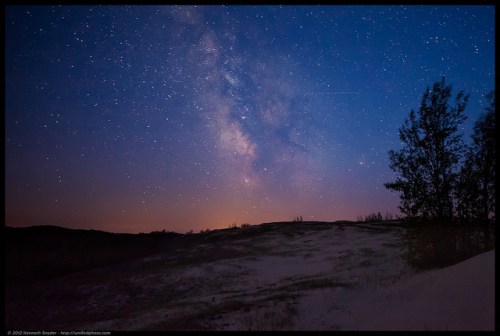
Sleeping Bear Twilight, photo by Unified Photography
Here’s a gorgeous shot from just after sunset on the Sleeping Bear Dunes. That little meteorite reminded me to check on the Perseids. EarthSky’s Meteor Shower Guide says that the Perseids will grace the sky August 10-12, 2012 with the peak the evening of the 11th.
Meteors are typically best after midnight, but in 2012, with the moon rising into the predawn sky, you might want to watch in late evening as well … The Perseids are typically fast and bright meteors. They radiate from a point in the constellation Perseus the Hero. You don’t need to know Perseus to watch the shower because the meteors appear in all parts of the sky. The Perseids are considered by many people to be the year’s best shower, and often peak at 50 or more meteors per hour in a dark sky.
The Perseids tend to strengthen in number as late night deepens into midnight, and typically produce the most meteors in the wee hours before dawn. These meteors are often bright and frequently leave persistent trains. Starting in late evening on the nights of August 10/11, 11/12 and 12/13. The Perseid meteors will streak across these short summer nights from late night until dawn, with only a little interference from the waning crescent moon. Plus the moon will be near the bright planets Venus and Jupiter in the eastern predawn sky.
If you want to keep up on when the meteors are showering, the Meteor page at Stardate.org is a great resource!
See it on black and be sure to check out Kenneth’s small but gorgeous Sleeping Bear Dunes slideshow for more including a great photo of the northern lights over Sleeping Bear Bay!
More on meteors from Michigan in Pictures!
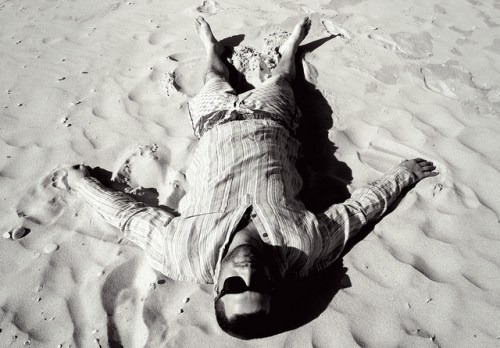
Andy, photo by Emily Flores
Perfect shot for how I feel after last weekend.
Check it out background big and in Emily’s slideshow.
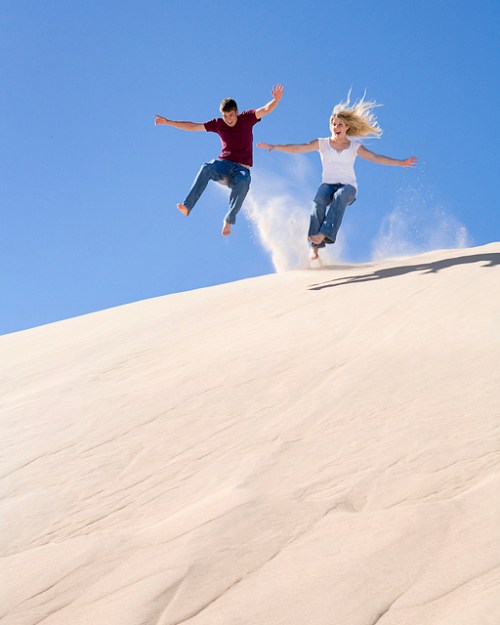
Flying High, photo by Steven White Photographic Art
Get out. Have fun. Repeat as necessary.
See this photo big as the Sulver Lake Dunes or in Steven’s Our World in Color slideshow.
Have a great weekend everyone!!
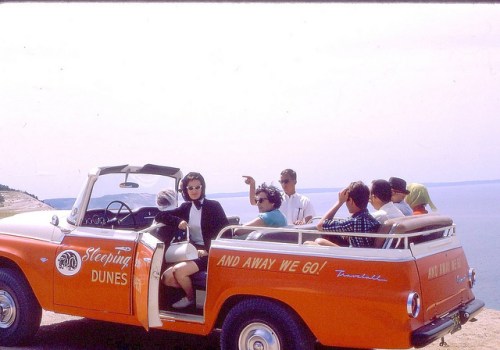
Dune rides, photo by creed_400.
This photo prompted me to dig out a ton of information & photos about this vanished part of the Sleeping Bear Dunes experience. Enjoy Sleeping Bear Dune Rides: Remembering the Dunesmobiles at Leelanau.com.
See it background big and in creed_400s Sleeping Bear Dunes National Lakeshore slideshow.
 Michigan in Pictures