Bracing Against The Wind at Saugatuck Dunes State Park

Bracing Against The Wind

Bracing Against The Wind, photo by josiah.keen.

2 months and only 60 miles? Looks like this Michigan shoreline tour might take more than just a summer (or a year) since I insist on pulling the car over at every state park along the way.

Josiah says the park is near his hometown of Holland and a frequent retreat. These pics are part of his great set of photos of Saugatuck Dunes State Park (view slideshow).

With the exception of a link to the interesting looking Felt Mansion (of which I suspect there will be more heard about here in the future), Wikipedia’s entry for Saugatuck Dunes State Park is pretty sparse, so we turn to the official Saugatuck Dunes State Park site which explains:

View Josiah's Saugatuck Dunes slideshow

A day-use park along a secluded strip of Lake Michigan shoreline, Saugatuck Dunes State Park offers 1,000 acres of land with 2.5 miles of shore line. The Lake Michigan beach is a 0.6 mile hike from the picnic parking area. In addition, the park has fresh water coastal dunes that are over 200 feet tall. The park’s terrain varies from steep slopes to rolling hills. The park, located in Allegan County, is relatively undeveloped. The land for Saugatuck Dunes was acquired in 1971 from the Augustinian Order, who used the buildings as a seminary. When the state took ownership, the structures were used as a prison and state police offices.The park’s major attractions are the long sandy beaches and the 300-acre natural area, which contains a coastal dune system, as well as three endangered plant species. Nature enthusiasts, birdwatchers and hikers are the predominant day users.

The park has also been a site of tension between preservation and development. In 2001, Concerned Citizens for Saugatuck Dunes State Park was founded in response to proposals to use the park for a water treatment plant. Recently, they and other groups formed the Saugatuck Dunes Coastal Alliance. Check them both out for background and also this video slideshow.

Check out the Flickr photo map and also explore the area at Saugatuck Dunes State Park on our Absolute Michigan map.

Michigan Orchard in Snow

Michigan Orchard in Snow

Michigan Orchard in Snow, photo by coonjamm.

Today’s photo of a cherry orchard near near Paw Paw from February will hopefully remind those of us tempted to complain about the heat of other things we could complain about.

I’d also like to call attention to Van Buren County, Michigan our latest Michigan shoreline county article on Absolute Michigan.

Ghost Forest, Sleeping Bear Point

Ghost Forest, Sleeping Bear Point
, photo by Matt Callow.

Matt writes All over the Sleeping Bear Dunes are the remains of trees killed by the constantly shifting sands, often clustered together in eerie stands of ghost forest.

Matt recently spent two weeks in an artist residency for the Glen Arbor Art Association. He also has placed this photo on a map. The Sleeping Bear Dunes National Lakeshore says that the trees in these ghost forests were killed hundreds of years ago by the moving dunes and that:

After an initial phase of active sand accumulation, a period of stability followed when trees began to grow on the dune. Later, more sand moved in and buried the trees. Two layers of buried soil within the dune indicate that there was a second period of stability and growth followed by another period of sand build-up and then the final growth of the trees and shrubs that now cover the sheltered portions of the dunes.

More in the Sleeping Bear Dunes Geology auto-tour.

Little Foxes

Little Foxes

Little Foxes, photo by curlyson.

Red fox cubs exploring the world near their den.

The Michigan DNR’s red fox (Vulpes vulpes fulva) page says that a large fox (14 inches high) will weigh only 12-15 pounds and be able to easily pass through a four inch hole.

The Red fox pages at the UM Animal Diversity web are sleeping late this morning but doubtless have great info, photos and fox barks. Wikipedia’s red fox entry has a lot more about foxes and shows their range as covering most of the northern hemisphere.

Michigan Shoreline Tour: Grand Mere State Park (and a flying dog)

My dog can fly

My dog can fly, photo by J. Star.

J Star writes:

The boy, the dog and I went to Lake Michigan yesterday, planning to stay until tonight. The forecast called for clear skies and eighty degrees for today…last night at about midnight the storms started. By morning, the thunder was deafening, the tent was afloat in three inches of water, and hail was pounding down everywhere. Needless to say, we packed it in early and headed home.

We did have fun on the beach for about two hours yesterday. Steve seems to think it was worth the drive. You can tell by the sand being joyously flung everywhere, and by the huge gob of it he left stuck to my polarizer.

The DNR page on Grand Mere State Park near Stevensville says that the 985 acre park features magnificent sand dunes, deep blowouts, one mile of Lake Michigan shoreline and three inland lakes behind the dunes in the undeveloped natural area. Both the DNR page and Wikipedia entry for Grand Mere State Park are remarkably scant on information, leading me to believe that with a 1/2 mile hike to the beach, it’s a pretty good place to avoid the crowds. Here’s a Google map to Grand Mere State Park.

Been there? Done that? Tell us or show us what it was like in the comments!

Michigan Shoreline Tour: Warren Dunes State Park

Warren Dunes State Park

Warren Dunes State Park, photo by mizjellybean

Heading up the shoreline from New Buffalo, we come to the Warren Dunes State Park. I think that the first thing you need to do is check out this slideshow of the Warren Dunes. Go ahead, we’ll wait.

Wikipedia’s entry for Warren Dunes State Park is a 1,952 acre state park, located along the shore of Lake Michigan in Berrien County, Michigan (near Sawyer). The park’s dunes include Mt. Fuller, Pikes Peak, Mt. Edwards and (the tallest) Tower Hill which rises 250′ above Lake Michigan. Warren Dunes was designated as a state park in 1930 and draws around one million visitors annually. The page on the village of Sawyer from the Harbor Country Chamber of Commerce adds that although most in the area saw the land as worthless, businessman Edward K. Warren had a vision to preserve them and bought the land at the turn of the century.

Speaking of Wikipedia – something we seem to do fairly often – they have a massive page of map data and hacks for Warren Dunes including a Flickr map of photos from the Warren Dunes area and the Google map to Warren Dunes State Park.

I should add that the DNR page for Warren Dunes State Park notes that due to an infestation of the Emerald Ash Borer beetle, over 4,000 ash trees have been removed from the modern campground unit, dramatically changing the appearance of that campground.

Kite Photography at Little Sable Point Lighthouse

we finally got our lighthouse!

we finally got our lighthouse!, photo by weaving major & tractor dan.

weaving major & tractor dan write that they’ve long admired everyone else’s lighthouse-from-a-kite shots, and now finally have a few of their own. They say if you’re interested, you can learn more about Kite Aerial Photography (KAP) right here. They have also added location information so you can view this photo on a map!

Terry Pepper’s Seeing the Light has a page on Little Sable Point Light that begins:

In the early 1800’s western Michigan consisted of seemingly endless forests, and with the skyrocketing growth of Chicago and Milwaukee, it was inevitable that there would be those who would come to the area to take advantage of the areas bounty. In the 1850’s, Charles Mears and Reverend William Ferry were both operating sawmills in the area around Little Sable Point. While almost all of the pine forests had been harvested by the 1880’s, there were still plenty of hemlock and hardwoods remaining.

In the late 1860’s Summers Fox, a local merchant supplying the lumber trade began lobbying the Lighthouse Board for the construction of a coastal lighthouse at what was then known as Petite Pointe Au Sable. With the grounding of the schooner “Pride” on Little Sable Point in 1871, cries for the construction of a lighthouse swelled…

The light was built activated in 1874. At 107′ tall, it is the tallest lighthouse on Lake Michigan.

From the top of Sleeping Bear Dunes

Muted by Jessie Turner

Muted, photo by Jessie Turner

This is the view of Little Glen Lake (foreground) and Big Glen Lake from atop the Sleeping Bear Dunes. It’s part of a great set of photos of the Sleeping Bear Dunes National Lakeshore.

I don’t have time to do a full history on the Sleeping Bear Dunes, but I can say that if you visit, you will not be disappointed. More information at the Sleeping Bear Dunes National Lakeshore web site and also the Unofficial Sleeping Bear Dunes Homepage. There is a shot from here in this YouTubed 1949 travelogue of Northern Michigan.

104

104

104, photo by Cara Jo Miller.

Cara Jo explains that this is a double exposure of the same negative – done in the dark room.

She is a photography & web design at Northern Michigan University. You can see a lot more of her work on Flickr and at her web site, cara-jo.net.

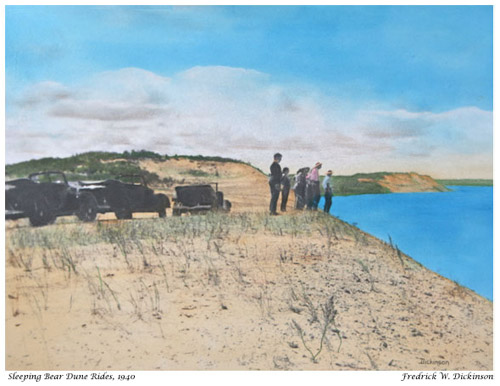
Sleeping Bear Dune Rides, 1940

Sleeping Bear Dune Rides, 1940, photo by Fred Dickinson

Sleeping Bear Dune Rides, 1940, photo by Fred Dickinson

In defiance of the weather we’re featuring a super-cool Michigan travelogue from 1949 on Absolute Michigan that begins in the Sleeping Bear Dunes. In addition to a selected of classic travel destinations, you can see the dunesmobiles in action.

Visit the Dickinson Gallery for many more classic photos and information on ordering and also check out Riding the Dunes from the Northern Michigan Journal for more about the Sleeping Bear Dunesmobiles.