Hand-building automobile bodies: Michigan’s Automobile Factories, 1900-1961

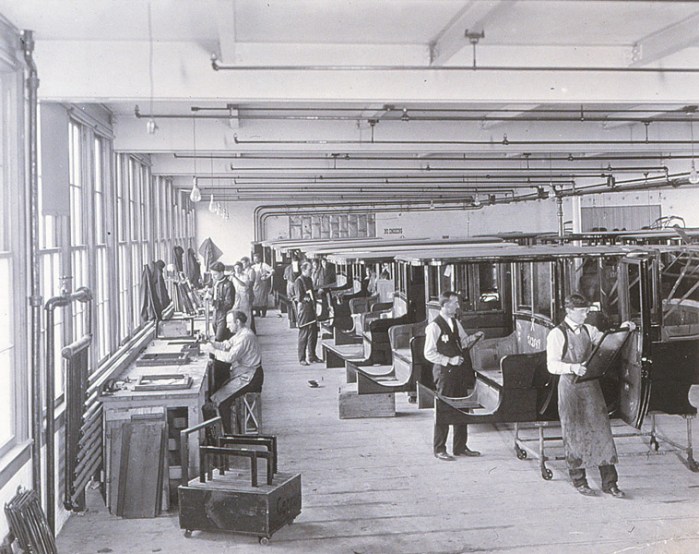
Packard Factory, Detroit, 1910, courtesy of the National Automotive History Collection, Detroit Public Library

The Michigan Radio Picture Project has a new feature titled Michigan’s Automobile Factories, 1900-1961 edited by Doug Aikenhea. It’s a fantastic tour through Michigan’s automobile heritage, that takes you from hand-built wooden auto bodies to sheet metal & assembly lines. It features well known factories in Detroit, Flint & Lansing like Ford, Buick and Chrysler along with lesser known ones such as Durant-Dort, Fisher, Chalmers & Maxwell. They write:

The industrial adventurers and entrepreneurs who launched Michigan’s automobile industry came from various backgrounds. Some of them began as carriage makers, like William C. Durant who would go on to found General Motors in 1908. The earliest automobiles, like their horse-drawn predecessors, were constructed largely from wood and were built individually until the assembly line evolved to accelerate production and incorporate standardized, mass-produced parts. As automobile manufacturing progressed, the role of the worker changed from traditional craftsman to skilled assembly line specialist. This series of historical photographs traces the evolution of Michigan automobile factories from 1900 until 1961.

Click through for more!

Play Ball! Detroit Tigers Opening Day 2010

have a seat in my time machine

have a seat in my time machine, photo by 1ManWithACamera.

The Detroit Tigers open the 2010 baseball season in Kansas City at 4:10 PM today. The Baseball Almanac says that since 1901, the Detroit Tigers are 58-50 on Opening Day. On April 26, 1992 when Larry took his nephew Aaron to his first Tiger game, the Bengals came up short to the Blue Jays, 2-4. Here’s hoping that the boxscore in 2010 looks more like the 15-2 crushdown that the Tigers laid on the Texas Rangers last year.

Over on Absolute Michigan we have our Detroit Tigers Opening Day 2010 Blog Roundup. More at absolutemichigan.com/Tigers and from Michigan in Pictures.

Check this out big as a ballpark and see more in Larry’s Detroit Tigers and their ballparks set (slideshow).

Detroit Metro Airport: start to finish

start to finish

start to finish, photo by paulhitz.

I started my day (and vacation*) today at the Detroit Metro Airport. Originally known as the Wayne County Airport, it was opened in September of 1929 with the first official landing taking pace on February 22, 1930 by theThompson Aeronautical Corporation, a predecessor company of American Airlines.

Today it has 6 runways, 145 gates, generates around 70,000 jobs and with 3,187,249 passengers in 2008, was ranked as the 13th busiest airport in North America, 24th in the world.

Check this photo out bigger or in Paul’s massive My Detroit set (slideshow).

For more shots, how about the Detroit Airport slideshow from the Absolute Michigan pool.

* I am planning to update as usual but there may be mornings or days when that doesn’t work!

Belle Isle Aquarium – 1905

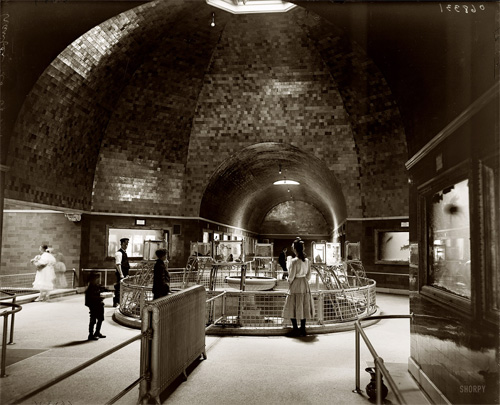
Fishbowl: 1905, photo via Shorpy Historic Photo Archive

The Friends of Belle Isle Aquarium history page (click through for some great photos & historic postcards) says:

It was August 18, 1904 in Detroit when architect Albert Kahn’s new aquarium would open to the public … The Belle Isle Aquarium, which opened adjacent with the new horticultural building on Belle Isle at a cost of $160,000, would quickly become, “one of the most popular attractions on the Island.”

…The interior of this aquarium were framed cypress tank-lined walls that were filled with fresh and salt water fish. The water contained in many of these tasks were brought direct from the ocean for the aquarium. Under the domed ceiling in the center of the building was a deep pool that was encircled by several small tanks. Later this pool would become the home to a large tank that would sit in the middle.

The most magnificent part of the interior was the grotto ceilings lined with shinny jade green titles, giving visitors a unique feeling of being underwater. Underneath this aquarium was a basement, that would be used by many as a speakeasy during Prohibition.

This photo is one that you absolutely have to check out bigger. You can get more shots from Belle Isle at Shorpy and prints too! and get more view & buy Detroit pics right here!

Detroit River Lighthouse, Bar Shoal – Lake Erie

Detroit River Lighthouse

Detroit River Lighthouse, photo by James Marvin Phelps (mandj98).

The Detroit River Light, also known as Bar Point Shoal Light, was first established as a lightship in 1875. In his writeup of the Detroit River Light at boatnerd.com. Dave Wobster says:

Completed in 1885 by the U.S. Army Corps of Engineers at a cost of $78,000, the Detroit River Light replaced a Canadian lightship that had served since 1875. The light was first exhibited August 20, 1885. Located near the end Bar Shoal which projects from the Canadian shore, in Lake Erie just south of the entrance into the Detroit River. This is the point where up bound vessels make the turn into the Detroit River.

The 49-feet high cast iron plate tower is 22-feet in diameter at the base and 18-feet at the top. It was built on a pre-fabricated 45′ x 18′, crib that was transported to the site from Amherstburg, Ontario, sunk in 22-feet of water, filled with concrete and surrounded by a granite pier.

The light station pier has the appearance of a vessel, with the pointed end directed toward the mouth of the river to break ice flows coming down river.

Click through to read about how the light handled an impact from the 635′ freighter Buffalo and see an aerial shot that shows the unique shape at Wikipedia’s Detroit River Light entry.

Check it out bigger or in James’s Detroit River set (slideshow) where you can also see a side view of the lighthouse. This is also for sale as a print from James.

View many more Michigan lighthouses from Michigan in Pictures.

i heart detroit and i heart michigan

i heart detroit

i heart detroit, photo by mlephotos.

Some people I talk to are not fans of Valentine’s Day.

I’ve always thought of Valentine’s Day as a celebration of everything and everyone I love and that has always made it one of my favorite holidays.

How about you? Love it? Hate it? Only in it for the chocolate?

Check this photo out bigger in Meghan’s heart slideshow or see what the whole Absolute Michigan pool hearts.

Hope you have a wonderful weekend.

Lightning Strikes Again: Exposure.Detroit February Show

looking out

looking out, photo by neubauerphotography.

The EXPOSURE.Detroit photography group opens their February Photography Exhibit  on Saturday, February 6th, 2010 from 7-10 PM at the Bean & Leaf Cafe in Royal Oak. The exhibit will feature the work of  five talented photographers:

Mike says that he loves trying to capture lightning. See this bigger in his slideshow.

Detroit’s Golden Age: Looking up Woodward Avenue

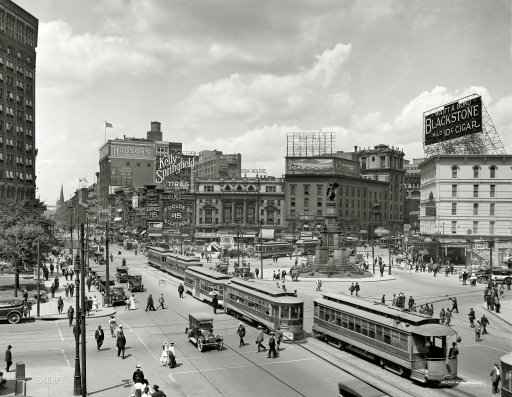
Looking Up Woodward Avenue, c 1917, photo by Detroit Publishing Company

Thanks Chris Sebok for today’s find and happy birthday to Michigan!

This dry plate glass negative comes from the Detroit Publishing Company. Check out more photos from the Detroit Publishing Company archive and purchase prints from Shorpy’s!

This photo inspired mLive to put together a fantastic photographic timeline feature they titled Photos of Detroit’s Golden Age: The other side of ‘ruin porn’. It begins:

Detroit these days is not exactly the model of a great American city. While still vibrant and beautiful in several areas, the Motor City isn’t what it used to be, and we’re not here to lie or sugarcoat it.

Those abandoned buildings that have been thrust into the world’s spotlight through photo galleries by the likes of Time and Slate are real and a major part of Detroit’s landscape today.

But a few months ago, we came across a different kind of photo from Detroit (above), one that showed the city as a bustling metropolis full of people and booming businesses — in 1917.

People seemed to love it just as much as they loved those Detroit “ruin porn” photos.

Read on (and see some video) at mLive and check the comments at Shorpy’s too!

(re) Enter the Delorean: 2010 Detroit Auto Show

Mercedes-Benz SLS AMG, photo courtesy North American International Auto Show

It’s a measure of how far the auto industry has fallen that I’ve barely heard a peep about the 2010 North American International Auto Show. What was once (still is?) the biggest event in Michigan opens to the public today through January 24th. We’ll hopefully have something on Absolute Michigan next week, but until then, check out the Freep and Detroit News coverage, Jalopnik’s Detroit Auto show page and the NAIAS slideshow in the Absolute Michigan pool, which should be updated as pool photographers attend the show!

Here’s a page on the gull-winged Mercedes-Benz SLS AMG. No word as to whether it’s flux capacitor ready…

Where To Now?

Where To Now?

Where To Now?, photo by Mike Lanzetta.

Mike took this photo yesterday at Michigan’s largest ruins, Michigan Central Station in Detroit. Check it out bigger in the Exposure.Detroit slideshow or in the MCS slideshow on Flickr.

Seeing this and other photos prompted me to look back in on TIME Magazine’s Assignment Detroit (?) to see what one of the nation’s largest media outlets was thinking about the future of Michigan’s largest city.

They have been exploring how people in the city are grappling with the profound challenges in Detroit including rising budget deficits in the face of soaring costs, reduced public services, unemployment and  also (according to Detroit Mayor Dave Bing) a failure by many to recognize just how serious the situation is. In many ways, these are the same issues that folks in other places in Michigan are dealing with.

One feature that caught my eye and that I really feel offers the kind of thinking that it will take to raise Michigan from its current depths is Can farming save Detroit?. They talk with Detroit businessman and millionaire John Hantz, who envisions:

A large-scale, for-profit agricultural enterprise, wholly contained within the city limits of Detroit. Hantz thinks farming could do his city a lot of good: restore big chunks of tax-delinquent, resource-draining urban blight to pastoral productivity; provide decent jobs with benefits; supply local markets and restaurants with fresh produce; attract tourists from all over the world; and — most important of all — stimulate development around the edges as the local land market tilts from stultifying abundance to something more like scarcity and investors move in. Hantz is willing to commit $30 million to the project. He’ll start with a pilot program this spring involving up to 50 acres on Detroit’s east side. “Out of the gates,” he says, “it’ll be the largest urban farm in the world.”

…But still there’s the problem of what to do with the city’s enormous amount of abandoned land, conservatively estimated at 40 square miles in a sprawling metropolis whose 139-square-mile footprint is easily bigger than San Francisco, Boston, and Manhattan combined. If you let it revert to nature, you abandon all hope of productive use. If you turn it over to parks and recreation, you add costs to an overburdened city government that can’t afford to teach its children, police its streets, or maintain the infrastructure it already has.

Faced with those facts, a growing number of policymakers and urban planners have begun to endorse farming as a solution. Former HUD secretary Henry Cisneros, now chairman of CityView, a private equity firm that invests in urban development, is familiar with Detroit’s land problem. He says he’s in favor of “other uses that engage human beings in their maintenance, such as urban agriculture.” After studying the city’s options at the request of civic leaders, the American Institute of Architects came to this conclusion in a recent report: “Detroit is particularly well suited to become a pioneer in urban agriculture at a commercial scale.”

Can you see the halls of massive ruins like Michigan Central Station, the Packard Plant or any of the countless other abandoned buildings across the state filled with green growth and warm light? Michigan is already a leader in agricultural diversity, producing an amazing array of crops. Rampant unemployment is a huge drain on our public services. Why not try and recover some of what we’re spending everywhere in Michigan by putting folks to work growing food and paying them in part in food?

Definitely check it out and offer your thoughts in the comments.