#TBT: Yesterday & today at the James Scott Memorial Fountain

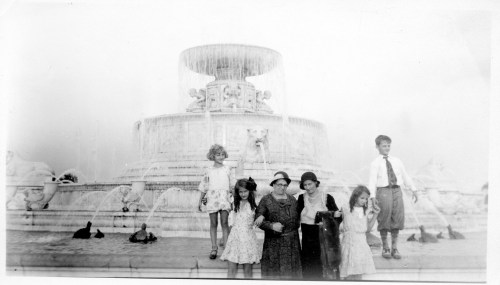
James Scott Memorial Fountain 1932

James Scott Memorial Fountain, c 1932, photo by Tom Clark

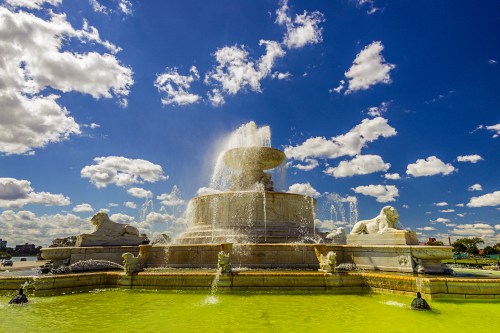
Here’s a fun pair of pics. Tom went back to where this family photo was taken in the early 30s and got a picture of the scene. You can see the one above background big, the one below right here and see more including another shot from the Belle Isle Conservatory in his Wonderful Michigan slideshow.

James Scott Memorial Fountain Bell Isle

More Belle Isle including the story of the James Scott Memorial Fountain on Michigan in Pictures.

Twenty … and Twenty One

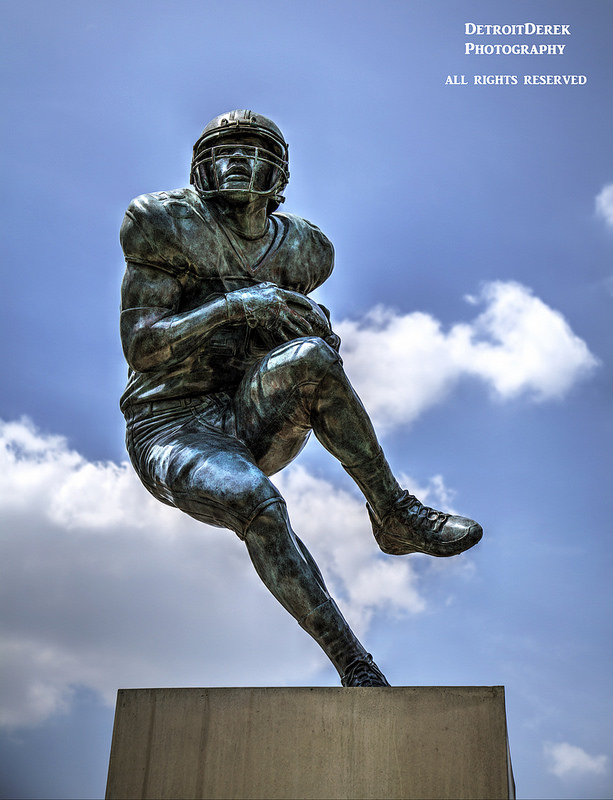
Barry Sanders 20 by Detroit Derek Photography

Twenty, photo by DetroitDerek Photography

Today is my little brother Shep’s birthday. He loves sports, the Detroit Lions and most definitely #20 Barry Sanders.

While Lions rookie #21 Ameer Abdullah has a long, long way to go to get into Barry Sanders territory, he made some runs that certainly remind you of someone. Check out this highlight reel from Ameer’s first pre-season game.

Derek took this photo of the statue of Barry Sanders outside the Detroit Athletic Club. View it bigger and see more in his massive Detroit slideshow.

More sports, more Detroit Lions and more Barry Sanders on Michigan in Pictures!


Stay Cool, Michigan

Stay Cool in Detroit and Michigan

Untitled, photo by Steve Swartz

mLive reports that today and this weekend are poised to bring very hot temperatures to Michigan:

The temperatures are building out west, and winds will turn to blow out of the south starting Friday to bring the heat our way.

Wednesday and Thursday will be comfortable, with temperatures in the 70s, but Friday will be much different, as the south wind should help boost temperatures to near 90 in the afternoon. Leftover clouds from morning storms will likely prevent breaking that mark, but the humidity should make it feel like 90 degrees.

Saturday should make it into the low 90s in all of the southern half of Lower Michigan. It might even make it to 90 degrees in parts of northern Lower Michigan. The humidity will also be higher, making it feel like mid-90s in southern Michigan.

Sunday will also be a hot, sticky day. Some spots will hit 90 degrees, while many spots will be humid and warm to 88 or 89 degrees. How hot we get Sunday will depend on how much sunshine we have and if storms hold off until Sunday evening.

If we have two 90-degree days in a row, it will be the first time in any Michigan city since July 19, 2013.

View Steve’s photo background bigtacular and see more in his Summer 2012 slideshow.

More summer wallpaper on Michigan in Pictures!

Freedom lies in being bold

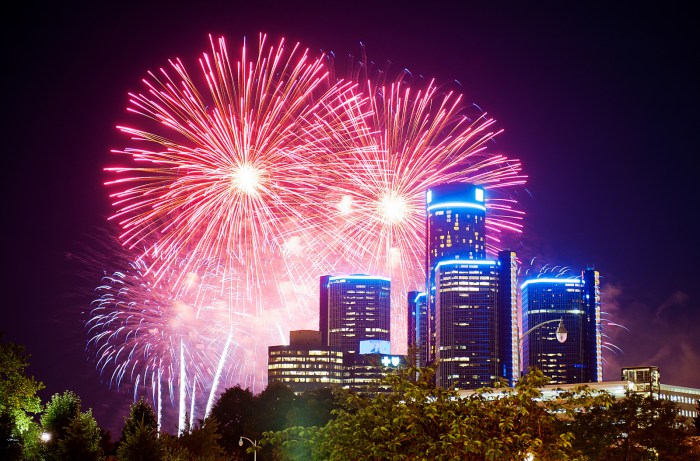
Renaissance Center Fireworks

freedom festival | detroit, michigan, photo by Ryan Southen

“Freedom lies in being bold.”
~Robert Frost

Hope your Fourth of July is as big, bold & amazing as this great shot of the Detroit fireworks over the Renaissance Center from Lafayette Park.

View Ryan’s photo biggerpurchase it and others and definitely follow him on Facebook!

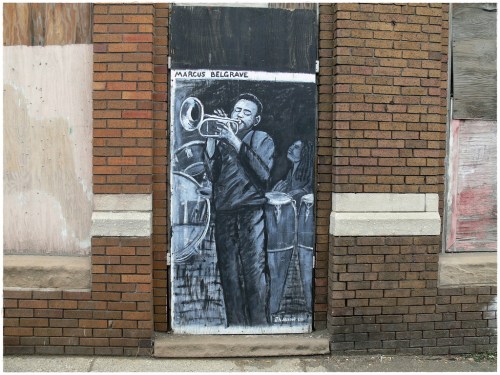
Remembering Detroit Jazz Legend Marcus Belgrave

Marcus Belgrave is the Door to Jazz

Marcus Belgrave is the Door to Jazz, photo by Derek Farr

“In order to get to the future, you have to go to the past. I try to instill that you learn from the masters in your presence and go back and forward from there. In order to find yourself, you have to be cognizant of what went down before you. That’s always been my philosophy.”
~Marcus Belgrave

The Freep reports that world-renown trumpeter Marcus Belgrave has passed away at the age of 78.

It’s impossible to overstate the impact that Belgrave has had on musical culture in Detroit as a musician, teacher and standard-bearer of jazz. Like an African griot (historian, storyteller, praise singer, poet and/or musician), he came to embody the soul and mythology of the city’s jazz history, handing down the values of swing and blues to multiple generations of students — many of whose fame would eventually outshine his own. Belgrave symbolized Detroit’s continued vitality as an incubator and epicenter of jazz, and he remained a key link between the city and the international jazz scene.

“He became a mentor to entire generations of musicians, and a lot of us would not have found the music without him,” said bassist Rodney Whitaker. “He brought us together. I have not met one musician from the last 50 years in Detroit that Marcus has not had some sort of impact on.”

Belgrave’s A-list resume included a long tenure with Ray Charles in the 1950s and early ’60s and associations with jazz royalty like Max Roach and Charles Mingus. Ultimately, however, Belgrave’s greatest contribution was the remarkable honor roll of his former students who graduated to leading roles on the national scene — including pianist Geri Allen, bassists Whitaker and Robert Hurst, alto saxophonist Kenny Garrett, violinist Regina Carter, and drummers Karriem Riggins, Ali Jackson and Gerald Cleaver.

Read on for lots more about this Detroit jazz legend and also check out their compilation of Belgrave recordings & videos – it’s some wonderful music. Be sure to also check out this great interview with Belgrave about the Detroit jazz scene and a bit of a performance from Eastern Market.

Derek says that four paintings including this one were put on doorways of an abandoned building on Gratiot Avenue near Downtown in 2005, but were taken down for some reason in 2008. View it bigger and see more in his massive Detroit Ruins (and other cities) slideshow.

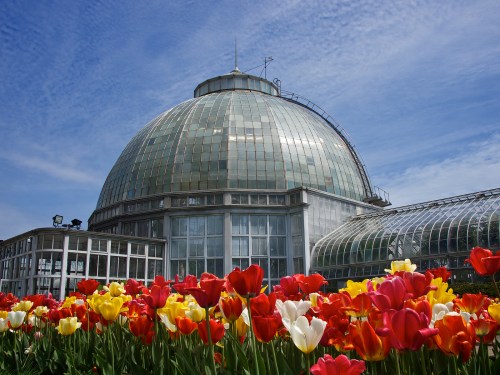
May Tulips at Belle Isle Conservatory

Belle Isle Conservatory - Detroit, Michigan

Belle Isle Conservatory – Detroit, Michigan, photo by David Marvin

Dan Austin of Historic Detroit has an excellent article on the Anna Scripps Whitcomb Conservatory on Belle Isle that begins:

If Belle Isle is Detroit’s crown, then the Anna Scripps Whitcomb Conservatory is its brightest emerald, full of brilliant green ferns, palms and cacti and plant life from all over the world.

The conservatory, opened in the center of the island on Aug. 18, 1904, the same day as its next door neighbor, the Belle Isle Aquarium. Both were designed by Albert Kahn, who for the conservatory turned to Thomas Jefferson’s Monticello for inspiration. It sits on 13 acres and features a lily pond on its north side and is fronted by formal perennial gardens on the west. These gardens are home to theLevi L. Barbour Memorial Fountain. For the first 51 years of its existence, the building was known as simply the Conservatory or the Horticulture Building. Today, the Anna Scripps Whitcomb Conservatory is the oldest, continually operating conservatory in the United States.

The building covers about an acre and has five areas, each housing a different climate, and features a north wing and a south wing and a 100,600 cubic feet dome 85 feet high to accommodate soaring palms and other tropical plants. The north wing houses hundreds of cacti and desert plants, and just beyond that is a room packed with ferns from floor to ceiling. The south is home to hundreds of tropical plants and the Children’s Christian Temperance Fountain. The collection also includes perennial gardens and displays of annuals. The show house, remodeled in 1980, features a continuous display of blooming plants.

Definitely read on at Historic Detroit on for how the Conservatory got its name and became home to the largest municipally owned orchid collection in the country. There’s also a great historic photo gallery.

Here’s the official site for Belle Isle Conservatory. The hours are Wednesday-Sunday, 10 AM – 5 PM and the Belle Isle Aquarium is open Saturdays and Sundays as well.

View David’s photo background bigtacular and see more in his slideshow.

More spring wallpaper on Michigan in Pictures.


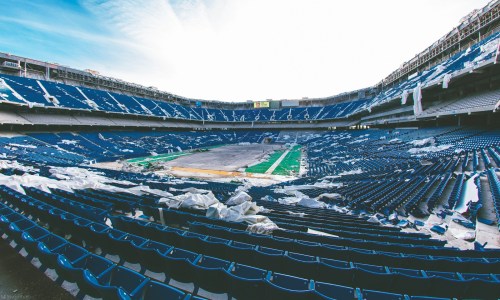
#TBT Offseason at the Pontiac Silverdome

Pontiac Silverdome

Pontiac Silverdome, photo by Mathew Davey

With the departure of some key players including Ndamukong Suh, Nick Fairley and Reggie Bush and addition of new faces including Ravens stalwart Haloti Ngata, the Lions have had a fairly eventful offseason. One place that not much is happening is the Lions’ former home, the massive and now domeless Pontiac Silverdome.

Stadiums of Pro Football’s page on the Pontiac Silverdome says that this modern-day ruin was designed by O’Dell/Hewlett & Luckenbach and built at a cost of $55 million:

Home of the Detroit Lions for more than 25 years, the Silverdome was one of the largest stadiums in the NFL. Prior to moving into the Silverdome, the Detroit Lions had played at Tiger Stadium since 1938, that was also the home of the Detroit Tigers (MLB). Tiger Stadium was primarily a baseball stadium, but served as the home to the Lions for more than 30 years. In the late 1960s, the team wanted a new football only stadium. After several bonds were passed allowing the team to build a stadium, the Lions bought land in nearby Pontiac, MI. Because of the area’s cold winter weather, the team decided to build a domed stadium. Construction on the stadium, named the Pontiac Silverdome, began on September 19, 1973 and was completed in 23 months.

Opening day for the Lions at the Silverdome was on October 6, 1975. The Silverdome became the largest stadium in the NFL with a capacity of 80,311. Three tiers of blue seats circled the entire Astroturf playing field. The roof at the Silverdome consisted of Teflon-coated fiberglass panels. In 1985 after a heavy snowstorm the roof was structurally damaged. However over the next several months a new canvas and steel-girder reinforced roof was added to prevent the problem from occurring again. The Silverdome had several amenities that included 93 executive suites and a club restaurant. Other than hosting football games, the Silverdome hosted many other events including tractor pulls, soccer and basketball games, and concerts. The first Super Bowl played in a northern city, Super Bowl XVI between the Cincinnati Bengals and San Francisco 49ers, was played at the Silverdome. In the mid 1990s, the Lions became dissatisfied with the Silverdome. By 1997, bonds were passed allowing construction of a new domed stadium in downtown Detroit. The Lions played their final game at the Silverdome on January 6, 2002. The team moved into Ford Field in August 2002.

The Oakland Press has 89 historical photos of the Silverdome including a couple with Barry Sanders. If you want to go get all depressed instead, head over to Curbed Detroit for the saga of the godawful mess the Silverdome has become.

Matthew took this photo in December of 2014. Click to view it big as the Silverdome!

More Detroit Lions on Michigan in Pictures.

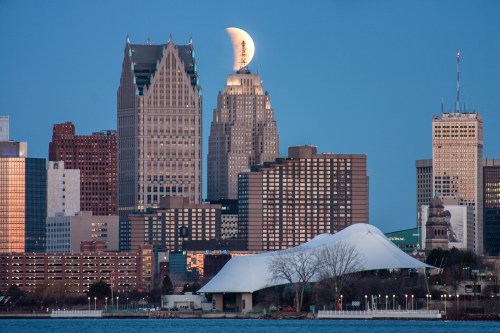
Lunar Eclipse at the Penobscot

Lunar Eclipse at the Penobscot

Lunar Eclipse at the Penobscot, photo by Tom Hughes

Sorry that I missed highlighting last weekend’s eclipse. Please accept Tom’s photo as a substitute!

View it bigger on Flickr and see more in his Detroit slideshow.


Detroit Tigers Opening Day, 2015 edition

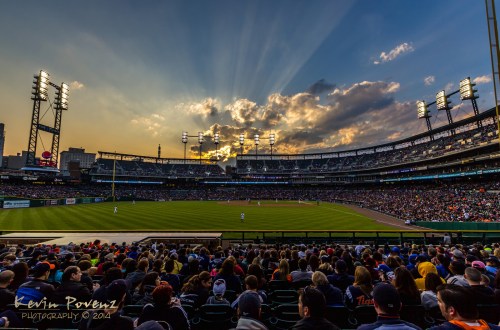
Comerica Sunset

Sunset – Comerica Park, photo by Kevin Povenz

At 1:08 PM today the Detroit Tigers face the Minnesota Twins in their 2015 home opener at Comerica Park. The Tigers’ timeline page begins:

On April 24, 1901, the Tigers prepared to take to the field for their first official American League game. A standing room only crowd was anticipated at Bennett Park, but unpredictable weather postponed the opening by a day.

On that historic afternoon, April 25, 1901, in front of 10,000 fans, the Tigers entered the ninth inning trailing Milwaukee, 13-4. A series of hits and miscues followed, moving the score to 13-12 with two runners on. With two out, Tiger Frank “Pop” Dillon faced reliever Bert Husting, and the lefthanded hitter rapped a two-run double to complete a 14-13 comeback win.

View Kevin’s photo bigger and see more in his Tigers slideshow.

Lots more Detroit Tigers on Michigan in Pictures!

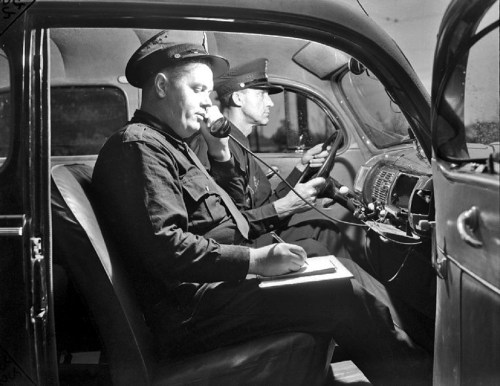
#TBT Detroit Police Radio Prowl Car

Detroit Police Radio Prowl Car
Detroit Police Radio Prowl Car, photo by Ronnie

I think the guy on the right is replaced by a computer in the 2015 version. About the photo, Ronnie writes:

Before the World War II started in Europe, 1939 was expected to be an exceptional year. America was filled with optimism, and with the Great Depression winding down, the nation was looking forward to what the coming decade of the 1940s would bring. Even the theme of the World’s Fair in New York was billed as “the world of tomorrow,” especially when it came to consumer and industrial electronics. However, for the Detroit Police Department one of the most important technological advancements in the world of law enforcement had become a reality.

Many electronics experts at the turn of the 1920s, said it would take another five decades before you would see two-way radios available for use in motor vehicles. While this philosophy was taken as gospel; several Amateur Radio operators pushed the envelope of experimentation to it’s zenith in their basements, and workshops across America. The fruits of their labor came to the forefront in the mid-to-late 1930s, which proved that two-way radio technology was viable for use by police officers in the field.

Earlier attempts at using two-way radio communications in the Motor City in 1934 had several drawbacks. The biggest was the cost, which was around $700 to equip each vehicle with the very large, and bulky equipment that took up the entire back seat and trunk of the patrol car. Not only did it take up a lot of space, but it really added a lot of weight that was hard on the vehicles’ suspension system.

Read on for more and to see the picture bigger and definitely check out Ronnie’s History photos for 100+ more photos from Michigan’s past with all kinds of great details!

More #TBT and more Michigan history on Michigan in Pictures.