Under the Ice

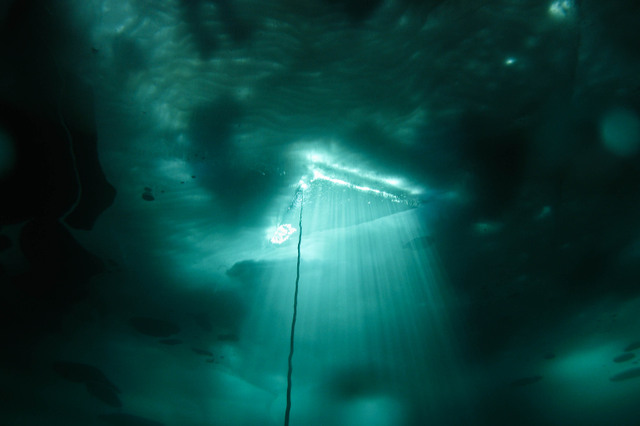
Under the Ice, photo by Christopher Morey

In First Dive Under the Ice, Christopher writes that he went to the local scuba shop:

I got into a conversation with Jack – the former owner of the shop, who still works there. He invited me to join a bunch of scubies for an ice dive on a wreck called the Keuka – which is up in Lake Charlevoix – about 50 miles north of where I live. I’ve never done a serious through-the-hole ice dive before.

While we were talking – he told me the story of the Keuka – which is a wooden freighter from the late 1800s and is about 180 feet long.

Read on for the story of the Keuka and see more photos in his Zenfolio gallery.

Wave Goodbye to Summer!

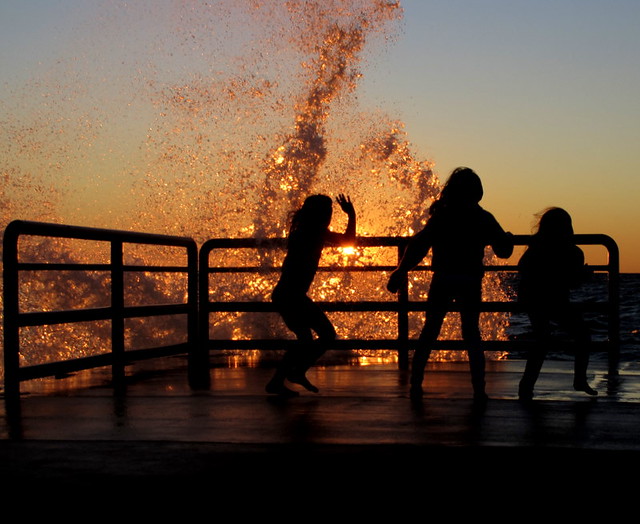
Summer Fun by Smiles7

Summer Fun……, photo by smiles7

Look out! The end of summer is crashing over the breakwall, and about 1.2 million Michiganders are hitting the road for Labor Day Weekend. If you’re one of them (or even if you’re not), you might want to check out Pure Michigan’s Labor Day Weekend page.  Lots of fun stuff there from Arts, Beats & Eats in Royal Oak, the Detroit Jazz Festival to the Fat Tire Festival way up in Copper Harbor.

Of course there’s also the Mackinac Bridge Walk and numerous Labor Day parades and observances.

You don’t really need any plans of course, throw a cooler or tent in the car and get out and grab a little summer before it’s gone!

Check this photo out bigger and in Julie’s Charlevoix slideshow.

Boulderdash: Charlevoix’s Earl Young Houses

Boulderdash

Boulderdash, photo by hausfrau23.

A few month’s ago on Absolute Michigan we featured the quirky & amazing Earl Young and his Charlevoix cottages. One of the articles we linked to from the Freep in 1973 said:

Stone houses seem to sprout as naturally as dandelions from the soil of this pleasant Lake Michigan resort community.

And they do because of an already legendary 84-year-old man named Earl A. Young, who built them all.

For more than half a century Young has combed lonesome fields and dusty quarries searching for the odds and ends of nature. He blends stones and timber with an architect’s skill and a geologist’s respect for his raw material, and so far he has fitted more than 40 local landscapes with his art.

“l have a very strong feeling for stone,” Young explained recently as he sat in his wood-paneled office on the lower level of one of his most flamboyant creations, the Weathervane Inn, a local restaurant.

“Stones have their own personalities. People say I’m crazy when I say so, but they really do. Why I found a stone that weighed 160 tons. It was formed 350 million years ago at the bottom of a warm sea and was carried here 10,000 years ago by glaciers.”

Click through for lots more and links to great resources for seeing some of these architectural oddities including the Earl Young Collection at the Charlevoix Library and Park Avenue Prowl, which has a walking guide.

Check this out big as a boulder and in hausfrau23’s Up North Vacation – September 2010 slideshow.

Charlevoix Railroad Depot

Charlevoix Depot.........

Charlevoix Depot………, photo by smiles7.

The Charlevoix Railroad Station to the Charlevoix Historical Society in June 1992 on the 100th anniversary of the first train arriving in Charlevoix.

When I was a kid, a friend of mine’s dad shot dealership posters for car companies. I couldn’t find the one we were in (fog machines and white clothes made it look like England as I recall) but I did find a 1957 Dodge Royal Lancer at the station.

Check this out bigger and in Julie’s Charlevoix slideshow.

Worlds (3rd) Largest Cherry Pie

Worlds (3rd) Largest Cherry Pie

Worlds (3rd) Largest Cherry Pie, photo by Allen Gathman.

February is National Cherry Month and there’s nothing more cherry than the cherry pie. The folks at Roadside America (who keep track of stuff like this) have this to say about the titanic battle for the World’s Largest Cherry Pie:

Charlevoix was the first into the mix. In 1976 a man named Dave Phillips, in a burst of bicentennial fervor, convinced local businesses in Charlevoix to bake the World’s Largest Cherry Pie as part of the town’s annual cherry festival. A giant pan was built, along with an equally titanic oven. Local farmers supplied the ingredients. The result: a cherry pie weighing 17,420 pounds. It was a world record.

Further south, the town of Traverse City had its own cherry festival. It had perhaps heard one too many boasts from Charlevoix, and in 1987 it decided to do something about it…

The Chef Pierre Bakeries went to work, and on July 25 it baked a cherry pie that put Charlevoix to shame: 28,350 pounds; 17 feet, 6 inches in diameter. As an added snub, the town had Guinness Book of World’s Records certify its pie as the largest ever. Charlevoix’s days in the spotlight were ended after only 11 years.

But time has a way of humbling the proud. The Chef Pierre Bakeries were bought out by Sara Lee. The cherry farms around Traverse City were turned into golf courses. Yuppies from downstate began invading the town, as they were invading Charlevoix. And in 1992, after only five years, Traverse City’s cherry pie crown was knocked clear into Canada when the tiny town of Oliver, British Columbia, baked a cherry pie for the ages — 39,683 pounds.

For some reason Oliver failed to save its pan, so you can still see the largest cherry pie pan in Traverse City here and get a sense of the scale right here.

Check Allen’s photo out bigger.

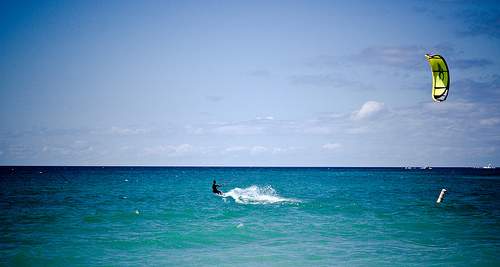
Michigan Kiteboarding: Big Wind, Big Water

Getting to Grandma's May Be Tricky

Getting to Grandma’s May Be Tricky, photo by docksidepress.

Check out some Michigan kiteboarding links from kiteUS and also Great Lakes Kiteboarding (check out their sweet video of a session on Lake Huron at Tawas.

Be sure to check this out bigger.

Sunset Season

sunset, photo by smiles7

Sunset season is here – check the Absolute Michigan pool for all kinds of Michigan sunsets.

Creating Cities in Michigan

Lansing, Detroit, Grand Rapids, Flint, Traverse City, Marquette and Kalamazoo are by no means all of Michigan’s cities (or even the largest). Each, however, seems to be an anchor for its region – a center to which people look to for culture, entertainment and commerce.

October 13-15, 2008, lovers of cities large & small from Michigan and all over the country will head to Detroit for the Creative Cities Summit 2.0 (CCS2), an exploration of what our cities could become and how we can work to make them. Organizers have chosen Detroit, a city so deeply forged in America’s industrial fires that it’s been devastated by the flickering of that flame. I’m headed down there and will try to bring some of the ideas back to you through Absolute Michigan – I hope that some of you can join me there.

The Photos (left to right)

Creative Cities Summit 2.0 in Detroit on Oct. 13-15, 2008

CCS2 will present a dynamic and engaging conversation about how communities around the world are integrating innovation, social entrepreneurship, sustainability, arts & culture and business to create vibrant economies. Full conference registration is $300 for the two and half day event, and there’s also a “no frills” registration that is only $100. There’s also a free “Unconference” at the Museum of Contemporary Art Detroit (MOCAD) on the 12th for designers, urban planners, civic leaders, entrepreneurs, artists, students, community leaders to explore and discuss what’s possible for Detroit.
Keynote speakers include:

  • Bill Strickland, MCG-Bidwell Corp.
  • Richard Florida, Author Who’s Your City
  • Charles Landry, Author The Art of City Making
  • John Howkins, Author The Creative Economy
  • Dean Kamen, Inventor, DEKA
  • Majora Carter, Sustainable South Bronx
  • Doug Farr, Architect and Author Sustainable Urbanism
  • Ben Hecht, Pres. & CEO Living Cities
  • Tom Wujec, Fellow, Autodesk
  • Carol Coletta, CEOs for Cities
  • Giorgio Di Cicco, Poet Laureate, City of Toronto and Author, The Municipal Mind
  • Diana Lind, Editor, Next American City magazine

Breakout sessions on topics such as:

  • Race and the Creative City
  • Cities, Universities & Talent
  • Marketing, Media and the Creative City
  • Measuring New Things – ROI in the Creative Economy
  • Creative (Small) Cities
  • New Ideas in Urban Amenities
  • Community Vitality: The Role of Artists, Gays, Lesbians & Immigrants
  • Midwest Mega-region: How the Midwest Can Compete
  • Transportation Innovation for Cities
  • Making the Scene: Music & Economic Development

Much (much) more at creativecitiessummit.com.

Fall Color Tours: Mackinaw City – Charlevoix – Petoskey

outside east jordan, mi. by redmudball

outside east jordan, mi., photo by redmudball

The above photo is of the St. John Nepomucene Catholic Church of East Jordan (link) and is part of Casey’s Fall in East Jordan set.

While the autumn color is still in full bloom in the Upper Peninsula, we better head south across the Mighty Mac and spend some time on color touring Michigan’s Lower Peninsula. Our first tour of Mackinaw City – Charlevoix – Petoskey (as designed by Travel Michigan) begins just on the other side of the Mackinac Bridge in Mackinaw City. They encourage you to stop in at the Old Mackinac Point Lighthouse, a beautifully restored 1892 structure that serves as a museum and is part of Mackinac State Historic Parks. You might pop for the MSHP day pass and check out Colonial Michilimackinac and/or Mackinac Island, but we better not get sidetracked.

Harbor Springs in fall by Latitude45Travel Michigan suggests getting off I-75 (a suggestion with which we heartily concur) and heading south down US-31. Just a few miles down, take Gill Rd. west to Just a Plain Farm, which features a full farm market & bakery plus all kinds of activities including hay rides, pumpkin picking and corn mazes. Then it’s back to 31 to Levering Rd. where you’ll want a map to navigate to Petoskey State Park, featuring 300+ acres on Little Traverse Bay, sandy beaches and one of the many dunes named Old Baldy on Lake Michigan. If you like views like the one to the right of Harbor Springs by Latitude45, continue on because this area is full of them! Martin has great photos of fall color from all over the Petoskey area as well!

You’ll want to keep that map handy (or turn to Google maps) as you head through the city of Petoskey (and maybe stop for lunch or a coffee at Roast & Toast). You may also want to wind through historic and tree-lined Bay View and check out the scenery & fishing on the Bear River. Up the Bear River is Walloon Lake (it’s a town and a lake). You can’t say Walloon Lake without also saying “Ernest Hemingway”, so here’s the Hemingway Resource Center’s page on the family cottage Windimere on the shore of Walloon Lake. The cottage is privately owned, but there’s a wealth of detail about the history of the area.

Assuming you avoid the temptation to brood moodily at Hemingway’s favorite barstool, it’s on to Charlevoix. On any of several ways, you can pass through a large number of small towns which are well detailed by the Petoskey – Harbor Springs – Boyne Country Visitors Bureau. There’s a lot of beautiful scenery here and even the back roads have back roads.

Like Petoskey, Charlevoix is full of all manner of shops and stores. If you’re in the mood for a more extended color trip, consider the ferry to Beaver Island. It’s known as America’s Emerald Isle, but in the fall, there’s all kinds of color to be enjoyed. Near Charlevoix there are two state parks, Young State Park on Lake Charlevoix and Fisherman’s Island State Park on Lake Michigan.

Assuming you head back north, take M-32 out of Petoskey to Harbor Springs. North of Harbor Springs on M-119 is the “Tunnel of Trees” a gorgeous stretch of narrow road along the shore that is lined with maple and other trees.

 Unique Door of Leggs Inn restaurant, Cross Village, Michigan by artbabeeThe Legs Inn in Cross Village is a textbook example of the “It’s my darn place and I’ll do whatever the heck I want with it” style of architecture for which northern Michigan is justly celebrated. The picture to the right of the door by artbabee is just the barest sample – she has more in her Charlevoix, Cross Village, and Walloon Lake, Michigan set! Their Polish food is also justly celebrated – here’s what they have to say about the whole thing:

Located in historic Cross Village, Michigan, Legs Inn is a “monument to nature.” Built on a high bluff overlooking Lake Michigan, it is unique and mysterious as seen in its architecture and decor. The fantasy-like atmosphere of this medieval looking stone, timber and driftwood landmark was created by one man, Polish immigrant, Stanley Smolak. He fell in love with Northern Michigan and its people, many of them Ottawa and Chippewa Indians and decided to settle in Cross Village in 1921.

Authentic Polish cuisine is our specialty, but delicious American dishes, including local fresh Whitefish, are also served. The Smolak family and staff are dedicated to making your visit to Legs Inn an unforgettable experience, which will have you returning often with family and friends throughout the years.

In a perfect world, you might arrive at Wilderness State Parkin time for sunset over Lake Michigan. In an even more perfect world, you’d be at the top of a multi-year waiting list for a cabin at the park!

Just so it’s clear, these fall color tour entries are produced by Absolute Michigan & Michigan in Pictures using the great information compiled in Travel Michigan’s Fall Color Tours as a starting point. We’re trying to add to what they’ve put together – not rip them off! As always, if you have links to information or photos that we missed, comments or reports, post them in the comments below!

Don’t miss our Michigan Fall Wallpaper series and see more of Travel Michigan’s Fall Color Tours.

Fisherman’s Island State Park

Fishermans Island SP Michigan

Fishermans Island SP Michigan, photo by F3_power_user.

The DNR page on Fisherman’s Island State Park (view a Wikimap) explains that…

Fisherman’s Island State Park is not actually an island, but a 2,678-acre park with five miles of unspoiled Lake Michigan shoreline. The park encompasses a tiny island, Fisherman’s Island, located a short distance offshore from the picnic area. Located just south of Charlevoix, it features a rustic campground with some of the sites nestled in the dunes along the lakeshore. The park road travels through the campground to the picnic area with access to the beach and miles of hiking trails. The interior terrain consists of rolling dunes covered with maple, birch and aspen broken up by bogs of cedar and black spruce.

Keith House says that this was scanned from an older 35mm chrome.