Untitled, photo by JRI Photos.
Just a castaway, an island lost at sea
another lonely day, no-one here but me
~The Police
Check this out bigger in Jeremy’s slideshow and have a great weekend!
Untitled, photo by JRI Photos.
Just a castaway, an island lost at sea
another lonely day, no-one here but me
~The Police
Check this out bigger in Jeremy’s slideshow and have a great weekend!

Rouge Remnants: Study II, photo by Jeff Gaydash.
Jeff writes:
Freighters travel this portion of The Rouge to access Henry Ford’s Rouge Complex, where upon completion in 1928 was the largest industrial complex in the world. The massive facility had the ability to turn raw materials such as iron ore into complete vehicles ready for the showroom. Many buildings within the complex were designed by Albert Kahn and have been subjects for Diego Rivera, Charles Sheeler and Michael Kenna, whose work here has been some of the biggest inspirations in my own work.
Can we see Michael Kenna’s work at the Rouge Plant?, you ask. Just click that link, I answer!
Check this out bigger in Jeff’s slideshow.

Burt Lake Shoreline ~ Indian River, Michigan, photo by peterlfrench.
Wikipedia says that Burt Lake is a 17,120 acre lake in Cheboygan County. It was named after William Austin Burt, who, together with John Mullett, made a federal survey of the area from 1840 to 1843. I know that you want to know more about William Austin Burt, and Wikipedia has it covered again:
William Austin Burt (June 13, 1792 – August 18, 1858) was an American inventor, legislator, surveyor, and millwright.
Burt was born in Worcester, Massachusetts, and lived in Michigan from 1822 until his death in 1858. He was a member of the Michigan Territorial Legislature, 1826-1827. He served as Mount Vernon’s first postmaster from 1832 to 1856. He was a Macomb County Circuit Court judge in 1833, a state legislator in 1853, and a deputy U.S. surveyor from 1833 to 1853. While surveying, he won acclaim for his accurate work on public land surveys. In 1857, Burt moved to Detroit, where he died a year later.
Among Burt’s numerous inventions were the typographer in 1829, which was a predecessor to the typewriter. He also invented the solar compass, a surveying tool used in the Michigan Survey, employed in regions that had an abundance of minerals, which would interfere with accurate readings when using ordinary instruments. While out surveying on September 19, 1844, in what is today Marquette County, Michigan, Burt discovered one of the largest iron ore deposits in the United States. A historical plaque commemorates William Austin Burt at Stony Creek, near his home in Mt. Vernon, Michigan.
See this bigger and in Peter’s Northern Michigan slideshow and check out more Michigan lakes on Michigan in Pictures!
On a personal note, when I was a kid my family had a cottage not far from here.

Elk Rapids Beach, photo by kmoyerus.
Somebody told me once, “If you see a curve, take a picture.”
Check this out bigger and see more black & white photography on Michigan in Pictures.
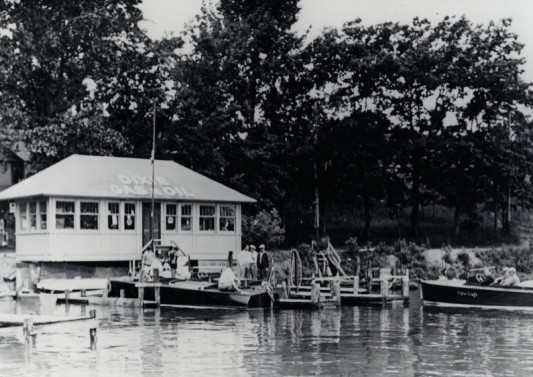
Gull Lake, Michigan, Circa 1930, photo courtesy Archives of Michigan
On Cooler by the Lake at seekingmichigan.org – the Library of Michigan and the Archives of Michigan’s very cool Michigan history site – Mary Zimmeth writes:
I am an urban child. During the summer, I rode my bike everywhere and took in a matinee at least once a week. I went to Tigers baseball games, enjoyed bittersweet hot fudge sundaes at Sanders, and watched the Scott Fountain change colors on Belle Isle. It was a great childhood, yet I envied people who owned cottages and boats. It did not matter that I could not swim. Each summer I desired a vacation near a lake with a boat in the dock. Boats in the water or being towed on the road equal summer.
This first image comes from the Charles R. Childs Collection of photograph prints and negatives dating 1922-1951. (Childs was a photographer from Illinois who specialized in tourist shots.) Taken at Gull Lake, this photograph (c. 1930) centers on Chris-Craft boats filling up at Dixie Gas and Oil. Builders of the standard “runabout,” the company marketed to the middle class by introducing payment plans in the mid-1920s. Boats were no longer just for the wealthy.
Read the rest and see lots more of Michigan’s photographic history at Seeking Michigan!
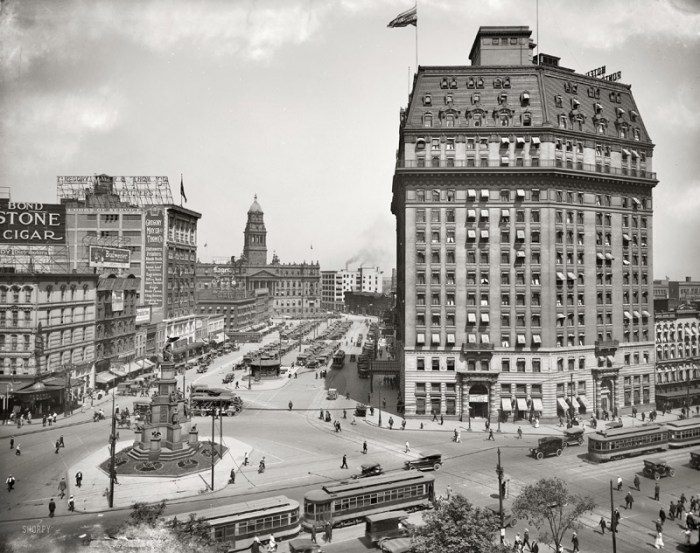
Hotel Pontchartrain and Cadillac Square from City Hall, 1916, photo by Detroit Publishing Co, via Shorpy
Hello Detroit, it’s your birthday!*
History Detroit tells the story of Cadillac and the founding of Detroit on July 24, 1701. They explain how Antoine de la Mothe, Sieur de Cadillac made a plan with his mentor and Governor General of New France, Louis de Buade, Comte de Frontenac, to found a new settlement at the south of Lake Huron to increase security of French interests on the Great Lakes. Frontenac died, and his successor was not fond of Cadillac so:
Cadillac set sail for France in 1698 in order to convince King Louis to allow him to found a new settlement lower in the Great Lakes. Specifically, he was interested in the area south of Lake Huron known as le détroit, or the straits.
The area known as le détroit was ideal for a new settlement because the land was fertile, the location on the river was felt to be easily defended against the British and the climate was more hospitable than that in the more northern settlements like Michilimackinac.
Cadillac returned to Quebec, then travelled to Montreal where he gathered canoes, farmers, traders, artisans, soldiers, and Native Americans to accompany him on his quest. The men set sail on June 4, 1701.
Cadillac and his men reached the Detroit River on July 23, 1701. The following day, July 24, 1701, the group traveled north on the Detroit River and chose a place to build the settlement. Cadillac named the settlement Fort Ponchartrain du Detroit in honor of King Louis’s Minister of Marine.
Read More About Fort Ponchartrain and Cadillac.
You have to check this photo from Shorpy (a great blog where you can also buy these old prints) background bigtacular to see the amazing detail and activity captured including the Soldiers and Sailors Monument in the bottom left corner. Here are earlier views of the hotel circa 1907, minus the upper floors, and 1910, minus most of the cars, and here’s Shorpy’s entire Detroit Michigan historic archive.
Need more? There’s a whole lot more Detroit on Michigan in Pictures and at absolutemichigan.com/Detroit.
* I feel a little weird giving a history lesson as a birthday present.
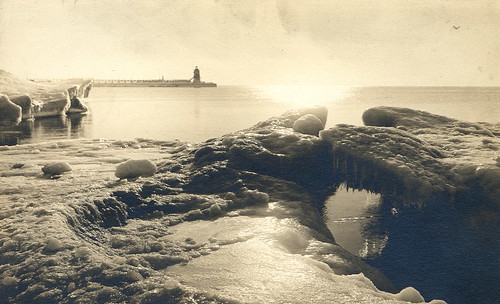
Benzie Vintage Winter Frankfort Beach Card looking South to the pod Pier and Lighthouse, photo by UpNorth Memories – Donald (Don) Harrison.
The Frankfort North Breakwater Light in the picture is one of three Michigan lighthouses that the Coast Guard is offloading.
Be sure to check this out background bigtacular Don’s Benzie vintage winter slideshow has more wintertime views from Northern Michigan.
Everyone OK with a little more summer?
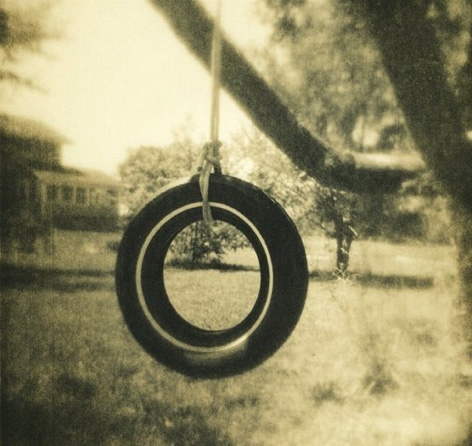
Untitled, photo by Marianne Priest
Marianne Priest is a self taught photographer living in northern lower Michigan who got her first camera in the late 90s, She’s developed her style through reading, trial and error, and the great talent and wisdom of friends who have helped and inspired her. One of those friends, Mark O’Brien, turned me on to her photos and I have to say that I’m grateful!
Check out her Holga slideshow and view lots more of her work at mariannepriest.com!
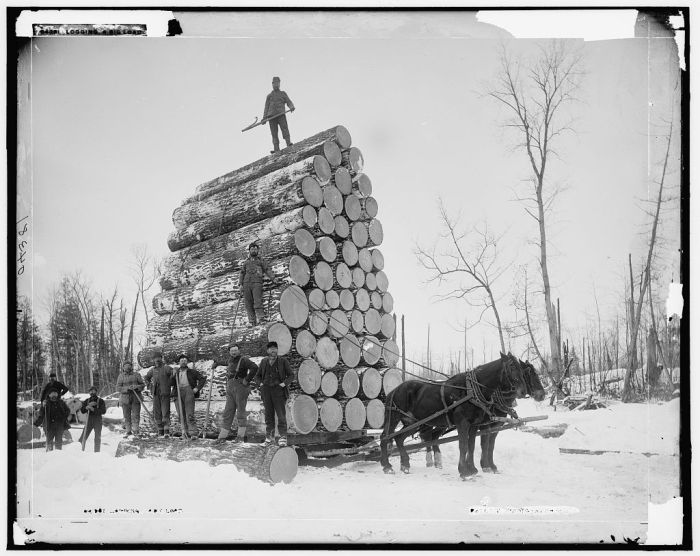
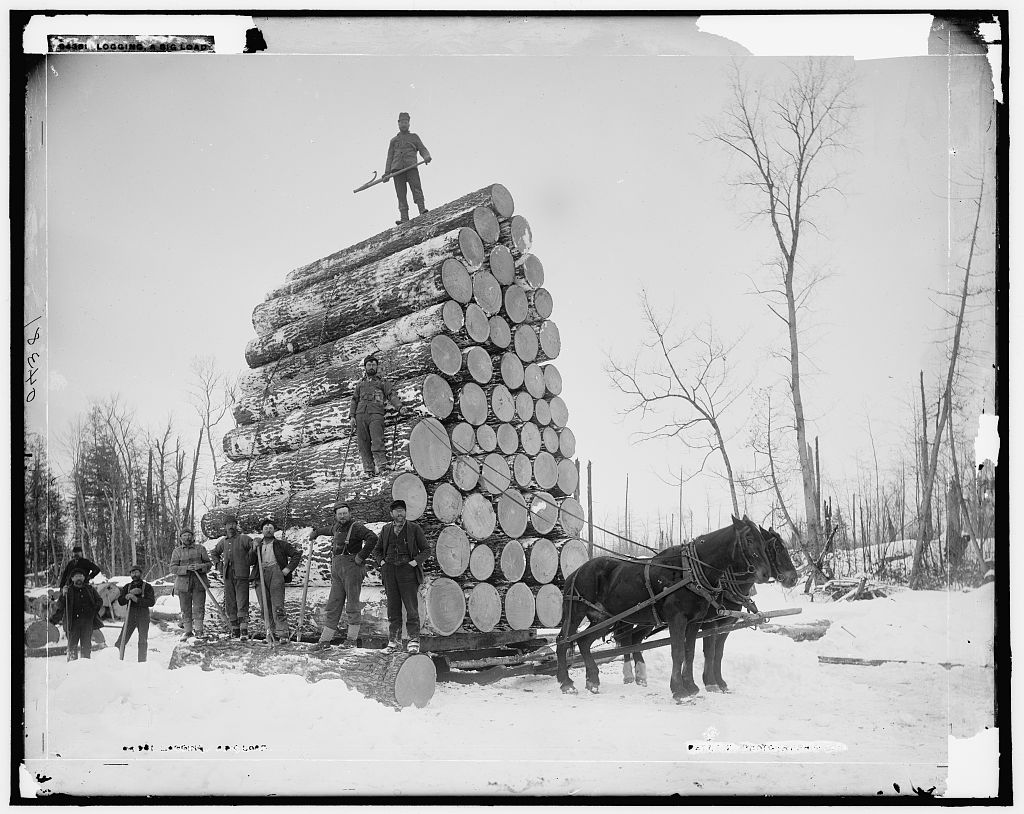
Logging a big load, photo courtesy Library of Congress/Detroit Publishing Co
The above photo was taken somewhere in Michigan in the late 1800s. Click to view it bigger.
Once upon a time, much of the state of Michigan was covered by a vast, white pine forest. If you want to get a taste of what old growth pines were like, and also a very cool logging camp, consider a trip to Hartwick Pines.
Seeking Michigan has a great feature about Life in a Logging Camp that includes some cool photos. It begins:
Michigan’s Lumber Boom
In the 1840s, Eastern states were beginning to exhaust their timber resources, and information about Michigan pine began to spread. Lumbermen began flocking to the Great Lakes State. According to George S. May’s revised edition of Willis Dunbar’s Michigan: A History of the Wolverine State, Michigan’s lumber boom peaked around 1880. Dunbar and May also note that lower peninsula forests were “virtually all cutover” by 1900 and that Upper Peninsula lumber production began to decline a few years after that. Conservation techniques and selective cutting increased productivity later in the twentieth century. By then, however, the “hey day” of the lumber industry was unquestionably over.
The Nature of a Logging Camp
For much of its history, logging was a winter activity. In winter, logs could be easily transported to river banks via bob sleds (or, in later years, by railroad.). In spring, when the ice melted, logs were floated down the river to saw mills. Log marks (the logging equivalent of “cattle brands”) determined ownership. Due to the seasonal nature of the business, logging camps tended to be temporary.
In “Michigan’s White Pine Era, 1840-1900” (Michigan History vol. 43, December 1959), Rolland H. Maybee describes a typical Michigan lumber camp, circa 1875-1900. Many camps of this era accommodated sixty to one hundred men. Typically, there would be five or six main buildings, all made of logs. A bunkhouse, a cookshanty, a barn, a blacksmith shop, and a camp office and store would be among the buildings. The camp office and store typically included living quarters for the foreman and log scaler.
Read on at Seeking Michigan!

Whitefish Point Groyne Study, photo by Jeff Gaydash.
Jeff writes:
On November 10, 1975, the famous SS Edmund Fitzgerald, one of the largest freighters on the Great Lakes sank about 17 miles from this location in approximately the direction in which this groyne is pointing. All 29 crew members were lost.
In case you’re like me and wondering “What’s a groyne?” Wikipedia has the answer:
A groyne (groin in the United States) is a rigid hydraulic structure built from an ocean shore that interrupts water flow and limits the movement of sediment. Groynes create beaches, or avoid having them washed away by longshore drift.
Be sure to check this out bigger and in Jeff’s The Great Lakes slideshow.
Absolute Michigan has lots more on the Edmund Fitzgerald including a phenomenal video.
 Michigan in Pictures