The Ford 999

Henry Ford and Barney Oldfield and the Ford 999 in 1902, photographer unknown (via Wikimedia)

Henry Ford, founder and namesake of the Ford Motor Company, was born on July 30, 1863. He’s shown above with early racing great Barney Oldfield and the Ford 999. The Motorsports Hall of Fame says:

The oldest vehicle in the Motorsports Hall of Fame is the famous Ford 999 racer from 1902. Although it is not the first race car ever built, it is certainly the first car to rise to the status of legend.

Always seeking publicity, Barney Oldfield dubbed the car 999 after the feats of the record-holding New York Central locomotive.

Although the car is equipped with only one seat, a “Mechanician” was often kept busy oiling bearings and making adjustments while the car was being driven! The role more closely resembled that of an active sidecar acrobat than that of a riding mechanic.

The sister car of the 999 was the Arrow. It was a rebuilt Arrow that Henry Ford drove to 91.37 mph on frozen Lake St. Clair in January of 1904, for the new automotive World Land Speed record. After Ford set the record, his racing partner, Tom Cooper, sold both the 999 and the Arrow. The Arrow was renamed the New 999 by the new owner.

…Shortly before his death, Henry Ford is said to have remarked to Barney Oldfield: “You made me and I made you.” Oldfield shook his head and replied “Old 999 made both of us.”

You can see a great gallery of photos of early Ford race cars that includes shots of Ford and his mechanician and a modern photo of the 999 from The Henry Ford Museum on Flickr. The Henry Ford is located in Dearborn and they (of course) have a ton of information about Henry Ford.

More cars on Michigan in Pictures!

The Descent

The Decent

The Descent, photo by J.M.Barclay

Here’s hoping that the equivalent of the Fun Slide passes through your weekend!

View it on black and in J.M.’s slideshow.

More great black & white photos on Michigan in Pictures.

I’ll Fly To You

Ill Fly To You

I’ll Fly To You, photo by J.M.Barclay

Check this out bigger and see more from the circus in his slideshow. You can also check out his work on Facebook.

More black & white photography on Michigan in Pictures.

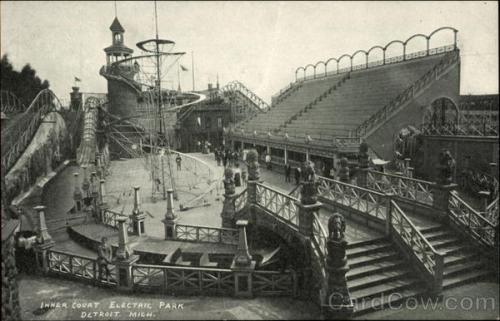
Detroit’s First Amusement Park: Electric Park

Inner Court Electric Park Detroit, Mich, photo by H.C. Hawkins

Today on Absolute Michigan we’re featuring a new festival called DLECTRICITY that is slated for October 5-6, 2012 on Detroit. DLECTRICITY organizers said that the name for the festival was inspired by Detroit’s first amusement park. The Detroit News Rearview Mirror page on Electric Park explains:

Electric Park, Detroit’s first mammoth amusement enterprise, opened May 26, 1906, near the Belle Isle Bridge approach. The Free Press heralded the opening of the park, “Detroit’s new Electric Park will be one of the largest in the world. Rome, with its seven hills will be a poor second to the roller coaster which is to be installed on the western site of the park. Here will be found l4 hills and any amount of hilarious fun my be derived within the enclosure.”

Owned by the Arthur Gaulker family, Electric Park, before it closed in 1928, went through many name changes and lengthy court battles over property rights. Some oldtimers remember the park’s nicknames: “Pike’s Peak, Lunar Park, Riverside or Granada.” Many of these names came from concessions located along the riverfront grounds.

You can read some more and see a whole bunch of great old photos at Electric Park on Water Winter Wonderland.

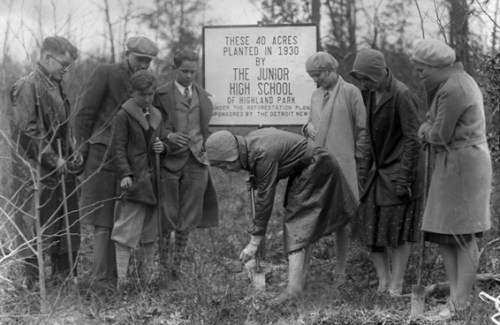
Arbor Day’s Michigan Roots

Highland Park Junior High School students plant trees, 1930, courtesy Walter P. Reuther Library, Wayne State University

We plant trees not for ourselves, but for future generations.”
– Caecilius

The Michigan Arbor Day Alliance explains that the first Arbor Day was celebrated in Nebraska on April 10, 1872. It was the brainchild of pioneer & journalist J. Sterling Morton to help restore plains that had been cleared for building materials, fuel and farming. Nebraskans planted over 1 million trees on that first Arbor Day, and Arbor Day became a legal holiday in Nebraska in 1885. Morton’s birthday of April 22 was selected as its observance and the holiday soon spread to other states.

Today, the most common date of state observance for Arbor Day is the last Friday in April, and several U.S. presidents have proclaimed a national Arbor Day on that Friday.

J. Sterling Morton’s love for trees came from his life in Michigan. Morton’s family lived in Detroit and he attended public school in Monroe, then later Albion College (Class of 1850) and the University of Michigan (Class of 1854). Morton missed the array of vibrant green trees he grew up with in Michigan and continued to plant them throughout his life.

…In 1885, the Michigan Legislature resolved “that the Governor is hereby requested to call the attention of the people of the state to the importance of planting trees for ornament and by naming a day upon which the work shall be given special attention to be known as Arbor Day.”

Until 1965, the Upper and Lower Peninsula had separate Arbor Days in the spring because of the difference in weather conditions for tree planting. Governor George Romney proclaimed an Arbor Week for the last week in April 1966. In his proclamation, Governor Romney broke with the traditional one day, “Because of the increased interest in and the importance of the statewide ‘Keep Michigan Beautiful’ program, one or two days do not afford enough time and opportunity for a full and proper observance of Arbor Day.”

“It is well that we bring attention to our trees and the need to continue to plant them about our homes, our places of business, our industries, our schools, our highways, and throughout the landscape so that their majesty will reflect our appreciation of the grandeur of nature and further the culture and economy of our state.”

Each year the Governor and Michigan Legislature proclaim the last week in April as Arbor Week and Arbor Day as the last Friday of that week.

The Michigan Arbor Day Alliance has a photo gallery of tree plantings from all over Michigan, monthly newsletters and their calendar has all kinds of events from across the state.

The photo above is from a great article about reforestation efforts in Michigan from Seeking Michigan.

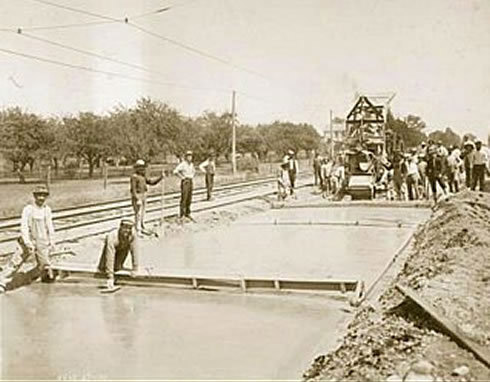
April 20, 1909: The World’s First Mile of Concrete Highway

Paving Woodward Avenue in 1909, photo courtesy Woodward Avenue Action Association

On April 20, 1909,construction of the world’s first mile of concrete highway was begun in Detroit. The History of the World’s First Mile of Concrete Highway from the Wayne County Road Commission begins.

The year was 1909, and it was a big year in Detroit. Ty Cobb led the Detroit Tigers to a League Pennant at Bennett Park, Henry Ford introduced the Model T and J.L. Hudson was scouting out a location at Woodward and Farmer for his department store’s new location.

Also that year, the Wayne County Road Commission introduced the world to a new kind of road: Concrete. The only place it could be found that year was Woodward Avenue between Six and Seven Mile Roads in Greenfield Township, which is now northwest Detroit.

Roads up to that point – if they were paved at all – had been built with brick, cobblestone, or a material called macadam, which was not much more than stones sprayed with a tar to form some kind of wear resistant surface. Unfortunately, brick and cobblestone were uneven and labor intensive, while macadam didn’t last long.

Read on for more about this Michigan first, from the creation of Michigan’s first road commission in Wayne County in 1906 (Henry Ford was a charter member) to the details of this and other transportation innovations from the Motor City. They also have the facts about that first mile including the cost ($13,492.83) and daily pay of workers.

See more photos from the Woodward Avenue Action Association and read a whole lot more about the history of Woodward Avenue.

More cars on Michigan in Pictures.

Michigan’s Titanic: The S.S. Alpena

SS_Alpena

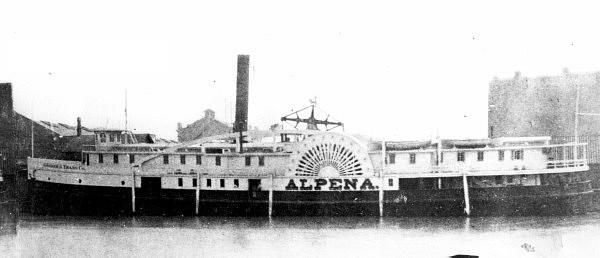
S.S. Alpena, photo from Wikimedia Commons

Over on Absolute Michigan we have a feature from the Archives of Michigan about two Michigan couples who were aboard the Titanic. I thought it would be interesting to see what the worst Michigan maritime disaster was. You might think it would be the immortalized Edmund Fitzgerald but with “only” 29, it’s down on the list. Or perhaps the tragic Carl D. Bradley in which 33 men perished, most from her home port of Rogers City.

It’s actually the sidewheel steamer S.S. Alpena. Michigan Shipwrecks says that this 197 foot Goodrich side wheel steamer was built in Marine City, Michigan in 1866. She was lost with about 80 crew & passengers in the “Big Blow” of 1880.

The Alpena left Grand Haven, Michigan bound for Chicago on Friday evening, October 15, 1880 at 9:30 PM. The weather was beautiful — Indian Summer like. But the barometer was indicating a storm was coming and storm signals were out. She was met on her southwest journey by the steamer Muskegon at about 1:00 AM and everything seemed normal.

At about 3:00 AM Saturday, October 16, 1880 the “worst gale in Lake Michigan recorded history” swept across the lake. The Alpena was seen at 6:00 AM, 7:00 AM and at 8:00 AM by the schooner Irish and by Captain George Boomsluiter of the barge City of Grand Haven about 35 miles off Kenosha, Wisconsin, laboring heavily in the high seas.

She was seen later by several other vessel captains –one of whom reported her lying on her side with one of her paddlewheels out of the water. Ten car loads of apples were stowed on her main deck and some speculate this cargo became unmanageable in the storm, shifted, and led to the capsizing.

…The weekly Holland City News reported on October 23: “The wreck is complete. She is broken into small fragments. The stern part of her hull lies near the harbor. The whole coast for 20 miles is strewn with the debris, freight, etc.” The largest piece to land near Holland was the piano, “it being barely able to float, our sailors concluded that she did not come very far. And the arrival of other heavy pieces of the wreck would seem to corroborate this.”

The wreck has never been found and you can read on for more. FYI, the Great Lakes Shipwreck database pegs the loss of life close to 100 and adds that the first indication that she was lost was when masses of wreckage began washing ashore along the coast near Manistee. It took several days for the magnitude of the disaster to be realized. Her paddlebox nameboard washed ashore at “Alpena Beach” in 1909, after a storm.

The largest loss of life in open water on the Great Lakes was 300 aboard the Lady Elgin that was rammed by the schooner Augusta in September of 1860 off Highwood, IL . An interesting note is that this shipwreck led to the requirement for sailing vessels to carry running lights. The Smithsonian relates that the worst shipwreck on the Great Lakes:

In terms of loss of life, hands down, that’s called the SS Eastland, which went down in the Chicago River on July 24, 1915. For whatever reason, the ship turned over onto its port side right there in the river. Passengers either wanted to see something in the river and they went to port side, or the engineer improperly ballasted the ship, or it wasn’t a stable ship to begin, but she flipped over right into the Chicago River, not terribly deep water maybe 20-30 feet, and killed 844 passengers and crew. It still remains the worst loss of life on any single shipwreck in the Great Lakes.

More shipwrecks on Michigan in Pictures.

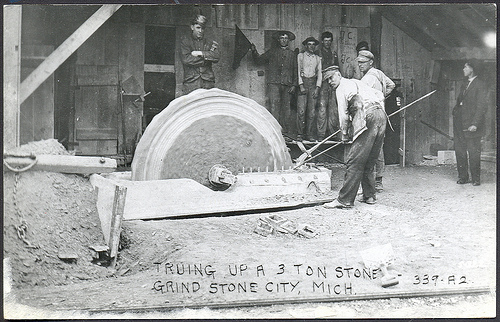
Truing up a 3 ton stone in Grindstone City

Grindstone City MI Lake Huron Village home to the old Grindstone Quarry LL Cook Card S322 1935 vintage Stamp Box Unsent

Grindstone City MI Lake Huron Village home to the old Grindstone Quarry LL Cook Card S322 1935 vintage Stamp Box Unsent, photo by UpNorth Memories – Donald (Don) Harrison.

“Grindstone City received its name in 1870. It happened in this way. Mr. James Wallace, one of the owners of the quarry at that time was talking to Mrs. Sam Kinch Sr., when she remarked that the village was growing so fast that it ought to have a name. They were discussing Stonington as a name when Mrs. Kinch suggested Grindstone and Mr. Wallace added City and from then on the village has been known as Grindstone City.”
from Mabel Cook’s “History of Grindstone City, New River and Eagle Bay” (1977).

The excellent history of Grindstone City from the Michigan State University, Department of Geography tells the fascinating story of the Huron County town that was once where the world turned for grindstones. This was due to the particular qualities of “Grindstone”, a special rock formation from Marshall Sandstone that made the finest sharpening stones. It all began:

In the year 1834, Capt. Aaron G. Peer, with his Schooner, the Rip Van Winkle, was forced to take haven in this natural harbor, during a storm. Capt. Peer is known as the “father” of Grindstone City, and located the first land in what is now Huron County. The sloop took anchorage here in a storm, and that Capt. Peer, his crew and his father came ashore to what was then a wilderness of pine, cedar, ash, beech, and maple, the cedar being so thick that snow remained in places although it was midsummer. In their exploring they found some big flat stone along the beach and on further examination, found evidence that these strata of rock was underlying the area to a lesser or greater extent . Samples were taken to Detroit where they were found superior to the Ohio flagstone which city officials were planning to use to pave some of the streets.

…On one trip, the sailors rigged up in a crude fashion a stone slab and used it to sharpen their tools. That year (1838) Capt. Peer, getting the idea from the sailors began shaping the grindstones at the place later known as Grindstone City.

Definitely read on to learn about the process that produced the grindstones from quarry to turning the stones shown above and ultimately to market.

One of the most commented posts on Michigan in Pictures is Not much remains of Grindstone City which featured a photo of one of the few remaining grindstones by Marty Hogan on a beach that was once covered in them. Here’s the Google Earth of Grindstone City, and there’s also a Grindstone City Facebook page with some photos and folks sharing memories and photos.

Don says the postcard above is from 1935. View it background big or settle back for his Grindstone City postcard slideshow.

Sorting cherries … and making sense of migrant labor in Michigan

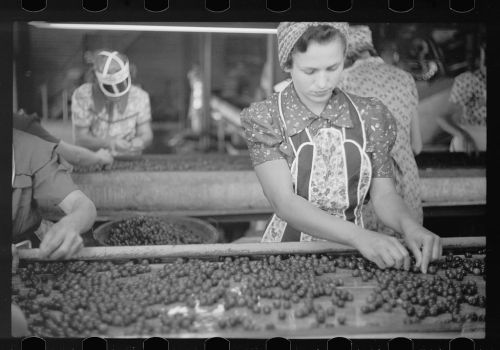
Migrant girls working in cherry canning plant Berrien County, photo by John Vachon

February is National Cherry Month and back in the day (July of 1940 to be precise), the cherry sorting machine was any able body that could tell the difference between a good and bad cherry as they sped past.

Agriculture is a vital part of the northern Michigan economy, and the League of Women Voters in Leelanau County has released an interesting study on migrant worker visas. They study contends that although the care for and harvesting of crops is a critical, labor-intensive aspect of our agriculture, Michigan workers aren’t stepping up to fill seasonal agricultural jobs, risking closure or bankruptcy for farmers and processors. The study notes that it’s an issue that’s been with us for years:

Seasonal workers have been essential to the operation of area farms since the transition from subsistence farming in the early 20th century. Agriculture was the principal livelihood for Michigan residents throughout the 1800s, but by the turn of the century, the Industrial Revolution was transforming agriculture from a small, self-sufficient family art to a large, mechanized, scientific industry. The tractor, the telephone, and the automobile revolutionized cultivation, communication, and transportation, and rural isolation was broken. Although farm conditions improved, people left the farms in droves and resettled in the cities. Rural depopulation became so severe during the 1920s that many farmers and growers had to import migrant labor.

The need for migrant labor has ebbed and flowed over the years. World War II was the catalyst for the Bracero Program, which from 1942 to 1964 brought Mexican migrant agricultural workers to the US legally. The program increased Michigan’s reliance on Mexican farm workers for harvest, and when the program ended, many workers continued to work in US agriculture.

Some crops like cherries have become largely mechanized, but apples, wine grapes and many other crops still have to be harvested by hand. Check out Migrant workers and Michigan agriculture on Absolute Michigan for a lot more about a critical issue for our farms and farmers.

You can get this photo background bigilicious and click to view the Michigan cherries gallery at the Library of Congress and you can also have a look at UpNorth Memories cherries slideshow.

The article on photographer John Vachon from the LOC’s American Memory Project says that his first job for the Farm Security Administration held the title “assistant messenger.” Vachon was twenty-one and had no intention of becoming a photographer when he took the position in 1936, but as his responsibilities increased for maintaining the FSA photographic file, his interest in photography grew. A memoir by his son quotes Stryker as telling the file clerk, “When you do the filing, why don’t you look at the pictures.”

Good advice.

Happy Birthday to you, Thomas Edison

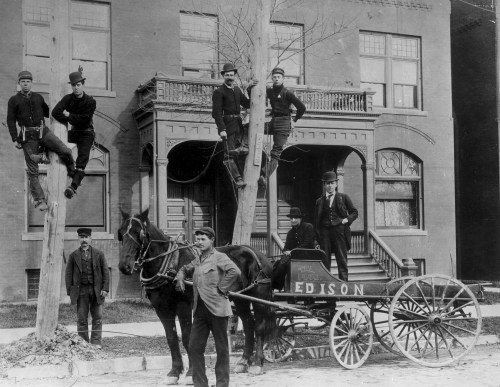
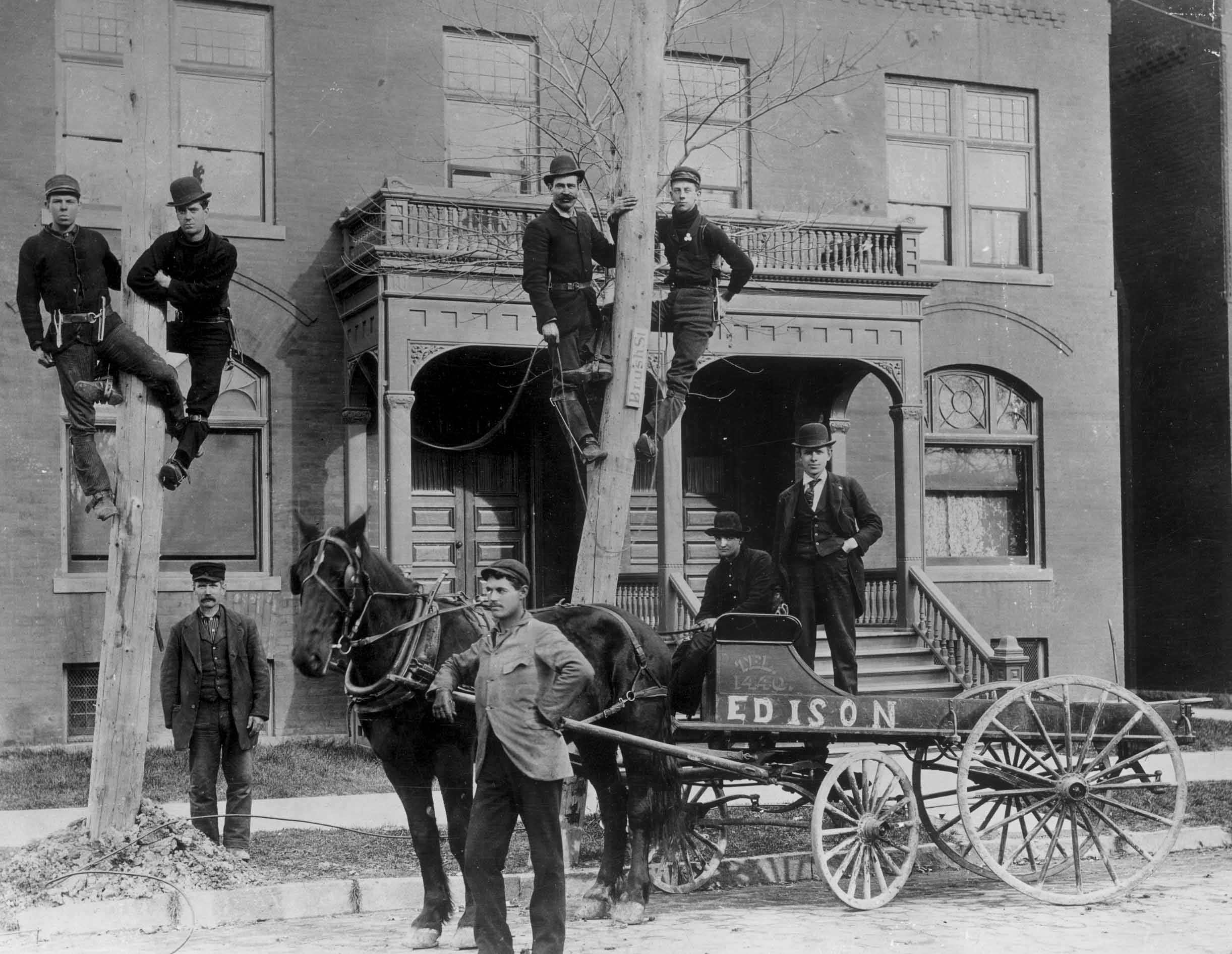
Detroit - Edison Illuminating Company high line crew

Detroit – Edison Illuminating Company high line crew, photo courtesy Seeking Michigan

The Life of Thomas Edison from American Memory at the Library of Congress says that:

Thomas Alva Edison was born to Sam and Nancy on February 11, 1847, in Milan, Ohio. Known as “Al” in his youth, Edison was the youngest of seven children, four of whom survived to adulthood. Edison tended to be in poor health when young.

To seek a better fortune, Sam Edison moved the family to Port Huron, Michigan, in 1854, where he worked in the lumber business.

Edison was a poor student. When a schoolmaster called Edison “addled,” his furious mother took him out of the school and proceeded to teach him at home. Edison said many years later, “My mother was the making of me. She was so true, so sure of me, and I felt I had some one to live for, some one I must not disappoint.”(1) At an early age, he showed a fascination for mechanical things and for chemical experiments.

In 1859, Edison took a job selling newspapers and candy on the Grand Trunk Railroad to Detroit. In the baggage car, he set up a laboratory for his chemistry experiments and a printing press, where he started the Grand Trunk Herald, the first newspaper published on a train. An accidental fire forced him to stop his experiments on board.

Read on for much more, and also see Thomas Edison at Wikipedia. While Edison’s life in Michigan didn’t include much of what one of the architects of our modern lifestyle was famous for, there’s some great places to visit to learn more about him. Two of the best are the Thomas Edison Depot Museum in Port Huron and Edison’s Menlo Park Laboratory at Greenfield Village.

Get this photo from Seeking Michigan big as the 20th Century and see a few more Edison-related photos from Seeking Michigan.

Post #350 on Michigan in Pictures!